She stood in her walk-in closet, surrounded by clothes she hadn’t worn in years, and started crying. Not from sadness exactly, but from a feeling she struggled to name. The weight of everything she owned, everything she had to organize and maintain and make decisions about, felt suddenly unbearable. “I have so much,” she said later, “and I feel like I have nothing at the same time.”
This isn’t an uncommon experience. Your physical environment affects your psychological state in ways that neuroscience is just beginning to quantify. Researchers at UCLA found that women who described their homes as cluttered or full of unfinished projects had higher cortisol levels throughout the day than women who described their homes as restful and restorative. The correlation was strong and consistent: more stuff meant measurably higher stress hormones.
Minimalism, the intentional reduction of possessions to what genuinely adds value, isn’t about deprivation or aesthetic preferences for empty rooms. It’s about removing what drains mental energy so that what matters has space to exist. The research accumulating around this practice reveals that the psychological benefits of owning less are real, measurable, and substantial enough to warrant serious attention from anyone struggling with chronic stress, difficulty focusing, or persistent feelings of overwhelm.
How Physical Clutter Creates Psychological Burden
The connection between cluttered environments and stressed minds operates through several well-documented mechanisms. Your visual cortex doesn’t selectively ignore the piles of papers, stacks of books, or scattered objects around you. It processes everything in your field of vision whether you’re consciously attending to it or not. Each item creates a tiny attentional demand that accumulates into significant cognitive load.
Princeton neuroscience researchers used functional magnetic resonance imaging to demonstrate that physical clutter competes for your attention, reducing working memory performance and increasing stress responses. When you sit down to concentrate in a cluttered environment, your brain must continuously filter out irrelevant stimuli just to focus on the task at hand. This filtering requires effort. It depletes the same executive function resources you need for complex thinking, creative problem-solving, and emotional regulation.
The decision fatigue dimension compounds this cognitive drain. Every possession requires ongoing micro-decisions: where to put it, whether to keep it, how to organize it, when to use it. A single object seems trivial, but multiply these tiny decisions by hundreds or thousands of items in a typical home, and the mental burden becomes substantial even though no individual choice feels significant. By the end of a day spent navigating an overcrowded environment, you’ve burned through decision-making capacity before reaching the choices that actually matter to you.
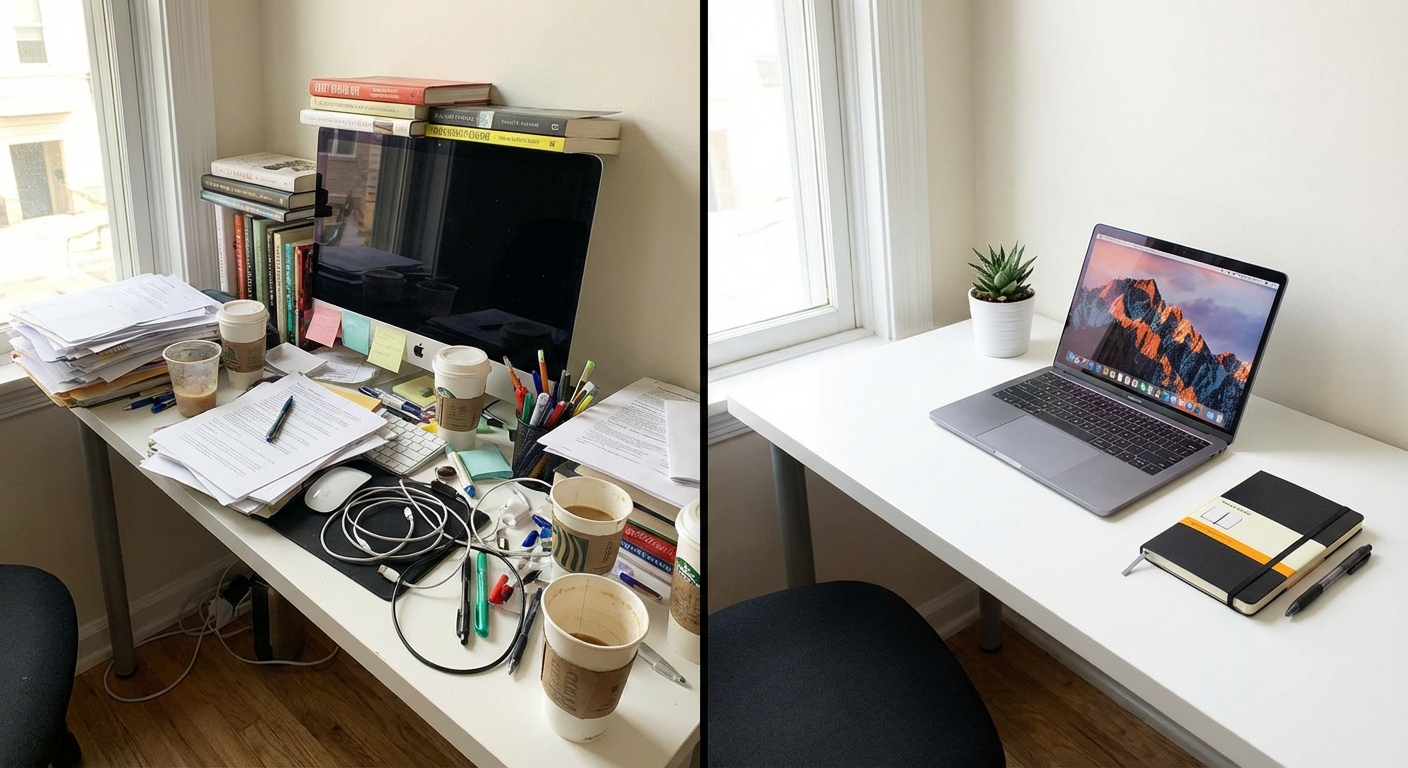
Studies document that people report genuine guilt about unused items they’re keeping, anxiety about disorganization they can’t seem to fix, and shame about their perceived inability to maintain order. These aren’t trivial emotions. They affect daily wellbeing, self-perception, and even relationship satisfaction. Cluttered spaces are strongly associated with procrastination because the overwhelming visual environment makes starting tasks psychologically harder. You sit down to work and your environment whispers about all the other things needing attention.
The relationship between clutter and stress runs bidirectional, creating a self-reinforcing cycle that’s difficult to escape without intentional intervention. Clutter increases stress, and stress impairs your ability to manage clutter. When you’re overwhelmed, the last thing you have energy for is organizing your possessions. So the clutter grows, the stress increases, and the cycle continues. Breaking this pattern requires understanding that you’re not just tidying up. You’re directly addressing a source of chronic psychological burden.
The Research Supporting Minimalism’s Benefits
For years, minimalism was dismissed as mere aesthetic preference or lifestyle choice for the affluent. But social scientists and psychologists have begun examining its claims with rigorous empirical methods. The data emerging from these studies demonstrates that material reduction translates into measurable improvements in wellbeing across multiple domains.
The landmark UCLA study tracked 32 families in Los Angeles, filming their homes, measuring cortisol through saliva samples, and conducting in-depth interviews about how residents felt about their spaces. Women who described their homes using words like “cluttered,” “messy,” and “stressful” showed cortisol patterns that didn’t drop appropriately in the evening, a stress response pattern associated with poor health outcomes. The density of household objects correlated strongly with stress markers. The language people used to describe their homes predicted their cortisol levels even after controlling for other factors.
Australian researchers conducting decluttering interventions found that participants who simplified their living spaces reported 37% improvement in perceived stress levels, along with better sleep quality, improved relationship satisfaction, and increased productivity. These weren’t just subjective reports. Sleep tracking devices confirmed the improvements in sleep architecture. The process of deliberately reducing possessions and creating organized environments produced tangible effects on wellbeing that persisted well beyond the initial decluttering period.
Financial psychology research reveals connections between minimalist approaches and economic wellbeing. Minimalists consistently show lower consumer debt, higher savings rates, greater financial satisfaction, and reduced financial anxiety, not because they earn more but because they spend intentionally. When acquisition of goods is no longer the default response to every emotional need or social pressure, money accumulates rather than disappearing into clutter that provides no lasting satisfaction. Understanding how our relationship with money affects mental health illuminates why minimalism’s financial benefits extend beyond simple budgeting.
The Cognitive Benefits of Simplified Environments
The human brain processes visual information continuously, whether or not you’re consciously attending to your surroundings. Every object in your peripheral vision creates some degree of neural activation that your brain must filter and manage. When environments are filled with hundreds of disorganized items, this filtering burden consumes cognitive resources that could otherwise support deep work, complex problem solving, and creative thinking.
Minimalism functions as noise cancellation for your visual field. By reducing the number of inputs your brain must process, you effectively free up processing capacity for intentional activities. The result is a state of clearer thinking and sustained attention that feels effortless rather than forced. People often describe this as feeling “lighter” mentally after decluttering, and the description accurately reflects reduced cognitive load.
Research at Carnegie Mellon demonstrated this effect clearly with children. Kids in classrooms with minimal visual clutter learned significantly better than those in heavily decorated rooms filled with posters, projects, and visual stimuli that teachers assumed would be engaging. The principle applies equally to adults. Your brain doesn’t distinguish between “inspiring decorations” and “distracting clutter” when it comes to attentional demands. Everything in your visual field requires processing.

The creative benefits of constraint appear paradoxical but are well-documented. Too many options can paralyze decision-making and fragment attention. A simplified environment provides the mental clarity that supports innovative thinking by eliminating the cognitive overhead of managing excessive possessions and navigating cluttered spaces. Writers, artists, and knowledge workers frequently report that their most productive periods coincide with physically simplified environments where nothing competes for their attention.
Decision-making capacity improves when fewer possessions require fewer decisions about those possessions. Mental energy previously spent on managing stuff becomes available for meaningful choices. This connects to research on daily routines and mental clarity showing that reducing unnecessary decisions preserves cognitive resources for what matters most.
Emotional and Psychological Transformation
Beyond measurable cognitive improvements, practitioners of minimalism often describe a profound subjective shift that occurs as they release excess possessions. Many report a physical sensation of lightness or unburdening, as if the weight of their belongings had been mirrored by psychological weight they hadn’t recognized until it lifted.
This emotional release stems partly from breaking the attachment-anxiety cycle that drives accumulation. We often hold onto things out of fear: fear of future scarcity, fear of forgetting the past, or fear that we might need something we’ve discarded. Confronting these fears directly by intentionally releasing objects associated with them can function as a form of therapeutic exposure. Each item released without catastrophe weakens the anxiety that drove keeping it.
The resulting environment supports emotional regulation rather than challenging it. A home becomes sanctuary rather than source of demand. The constant low-level stress of navigating and maintaining excessive possessions gives way to environments that feel genuinely restorative. For people managing chronic stress or anxiety, environmental simplification provides a foundational intervention that makes other stress management techniques more effective.
Studies correlate organized, minimal environments with better mood states and lower depression scores. The mechanisms include increased sense of control over one’s environment, reduced visual chaos that can trigger overwhelm, fewer maintenance demands competing for limited energy, and clearer physical boundaries between different life domains. When your environment is manageable, you feel more capable of managing life more broadly.
Self-efficacy improves through the decluttering process itself. Successfully simplifying your environment requires decisions and sustained action. Each item evaluated and intentionally kept or released builds confidence in your ability to shape your life according to your values. The psychological benefit isn’t just the resulting environment. It’s the proven capacity to create change.
The Financial and Relationship Dimensions
Minimalism inevitably intersects with economics because consumer culture treats shopping as solution to problems that purchases can’t actually solve. Minimalism inverts this relationship, suggesting that solutions often lie in subtraction rather than addition.
The shift in mindset acts as powerful financial protection. When you stop viewing shopping as hobby or emotional regulation strategy, the flow of money outward slows dramatically. The “Diderot Effect,” where buying one new item triggers a cascade of additional purchases to match it, gets interrupted when you consciously question each potential acquisition. Studies suggest minimalist households spend 20-30% less on discretionary purchases than comparable non-minimalist households, not because they’re depriving themselves but because they’ve redefined what satisfaction looks like.
Lower consumer debt, increased savings, and reduced financial anxiety follow naturally from buying less. The financial freedom gained isn’t merely about accumulating more money. It’s about decoupling your sense of security and self-worth from your ability to acquire goods. This psychological shift proves as valuable as the tangible financial benefits.
Our physical spaces provide the stage on which relationships unfold. When that stage is cluttered and chaotic, relational friction often follows. Arguments about cleaning responsibilities, frustration over lost items, and conflict about money spent on “stuff” are common sources of household tension. Minimalism changes the dynamic by removing physical objects as wedges between people.

Partners who embrace minimalism together report fewer conflicts about possessions and money, more time available for relationship because less time goes to managing stuff, aligned values and priorities, and shared sense of purpose. The process of simplifying a home together forces conversations about what’s truly important, often strengthening connection through the shared project.
Starting Without Overwhelming Yourself
The most common reason people fail at decluttering is attempting too much too fast. Influenced by reality television makeover shows depicting dramatic transformations, they try to overhaul their entire home in a weekend. Decision fatigue sets in quickly, burnout follows, and within months the clutter often returns.
Sustainable minimalism is a skill developed through practice, not an event completed in a single weekend. It involves retraining your brain to make different decisions about both acquisition and retention. Like any habit, it builds most effectively through consistent small actions that compound over time rather than dramatic but unsustainable interventions.
Start with observation rather than action. Spend a week simply noticing what you actually use, tracking purchases and impulses, identifying clutter pain points in your home, and recognizing your emotional attachments to various objects. This awareness phase reveals patterns that inform more effective decluttering when you begin.
When you do start removing items, choose a single small category or space. A bathroom medicine cabinet, one drawer, a single shelf. Complete that space fully before moving on. This builds momentum through visible success while preventing the overwhelm that derails larger projects. For each item, ask three questions: Do I use this regularly? Does it add genuine value to my life? Would I buy this again today at full price? Items that fail all three criteria are clear candidates for removal.
Avoid creating a “maybe” pile, which simply delays decisions and clutters your space with indecision. Force yourself to choose keep, donate, or discard for each item. The constraint feels uncomfortable but prevents the common failure mode of shuffling possessions around without actually simplifying. If you genuinely can’t decide, ask when you last used the item. If the answer exceeds twelve months, you likely won’t use it again, and replacement cost for the rare exception is usually minimal compared to the ongoing cost of clutter.
Finding Your Personal Version of Less
Minimalism isn’t monolithic. There’s no authority defining correct possession counts or appropriate amounts of stuff. It’s a flexible philosophy adaptable to bachelor living in a van or family of five in the suburbs. The right approach is whatever solves your specific stress points and supports your particular values.
Extreme minimalism, often defined as owning 100 possessions or fewer, works for some people who prioritize mobility, simplicity, or want to prove what’s possible. But this version isn’t necessary or even advisable for most. Functional minimalism, keeping what serves genuine purpose while eliminating excess, proves more sustainable and widely applicable. Aesthetic minimalism focuses on visual simplicity and organized spaces where possessions exist but are intentionally curated and stored thoughtfully.
The one-in-one-out rule helps maintain equilibrium after initial decluttering. When a new item comes in, an old item goes out. This prevents gradual re-accumulation while still allowing for acquisition when genuinely needed. Seasonal purges, quarterly or annual decluttering cycles, provide regular reset points rather than hoping one-time effort produces permanent results.
Choose an approach matching your values, life stage, and specific circumstances. A photographer needs more equipment than a writer. A parent of young children navigates different considerations than an empty nester. Minimalism is tool for creating environments that support your flourishing, not religion requiring adherence to others’ definitions of sufficient simplicity.
The Bottom Line
Research demonstrates that minimalism provides measurable psychological benefits extending far beyond cleaner spaces. Reduced cortisol and stress markers, improved focus and cognitive function, enhanced mood and life satisfaction, better sleep quality, stronger relationships, and greater financial security all emerge from the practice of intentional reduction.
The underlying mechanism is straightforward: reducing physical clutter reduces mental clutter. Energy previously spent processing, organizing, deciding about, and maintaining possessions becomes available for activities and relationships that actually matter. The cognitive load of living in cluttered environments is real and measurable, and removing that load produces proportional psychological benefits.
Key findings from the research:
- Cluttered homes correlate with elevated cortisol levels that don’t drop appropriately throughout the day
- Decluttering interventions produce 37% improvement in perceived stress and measurable improvements in sleep
- Minimalist households show lower debt, higher savings, and reduced financial anxiety
- Simplified environments improve focus, creative thinking, and decision-making quality
- Partners who declutter together report fewer conflicts and higher relationship satisfaction
If you’re considering starting:
- Begin with one week of observation before removing anything
- Choose a single small space to complete fully before expanding
- Ask the three questions: Do I use it? Does it add value? Would I buy it again?
- Avoid “maybe” piles that postpone decisions rather than making them
- Find the version of minimalism that fits your life rather than copying others
Minimalism isn’t about empty rooms or arbitrary possession counts. It’s about making space, both physical and mental, for the life you actually want. Intentional reduction leads to meaningful expansion. What you gain by releasing what doesn’t serve you is room for everything that does.
Sources: UCLA cortisol and clutter research, Princeton visual attention studies, Australian decluttering intervention trials, Carnegie Mellon classroom environment research, financial psychology and minimalism surveys.