
You’ve probably heard the advice: morning workouts boost metabolism, evening sessions build more strength. But here’s what most fitness advice misses entirely. Your optimal workout time isn’t determined by some universal biological truth. It’s written in your genes, expressed through your chronotype, and fighting against it may be sabotaging your progress.
That 5 AM alarm that works miracles for your colleague might be actively working against your physiology. Research published in the Journal of Sports Sciences in 2024 found that performance differences between chronotypes can reach 26% depending on workout timing. That’s not a marginal gain. That’s the difference between a good training session and a great one.
The science of chronotypes has evolved far beyond simple “morning person” or “night owl” labels. We now understand that your internal clock influences everything from core body temperature and hormone release to reaction time and perceived exertion. Aligning your training with these rhythms isn’t just optimization. It’s working with your biology instead of against it.
What Your Chronotype Actually Tells You
Your chronotype reflects your body’s preferred timing for sleep, wakefulness, and peak cognitive and physical performance. It’s primarily determined by genetic variants in clock genes, particularly PER3, which influences the length of your natural circadian cycle. Unlike preferences that can shift with habit, your fundamental chronotype remains relatively stable throughout adulthood.
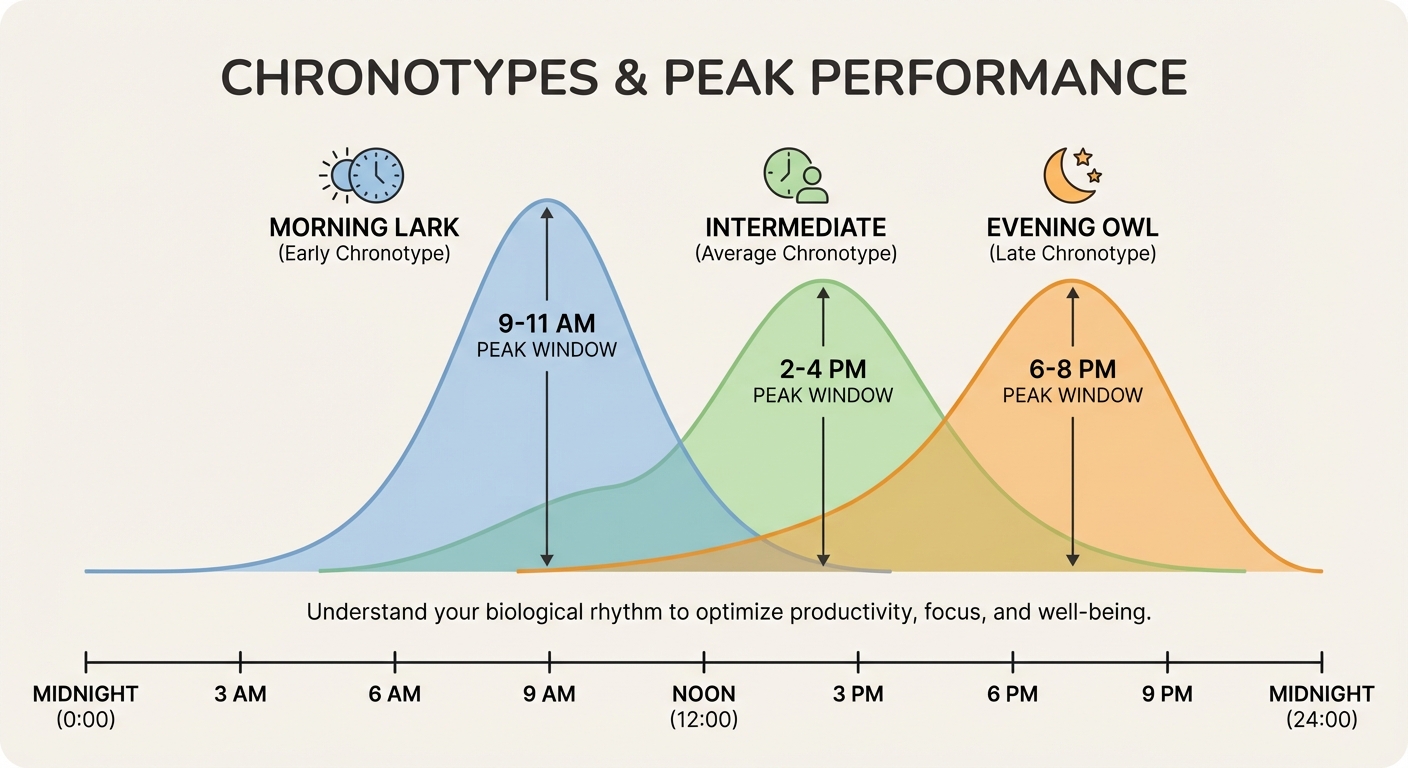
The traditional classification divides people into three main categories, though the reality exists on a spectrum. Morning chronotypes, often called larks, naturally wake early and experience peak alertness in the first half of the day. Evening chronotypes, or owls, don’t hit their stride until later and often struggle with early morning demands. Intermediate types fall somewhere between, with more flexibility in either direction.
Dr. Michael Breus, a clinical psychologist specializing in sleep medicine, has expanded this framework to include four chronotypes: lions (early risers), bears (following solar rhythms), wolves (evening types), and dolphins (light sleepers with irregular patterns). While simplified, this framework helps identify how your body’s natural rhythms might align with different training schedules.
What makes chronotype research particularly relevant for fitness is the discovery that physical performance markers follow predictable patterns based on your type. Core body temperature, which influences muscle function and injury risk, peaks at different times for different chronotypes. Testosterone, critical for strength and recovery, shows morning spikes in some individuals and afternoon peaks in others.
The Science of Performance Timing
The relationship between chronotype and athletic performance has been studied extensively in competitive sports, where marginal gains matter enormously. A landmark study from the University of Birmingham tracked elite athletes and found that morning types performed 7-10% better in morning competitions, while evening types showed similar advantages in late-day events. For recreational exercisers, these differences might be even more pronounced because we’re less conditioned to override our natural rhythms.
Core body temperature sits at the heart of this phenomenon. Your muscles contract more efficiently and with reduced injury risk when body temperature is elevated. For morning chronotypes, this rise happens earlier, reaching optimal levels by mid-morning. Evening types may not hit their thermal peak until 6 or 7 PM. Exercising when your core temperature is still rising, rather than at its peak, means you’re literally warming up twice.
Hormone profiles add another layer of complexity. Cortisol, which helps mobilize energy and increase alertness, naturally peaks in the morning for most people but shows earlier and more pronounced spikes in morning chronotypes. This creates a natural pre-workout energy boost that evening types simply don’t experience at 6 AM. Forcing an owl into a lark’s training schedule means asking their body to perform without its usual hormonal support.
Reaction time and neuromuscular coordination also follow chronotype-specific patterns. Research from Chronobiology International demonstrated that hand-eye coordination and complex movement accuracy peaked 6-8 hours after natural wake time for both chronotypes. For a natural early riser who wakes at 5:30 AM, that’s around noon. For someone who naturally wakes at 8 AM, optimal coordination arrives mid-afternoon.
Morning Chronotype Training Strategies
If you naturally wake before your alarm and feel genuinely alert within 30 minutes of rising, you likely carry morning chronotype characteristics. Your cortisol awakening response is robust, your body temperature rises early, and your mental focus peaks in the first half of the day. This biological setup offers specific advantages and considerations for training.
Morning chronotypes can capitalize on their natural alertness for technically demanding workouts early in the day. Complex movements, skill-based training, and activities requiring focus and coordination align well with your peak cognitive window. The early cortisol spike provides natural energy without requiring extensive pre-workout nutrition or caffeine supplementation.
However, strength performance may not peak quite as early as alertness does. Research suggests that even strong morning types may benefit from scheduling heavy lifting for mid-morning rather than immediately upon waking. This allows core temperature to fully elevate and joints to lubricate properly. A 7 AM wake time might mean optimal strength training around 9-10 AM, with the hours immediately after waking better suited to cardio or mobility work.

The practical challenge for morning chronotypes often involves social and work schedules rather than biology. If your body wants to train at 6 AM but your gym doesn’t open until 7, or if family responsibilities occupy your optimal window, you may need to shift workouts slightly later. The good news is that morning types generally adapt better to small timing adjustments than evening types do.
Recovery timing deserves attention too. Morning chronotypes tend to experience earlier melatonin release, often feeling genuinely tired by 9 PM. This means post-workout nutrition and recovery practices need to happen earlier in the evening to support sleep quality. Training too late in the day, even if it feels fine physically, can disrupt the early sleep onset that morning chronotypes depend on for full recovery.
Evening Chronotype Training Optimization
Evening chronotypes face a different set of challenges and opportunities. If you struggle to feel human before 10 AM regardless of sleep duration, if your best ideas come after dinner, and if you could easily stay awake past midnight without fatigue, your circadian biology runs on a later schedule. This doesn’t make you lazy or undisciplined. It makes you genetically programmed for a different rhythm.
The primary advantage for evening types is significant: peak physical performance arrives when most people are winding down. Core body temperature reaches its maximum in the late afternoon or early evening, joints are fully mobile, and reaction time and coordination are optimized. Strength output can be 8-10% higher compared to morning sessions. For serious strength training, this window between roughly 5-8 PM represents your biological prime time.
The challenge, of course, is that modern life often demands morning functionality. Work schedules, family obligations, and gym crowding may push you toward morning workouts even when your body protests. Research on forced timing shifts shows that evening chronotypes can partially adapt to earlier training, but full adaptation requires consistent exposure over weeks and often comes with a performance cost.
If morning workouts are unavoidable, evening chronotypes should extend their warm-up significantly. What takes a morning type 5-10 minutes may require 15-20 minutes for an evening type training at 6 AM. The goal is to artificially elevate core temperature and neurological readiness that hasn’t occurred naturally. Light exposure immediately upon waking, using a light therapy lamp or outdoor exposure, can help shift the cortisol curve earlier over time.
Caffeine timing becomes strategic for evening types attempting morning training. The adenosine buildup that creates morning grogginess can be partially overcome with caffeine, but timing matters. Consuming coffee 90 minutes before a morning workout allows peak caffeine effects to coincide with training, rather than taking effect afterward when you’re already finished.
Matching Exercise Types to Your Rhythms
Different types of exercise may align differently with chronotype-specific performance windows. Understanding these nuances allows for more sophisticated training programming than simply “work out when you feel best.”
Cardiovascular endurance shows less chronotype sensitivity than strength or power activities. Your aerobic capacity remains relatively stable across the day, with only modest variations based on timing. This means cardio sessions can be more flexibly scheduled without significant performance impact. If your primary goal is zone 2 conditioning or general cardiovascular health, you have more timing flexibility than someone focused on maximal strength.

High-intensity interval training and explosive movements show stronger chronotype effects. Power output, which requires rapid force production and neural efficiency, peaks when your nervous system is fully activated. For morning types, this may occur by late morning. For evening types, expect optimal power production in the late afternoon or evening. Scheduling sprint work or plyometrics outside your peak window doesn’t prevent training, but may limit performance gains.
Skill acquisition and motor learning present an interesting case. While physical performance may be optimized at specific times, learning new movement patterns appears to benefit from training at consistent times regardless of chronotype. The brain seems to consolidate motor learning most effectively when training occurs at the same time daily. If you’re learning a new skill, picking a consistent time may matter more than picking your optimal time.
Flexibility and mobility work can be effectively performed at almost any time, though passive stretching may be safest when core temperature is elevated. This makes mobility work an excellent option for evening types forced into morning slots. Rather than fighting biology with high-intensity work, use early sessions for movement quality and save intense training for later when possible.
Practical Implementation Strategies
Translating chronotype science into actionable programming requires honesty about your current schedule, genuine chronotype, and training priorities. Here’s how to build a chronotype-aligned training approach.
First, accurately identify your chronotype. Online quizzes can provide initial guidance, but the most reliable indicator is your sleep-wake pattern during extended time off from work or social obligations. What time do you naturally fall asleep and wake up when you have no constraints? Your natural midpoint of sleep, the time equidistant from sleep onset and wake time, indicates your chronotype. A midpoint before 3 AM suggests morning tendencies, while a midpoint after 5 AM indicates evening orientation.
Build training blocks that respect your rhythms when possible. If you’re an evening type who can only train in the morning twice per week but can train in the evening three times, schedule your most important or demanding sessions for those evening slots. Use morning sessions for lower-intensity work, recovery-focused training, or technique practice that doesn’t require peak physical output.
Consider chronotype when periodizing training. During phases focused on maximal strength or power, evening types might benefit from temporarily adjusting schedules to allow later training. During base-building or volume phases, timing flexibility increases because the work is less neurally demanding.
Track your performance across different training times to generate personal data. Rate perceived exertion, training loads achieved, and subjective session quality can reveal whether your assumed chronotype matches your actual performance patterns. Some people discover their self-identified chronotype doesn’t match their training reality.
The Bottom Line
Your chronotype isn’t a limitation to overcome but a biological reality to leverage. Morning types who embrace early training and evening types who protect their late-day workout windows will likely see better results than those who ignore these rhythms entirely.
Next Steps:
- Determine your true chronotype by tracking natural sleep-wake patterns for at least a week without alarm constraints
- Map your current training schedule against your chronotype and identify misalignments
- Restructure your training week to place your most demanding sessions in your peak performance window
- Extend warm-ups significantly when forced to train outside your optimal timing
- Track performance metrics across different training times to verify your approach
The 26% performance difference that chronotype-aligned training can provide isn’t available through any supplement or program change. It’s already built into your biology. The only question is whether you’re working with it or against it.
Sources: Journal of Sports Sciences 2024, University of Birmingham chronotype athletics research, Chronobiology International neuromuscular timing studies, Dr. Michael Breus chronotype classification research.