
You’ve probably heard some version of this discouraging idea: exercise doesn’t really help with weight management because your body compensates by burning fewer calories elsewhere. According to this theory, your metabolism operates on a fixed budget, and the extra energy spent running or lifting weights gets clawed back through reduced activity during the rest of your day. Your morning jog supposedly gets canceled out by your body becoming more efficient, leaving you no better off than if you’d stayed in bed.
A new study from Virginia Tech researchers, published in the Proceedings of the National Academy of Sciences, challenges this pessimistic view with compelling evidence. Using the gold-standard doubly labeled water technique to measure total daily energy expenditure, they found no evidence of metabolic compensation. Exercise genuinely increases the calories you burn, and your body doesn’t sabotage your efforts by dialing down energy use elsewhere.
The Constrained Energy Model: Why We Believed Exercise Was Futile
The idea that the body operates on a fixed energy budget gained scientific traction in 2016 when anthropologist Herman Pontzer and colleagues published research comparing energy expenditure across populations with dramatically different activity levels. They found that the Hadza, hunter-gatherers in Tanzania who walk miles daily and perform extensive physical labor, didn’t burn substantially more total calories than sedentary Westerners. This led to the “constrained total energy expenditure” model.
According to this framework, the body maintains energy expenditure within a narrow range regardless of physical activity. When you exercise more, the theory proposes, your body compensates by reducing energy devoted to other physiological processes. Immune function, reproductive hormones, stress responses, and cellular maintenance might all be throttled to maintain the energy budget. The implications were troubling: exercise might provide fitness benefits but wouldn’t meaningfully contribute to energy balance or weight management.
This model gained cultural momentum beyond its scientific merit. It provided a comforting explanation for why exercise alone often fails to produce expected weight loss. It aligned with the frustration of people who worked out diligently but saw minimal scale changes. And it offered ammunition to those arguing that diet matters more than exercise for weight control, which is true but doesn’t mean exercise is metabolically irrelevant.
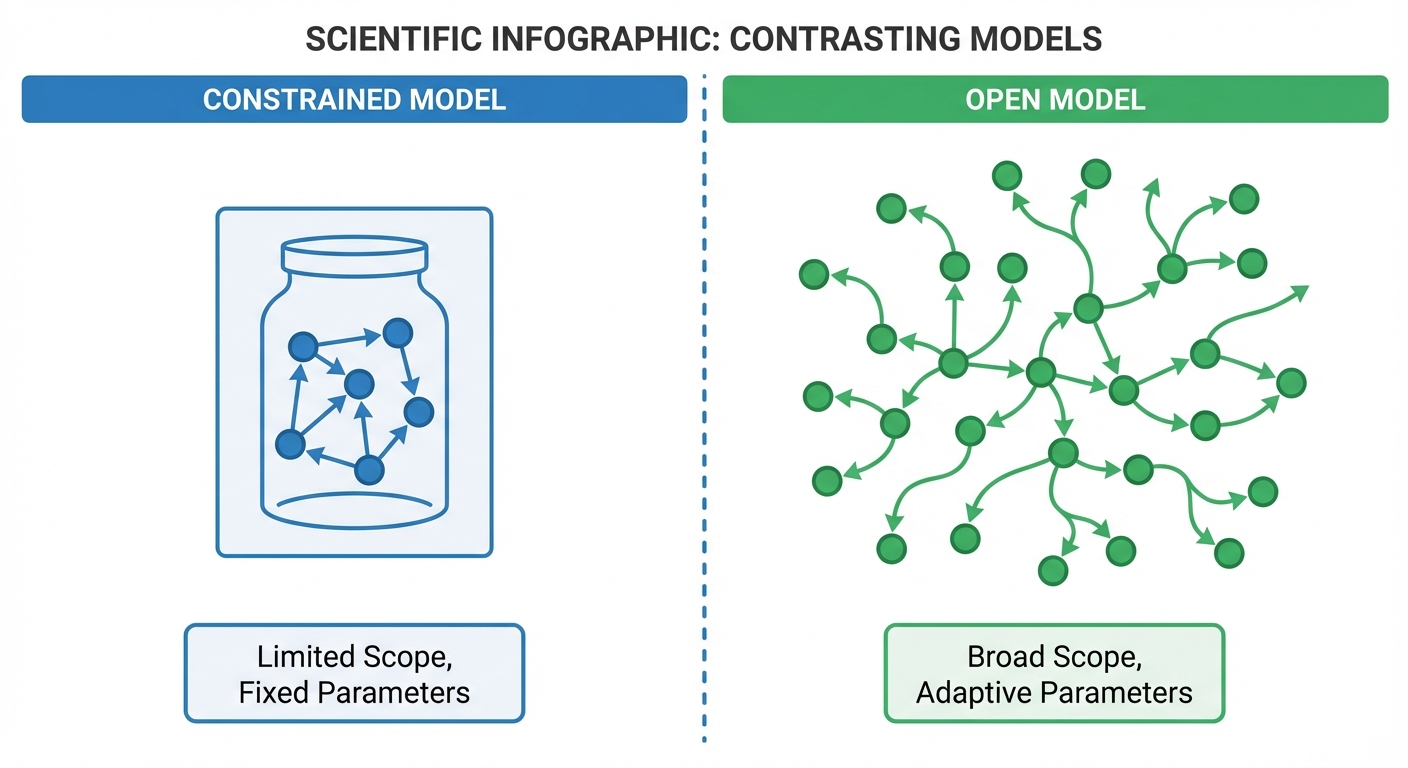
However, the constrained energy model had problems from the start. The original cross-cultural comparisons couldn’t account for the many variables differing between Hadza foragers and American office workers beyond activity levels. Subsequent research produced mixed findings, with some studies supporting compensation and others showing that active people genuinely expended more total energy. The debate remained unsettled until researchers could directly measure individual responses to varying activity levels using precise methodologies.
The New Research: What Virginia Tech Found
Kevin Davy, a professor in Virginia Tech’s Department of Human Nutrition, Foods, and Exercise, led a team that designed a study specifically to test whether metabolic compensation occurs in well-nourished individuals across a wide activity spectrum. Their findings, published in late 2025, deliver a clear verdict: increased physical activity directly increases total daily energy expenditure without triggering compensatory reductions.
The study included 75 participants ranging from ages 19 to 63, spanning activity levels from completely sedentary individuals to ultra-endurance runners. This range was crucial because the constrained energy model predicted that compensation would be most evident at high activity levels where the body would need to redirect energy from other processes.
“Our study found that more physical activity is associated with higher calorie burn, regardless of body composition, and that this increase is not balanced out by the body reducing energy spent elsewhere,” Davy explained. The relationship between activity and total energy expenditure was linear, meaning each increment of additional physical activity corresponded to proportionally higher total calorie burn.
The research found zero evidence of compensation in any physiological measure. Basic bodily functions like breathing, circulation, and temperature regulation maintained consistent energy demands regardless of how active participants were. No biomarkers suggested that immune function, hormone production, or cellular maintenance were being suppressed to fund exercise. The body wasn’t robbing Peter to pay Paul.
The Methodology: How Doubly Labeled Water Proved It
The strength of this research lies in its measurement technique. Doubly labeled water is considered the gold standard for assessing total daily energy expenditure in free-living humans. It doesn’t rely on questionnaires, activity trackers, or laboratory estimates. It measures what actually happens in the body over days to weeks.
Participants consumed water containing stable isotopes of both hydrogen and oxygen. These aren’t radioactive and pose no health risk. Over the following two weeks, participants provided urine samples that researchers analyzed for isotope concentrations.
Here’s how it works: oxygen leaves the body as both water and carbon dioxide, while hydrogen leaves only as water. By measuring the different rates at which these isotopes disappear, researchers can calculate exactly how much carbon dioxide the body produced. Since carbon dioxide production directly reflects energy metabolism, this provides a precise measure of total calorie burn during normal daily life, not just during tracked exercise sessions.
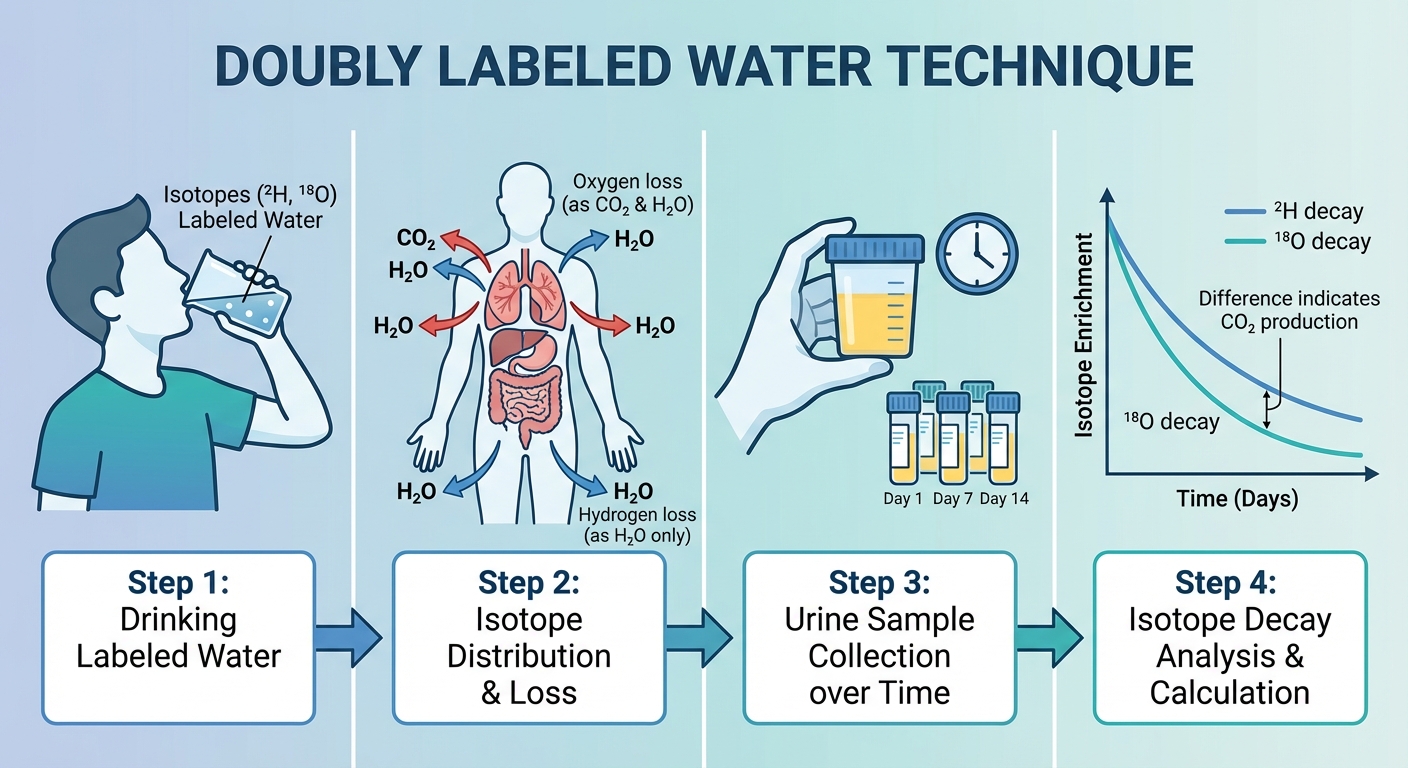
Participants also wore waist-mounted accelerometers that recorded movement patterns in multiple directions throughout the day. This provided objective physical activity data to correlate with the energy expenditure measurements. The combination of precise metabolic measurement and objective activity tracking created a comprehensive picture of how daily movement relates to total calorie burn.
The study included only participants who were adequately nourished and weight-stable. This detail matters because previous research suggested that energy restriction or under-fueling might trigger different metabolic responses. Lead author Kristen Howard noted: “Energy balance was a key piece of the study. We looked at folks who were adequately fueled. It could be that apparent compensation under extreme conditions may reflect under-fueling.”
Why This Changes How We Think About Exercise
These findings have meaningful implications for how we understand exercise’s role in health and weight management. The constrained energy model, if true, would have meant that exercise benefits came entirely from fitness improvements, cardiovascular adaptations, and psychological effects rather than from increased energy expenditure. Under that framework, someone concerned about energy balance should focus exclusively on diet.
The Virginia Tech research restores exercise to its intuitive role in the energy balance equation. Physical activity genuinely increases the calories your body uses. A morning run actually does burn additional calories that wouldn’t have been burned otherwise. Resistance training really does add to your total daily energy expenditure beyond just the workout itself.
This doesn’t mean exercise is a magic weight loss solution. The actual number of calories burned through exercise is often smaller than people expect, and it’s easy to compensate behaviorally by eating more without realizing it. But the metabolic mechanism works exactly as common sense would suggest: move more, burn more.
The research also has implications for understanding why exercise benefits cognition and overall health beyond just cardiovascular fitness. If the body truly operated on a fixed energy budget, improvements in one system would necessarily come at the cost of others. The additive model suggests the body can actually support enhanced function across multiple systems when provided with adequate nutrition and physical challenge.

For people trying to manage weight, the takeaway is that exercise and diet both matter for energy balance, not just diet. While it’s true that “you can’t outrun a bad diet” in the sense that one cookie contains more calories than most people burn running a mile, consistent physical activity does contribute meaningfully to total energy expenditure over time. Combined with attention to dietary patterns, exercise genuinely helps create the energy deficit needed for weight loss.
What This Doesn’t Prove: Important Caveats
The Virginia Tech findings don’t mean weight loss becomes easy with exercise. Several important caveats apply.
Appetite often increases with activity. While your body doesn’t metabolically compensate for exercise by burning fewer calories elsewhere, behavioral compensation through increased food intake remains common. People feel hungrier after workouts and may unconsciously eat more. The metabolic math works, but the fork can undermine it.
Extreme conditions may differ. The researchers specifically noted that under-fueling or extreme training loads might produce different results. Athletes in heavy training blocks or people combining intense exercise with severe caloric restriction may see compensatory responses that didn’t appear in this well-nourished population. The findings apply most clearly to people eating adequately while maintaining reasonable activity levels.
Individual variation exists. While the study found no compensation at the group level, individuals likely vary in their responses. Some people may naturally become more sedentary outside of formal exercise sessions, effectively offsetting some of their workout energy expenditure through reduced daily movement. The research doesn’t prove that no one ever compensates, just that it’s not an inevitable metabolic phenomenon.
Exercise alone produces modest weight loss. Multiple reviews have found that exercise-only interventions typically produce 2-3% weight loss on average. This aligns with the relatively small calorie deficits created by typical exercise volumes compared to dietary modifications. The Virginia Tech research confirms exercise calories count but doesn’t change the basic math that diet modifications create larger deficits more easily.
Practical Applications: What This Means for Your Fitness Routine
Understanding that exercise genuinely increases energy expenditure should inform both expectations and practices around physical activity.
Trust your effort. When you complete a workout, you’ve genuinely burned additional calories that wouldn’t have been burned sitting still. Your fitness tracker’s estimate may be imperfect, but the basic concept holds. The work you put in has metabolic value.
Don’t expect exercise alone to produce dramatic weight loss. The calories burned through reasonable exercise volumes, while real, are relatively modest compared to total daily intake. A 30-minute run might burn 300 calories, roughly equivalent to a single muffin. Exercise supports weight management but works best combined with dietary awareness.
Prioritize adequate fueling. The study specifically examined well-nourished individuals. Under-eating while exercising heavily may trigger responses that didn’t appear in this research. For sustainable fitness, eating enough to support your activity level matters, especially if you’re pursuing performance or long-term adherence rather than short-term weight loss.
Consider total daily movement. The research used accelerometers tracking all-day activity, not just formal exercise sessions. Non-exercise activity thermogenesis (NEAT), the calories burned through daily activities like walking, standing, and fidgeting, contributes meaningfully to total expenditure. Building more movement into daily life complements dedicated workout time.
Use exercise for its many benefits beyond calories. Even if the energy expenditure component of exercise were smaller than this research suggests, physical activity provides profound benefits for cardiovascular health, cognitive function, mood, sleep, bone density, muscle mass, and longevity. These benefits don’t depend on the calorie math at all.
The Bottom Line
The Virginia Tech research, using the gold-standard doubly labeled water technique across 75 participants of varying activity levels, found no evidence that the body compensates for exercise by reducing energy expenditure elsewhere. Physical activity genuinely increases total daily calorie burn in a straightforward additive manner. Your workouts count.
This contradicts the influential “constrained total energy expenditure” model that suggested the body operates on a fixed energy budget, redirecting resources away from other physiological processes when exercise increases. The data shows that well-nourished individuals can increase activity without sacrificing immune function, hormonal health, or cellular maintenance.
While this doesn’t make exercise a magic weight loss solution, given that appetite effects and the modest calorie burn of typical workouts remain considerations, it restores confidence in the fundamental logic that moving more burns more energy. Exercise and diet both contribute to energy balance, not just diet alone.
Key Takeaways:
- The body doesn’t compensate for exercise by burning fewer calories elsewhere
- Physical activity adds directly to total daily energy expenditure
- These findings apply to well-nourished individuals; extreme under-fueling may differ
- Exercise calories are real but modest; diet still matters most for weight loss
- Beyond calorie math, exercise provides irreplaceable health benefits
Sources: Proceedings of the National Academy of Sciences (2025), Virginia Tech Department of Human Nutrition, Foods, and Exercise, Kevin Davy and Kristen Howard research team, doubly labeled water methodology, University of Aberdeen collaboration.