
The fitness industry has spent decades obsessing over training: more volume, higher intensity, advanced programming. Meanwhile, recovery was treated as what happens between workouts, an afterthought rather than a discipline. That perspective is finally shifting. The American College of Sports Medicine’s 2026 fitness trends survey identified recovery as a top priority, no longer a “nice-to-have” but a critical component of performance, longevity, and overall well-being.
This shift reflects accumulating evidence that adaptation happens during recovery, not during training itself. Training provides the stimulus, the stress signal that tells your body to become stronger, faster, or more enduring. But the actual physiological changes, the protein synthesis, the neural refinement, the metabolic optimization, occur during the hours and days after training when your body repairs and rebuilds. Without adequate recovery, you’re just accumulating stress without reaping the benefits.
The modern understanding of recovery has also become more sophisticated than “take a rest day.” We now recognize that recovery is itself trainable, that different types of fatigue require different recovery strategies, and that monitoring recovery status can inform training decisions just as measuring strength or endurance does. Recovery has become a science rather than intuition.
Understanding Different Types of Fatigue
Not all fatigue is created equal, and effective recovery requires understanding what kind of fatigue you’re actually experiencing. The research distinguishes between at least three distinct fatigue categories, each with different recovery requirements and timelines.
Metabolic fatigue refers to the depletion of energy substrates and accumulation of metabolic byproducts during exercise. When you finish a glycogen-depleting workout, your muscles are metabolically fatigued. This type of fatigue typically resolves within 24-48 hours with adequate nutrition and sleep. It’s the most straightforward to address: replenish glycogen with carbohydrates, provide protein for repair, hydrate well, and sleep.
Neural fatigue involves the central and peripheral nervous systems’ reduced ability to recruit muscle fibers effectively and coordinate movement patterns. High-intensity or highly technical training creates neural fatigue that may not feel like muscular exhaustion but manifests as slower reaction times, reduced coordination, and decreased rate of force development. This fatigue can persist longer than metabolic fatigue, sometimes requiring 48-72 hours for complete resolution after particularly demanding sessions.
Structural fatigue encompasses the actual muscle damage, connective tissue stress, and mechanical wear that training produces. This is the fatigue associated with delayed onset muscle soreness, though it continues at the microscopic level even when subjective soreness has resolved. Structural recovery involves genuine tissue remodeling and can require 48-96 hours depending on training severity and individual recovery capacity.
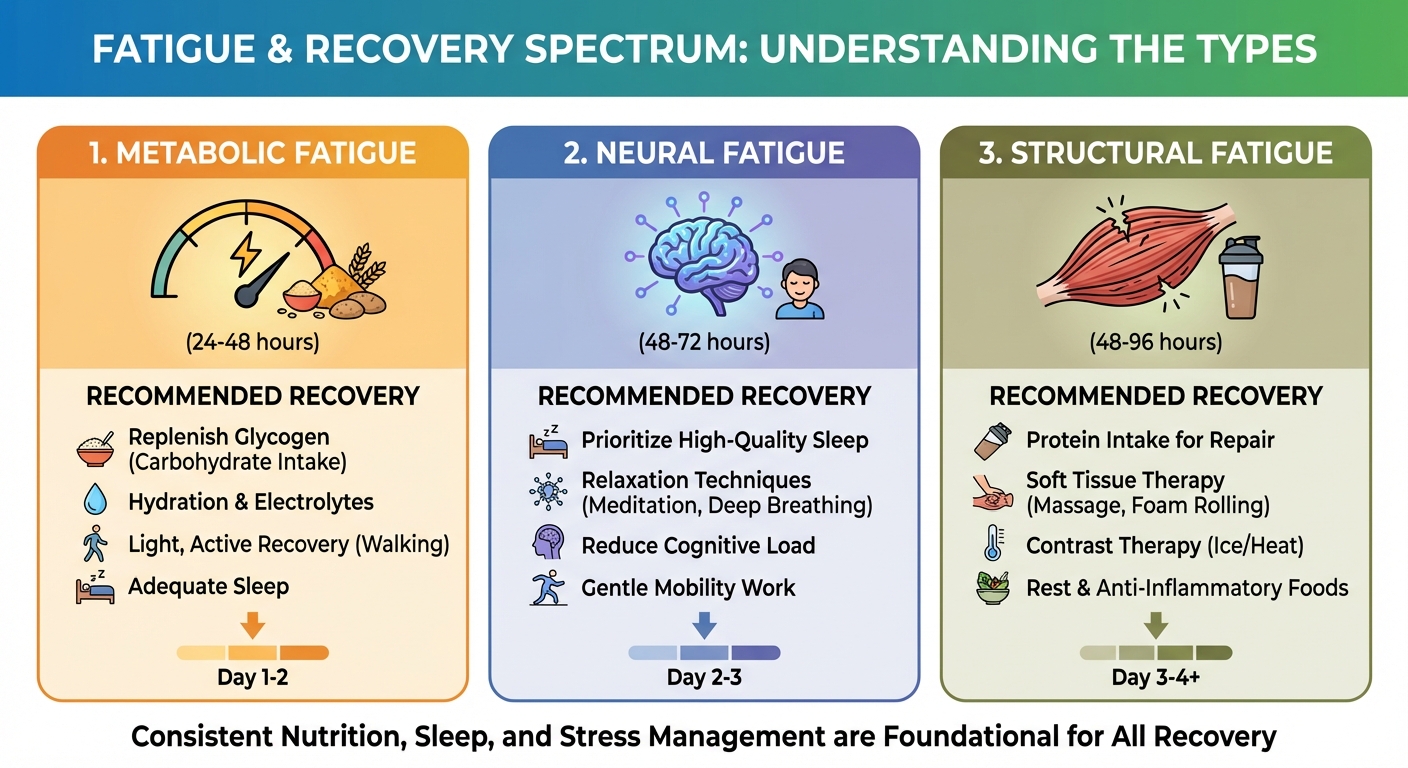
Understanding which type of fatigue predominates after a particular workout helps determine appropriate recovery interventions. A heavy strength session creates primarily neural and structural fatigue requiring adequate rest before the next high-intensity session. A long endurance workout may create significant metabolic fatigue but less structural damage, allowing for earlier return to easy training once fuel stores are replenished.
Sleep as the Foundation of Recovery
No recovery technology, supplement, or protocol can substitute for adequate sleep. The research is unequivocal: sleep is when the body accomplishes most of its repair, adaptation, and hormonal optimization. Every other recovery intervention works best when layered on top of solid sleep, and none can fully compensate for sleep deficit.
During deep sleep stages, growth hormone release peaks. This hormone drives protein synthesis, tissue repair, and metabolic recovery. Sleep-deprived athletes show measurably reduced growth hormone secretion and impaired adaptation to training. The practical threshold appears to be around seven to nine hours for most adults, with athletes often benefiting from the higher end of that range, particularly during intensive training periods.
Sleep quality matters as much as duration. Fragmented sleep that repeatedly interrupts deep sleep cycles provides less recovery benefit than consolidated sleep even of slightly shorter duration. Sleep environment optimization, including temperature control (65-68°F optimal for most people), darkness, and quiet, supports sleep quality. Consistent sleep timing helps entrain circadian rhythms, improving both sleep initiation and depth.
The research on sleep extension is particularly striking. Stanford University studies on basketball players found that extending sleep from typical durations to 10 hours per night improved sprint times, shooting accuracy, and reaction time significantly. The athletes weren’t sleep-deprived to begin with by clinical standards; they were simply getting less sleep than their bodies could optimally use. For serious athletes, sleep may be the single most underutilized performance enhancer.
Active Recovery Versus Complete Rest
The debate between active recovery and complete rest has largely resolved in favor of active recovery for most situations, though context matters. Light movement on rest days appears to enhance recovery compared to sedentary rest, primarily through circulation effects and the maintenance of movement patterns.
Active recovery promotes blood flow to recovering muscles, enhancing nutrient delivery and waste product removal. The mechanical stress of gentle movement also appears to support tissue remodeling, potentially reducing the formation of adhesions and maintaining range of motion. Easy swimming, cycling, or walking on rest days typically falls into this category, keeping heart rate in zone 1 (roughly 50-60% of maximum).

The key distinction is intensity. Active recovery means genuinely easy effort that doesn’t create additional training stress. If your “recovery” session leaves you breathing hard or muscles fatigued, it’s not recovery; it’s training and will add to your accumulated stress rather than relieving it. Many athletes struggle with this, using recovery days for extra training in disguise and wondering why they feel increasingly run down.
Complete rest, meaning minimal physical activity, still has its place. After particularly brutal training blocks, in the initial days following illness, or when cumulative fatigue has reached extreme levels, the body may benefit from genuine stillness. Some practitioners recommend one complete rest day per week alongside additional active recovery days. Individual response varies, and paying attention to how your body responds to different recovery approaches provides the best guidance.
Recovery Tools and Technologies
The market for recovery technology has exploded, ranging from foam rollers and massage guns to compression boots and cryotherapy chambers. Evaluating which tools provide genuine benefit versus expensive placebo requires examining the research behind each category.
Foam rolling and self-myofascial release have the strongest evidence base among common recovery tools. Research demonstrates that foam rolling reduces delayed onset muscle soreness, maintains range of motion after training, and may modestly improve subsequent performance. The mechanism involves both mechanical effects on fascial tissue and neural effects through sensory stimulation. A 10-15 minute foam rolling session targeting trained muscle groups appears to provide measurable benefit.
Percussion massage devices, the vibrating massage guns now ubiquitous in gyms, show similar effects to foam rolling in available research, with the advantage of requiring less physical effort and allowing more precise targeting. The rapid percussion appears to reduce local muscle tension and may enhance blood flow. For traveling athletes or those with limited time, these devices offer a practical option. Whether they’re superior to skilled foam rolling remains unclear.
Compression therapy, particularly pneumatic compression boots, has gained popularity among endurance athletes. The research supports modest improvements in perceived recovery and some physiological markers, though effects on actual subsequent performance are less consistent. These tools likely provide benefit for high-volume athletes, particularly those logging significant running or cycling miles, but may be overkill for recreational exercisers.
Cold exposure, whether ice baths, cold showers, or cryotherapy chambers, presents a more complicated picture. Cold exposure immediately after training may actually blunt some adaptive responses, particularly hypertrophy signaling. However, cold exposure for general recovery, separated from training by several hours, or for acute anti-inflammatory effects after competition or injury, remains supported. The optimal protocol for most people is probably to avoid cold immersion immediately post-training while remaining open to cold exposure at other times.
Nutrition for Recovery Optimization
Recovery nutrition has evolved from simple “eat protein after training” to more nuanced protocols that address the full spectrum of recovery needs. The timing and composition of post-training nutrition influences how quickly and completely recovery occurs.
Protein consumption after training supports muscle protein synthesis, the process of building new muscle tissue. The research suggests a threshold effect: approximately 0.3-0.4 grams of protein per kilogram of body weight post-training maximizes the synthetic response, with diminishing returns beyond that point. For a 75 kg individual, that’s 22-30 grams of high-quality protein within a few hours of training. The “anabolic window” is real but wider than once believed; consuming protein within 2-3 hours post-training captures most of the benefit.

Carbohydrate replenishment matters for athletes with frequent training sessions or those following glycogen-depleting protocols. The 30-60 minute window after training represents the period of maximum glycogen synthesis rate. Consuming 1.0-1.2 grams of carbohydrate per kilogram of body weight during this window, potentially in multiple smaller doses, optimizes glycogen restoration. For recreational exercisers training once daily with typical carbohydrate intake, this precise timing matters less than overall daily carbohydrate adequacy.
Beyond the immediate post-training window, overall nutrition quality supports ongoing recovery. Anti-inflammatory nutrients from vegetables, fruits, fatty fish, and whole foods support the resolution of training-induced inflammation. Adequate hydration maintains blood volume for circulation. Micronutrients including zinc, magnesium, and vitamin D participate in repair processes. No single supplement replaces a well-constructed diet, though individual deficiencies can be worth addressing.
Tart cherry juice and other polyphenol-rich foods have accumulated research support for enhancing recovery, likely through anti-inflammatory and antioxidant effects. The evidence is strongest for tart cherry concentrate consumed before and after intense training or competition, with studies showing reduced soreness and faster recovery of strength. This represents one of the few food-as-supplement approaches with consistent research backing.
Monitoring Recovery Status
Training load monitoring has become sophisticated, but recovery monitoring offers equal value for optimizing performance. Knowing when you’re recovered enough to train hard, versus when you need continued rest, prevents both underrecovering and unnecessary rest.
Heart rate variability (HRV) has emerged as the most practical and validated recovery biomarker available outside laboratory settings. HRV measures the variation in time between heartbeats, reflecting autonomic nervous system balance. Higher HRV generally indicates parasympathetic dominance and recovered status; lower HRV suggests sympathetic dominance and accumulated stress. Wearable devices now track HRV continuously, providing trend data that can inform training decisions.
The practical application involves establishing your personal baseline over several weeks, then monitoring deviations. A significantly suppressed HRV reading suggests incomplete recovery, indicating that the planned high-intensity session might be better replaced with easy training or rest. Some athletes train through moderate HRV dips but respect severe or persistent suppression. The key is using the data to inform decisions rather than blindly following numbers.
Subjective measures retain value alongside technology. Sleep quality, perceived energy level, mood, motivation to train, and training session performance all provide recovery information. A validated tool called the DALDA (Daily Analysis of Life Demands for Athletes) questionnaire tracks these factors systematically, though simpler approaches work too. If you consistently feel like you can’t wait to train and sessions go well, you’re probably recovering adequately. If training feels like an obligation and performance suffers, recovery likely needs attention.
The Bottom Line
Recovery has graduated from an afterthought to a discipline as sophisticated as training itself. Understanding that different fatigue types require different interventions, that sleep underpins everything else, that nutrition timing and composition matter, and that recovery status can be monitored and managed transforms recovery from passive waiting into active optimization.
Implementation Priorities:
- Audit your sleep: Track duration and quality for two weeks; aim for 7-9 hours with minimal disruption
- Distinguish active recovery from easy training: Keep genuine recovery efforts in zone 1
- Address post-training nutrition: 25-40g protein within 2-3 hours, carbohydrates as needed for training schedule
- Consider foam rolling: 10-15 minutes targeting trained muscles on training days
- Monitor recovery status: Use HRV trends or subjective tracking to inform training decisions
Sample Weekly Recovery Framework:
- Training Days: Post-workout nutrition, foam rolling, sleep prioritization
- Active Recovery Days: Zone 1 movement (20-40 minutes), mobility work, extended sleep if possible
- Complete Rest Days: Minimal structured activity, focus on sleep and nutrition quality
The athletes who recover best perform best over time. Training hard matters, but recovering hard is what allows you to keep training hard without breaking down.
Sources: American College of Sports Medicine 2026 fitness trends survey, Stanford sleep extension research, muscle protein synthesis and recovery nutrition studies from Journal of the International Society of Sports Nutrition, heart rate variability monitoring research.