
Zone 2 training has become the most discussed exercise prescription in longevity circles. Dr. Peter Attia popularized it in his book Outlive, Dr. Inan San Millan developed the underlying metabolic framework at the University of Colorado, and wellness podcasts have repeated the message so frequently that “Zone 2” has become shorthand for “the exercise that keeps you alive longer.” The recommendation sounds straightforward: train at a low-to-moderate intensity where you can maintain a conversation, and you will build mitochondrial capacity, improve fat oxidation, and protect yourself against metabolic disease and cardiovascular decline.
Then a narrative review published in July 2025 in Sports Medicine examined the actual evidence and reached an uncomfortable conclusion: the data supporting Zone 2 as the optimal training intensity for mitochondrial adaptations is weaker than the popular narrative suggests. Higher intensities may produce larger mitochondrial and metabolic responses, especially at the training volumes most people realistically achieve. The review did not dismiss Zone 2 training. It challenged whether Zone 2 deserves its privileged position as the single best exercise intensity for health and longevity.
The truth, as usual, is more nuanced than either “Zone 2 is the answer” or “Zone 2 is overhyped.” Understanding what Zone 2 training actually does, what it does not do, and how it fits within a broader training program requires looking at the physiology rather than the marketing.
What Zone 2 Actually Is
Zone 2 refers to a specific metabolic intensity, not just a feeling or heart rate range. The definition comes from the two-threshold model of exercise physiology, which divides exercise intensity into zones based on lactate accumulation in the blood.
At rest and at very low intensities, blood lactate concentrations hover around 1 mmol/L. As intensity increases, lactate production begins to exceed the rate at which muscles and other tissues can clear it. The first lactate threshold (LT1) marks the intensity at which blood lactate first begins to rise above baseline. Zone 2 is the range of intensity just below this threshold, typically corresponding to blood lactate levels of 1.5-2.0 mmol/L. You are working hard enough to stress the aerobic energy system but not so hard that lactate accumulates faster than your body can process it.
In heart rate terms, Zone 2 typically falls between 60-70% of maximum heart rate for most people, though individual variation is substantial. The conversational test is a reasonable proxy: if you can speak in full sentences without gasping between words, you are probably in or near Zone 2. If speaking requires pausing for breath, you have crossed into Zone 3 or higher.
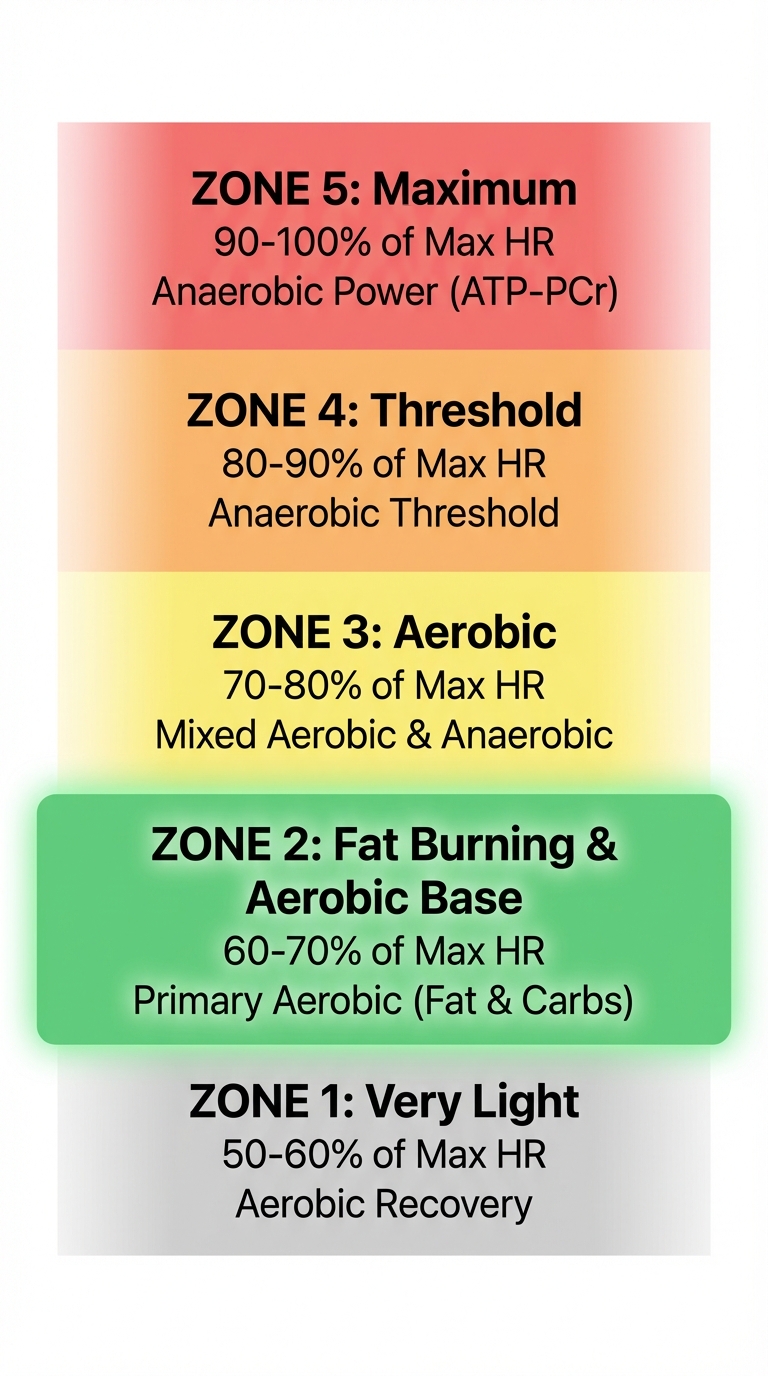
Dr. Inan San Millan, a physiologist at the University of Colorado School of Medicine and the man credited with developing much of the Zone 2 training framework for health, defines it by metabolic function rather than heart rate. At Zone 2 intensity, the body relies primarily on fat oxidation for fuel, mitochondria are operating at a high but sustainable rate, and lactate production serves as a signaling molecule that promotes beneficial metabolic adaptations. San Millan’s research with Tour de France cyclists and with metabolic disease patients has shaped the argument that this intensity uniquely targets mitochondrial biogenesis, the process by which cells create new mitochondria.
The Case for Zone 2: Mitochondria and Metabolic Health
The pro-Zone 2 argument rests on two pillars: mitochondrial biogenesis and fat oxidation capacity. Both are genuine adaptations with health implications.
Mitochondria are the organelles that produce ATP, the energy currency of cells. Skeletal muscle mitochondrial density and function decline with age, contributing to reduced exercise capacity, impaired glucose disposal, and metabolic disease. Type 2 diabetes, at the cellular level, involves mitochondrial dysfunction in muscle tissue: mitochondria become less efficient at oxidizing both fats and carbohydrates, creating a metabolic bottleneck that drives insulin resistance. Training that increases mitochondrial density and function addresses this root cause rather than merely managing symptoms.
Zone 2 training stimulates mitochondrial biogenesis through the PGC-1alpha signaling pathway. Sustained moderate-intensity exercise activates AMPK (AMP-activated protein kinase), which triggers PGC-1alpha, the “master regulator” of mitochondrial biogenesis. Over weeks and months of consistent Zone 2 training, muscle cells increase their mitochondrial content, improving the capacity to oxidize fatty acids and produce energy aerobically.
Fat oxidation capacity has direct longevity implications. The ability to efficiently burn fat as fuel, rather than relying predominantly on glucose, provides metabolic flexibility that protects against insulin resistance, reduces dependence on frequent eating, and supports stable energy throughout the day. Zone 2 intensity maximizes the rate of fat oxidation during exercise (the “Fat Max” zone) because the aerobic system is fully engaged but glycolytic contribution remains low. Over time, training at this intensity improves the metabolic machinery for fat utilization at rest and during all activities.
The cardiovascular benefits of sustained aerobic exercise are among the most robust findings in exercise science. Large cohort studies, including analyses from the Cooper Center Longitudinal Study involving over 122,000 participants, show a clear dose-response relationship between cardiorespiratory fitness (measured by VO2max) and all-cause mortality reduction. Moving from the bottom 25% to the 50th percentile of fitness reduces mortality risk by roughly 50%. The longevity benefit of aerobic fitness exceeds the risk reduction from controlling blood pressure, cholesterol, or smoking.
The 2025 Challenge: Is Zone 2 Really Optimal?
The narrative review in Sports Medicine by researchers including Brad Schoenfeld (a leading exercise scientist) and colleagues examined whether Zone 2 is uniquely effective for mitochondrial adaptations, or whether its reputation outpaces the evidence.
Their central argument: when total training volume is matched, higher-intensity exercise produces equal or greater mitochondrial adaptations compared to Zone 2. Acute studies show that Zone 2 exercise induces modest changes in AMP/ADP ratios and AMPK activation, the signaling molecules that trigger mitochondrial biogenesis. Higher-intensity work (above lactate threshold) produces stronger signaling through these same pathways, plus additional signals (increased calcium flux, greater mechanical stress) that Zone 2 does not sufficiently activate.

The practical implication concerns training volume. Elite endurance athletes train 15-25 hours per week, with roughly 80% of that volume in Zone 2 and 20% at high intensity (the “polarized” model). At these volumes, Zone 2 serves as recoverable base work that accumulates aerobic stimulus without the fatigue cost of high-intensity sessions. But most health-oriented exercisers train 3-5 hours per week. At these volumes, spending 80% of limited training time at low intensity may not be optimal.
The review argues that for time-limited exercisers (the vast majority of the population), prioritizing higher intensities delivers greater metabolic returns per minute invested. A 30-minute interval session at or above lactate threshold may produce mitochondrial signaling equivalent to or exceeding a 60-minute Zone 2 session. For someone who can train only four hours per week, this efficiency matters.
This does not mean Zone 2 is useless. The review acknowledges that Zone 2 provides a low-fatigue, low-injury-risk training method that is sustainable for beginners, older adults, and anyone managing recovery limitations. It also serves important recovery and base-building functions within a well-designed training program. The objection is to Zone 2 as the sole or primary training prescription for the general population seeking health and longevity benefits.
The Resolution: A Balanced Approach
The apparent conflict between Zone 2 advocates and the 2025 review dissolves when you recognize they are answering slightly different questions. San Millan and Attia are asking: “What type of training builds mitochondrial density and metabolic health most effectively for people who can dedicate significant training time?” The review authors are asking: “Given the training volumes most people actually achieve, what intensity distribution produces the best outcomes?”
Both answers point toward the same practical framework: a training program that includes both Zone 2 and higher-intensity work outperforms either approach alone. The proportions should reflect individual training volume, fitness level, and goals.
For someone training 3-4 hours per week (the most common range for health-oriented exercisers), a reasonable distribution might be:
- 2 sessions of 30-45 minutes at Zone 2 (sustained conversational-pace walking, cycling, swimming, or jogging)
- 1-2 sessions incorporating higher intensity (intervals at or above lactate threshold, or vigorous continuous exercise at Zone 3-4)
- 1-2 sessions of resistance training (which provides complementary metabolic and musculoskeletal benefits)
For someone with more available training time (6-10 hours per week), the polarized model becomes more appropriate:
- 70-80% of sessions at Zone 2 (building aerobic base with manageable fatigue)
- 20-30% at high intensity (intervals, tempo work, or vigorous continuous exercise)
The key insight from both camps is that VO2max, the gold-standard measure of cardiorespiratory fitness, is the strongest exercise-related predictor of longevity. Both Zone 2 training and high-intensity training improve VO2max, with high-intensity intervals producing faster improvement and Zone 2 providing the volume base that supports sustained long-term development. A program that neglects either component leaves longevity benefits on the table.
Practical Zone 2 Prescription
If you include Zone 2 training in your program, these practical guidelines help you actually stay in the right zone, which many exercisers find harder than expected.
Finding your Zone 2: The most accurate method is lactate testing with a metabolic coach or sports physiologist, who will identify the exact heart rate at which your blood lactate first begins to accumulate. Without testing, the conversational test works: you should be able to speak in full sentences but not sing. If you can belt out a song, increase intensity slightly. If you need to pause for breath between phrases, slow down.
Heart rate monitoring helps but requires calibration. Generic formulas (220 minus age for max heart rate, then 60-70% for Zone 2) provide rough estimates but can be off by 15-20 beats per minute in either direction. If you use heart rate, calibrate against the conversational test and adjust over time as fitness improves.
Duration matters more than frequency for Zone 2. The mitochondrial adaptations require sustained effort, so 45-60 minute Zone 2 sessions produce better results than multiple 20-minute sessions. San Millan recommends sessions of 45 minutes to two hours for meaningful mitochondrial stimulus, with a minimum of three to four sessions per week for the general population seeking metabolic health.
The most common mistake is going too hard. Most people’s “easy pace” is actually Zone 3 or Zone 4, too hard to build aerobic base efficiently and too easy to stimulate the high-intensity adaptations. True Zone 2 feels uncomfortably slow for fit individuals. This is normal and expected. The training effect comes from time spent at the specific metabolic intensity, not from the perceived difficulty.
The Training Takeaway
Zone 2 training is not overhyped as a concept but is overapplied as a universal prescription. The mitochondrial, metabolic, and cardiovascular benefits are real and supported by decades of exercise physiology research. The correction from the 2025 review is that Zone 2 works best as one component of a training program, not as the only component, especially for people training fewer than six hours per week.

Your longevity training framework:
- Include Zone 2 work (two to three sessions of 30-60 minutes at conversational pace): walking, easy cycling, swimming, or jogging
- Include higher-intensity work (one to two sessions per week): intervals, hill repeats, vigorous continuous exercise, or group fitness
- Include resistance training (two to three sessions per week): compound movements like squats, deadlifts, presses, and pulls for muscle mass and bone density
- Track VO2max trends if your wearable provides estimates, and aim to maintain or improve over time
- Prioritize consistency over perfection: four moderate sessions per week, maintained for years, outperforms intense short-term programs followed by inactivity
The science of longevity exercise is more nuanced than any single prescription suggests. But the central finding is unambiguous: cardiorespiratory fitness is the strongest modifiable predictor of how long and how well you will live. Training programs that build and maintain that fitness, through whatever combination of intensities works for your schedule and preferences, deliver the longevity benefit.
Sources
- Schoenfeld, B. et al. “Much Ado About Zone 2: A Narrative Review Assessing the Efficacy of Zone 2 Training for Improving Mitochondrial Capacity.” Sports Medicine, July 2025.
- San Millan, I. and Brooks, G.A. “Assessment of Metabolic Flexibility by Means of Measuring Blood Lactate, Fat, and Carbohydrate Oxidation Responses to Exercise in Professional Endurance Athletes and Less-Fit Individuals.” Sports Medicine, 2018.
- Vail Health / The Power of Zone 2 Training. 2025.
- CAROL Bike Science. “Zone 2 training: Hype vs hard data.” 2025.