You’ve heard the standard exercise prescription a thousand times: 150 minutes of moderate activity per week, two to three resistance training sessions, progressive overload across multiple sets. It’s sound advice, supported by decades of research. It’s also a commitment that roughly 75% of American adults fail to meet consistently. The gap between what exercise science recommends and what people actually do has remained stubbornly wide for decades, despite increasingly creative public health messaging.
What if the minimum effective dose were dramatically lower than anyone assumed?
A study published in Research Quarterly for Exercise and Sport followed nearly 15,000 people for up to seven years, making it the largest investigation ever conducted in sports and exercise science. The participants trained just once per week for approximately 20 minutes per session. They performed six exercises, each for a single set of five to six repetitions. And they got substantially stronger: 30 to 50% stronger in the first year, regardless of age, gender, or starting fitness level. The gains were maintained, not lost, over the full multi-year follow-up period.
This isn’t permission to be lazy. It’s evidence that the barrier to entry for meaningful strength adaptation may be far lower than the fitness industry has led people to believe.
Inside the Largest Exercise Study Ever Conducted
The study was led by Dr. James Steele, Associate Professor of Sport and Exercise Sciences at Solent University in the United Kingdom. What makes it unusual isn’t just its size but its methodology. Most resistance training studies are conducted in university labs with 30 to 40 participants over 8 to 12 weeks. Subjects follow tightly controlled protocols, and researchers extrapolate long-term outcomes from short-term data. Steele’s study took the opposite approach: it analyzed real-world training data from nearly 15,000 people training at fit20 facilities over periods of up to seven years.
The training protocol was deliberately minimal. Participants visited the facility once per week and performed a single 20-minute session consisting of six compound exercises. Each exercise was performed for one set of five to six repetitions using slow, controlled movements that maximized time under tension. There were no warm-up sets, no multiple-set protocols, no twice-weekly frequency. Just six exercises, one set each, one time per week.
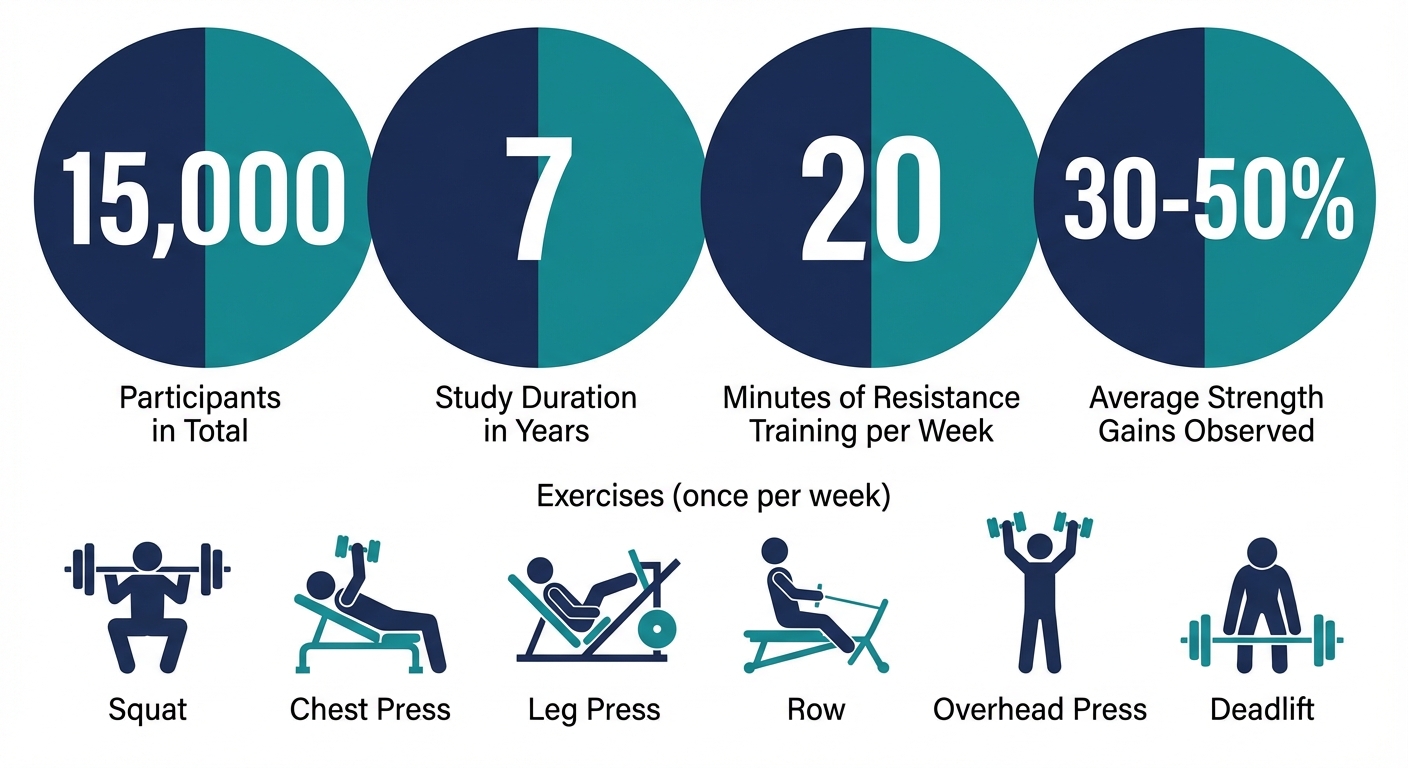
The results were striking. The typical participant experienced 30 to 50% strength gains in the first year. These gains occurred across all demographic groups: men and women, younger and older adults, previously trained and completely untrained individuals. After the initial rapid adaptation phase, strength levels plateaued but were maintained over the following years without any increase in training volume or frequency. Participants who continued their once-weekly sessions didn’t regress. They held their gains.
Steele described the findings with characteristic understatement: “They trained, like, once a week. They did a handful of exercises, and that was it.” The implication is not that minimal training is optimal. It’s that the minimum dose required to produce clinically meaningful strength adaptation is far lower than what most exercise recommendations suggest.
Why So Little Can Do So Much
The physiology behind minimum-dose strength training makes sense once you understand how muscles adapt to resistance. Muscle protein synthesis (the process of building and repairing muscle tissue) is triggered by mechanical tension, the physical load placed on muscle fibers during contraction. This trigger doesn’t require prolonged or repeated stimulus. A single set taken to or near muscular failure generates sufficient mechanical tension to activate the molecular signaling cascades that drive strength adaptation.
Exercise physiologist David Behm of Memorial University of Newfoundland explains the concept through diminishing returns. Your first set of an exercise produces the largest adaptive stimulus. Your second set adds a smaller increment. Your third and fourth sets add progressively less. The relationship between training volume and adaptation is not linear; it’s logarithmic. Going from zero sets to one set per week represents an enormous jump in adaptive stimulus. Going from three sets to six sets per week provides a much smaller marginal gain relative to the additional time and recovery cost.
The slow, controlled repetition style used in the study amplified the effectiveness of each set. By extending the time under tension per repetition (typically 10 seconds lifting and 10 seconds lowering, compared to the 1-2 second tempo common in most gyms), participants maximized the mechanical load on their muscles without requiring heavy weights. This approach reduces joint stress and injury risk while maintaining the tension stimulus that drives adaptation. For older adults or people returning from injury, this method offers a particularly favorable risk-to-reward ratio.
The neural component matters too. Strength isn’t purely a function of muscle size. A significant portion of early strength gains comes from improved neuromuscular efficiency, meaning your brain gets better at recruiting existing muscle fibers and coordinating their activation patterns. This neural adaptation responds to relatively low training frequencies and volumes, which explains why beginners can get dramatically stronger without visible changes in muscle size.
More Is Better, But the Returns Diminish Quickly
The Steele study isn’t the only recent evidence supporting lower training volumes. Brad Schoenfeld, an exercise scientist at Lehman College widely regarded as the leading researcher on hypertrophy (muscle growth), has published extensively on dose-response relationships in resistance training. His work suggests that for most health and strength outcomes, two separate workouts per week of about 30 to 45 minutes each, with a total of four to six sets per muscle group over the course of the week, represents the optimal balance between results and time investment.
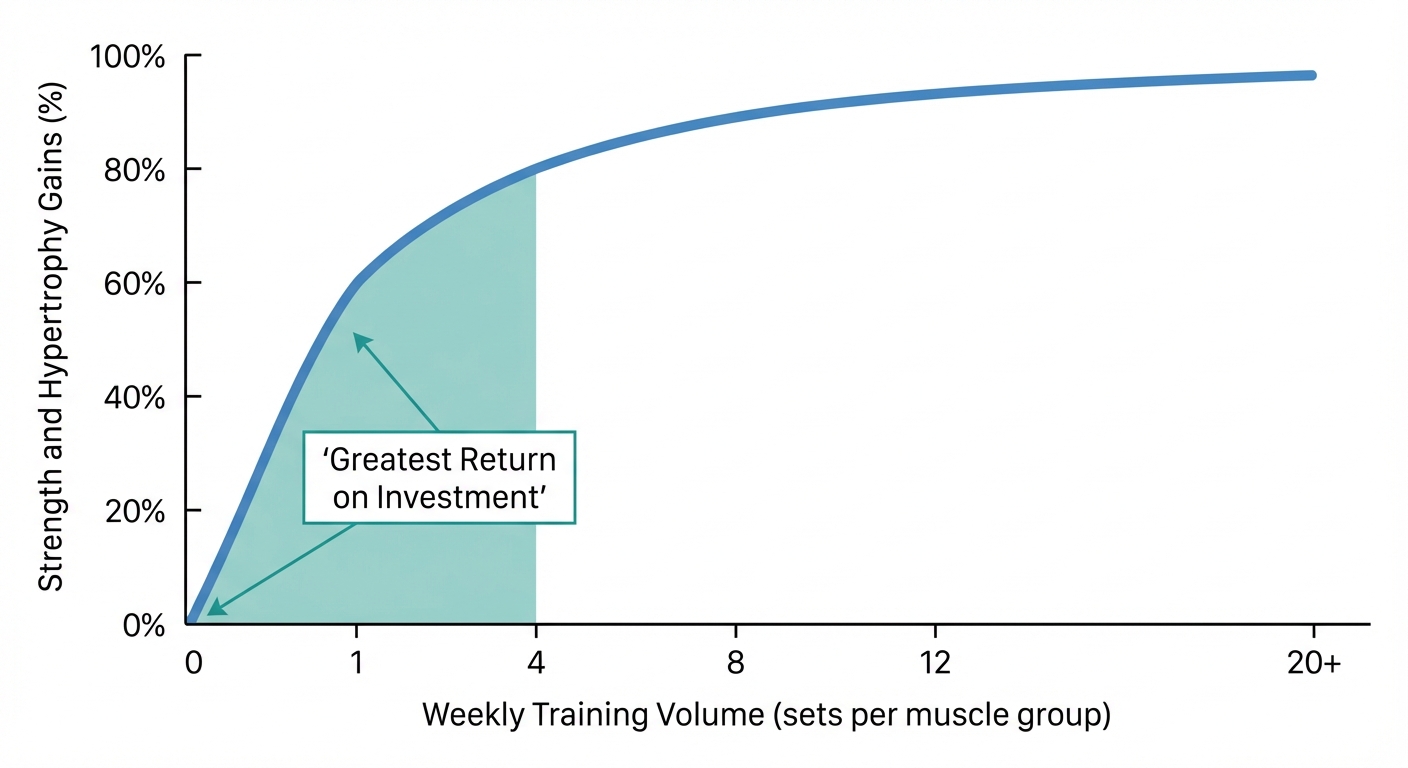
Schoenfeld’s recommended volume (four to six weekly sets per muscle group) produces more muscle growth than a single weekly set. That’s not in dispute. If your goal is maximizing hypertrophy for aesthetic or performance purposes, you will need to train more than once per week. But the critical insight is how steeply the curve rises at the low end. The difference between zero weekly sets and one weekly set is enormous. The difference between four weekly sets and eight weekly sets is meaningful but much smaller. The difference between twelve weekly sets and twenty weekly sets is minimal for most people and may actually impair recovery in older adults.
This curve matters for public health because it reframes the conversation. Instead of telling people they need three to five hours of structured exercise per week (which most won’t do), we can tell them that even one 20-minute session per week produces significant, measurable, lasting strength improvements. That message is both accurate and radically more achievable for the 75% of Americans who are currently doing nothing.
What the Study Means for Different Populations
The findings have particular relevance for populations traditionally underserved by conventional fitness programming.
Older adults (60+) stood to gain the most from the minimum-dose approach. The study found that participants continued to make strength gains well into their 60s, 70s, and 80s, and the once-weekly protocol was sustainable in a way that more demanding programs often are not. Age-related muscle loss (sarcopenia) begins accelerating around age 50, and resistance training is the single most effective intervention. The fact that meaningful protection against sarcopenia can be achieved with 20 minutes per week removes one of the primary objections older adults cite when declining exercise programs: time commitment and physical difficulty.
People with chronic conditions who have been told to exercise but find standard recommendations overwhelming can use the minimum-dose framework as a genuine starting point, not a compromise. For someone with chronic pain, fatigue, or mental health conditions that make regular gym attendance difficult, one weekly session is dramatically more achievable than three.
Time-constrained professionals who consistently cite lack of time as their primary barrier to exercise now face a different equation. Twenty minutes per week is less time than most people spend choosing what to watch on streaming services in a single evening. The barrier is no longer time. It’s inertia.
Deconditioned beginners who feel intimidated by gym culture and complex programming can start with a protocol that is simple, brief, and proven effective. Six exercises. One set each. Twenty minutes. That’s an entry point almost anyone can commit to.
A Practical Minimum-Dose Protocol
Based on the study protocol and recommendations from exercise physiologists including Behm and Schoenfeld, here’s a practical starting framework for someone who is currently not strength training at all.
Weeks 1-12 (Foundation Phase):
- Frequency: Once per week
- Duration: 20 minutes
- Exercises: Six compound movements (leg press, chest press, seated row, shoulder press, lat pulldown, leg curl)
- Volume: One set per exercise, 6-12 repetitions
- Tempo: Slow and controlled (4 seconds lifting, 4 seconds lowering minimum)
- Intensity: Each set should reach the point where one to two more repetitions would be possible but difficult (RPE 7-8 out of 10)
Weeks 13-24 (Progression Phase):
- Frequency: Move to twice per week if schedule allows
- Add a second set of 2-3 exercises where you feel strongest
- Maintain slow, controlled tempo
- Gradually increase resistance when you can comfortably complete 12 reps
Key principles:
- Compound exercises only. Squats, presses, rows, and pulls work multiple muscle groups simultaneously, maximizing the stimulus per minute of training.
- Go to near-failure. The effectiveness of a single set depends on intensity. A casual set of 12 reps that feels easy produces minimal adaptation. A focused set where the last two reps require genuine effort triggers the mechanical tension signal that drives strength gains.
- Prioritize consistency over intensity. Fifty-two sessions per year (once weekly) beats six weeks of four-times-weekly training followed by months off. The study’s seven-year follow-up demonstrated that sustained minimal training beats ambitious programs that people abandon.
Put It Into Practice
The Steele study, alongside decades of dose-response research, establishes something that the fitness industry has been reluctant to say plainly: you don’t need very much structured exercise to get meaningfully stronger. The ideal amount is more than 20 minutes per week. But the minimum effective dose is far lower than the standard recommendations suggest, and starting with that minimum is infinitely better than doing nothing while waiting for the motivation to commit to a full program.
Three steps to start:
- Commit to one 20-minute session this week. Find a gym, use machines for simplicity, and perform one set of six compound exercises. Leg press, chest press, row, shoulder press, lat pulldown, and leg curl. Use a weight that makes the last two reps genuinely challenging. That’s it.
- Repeat weekly for 12 weeks. Don’t add volume, frequency, or complexity during this period. Focus on showing up consistently and gradually increasing resistance as exercises become easier. The research shows that recovery between sessions matters as much as the training itself.
- Evaluate and adjust at week 13. If you’re enjoying the process and want more, add a second session or a second set on key exercises. If once per week is all you can sustain, continue. You’re still getting 30 to 50% stronger than when you started, and those gains will persist as long as you keep showing up.
The largest study in exercise science history says that 20 minutes per week, done consistently and with genuine effort, produces substantial strength gains across every demographic. The best program is the one you actually do. For 15,000 people over seven years, that program was remarkably simple.
Sources
- Solent University. “20 Minutes of Training Per Week Provides Substantial Strength Gains.” 2026.
- NPR. “Research Says This Is the ‘Minimum Dose’ of Gym Time You Need to See Results.” January 2026.
- NPR. “For Strength Training, Short Workouts Can Deliver Results.” January 2026.
- Harvard Gazette. “How to Get Stronger.” January 2026.
- McMaster University. “Analysis: Why Strength Training Matters at Any Age.” 2026.