
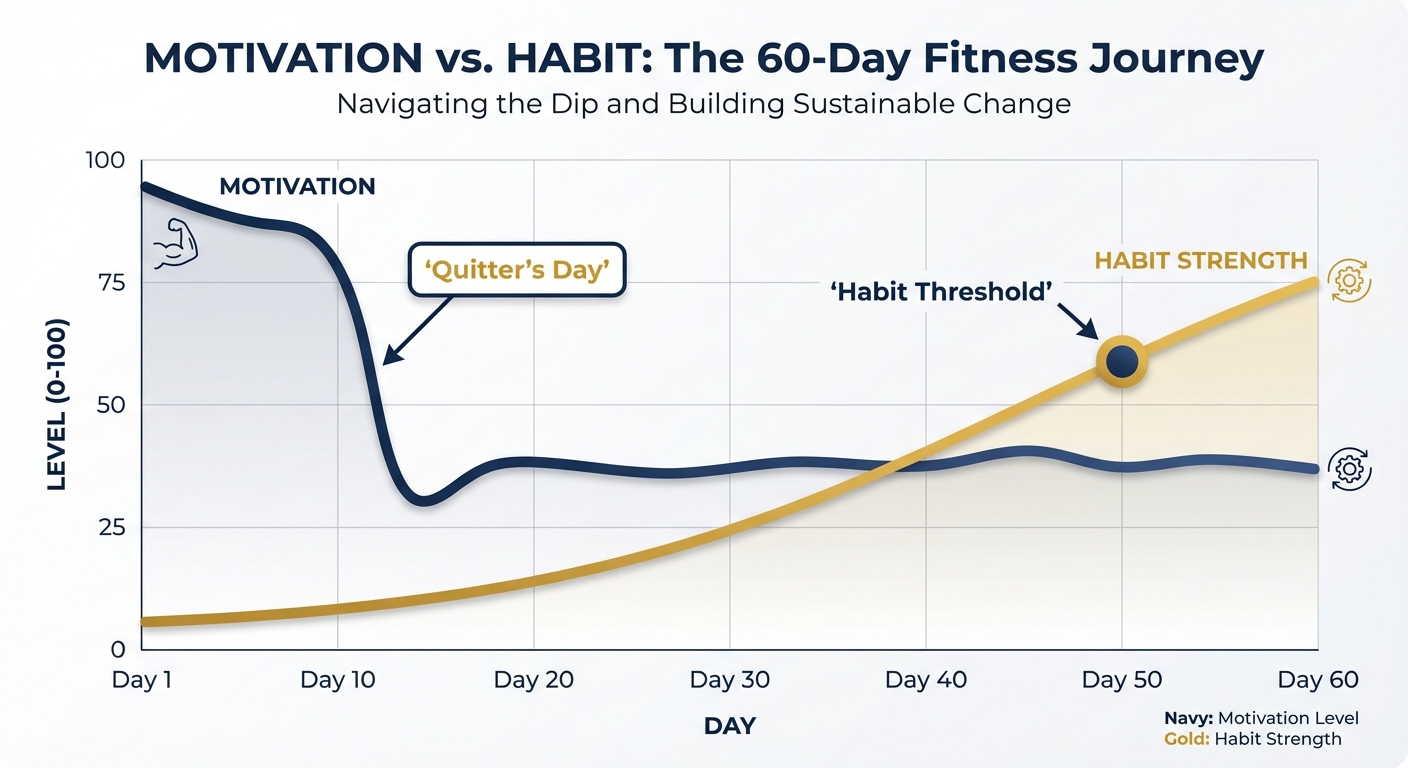
The second week of January has a nickname in the fitness industry: Quitter’s Day. It marks the point when most New Year’s fitness resolutions collapse, as the motivation that felt unstoppable on January 1st gives way to the realities of busy schedules, sore muscles, and the gravitational pull of old habits. Research consistently shows that more than half of resolution-makers abandon their goals within the first month, with fitness commitments among the most commonly discarded.
The problem is not a lack of willpower. The problem is a fundamental misunderstanding of how habits form in the brain and what it actually takes to make exercise a sustainable part of your life. Neuroscience research has revealed that building lasting fitness habits requires working with your brain’s reward systems rather than against them, and that the strategies most people employ, setting ambitious goals and relying on motivation, are precisely the approaches most likely to fail.
Understanding the science behind habit formation can transform your approach to fitness in 2026. The same neural mechanisms that make bad habits so hard to break can be harnessed to make good habits feel automatic. The key lies in the first 30 to 60 days, the dopamine reward system, and a principle that runs counter to everything fitness marketing tells you: consistency beats intensity.
Why Motivation Fails
That surge of determination you felt on New Year’s Day is a neurological phenomenon, not a personality trait. Behavioral scientists call it the “fresh start effect,” a psychological reset that comes with temporal landmarks like new years, new months, or even Mondays. These moments create a mental separation from past failures, making us feel capable of becoming a different person. Gyms and fitness brands capitalize on this effect, knowing that January brings a flood of sign-ups.
The problem is that the fresh start effect is inherently temporary. Motivation is an emotion, and like all emotions, it fluctuates based on circumstances, stress levels, sleep quality, and dozens of other factors beyond your control. Research from behavioral scientist Dr. Heather McKee shows that the fitness industry’s reliance on motivation-based marketing, emphasizing transformation and dramatic results, sets people up for failure by creating expectations that cannot be sustained.
When motivation inevitably wanes, usually within the first two weeks, people interpret this as personal failure. They conclude that they lack discipline or that exercise is not for them. In reality, they have simply run out of the neurological fuel that powered their initial efforts. Successful long-term exercisers are not more motivated than everyone else; they have built systems that do not require constant motivation to maintain.
The science is clear on this point: you cannot motivate your way to lasting behavior change. Motivation gets you started; habits keep you going. The distinction is not semantic. It reflects fundamentally different neural pathways and brain regions. Understanding these differences is the first step toward building exercise habits that persist long after the January enthusiasm fades.
The Neuroscience of Exercise Habits
Your brain has two distinct systems for controlling behavior, and understanding them explains why habit formation requires different strategies than motivation-based approaches. The prefrontal cortex, the brain region responsible for conscious decision-making and self-control, handles new and deliberate actions. When you first start exercising, this region does the heavy lifting, requiring active effort and attention for every workout decision.
The basal ganglia, a deeper brain structure, takes over as behaviors become habitual. This region specializes in automatic, routine actions, the kind you perform without thinking. Driving a familiar route, brushing your teeth, or reaching for your phone are all basal ganglia-driven behaviors. Once exercise becomes a habit, the basal ganglia reduces the cognitive load required to work out, making it feel less like a decision and more like something you simply do.
Dopamine, the neurotransmitter most associated with reward and motivation, plays a crucial role in this transition. When you first start exercising, dopamine is released after the workout as a reward signal. Your brain registers the good feeling and notes that this behavior led to a positive outcome. Over time, something interesting happens: dopamine release shifts from occurring after the behavior to occurring before it. Your brain begins releasing dopamine in anticipation of exercise, creating a pull toward the behavior rather than requiring a push.
Research from NYU Grossman School of Medicine demonstrated this mechanism directly. Mice that ran on a wheel for 30 days showed a 40% increase in dopamine release in the dorsal striatum compared to sedentary mice. Even more remarkable, the increased dopamine levels persisted for a week after the mice stopped running, suggesting that consistent exercise creates lasting changes in reward circuitry. The runners also showed nearly 60% higher levels of BDNF (brain-derived neurotrophic factor), a protein that supports the growth and maintenance of neurons. This neuroplasticity mechanism, explored in depth in our coverage of BDNF and brain health, helps explain why consistent exercise provides cognitive benefits beyond physical fitness.
This research explains why the first month is so critical and so difficult. Your brain has not yet rewired its reward circuits to anticipate exercise. You are operating on prefrontal cortex willpower, fighting against established patterns. But if you can push through this initial period, the neurological architecture begins to shift in your favor.
The 30 to 60 Day Threshold
The popular claim that habits form in 21 days is a myth that can set people up for failure. Research on habit formation, including a widely cited study from University College London, found that the time required to automate a new behavior ranges from 18 to 254 days, with an average of 66 days. Exercise habits, which involve complex behaviors, physical effort, and schedule coordination, tend to fall toward the longer end of this range.
The first 30 to 60 days should be treated as a distinct phase with different rules than ongoing maintenance. During this period, your primary goal is not fitness improvement. It is showing up. The quality, duration, and intensity of your workouts matter far less than the simple act of doing something physical on your scheduled days. Each repetition strengthens the neural pathway, moving the behavior closer to automatic.

This principle, consistency over intensity, runs counter to fitness culture’s emphasis on pushing hard and seeing rapid results. But the science supports a different approach. Research on habit formation shows that distributed practice over time creates stronger neural pathways than intensive practice over short periods. A 10-minute walk every day builds a stronger habit than three hour-long sessions per week, even though the total time is less.
Gyms that treat onboarding as habit coaching rather than just orientation see dramatically better retention rates. The successful approach involves setting expectations for the difficult first weeks, celebrating effort rather than just outcomes, and creating structures that minimize the decisions required to show up. You can apply these principles to your own fitness journey by focusing on the process during the initial period rather than the results.
What does this look like in practice? If your goal is to become a regular gym-goer, the first 30 days might involve simply putting on workout clothes and driving to the gym, even if you only stay for 15 minutes. If running is your target, you might start with a daily five-minute walk at the time you want to eventually run. The behavior pattern, the when and where, matters more than the specific activity during this phase.
Practical Strategies That Work
The neuroscience of habit formation translates into several evidence-based strategies for building lasting fitness habits. These approaches work because they align with how your brain actually processes and automates behavior, rather than fighting against it.
Start absurdly small. The principle of minimum viable habits suggests beginning with the smallest possible version of your desired behavior. Instead of committing to hour-long workouts, commit to 5 minutes. Instead of running three miles, commit to putting on your shoes and walking outside. This approach removes the activation energy barrier that stops most people before they start. Once you are in motion, you often do more than the minimum, but the commitment remains low enough that it rarely feels overwhelming.
Habit stack onto existing routines. Your existing habits can serve as triggers for new ones. If you already make coffee every morning, the act of starting the coffee maker becomes a cue for a brief stretching routine while it brews. If you always shower before work, a pre-shower five-minute workout requires no additional decision-making about timing. The existing habit provides the contextual cue that triggers the new behavior.
Eliminate friction. Every obstacle between you and your workout is a potential failure point. Prepare workout clothes the night before. Keep equipment accessible. If you plan to exercise in the morning, sleep in clothes you can work out in. The goal is to reduce the number of decisions and steps required to start exercising. Research shows that even small increases in friction, like having to drive to a gym versus walking to a home workout space, significantly reduce adherence.
Protect the streak, not the outcome. During habit formation, an imperfect workout completed is more valuable than a perfect workout skipped. If you are exhausted, do a gentle five-minute stretch rather than skipping entirely. If you are short on time, do a single set of each exercise rather than postponing for a “proper” session. Each completed instance reinforces the habit loop, while each skip weakens it.

Match your plan to reality. One of the most common mistakes is creating a workout schedule based on your ideal life rather than your actual life. If you can realistically exercise three days per week given your current commitments, that is your starting point. Attempting to force six workouts per week before you have built the three-day habit typically leads to inconsistency and eventual abandonment. You can always add frequency once the baseline habit is established.
The Role of Progress and Reward
Your brain needs feedback to sustain behavior change. The dopamine system responds not just to rewards themselves but to the anticipation of rewards and to evidence that you are making progress. Behavioral research shows that visible progress, even when measured subjectively or through effort-based metrics rather than outcomes, reinforces intrinsic motivation and increases the likelihood of long-term adherence.
This is where many fitness approaches go wrong. They emphasize outcome metrics like pounds lost or miles run, which change slowly and unpredictably. During the initial weeks of a program, you may see little change in these numbers even with consistent effort. For your brain’s reward system, this feels like failed expectations, reducing dopamine-driven motivation.
A more effective approach tracks effort-based metrics that you directly control. Did you complete your scheduled workout? Did you hit your minimum movement goal? Did you maintain your streak? These process metrics provide immediate feedback and satisfaction regardless of whether the scale moved or your running pace improved.
Some people benefit from external accountability structures, whether that is a workout partner, a coach, or a fitness community. Social connection activates reward circuits independent of the exercise itself, and the commitment to others creates additional motivation to show up. Research shows that when people feel socially connected to their fitness activities, the likelihood of long-term adherence increases dramatically.
The key insight is that long-term fitness is driven not by intensity alone but by frequency and consistency. Small, repeated efforts compound over time, improving cardiovascular health, metabolic function, and mental well-being. Research comparing fitness versus weight loss for longevity confirms that sustained activity patterns matter more than short-term intensity. The person who maintains a moderate three-day-per-week routine for five years will be healthier than someone who does intense daily workouts for two months and then quits.
Beyond January: Maintaining Momentum
Once you cross the 30 to 60 day threshold, the neurological landscape shifts. Exercise begins to feel more automatic, requiring less conscious effort to initiate. But habit maintenance requires its own strategies, and the transition from formation to maintenance is another vulnerable period.
Successful long-term exercisers build flexibility into their systems. They have backup plans for travel, illness, and schedule disruptions. They know the minimum effective dose that will maintain their habit during difficult periods. Instead of an all-or-nothing approach where any deviation feels like failure, they practice strategic adaptation.
This flexibility reflects a deeper principle: fitness is a lifelong practice, not a destination. The goal is not to white-knuckle your way through the year but to build a relationship with movement that can evolve as your circumstances change. Sometimes that means intense training blocks; sometimes it means maintenance mode with shorter, easier sessions. For those seeking efficient approaches during busy periods, exercise snacking offers an evidence-based strategy for maintaining fitness without lengthy workout sessions.
Research on habit durability shows that occasional lapses do not necessarily destroy habits, but complete breaks do. Missing a single workout has minimal impact on established habits, while taking a full week off can significantly weaken the automatic nature of the behavior. When disruptions occur, the priority should be returning to any form of the habit as quickly as possible, even if it is a reduced version.
The Bottom Line
Fitness resolutions fail not because people lack willpower but because they rely on motivation rather than systems. Neuroscience reveals that lasting exercise habits require working with your brain’s reward circuits, prioritizing consistency over intensity, and treating the first 30 to 60 days as a distinct habit-formation phase with different rules than ongoing maintenance.
The strategies that work, starting absurdly small, habit stacking, eliminating friction, and tracking effort rather than outcomes, feel counterintuitive to a fitness culture obsessed with transformation and intensity. But they align with how your brain actually builds automatic behaviors. Every day you show up, even for a brief session, strengthens the neural pathway that will eventually make exercise feel as natural as brushing your teeth.
Next Steps for Building Your Exercise Habit:
- Choose one specific exercise behavior (not a goal) and define the minimum version you could do daily
- Attach it to an existing habit you already perform consistently
- Prepare everything you need the night before to eliminate morning friction
- Commit to 30 days of showing up, tracking completion rather than performance
- After the initial period, gradually increase duration and intensity while maintaining frequency
The people who will still be exercising in June are not the ones who started hardest in January. They are the ones who understood that building a habit is itself the accomplishment, and that every small workout completed is a deposit in their long-term health.
Sources: NYU Grossman School of Medicine dopamine research (Journal of Neuroscience), University College London habit formation study, behavioral research on the fresh start effect, American College of Sports Medicine exercise adherence guidelines, Dr. Heather McKee behavioral science research.