The woman in front of you at the grocery store is struggling with her bags. She’s maybe 75, thin, arms trembling under loads you don’t even notice carrying. You help her to her car and drive home thinking about your own mother, your own future. What separates the 80-year-old who travels independently, carries their own luggage, and plays on the floor with grandchildren from the one who needs help getting out of a chair? The answer, more than almost any other factor, is muscle mass and strength maintained across the preceding decades.
At 40, you begin losing muscle mass even if nothing changes about your lifestyle. The process is subtle at first, perhaps 2-3% loss per decade that you barely notice. But it accelerates. By 60, if you’ve done nothing to counteract this trajectory, you might have lost 15-20% of the muscle mass you had at 30. By 80, potentially 30-40%. This isn’t merely aesthetics or athletic performance declining. Muscle mass directly predicts metabolic health, bone density, insulin sensitivity, functional independence, and longevity itself.
The condition has a clinical name: sarcopenia, age-related muscle loss. And here’s what the research makes clear that most people don’t realize, sarcopenia is not inevitable. Studies demonstrate that adults in their 60s, 70s, even 80s and 90s can build muscle, regain substantial strength, and reverse years of decline with proper training and nutrition. The biology of muscle doesn’t stop responding to resistance training because you’ve reached a certain birthday. It stops responding when you stop providing stimulus.
The Silent Progression of Muscle Loss
Sarcopenia affects roughly 10-15% of people over 60 and 50% of people over 80, making it one of the most prevalent conditions in older populations. But the process begins much earlier than those diagnostic thresholds, accumulating gradually in your 30s and 40s until the effects become obvious decades later when functional capacity has already significantly declined.
The typical progression follows a predictable pattern that most people don’t recognize until substantial damage is done. Between ages 30 and 40, loss is minimal, perhaps 2-3% decline per decade that’s impossible to notice without precise measurement. Most people in this decade attribute any subtle strength decline to busy schedules or less time for exercise rather than biological muscle loss. Between 40 and 50, loss accelerates to 3-5% per decade, and recovery from physical activity takes noticeably longer. Strength starts declining in ways that begin affecting daily activities, though many people attribute this to “getting older” rather than preventable muscle loss.
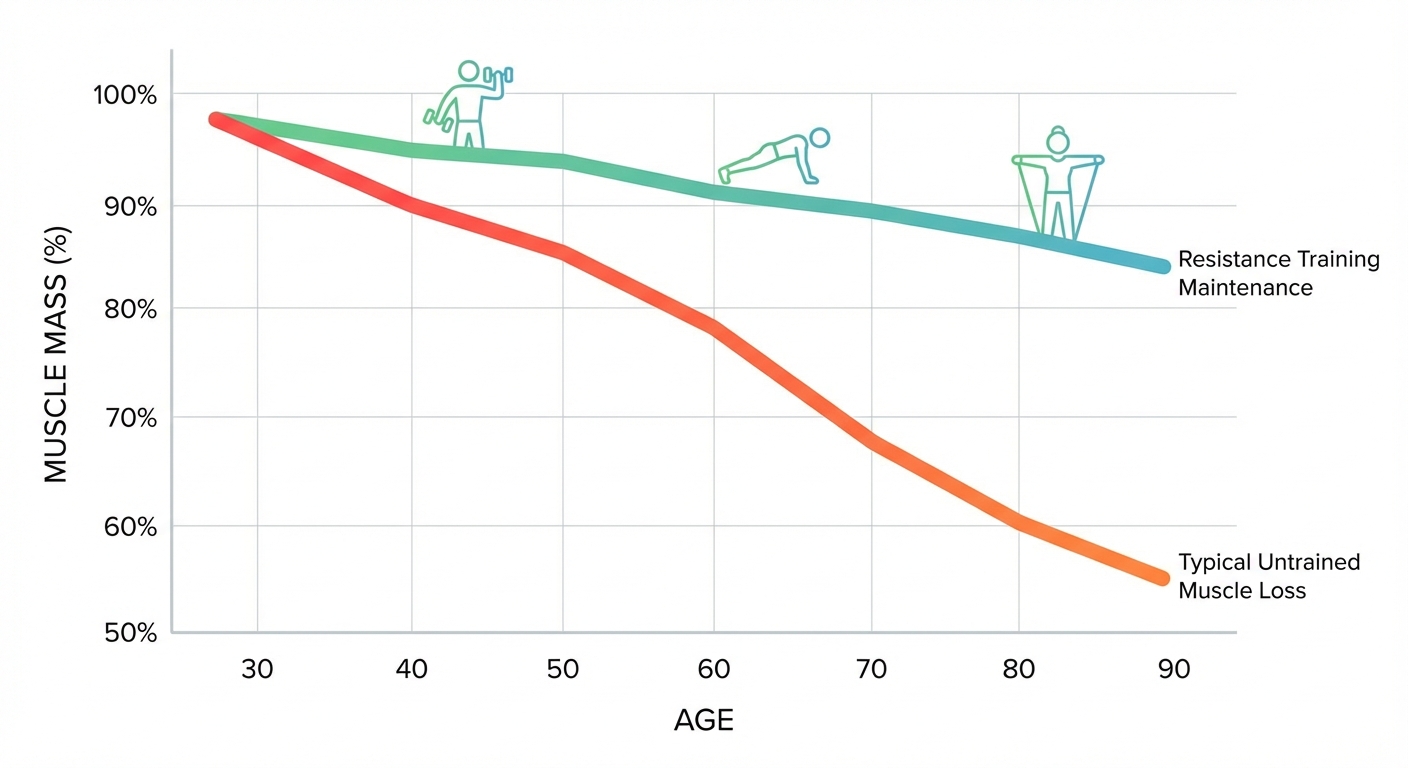
The 50s and 60s represent the critical window where intervention most dramatically changes outcomes. Without resistance training, loss accelerates to 5-8% per decade, and physical tasks that were previously easy become noticeably harder. Getting off low couches, carrying heavy items, climbing stairs, these everyday activities start requiring more effort. After 60, untrained individuals experience dramatic acceleration to 8-10% or more loss per decade. Falls, fractures, disability, and loss of independence become real risks rather than distant concerns.
The earlier you intervene with resistance training, the easier it is to maintain muscle mass rather than trying to rebuild it later. But here’s the empowering reality: it’s genuinely never too late to start. Research consistently shows that even adults in their 80s and 90s can gain meaningful muscle mass and double their functional strength with appropriate training programs.
Why Muscle Matters Beyond Strength
Muscle tissue isn’t just for moving your body. It functions as the largest metabolic organ you have, with effects that ripple through virtually every aspect of health and disease risk. Understanding why muscle matters beyond simply being strong helps explain why resistance training is essential medicine, not optional exercise.
Muscle serves as the primary site for glucose disposal after you eat carbohydrates. When you consume foods containing carbs, glucose enters your bloodstream and needs somewhere to go. Muscle tissue absorbs and stores this glucose as glycogen, removing it from circulation and preventing dangerous blood sugar spikes. More muscle mass means more glucose storage capacity, which translates directly to better blood sugar control and lower diabetes risk. Studies demonstrate that higher muscle mass protects against type 2 diabetes independent of body fat percentage. Strength training improves insulin sensitivity by 20-40% in most people, often within weeks of beginning a program, making it one of the most powerful interventions for metabolic health.
Bone density responds directly to mechanical loading. The same forces that build muscle also build bone through mechanotransduction, the process by which bones sense strain and respond by increasing mineral density. This relationship is especially critical for preventing osteoporosis, particularly in postmenopausal women who face accelerated bone loss. Medications can slow bone deterioration, but resistance training is one of the few interventions proven to actually increase bone density in older adults. Research on strength training and aging shows bone density improvements of 1-3% annually with consistent heavy resistance training, compared to 1-2% annual losses in sedentary adults.
Muscle tissue burns substantially more calories at rest than fat tissue. The more muscle you have, the higher your basal metabolic rate, the calories you burn simply existing before any activity. Age-related muscle loss is a primary driver of the metabolic slowdown people experience with aging. Maintaining muscle mass helps maintain metabolic rate, making weight management progressively easier rather than harder over time.
Falls represent the leading cause of injury death in adults over 65, and most falls result from a combination of weak muscles, poor balance, and low bone density. Strength training addresses all three factors simultaneously: it builds the leg and core strength needed to prevent falls and recover from stumbles, improves the proprioception and balance that come from training under load, and increases the bone density that determines whether a fall results in bruising or hip fracture. Studies consistently show that older adults who strength train have dramatically lower fall rates than sedentary peers.
The Longevity Evidence
For decades, aerobic exercise was positioned as the gold standard for health and longevity. Cardiovascular fitness received all the attention while lifting weights was viewed as something for athletes or bodybuilders, optional rather than essential for ordinary people. Recent epidemiological research has completely overturned this hierarchy, revealing that muscle strength predicts mortality at least as powerfully as cardiovascular fitness.
Multiple large-scale studies now demonstrate strong associations between muscular strength and survival. Research led by Dr. Emmanuel Stamatakis at the University of Sydney published in the BMJ found that just two 45-minute strength training sessions weekly was associated with 15-20% reduction in all-cause mortality in adults over 60, an effect size comparable to many pharmaceutical interventions. Studies examining grip strength, a simple proxy for total body strength, consistently show that stronger individuals live longer across all age groups, with the correlation persisting after controlling for cardiovascular fitness, body weight, and other factors.

The Journal of Gerontology research found that muscle mass and strength are independent predictors of longevity, meaning their protective effects persist even after accounting for cardiovascular fitness, body weight, chronic disease status, and other health factors. This independence is crucial: it means strength training provides survival benefits beyond what you’d get from aerobic exercise alone, and the two forms of exercise are complementary rather than substitutable.
The biological mechanisms connecting muscle to longevity are increasingly well understood. Muscle tissue produces anti-inflammatory compounds called myokines during contraction that circulate throughout the body and reduce systemic inflammation, a primary driver of chronic disease. Muscle mass maintains metabolic health through glucose regulation and insulin sensitivity. Strong muscles protect against the falls and fractures that trigger the downward spiral of hospitalization, immobility, and further decline that often proves fatal in older adults.
How to Start Strength Training After 40
If you haven’t lifted weights consistently in years, or ever, the prospect of beginning can feel intimidating. The key is starting appropriately for your current fitness level and progressing systematically rather than either doing too little to produce adaptation or too much and creating injury. Here’s how to begin safely and effectively.
If you have existing health conditions including heart disease, severe arthritis, diagnosed osteoporosis, or significant injuries, get medical clearance first. This isn’t bureaucratic caution; it’s ensuring that any necessary modifications are incorporated from the beginning. Most people are cleared to strength train, but starting points and progressions might need adjustment.
Begin with bodyweight exercises or light resistance to establish movement patterns before adding significant load. You don’t need a gym membership or heavy equipment to start building strength. Bodyweight training provides an excellent foundation that teaches your nervous system proper movement mechanics.
For lower body, start with squats, either full depth or chair squats where you lower to a chair and stand back up if full squats aren’t yet manageable. Add lunges or split squats, step-ups onto a low platform, and glute bridges performed lying on your back. For upper body, push-ups form the foundation, modified from a wall, elevated surface, or knees if standard push-ups aren’t yet possible. Add rows using resistance bands anchored to a door, and overhead shoulder presses with light dumbbells or bands. For core stability, include planks starting with 10-20 second holds and building duration, along with bird-dog and dead-bug exercises that challenge stability through controlled movement.
Start with just 1-2 sets of 8-12 repetitions for each exercise. The resistance should feel challenging by the final few reps but not impossible to complete with good form. Focus obsessively on form during this phase rather than how much weight you’re using. Poor form creates bad movement patterns that become harder to correct later and increases injury risk. Good form builds strength safely even with light resistance.
The biggest mistake beginners make is doing too much too soon because initial enthusiasm exceeds current capacity. Your muscles might adapt and recover within days, but your tendons, ligaments, and connective tissues need substantially more time to strengthen. Overwhelming them with excessive volume or intensity creates tendinitis, joint pain, and injuries that can set you back months. Progress gradually: increase load or difficulty by approximately 5-10% per week maximum when you’re recovering well and completing all sets without form breakdown.
For muscle maintenance and growth, research supports 2-3 strength training sessions per week with at least one full day between sessions targeting the same muscle groups. This frequency provides adequate stimulus for adaptation while allowing recovery. Training more than three times weekly doesn’t significantly improve outcomes for most people over 40 and substantially increases injury risk from accumulated fatigue.
The Protein Factor
Strength training alone isn’t sufficient for building and maintaining muscle. You need adequate protein intake to provide the raw materials for muscle protein synthesis, and requirements increase with age due to a phenomenon called anabolic resistance, the reduced efficiency with which older bodies convert dietary protein into muscle tissue.
For adults over 40 focused on maintaining existing muscle mass, target 1.2-1.6 grams of protein per kilogram of body weight daily. For those actively trying to build new muscle, increase to 1.6-2.0 grams per kilogram. Adults over 65 should target at minimum 1.5 grams per kilogram to overcome greater anabolic resistance. For a 150-pound (68 kg) person, this translates to roughly 80-135 grams of protein daily, distributed across multiple meals.

Research on protein timing demonstrates that distribution matters as much as total intake. Including 25-40 grams of protein at each of 3-4 meals daily produces better muscle protein synthesis than consuming the same total protein concentrated in one or two meals. The leucine content of protein sources particularly matters, as leucine is the amino acid that triggers muscle protein synthesis most directly. Animal proteins like eggs, dairy, meat, and fish are leucine-rich; plant proteins require larger servings or strategic combinations to reach equivalent leucine doses.
Common Concerns Addressed
The objections to strength training after 40 are predictable and almost universally based on misconceptions rather than evidence. Let’s address them directly.
“I’m too old to start lifting weights.” No, you’re not. Studies consistently demonstrate that adults in their 80s and 90s can gain significant muscle mass and strength with appropriate training. The adaptations might be somewhat slower than in younger adults, but they absolutely occur. There is no age at which you become too old to benefit from resistance training.
“I’ll hurt myself.” Properly progressed strength training has remarkably low injury rates, lower than many activities including recreational running. The keys are starting with appropriate resistance, progressing gradually, maintaining good form, and allowing adequate recovery. Studies of older adults in supervised strength training programs show injury rates comparable to or lower than daily living activities.
“I don’t want to get bulky.” You won’t. Building significant muscle mass requires years of dedicated high-volume training combined with specific nutritional strategies and, for most people, levels of testosterone that postmenopausal women and most older men don’t possess. Moderate strength training will make you stronger, leaner, and healthier without creating bulk. The physiques you see in bodybuilding represent extreme dedication that general fitness training doesn’t approach.
“I have arthritis and joint problems.” Strength training typically helps rather than harms arthritic joints by strengthening the muscles that support and stabilize those joints. Research shows that resistance training reduces arthritis pain and improves function in most people with osteoarthritis. The key is appropriate exercise selection and starting with lighter loads, potentially working with a physical therapist initially to establish safe movements.
“It’s too late, I’ve already lost too much muscle.” Muscle loss is reversible at any age. Even after years or decades of decline, training can rebuild substantial portions of what was lost. The muscle tissue doesn’t become incapable of growth; it simply stops growing without adequate stimulus. Provide the stimulus, and adaptation follows.
The Investment in Your Future Self
The time to start strength training isn’t when you’ve already lost significant muscle and independence and face disability. It’s now, while you’re still capable and the intervention is easier. Think of strength training as retirement savings for your body: the work you do in your 40s and 50s compounds into functional capacity in your 70s and 80s.
The difference between an 80-year-old who can walk independently, carry their own groceries, get up from chairs without assistance, travel, and live alone versus one who needs help with basic daily activities often comes down to muscle mass and strength maintained through the preceding decades. The trajectory is set by choices made in middle age, not by genetics or luck.
You’re not just training for today’s fitness. You’re training for the person you’ll be in 20, 30, or 40 years. That future person’s quality of life, independence, and freedom from disability depend substantially on decisions you make now about whether to build and maintain the muscle that makes independent living possible.
Next Steps:
- Schedule a starting point assessment: note how many chair stands you can do without using arms, how long you can hold a plank, and whether you can stand from floor to standing without using hands for support
- Begin with the bodyweight program outlined above, 2-3 sessions per week, focusing on form over intensity
- Calculate your daily protein target (1.2-1.6g per kg body weight) and track intake for one week to identify gaps
- Progress load or difficulty by 5-10% weekly as movements feel comfortable and recovery is complete
The weights are waiting. Your future self is counting on you to start.
Sources: Journal of Gerontology sarcopenia research, American College of Sports Medicine position stands on resistance training, BMJ muscle strength and mortality studies, JAMA muscle mass and longevity associations, protein timing research (Journal of the International Society of Sports Nutrition), bone density and resistance training meta-analyses.