
You want to be strong. You also want good cardiovascular fitness. The question that haunts fitness forums and gym conversations everywhere is whether you can effectively pursue both goals simultaneously or whether you have to choose one and sacrifice the other. Bodybuilders famously minimize cardio, worried it will interfere with muscle gains. Endurance athletes avoid heavy lifting, concerned it will slow them down. The conventional wisdom suggests picking a lane and staying in it.
This concern stems from real research showing an “interference effect” where endurance training appears to blunt strength and muscle gain adaptations when combined with resistance training. The molecular biology seems clear: strength training activates different cellular pathways than endurance training, and simultaneously activating both creates competing signals that could theoretically compromise both adaptations.
But for most people, the interference effect is dramatically overblown. It’s real but smaller than feared, and it matters primarily for elite athletes pushing toward the absolute limits of single-quality performance. For the vast majority of people pursuing general fitness, health, and longevity, concurrent training, deliberately combining both strength and endurance work, isn’t just acceptable. It’s probably optimal.
The benefits of training both qualities substantially outweigh the modest reduction in maximum gains that concurrent training produces compared to single-quality specialization. Understanding the science of interference allows you to program intelligently, minimize the trade-offs, and build a body that’s both strong and aerobically capable.
The Molecular Biology of Interference
The interference effect has genuine biological underpinnings that explain why the concern exists even if it’s often overstated in practical application.
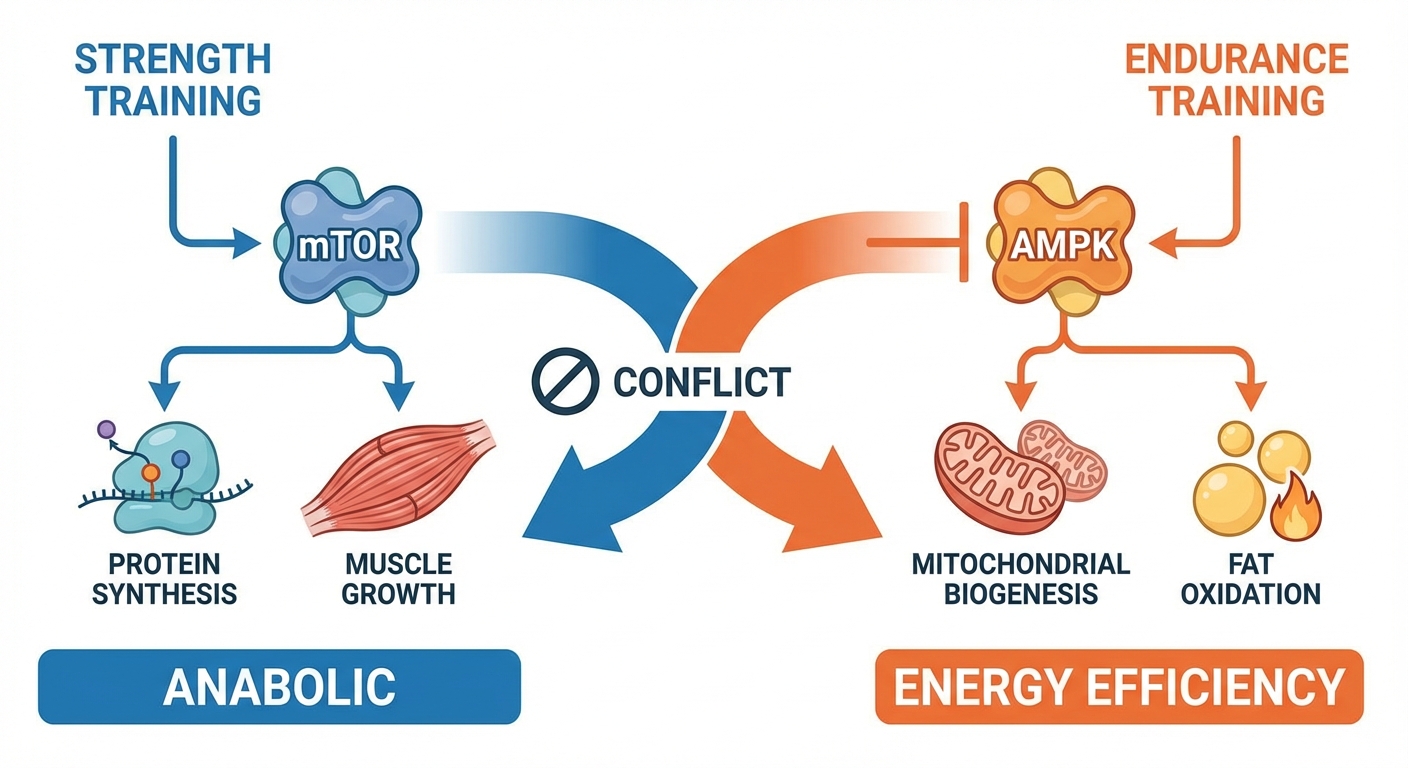
Strength training activates the mTOR (mechanistic target of rapamycin) pathway, a cellular signaling cascade that promotes protein synthesis, muscle growth, and the anabolic processes that make you stronger and more muscular. This pathway responds to mechanical tension on muscle fibers and amino acid availability, explaining why lifting weights and eating protein produces muscle growth.
Endurance training activates the AMPK (AMP-activated protein kinase) pathway, which promotes mitochondrial biogenesis, fat oxidation, and the metabolic adaptations that improve aerobic capacity. This pathway responds to energy depletion and metabolic stress, explaining why cardiovascular training makes you better at sustained activity.
Here’s the problem: these pathways have some antagonistic effects at the molecular level. AMPK activation can partially suppress mTOR signaling, and elevated mTOR can interfere with some AMPK-mediated adaptations. When you activate both pathways in close proximity, the signals compete, and the resulting adaptations to each stimulus may be somewhat blunted compared to what you’d achieve training either quality in isolation.
Research quantifying this interference generally finds that adding endurance training to a strength program reduces muscle and strength gains by approximately 30 to 50 percent compared to strength training alone. Adding strength training to an endurance program reduces VO2 max gains by 10 to 20 percent compared to endurance training alone. The interference is greater when training sessions occur close together in time, and lower body adaptations are affected more than upper body because most endurance activities primarily stress the legs.
These numbers sound concerning until you examine what they actually mean in practice.
Why Interference Matters Less Than You Think
The interference research compares three conditions: strength training alone, endurance training alone, and both combined. Combining produces slightly worse results in each quality than focusing exclusively on one. This finding is robust and reproducible. What matters is whether this trade-off is meaningful for your goals.
For the vast majority of people, the answer is no. Consider what the interference actually means in practical terms. If pure strength training would produce a 20 percent increase in your squat over six months, concurrent training might produce only a 12 to 14 percent increase, the 30 to 50 percent reduction in gains. You still get substantially stronger; you just don’t get as strong as you theoretically could with total single-quality focus. Meanwhile, you’ve also improved your cardiovascular fitness, your metabolic health, your endurance for daily activities, and your longevity markers.
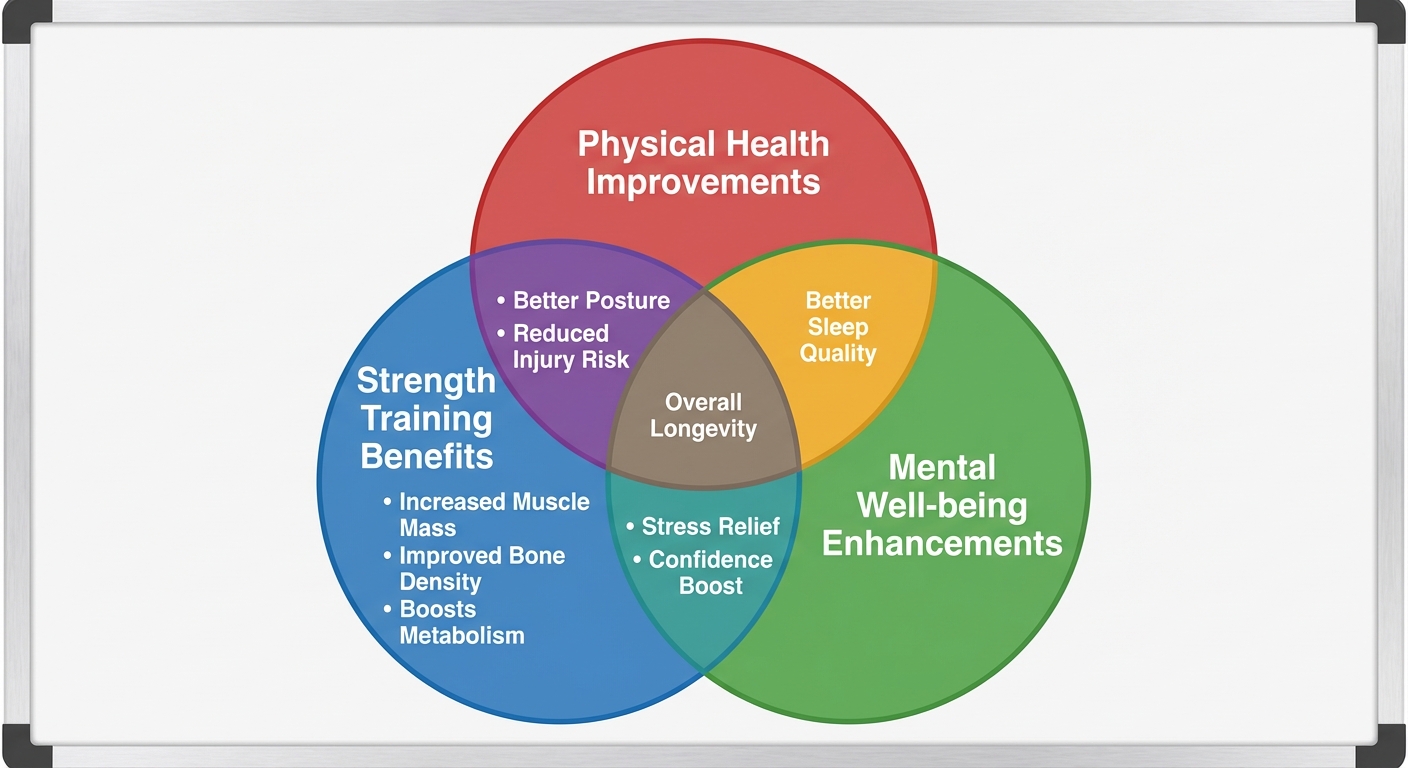
The health benefits of training both qualities substantially exceed what you get from training either alone. Blood pressure improves more with concurrent training than with either modality in isolation. Glucose control and insulin sensitivity show greater improvements. Cholesterol profiles benefit more. Inflammatory markers decrease more. Body composition, the ratio of muscle to fat, often improves most with concurrent training because you’re building muscle while also burning fat. The interference in absolute performance gains is more than compensated by the superior health outcomes.
For general fitness and longevity rather than competitive athletic performance, concurrent training is clearly optimal despite the theoretical interference.
The interference effect also matters far more for advanced trainees than for beginners or intermediates. If you’re a novice lifter or haven’t done serious cardio in years, your body has enormous untapped potential for adaptation in both directions. You can make substantial progress in both strength and endurance simultaneously because you’re so far from your ceiling in either. The interference research was largely conducted on trained subjects pushing toward their limits. For most people starting a balanced fitness program, gains will flow in both directions with minimal conflict.
Programming to Minimize Interference
While the interference effect is smaller than commonly feared, you can further reduce it through intelligent programming that respects the molecular biology without overreacting to it.
Separating strength and endurance sessions by time reduces signaling conflict. The molecular cascades triggered by each type of training take several hours to fully resolve. Training strength in the morning and endurance in the evening, or strength on Monday and endurance on Tuesday, gives each adaptation stimulus a cleaner signaling window. Research suggests 24 hours of separation is ideal, 6 or more hours within the same day is good, and 3 to 4 hours is acceptable. Avoid back-to-back training where you finish strength work and immediately begin endurance work or vice versa.
When you must train both modalities in a single session due to schedule constraints, sequence matters. Strength training before endurance generally produces better results than the reverse order. You perform the strength work when fresh, with full glycogen stores and peak neural drive, giving that adaptation the higher-quality stimulus. Endurance performance doesn’t suffer as much from prior fatigue as strength performance does. Most studies comparing same-session sequencing show strength-then-endurance produces superior outcomes to endurance-then-strength for people prioritizing strength, and the reverse order is relatively rare to recommend regardless of priority.
Volume and intensity balance prevents overreaching that would amplify interference. If you’re doing heavy strength training four times weekly, keep endurance work moderate in intensity, primarily Zone 2 aerobic training rather than high-intensity intervals. If you’re in a phase of high-volume endurance training for a race, reduce strength training to twice-weekly maintenance with moderate loads. Trying to maximize both simultaneously creates excessive systemic stress that degrades recovery and amplifies interference effects.
For detailed guidance on Zone 2 training that complements strength work, our guide to Zone 2 cardio covers the intensity level that minimizes interference while building aerobic base.
Practical Weekly Programming
Different goal profiles call for different concurrent training structures. Here are evidence-based templates that balance the modalities appropriately for various objectives.
For balanced general fitness where you want reasonable development in both qualities without prioritizing either, a structure like the following works well: strength training three times weekly with 45-minute full-body sessions on Monday, Wednesday, and Friday; moderate aerobic training twice weekly with 30 to 45 minutes of Zone 2 work on Tuesday and Thursday; one longer or more intense endurance session on Saturday such as a 60-minute run or 30 minutes of intervals; and Sunday for rest or light activity. This provides adequate stimulus for both adaptations while allowing sufficient recovery.
For strength priority where you’re primarily building muscle and strength while maintaining cardiovascular health, increase strength volume to four sessions weekly while reducing cardio to twice weekly at moderate intensity. Avoid high-intensity interval work during strength-focused blocks because the metabolic stress amplifies interference. Keep cardio sessions on separate days from strength work when possible.
For endurance priority when training for a race or primarily building aerobic capacity, flip the ratio: four to five endurance sessions weekly with appropriate mix of Zone 2 and intervals for your event, and only two strength sessions weekly focused on maintaining muscle mass rather than building new tissue. The strength work preserves bone density and prevents the muscle loss that pure endurance training can produce, but it’s maintenance dosing rather than progressive overload.
For longevity and healthspan optimization, where maximum lifespan and functional capacity trump absolute performance, balance moderate doses of both: two to three strength sessions and three to four Zone 2 cardio sessions weekly, plus one higher-intensity or interval session. This combination addresses the independent longevity predictors of both muscle mass and cardiorespiratory fitness while keeping training sustainable long-term.
Nutrition for Concurrent Training
Training both energy systems creates nutritional demands that exceed either modality alone. Inadequate nutrition amplifies interference effects because your body lacks the resources to fully support both adaptation processes.
Protein requirements increase when combining strength and endurance training compared to either alone. Target 1.6 to 2.0 grams per kilogram of body weight daily to support muscle maintenance and growth despite the catabolic stress of endurance training. This is higher than endurance athletes typically consume and similar to the upper end of strength-focused recommendations.
Carbohydrate needs increase substantially compared to pure strength training because endurance work depletes glycogen stores that must be replenished for recovery and subsequent training. Depending on endurance volume, target 3 to 5 grams of carbohydrate per kilogram daily, with the higher end appropriate for heavy endurance training phases. Inadequate carbohydrate availability impairs both endurance performance and muscle protein synthesis.
Total caloric intake typically needs to be at maintenance or slight surplus. Building strength and muscle while simultaneously doing significant endurance work is very difficult in a substantial caloric deficit. Your body prioritizes survival over adaptation when energy is scarce, and the combined training stress amplifies this prioritization. If fat loss is a goal, modest deficits of 10 to 15 percent below maintenance are more sustainable than aggressive cuts.
For comprehensive guidance on protein distribution and timing, our protein timing guide covers strategies that optimize muscle protein synthesis for concurrent trainees.
Who Benefits Most From Concurrent Training
Almost everyone pursuing general fitness rather than competitive performance in a single modality benefits from concurrent training despite the theoretical interference. The balanced development serves health and function better than specialization for the vast majority of people.
Older adults have particularly strong reasons to train both qualities. They need strength training to prevent sarcopenia and maintain functional independence. They also need cardiovascular fitness for longevity and metabolic health. Concurrent training addresses both critical needs simultaneously, making it the obvious choice for healthy aging.
Military personnel, law enforcement officers, firefighters, and other occupational athletes require both strength and endurance to perform their jobs. They cannot specialize and must train both qualities concurrently. Programming for these populations has been studied extensively and demonstrates that effective concurrent training is clearly achievable.
Athletes in hybrid sports like CrossFit, obstacle course racing, adventure racing, and most team sports need both qualities by the nature of their competition. Single-quality specialization would make them worse at their sport, not better.
Anyone prioritizing healthspan and longevity should train concurrently because both strength and cardiovascular fitness are independent predictors of mortality. Having high fitness in one domain but low fitness in the other produces worse longevity outcomes than moderate fitness in both. The additive benefits of meeting both strength and cardio guidelines exceed the sum of their individual effects.
When Specialization Makes Sense
For a small minority of people, the interference effect matters enough to warrant specialization. These are competitive athletes in strength or endurance sports where fractional performance improvements determine outcomes.
Competitive powerlifters and bodybuilders maximizing absolute strength and muscle size might limit cardio to the minimum necessary for health. The 30 to 50 percent reduction in gains could mean the difference between winning and losing at elite levels. Even so, many successful strength athletes include some cardiovascular work without obvious competitive detriment.
Elite endurance athletes prioritizing VO2 max and race performance might do only maintenance-level strength training. The 10 to 20 percent reduction in aerobic gains matters when racing at the limits of human performance. However, research increasingly shows that some strength training improves endurance performance through neuromuscular efficiency and injury prevention, so even elite endurance athletes benefit from some resistance work.
These populations represent perhaps 5 percent of people who exercise. For the other 95 percent, balanced concurrent training is clearly superior despite theoretical interference.
The Bottom Line
The interference effect between strength and endurance training is real at the molecular level but dramatically overblown in practical application for most people. Yes, you would gain slightly more strength focusing exclusively on lifting, and slightly more aerobic capacity focusing exclusively on cardio. But for health, functionality, and longevity, training both qualities produces superior outcomes despite modest reductions in maximum gains in either.
The key is programming strategically rather than randomly throwing both modalities together. Separate sessions by time when possible. Sequence strength before endurance when training same-day. Manage total volume and intensity to allow recovery. Prioritize protein intake and adequate nutrition. Accept that gains in each quality will be slightly slower than single-focus training while recognizing that the combined benefits far exceed what single-quality specialization provides for health and function.
Your Concurrent Training Protocol:
-
For general fitness: Three strength sessions plus two to three cardio sessions weekly, separated by time when possible.
-
Same-day training: Strength first, then cardio, with at least 3-4 hours separation if schedule allows.
-
Volume balance: If one modality is high-intensity or high-volume, keep the other moderate.
-
Nutrition support: 1.6-2.0g/kg protein daily, adequate carbohydrates for endurance volume, caloric intake at maintenance or above.
-
Periodization option: Alternate 8-12 week blocks emphasizing strength or endurance while maintaining the other at moderate levels.
Be strong and have endurance. Your body, your health, and your longevity will be better for the combination than for specialization in either quality alone.
Sources: Concurrent training research reviews and meta-analyses, molecular signaling pathway studies (mTOR and AMPK interactions), exercise and longevity research, practical programming guidelines from strength and endurance coaches, Journal of Strength and Conditioning Research concurrent training studies.