Tim Cook wakes at 3:45 AM. Anna Wintour is at the tennis court by 5:45. Howard Schultz rises at 4:30 to walk his dogs. The mythology of successful people and their early mornings has spawned an entire industry of productivity content, much of it suggesting that simply copying these routines will somehow transfer their success to you. It won’t. But beneath the hype lies something real: the neuroscience of mornings reveals why how you spend your first waking hour genuinely shapes the next 23.
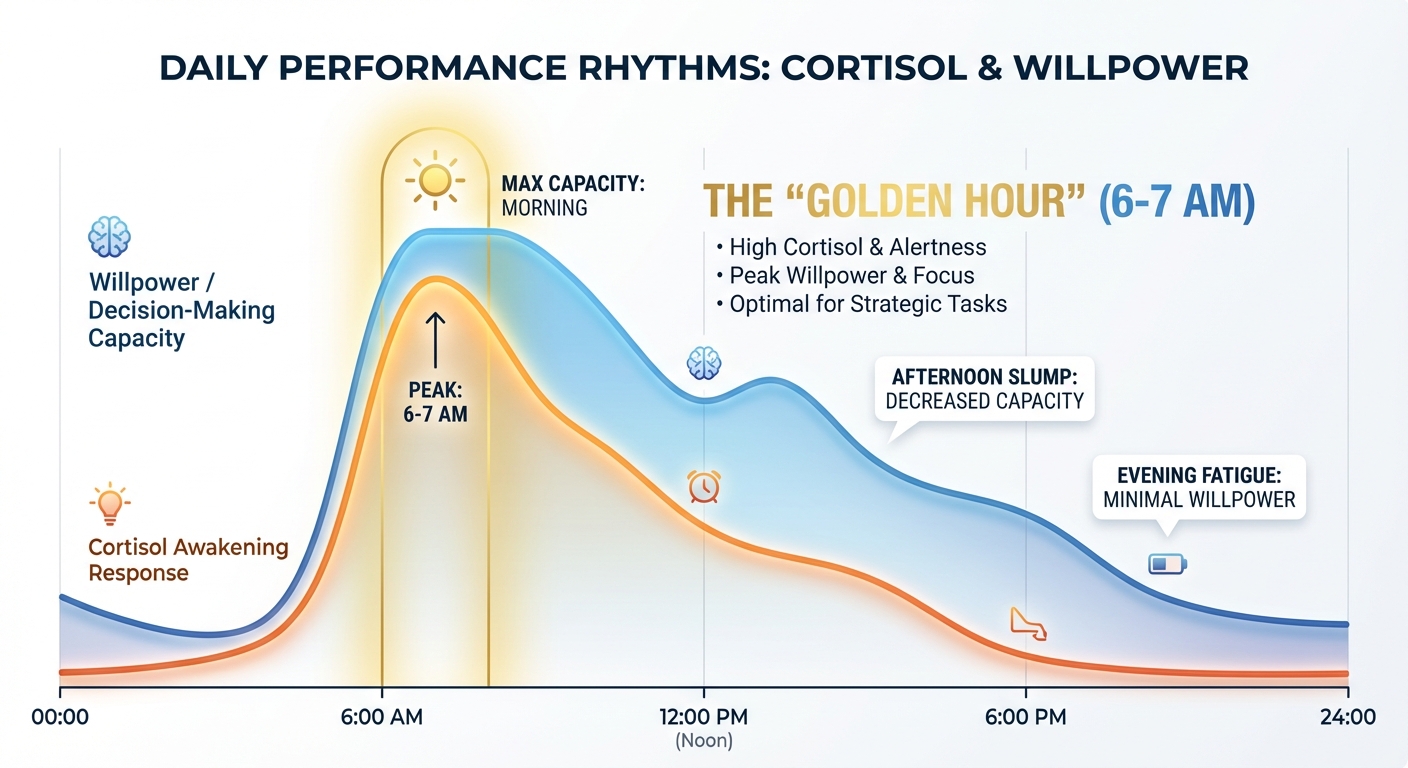
The research is compelling and surprisingly consistent. Your first 60-90 minutes awake represent a unique physiological window. Cortisol, the alertness hormone, naturally spikes 50-75% within the first hour of waking, a phenomenon called the cortisol awakening response (CAR). Your prefrontal cortex, the brain region responsible for willpower, decision-making, and executive function, operates at peak capacity before the day’s demands deplete it. Glycogen stores are full, meaning your brain has ample glucose for complex cognitive tasks. This convergence of factors creates an opportunity that most people squander scrolling social media in bed.
Studies comparing people with consistent morning routines to those without show the routine-havers report 25% higher perceived productivity, better mood throughout the day, lower stress markers, and greater sense of control over their lives. The specific practices matter less than the consistency and intentionality. You don’t need to meditate for an hour or blend exotic supplements. You need to use your morning peak state deliberately rather than reactively. Here’s what the science says about how.
The Neuroscience Behind Why Mornings Matter
Understanding why mornings are uniquely valuable requires a brief journey into the biology of waking. Sleep isn’t simply “off” time for your brain; it’s an active period of consolidation, cleanup, and preparation. During the transition from sleep to wakefulness, your brain undergoes a massive neurochemical shift that creates conditions you can either leverage or waste.
The hypothalamic-pituitary-adrenal (HPA) axis orchestrates this transition. When light hits your retina, it signals your suprachiasmatic nucleus (the brain’s master clock) to suppress melatonin and trigger cortisol release from your adrenal glands. This cortisol surge, the CAR, isn’t the stress response many people assume it to be. In the morning context, cortisol is fuel. It mobilizes glucose, enhances alertness, and prepares your body and mind for action. Research from the University of Westminster found that people with robust CAR showed better cognitive performance, faster reaction times, and more stable mood throughout the day compared to those with blunted awakening responses.
Willpower operates like a battery that starts each day at full charge and depletes with use. Every decision you make, every temptation you resist, every difficult task you tackle draws from this finite reserve. Psychologist Roy Baumeister’s research on ego depletion demonstrates that decision-making quality deteriorates measurably as the day progresses. By evening, you’re operating on reserves. This means your morning hours, when the battery is full, represent your best opportunity for tasks requiring discipline, creativity, or complex thinking. If you spend that peak capacity choosing what to wear, deciding what to eat, and responding to other people’s urgent emails, you’ve squandered your daily cognitive prime time on trivialities.
Circadian rhythm alignment adds another layer to morning importance. Your biological clock influences nearly every physiological process, from hormone secretion to body temperature to gene expression. Morning behaviors, particularly light exposure, eating, and physical activity, serve as zeitgebers (time-givers) that synchronize your internal clock with the external world. Consistent morning routines strengthen this alignment, improving sleep quality at night, which in turn enhances morning function. This creates a virtuous cycle: good mornings make good nights, and good nights make good mornings.
The Evidence-Based Core Practices
If you consume morning routine content online, you’ll find elaborate protocols involving ice baths, gratitude journals, visualization exercises, and meditation apps. Some of these have merit. But the scientific foundation for an effective morning rests on just a handful of physiological interventions that most people overlook while chasing more exotic practices.
Hydration is the simplest and most underutilized morning intervention. You’ve just gone 6-8 hours without water while continuing to lose moisture through respiration and perspiration. Research from the University of Connecticut’s Human Performance Laboratory shows that even mild dehydration, as little as 1.5% fluid loss, impairs cognitive function, mood, and energy. Drinking 16-24 ounces of water within the first 30 minutes of waking reverses overnight dehydration and produces measurable improvements in alertness. Adding a pinch of salt provides electrolytes lost during sleep. This costs nothing, takes 30 seconds, and provides 10-15% cognitive improvement according to hydration studies.
Light exposure triggers the cascade of hormones that properly wakes your body. Indoor lighting, even when it seems bright, typically provides only 200-500 lux. Outdoor daylight, even on an overcast day, delivers 1,000-10,000 lux. This difference matters enormously for circadian signaling. Dr. Andrew Huberman, a neuroscientist at Stanford, recommends 10-30 minutes of outdoor light exposure within the first hour of waking to optimize the cortisol awakening response and suppress residual melatonin. This single habit improves morning alertness, enhances mood, and improves sleep quality that night by setting your circadian rhythm earlier. If you can’t get outside, a 10,000 lux light therapy box provides similar benefit.
Movement activates your body in ways that simply being awake doesn’t accomplish. Even five minutes of walking, stretching, or gentle yoga increases heart rate, promotes blood flow, and triggers endorphin release that elevates mood for hours afterward. Exercise science research consistently shows that morning movement improves cognitive performance and emotional regulation for 4-8 hours post-exercise. The specific activity matters less than doing something that engages your muscles and elevates your heart rate slightly. A 10-minute walk, a brief yoga flow, push-ups while coffee brews, any movement counts.
Protein-rich breakfast stabilizes blood glucose and promotes satiety hormones that prevent the mid-morning energy crash many people experience. Research from the University of Missouri found that high-protein breakfasts (25-35g protein) reduced total daily calorie intake by 10-15%, improved satiety, and stabilized energy levels compared to high-carbohydrate or skipped breakfasts. The 30g morning protein rule has become a cornerstone recommendation for both weight management and sustained cognitive energy. Eggs, Greek yogurt, cottage cheese, or a protein shake all accomplish this.
The Phone Problem: Why Reactivity Ruins Mornings
Nothing sabotages morning intentionality faster than reaching for your smartphone. The average person checks their phone within 10 minutes of waking, often before even getting out of bed. This single habit may be the most damaging thing you can do to your morning, and understanding why reveals something important about how productivity actually works.
When you check email or social media immediately upon waking, you shift from proactive mode to reactive mode. Proactive mode means you choose your priorities and pursue them. Reactive mode means you respond to other people’s priorities and demands. Your morning, your peak cognitive window, becomes consumed by obligations, notifications, and other people’s agendas. Research from the University of British Columbia found that people who limited email checking to specific times reported significantly lower stress and higher perceived productivity than those who checked continuously. The morning hours are precisely when unlimited access does the most damage.
The neurochemistry makes this worse. Social media platforms are engineered to trigger dopamine release through variable reward schedules, the same mechanism that makes slot machines addictive. When you scroll your feed first thing in the morning, you’re essentially hijacking your brain’s reward system before you’ve accomplished anything. This can create a subtle but pervasive sense of dissatisfaction throughout the day, as nothing you do provides the quick dopamine hits your brain has come to expect from the first minutes of waking.

The evidence-based recommendation is straightforward: delay phone checking until after your morning routine is complete, ideally 60-90 minutes after waking. Keep your phone in another room or on airplane mode until then. The emails will still be there. The notifications will wait. But your peak cognitive state won’t, once spent on reactive tasks, it doesn’t return until the next morning.
Designing Your Personalized Routine
Generic morning routine advice fails because people have different goals, chronotypes, constraints, and preferences. The productivity-focused morning of a software engineer looks nothing like the creativity-focused morning of a novelist, and both differ from the performance-focused morning of a competitive athlete. Effective routines are bespoke, designed around what you specifically need to accomplish and who you specifically are.
Chronotype matters more than most people realize. True genetic night owls (about 25% of the population) have circadian rhythms that naturally peak later in the day. Forcing a 5 AM routine on such a person doesn’t make them productive; it makes them chronically sleep-deprived and miserable. If you’ve always struggled with early mornings despite genuine effort, your biology may not be suited for them. The goal isn’t an early routine; it’s a consistent routine that aligns with your natural tendencies while still capturing your personal peak window.
Goal alignment should drive routine design. If your primary goal is productivity, your morning should protect focus and deploy your cognitive resources toward your most important work before anything else. Wake at the same time daily to align with CAR. Hydrate immediately. Avoid your phone. Tackle deep work first, before meetings fragment your attention. If your primary goal is creativity, you might favor a gentler, more spacious morning that allows your mind to wander. Wake naturally without alarms if possible. Journal or free-write to capture morning thoughts. Take a walk without audio input, letting your mind roam. The default mode network, where creative insights emerge, activates during unfocused activity.
Constraint realism prevents routine abandonment. A single parent getting kids ready for school cannot execute a 90-minute morning routine no matter how optimized it might be. A shift worker can’t maintain 6 AM consistency when their schedule rotates. The best routine is one you’ll actually maintain for years, not one that sounds impressive but collapses within weeks. Start with your actual life circumstances and design around them rather than imagining an ideal life you don’t have.
Evening Preparation: The Setup for Morning Success
A successful morning doesn’t start at 6 AM; it starts at 9 PM the night before. Decision fatigue compounds throughout the day, which means by evening your ability to make optimal choices has degraded significantly. But evening decisions about routine tasks are relatively easy. By offloading morning logistics to your tired evening self, you gift your sharp morning self a frictionless start.
Mise en place, a culinary term meaning “everything in its place,” applies perfectly here. Chefs prep their stations before service so they can cook without thinking during the rush. You can apply the same principle to your morning. The night before, lay out the clothes you’ll wear, eliminating a decision point when you’re groggy. Prep breakfast or have all ingredients easily accessible. Set up your coffee maker so it’s one button press. Charge devices away from your bedroom, removing the temptation to check them first thing. Most importantly, go to bed early enough to get adequate sleep without needing to snooze your alarm repeatedly.
This preparation takes perhaps 10-15 minutes in the evening but saves 30+ minutes of scrambling and decision-making the next morning. More importantly, it removes friction from positive behaviors. When your workout clothes are already laid out, the barrier to morning exercise drops dramatically. When healthy breakfast ingredients are prepped and waiting, reaching for them becomes the easy choice. Habit formation research consistently shows that reducing friction for desired behaviors and increasing friction for undesired behaviors is the most effective strategy for behavior change.
The Minimal Viable Morning
Life happens. You oversleep. The baby was up all night. You have an early flight. On these chaotic days, the full routine goes out the window. The danger here is the all-or-nothing mentality: if you can’t do the whole thing, you might as well do nothing. This thinking pattern guarantees failure because perfect conditions rarely exist.
Instead, design a backup plan: the minimal viable morning. This stripped-down routine captures the essential core in 10-15 minutes, maintaining the habit even when full execution isn’t possible. Wake, hydrate (2 minutes). Light movement or stretching (5 minutes). Protein-rich breakfast (8 minutes). This abbreviated version won’t optimize your day, but it provides hydration benefit, movement activation, and nutritional foundation. It maintains the neural pathway of “morning routine” even when circumstances prevent the ideal.

The consistency of having a morning routine, even an abbreviated one, matters more than the perfection of any single day’s execution. Research on habit formation shows that maintaining consistency through imperfect execution builds stronger habits than sporadic perfect execution. Missing occasionally is inevitable; missing consistently is destructive. Your minimal viable morning prevents occasional misses from becoming consistent abandonment.
Habit Stacking: Building Routines That Stick
Building entirely new routines from scratch requires enormous willpower and often fails. A more effective approach, developed by behavioral scientist BJ Fogg and popularized by James Clear in Atomic Habits, involves linking new behaviors to existing automatic ones. Your brain already has established morning triggers: making coffee, brushing teeth, getting dressed. These are automatic, requiring no thought or willpower. By attaching new habits to these existing triggers, you make the new behaviors significantly easier to adopt.
The formula is simple: “After I [CURRENT HABIT], I will [NEW HABIT].” While your coffee brews, do a set of push-ups or stretch for three minutes. After brushing your teeth, drink a full glass of water. While eating breakfast, journal for five minutes or read something meaningful. After breakfast, take a 10-minute walk around the block. These connections transform abstract intentions into concrete, situation-specific behaviors.
The power of habit stacking lies in leveraging existing neural pathways. You don’t have to remember or decide to do the new habit; the existing trigger automatically cues it. This reduces cognitive load and willpower requirements, making consistency dramatically easier. Over time, the stacked behaviors become as automatic as the original triggers. The 3-2-1 evening routine for better sleep uses similar principles, chaining behaviors in ways that reinforce each other.
The Timeline: When Benefits Emerge
If you’re starting a morning routine from scratch, understanding the timeline helps set realistic expectations. New routines feel effortful and unnatural at first. The benefits don’t appear instantly; they emerge gradually as the behaviors become habitual and the physiological effects compound.
Weeks 1-2 are the hardest. The routine feels forced, unnatural, and perhaps pointless. Focus on consistency, not perfection. Just do the behaviors, even if they feel silly or ineffective. Don’t evaluate whether it’s “working” yet; there’s not enough data. This is the period when most people quit because they expect immediate transformation and feel disappointed when it doesn’t arrive.
Weeks 3-4 bring the first signs of automaticity. You’ll notice yourself reaching for the water glass without thinking, or walking outside without having to convince yourself. The behaviors are starting to feel normal rather than imposed. You might begin noticing modest improvements in morning energy, focus, and mood, though these could still be placebo effect at this stage.
Months 2-3 represent the consolidation phase. The routine is now a habit. Skipping it feels wrong, like forgetting to brush your teeth. Benefits become clear and valued: better energy, improved focus, reduced stress, greater sense of control. You’ll likely start adjusting and optimizing the routine based on what you’ve learned about yourself.
Long-term, the morning routine becomes a foundational anchor for your day, as automatic and essential as sleep itself. The person you’ve become through consistent practice is simply someone who does these things. The effort disappears; only the benefits remain.
The Bottom Line
Morning routines work not through magic or the specific activities involved, but through their optimization of human neurobiology. They leverage the cortisol awakening response, deploy peak willpower before it depletes, align circadian rhythms, and create consistency that reduces decision fatigue. The practices themselves, hydration, light exposure, movement, protein, phone avoidance, are unremarkable. Their power lies in their timing and their consistency.
Design your routine around your actual life, goals, and preferences rather than copying what works for someone with a different situation. Include the physiological essentials: water, light, movement, protein. Protect your morning from reactive phone use that hijacks your best cognitive hours. Prepare the night before to remove friction. Have a minimal viable version for chaotic days. Stack new habits onto existing triggers to build automaticity.
Your first waking hour is the most neurobiologically favorable period of your day. You can spend it scrolling social media, responding to emails, and letting other people’s priorities dictate your attention. Or you can spend it deliberately, using your peak state for what matters most to you. The research is clear about which approach leads to greater productivity, better mood, and stronger sense of control. The choice is yours, and you make it every morning.
Sources: Cortisol awakening response research (University of Westminster), ego depletion studies (Roy Baumeister), circadian biology and light exposure (Stanford Neuroscience Lab), morning protein research (University of Missouri), habit formation science (BJ Fogg, Atomic Habits), email and stress studies (University of British Columbia).