
You check your phone 96 times per day on average. That’s every 10 minutes during waking hours, most checks unconscious, an automated response to boredom, transition moments, or low-grade anxiety that you’ve learned to soothe with a quick scroll.
Each check seems trivial, just a few seconds. But those seconds compound into something more significant. Research from the University of California, Irvine found that it takes an average of 23 minutes to return to full concentration after an interruption. Your fragmented attention never has time to deepen into focused thought. You’re perpetually resurfacing, never diving deep.
The costs extend beyond productivity. Extensive research links heavy social media use with increased anxiety and depression, particularly in young adults. Sleep disruption from screens, both the blue light suppressing melatonin and the stimulating content keeping minds active, has become epidemic. Relationships suffer from “phubbing,” the practice of checking phones during in-person interactions, with studies showing that even a phone’s visible presence on a table reduces relationship satisfaction and conversation quality.
Digital minimalism, a framework articulated by Georgetown professor Cal Newport, offers an alternative to the default state of reactive technology use that most of us have drifted into. It’s not about rejecting technology or moving off-grid. It’s about using technology intentionally, as a tool that serves your values rather than a slot machine that captures your attention for someone else’s profit.
Understanding the Attention Economy
We often think of our devices as neutral tools, like a hammer or a wrench, waiting patiently to be picked up when needed. This framing is dangerously naive. Modern software isn’t passive; it’s an active participant in your cognitive life, designed with a specific goal: to keep you scrolling, tapping, and watching for as long as possible.
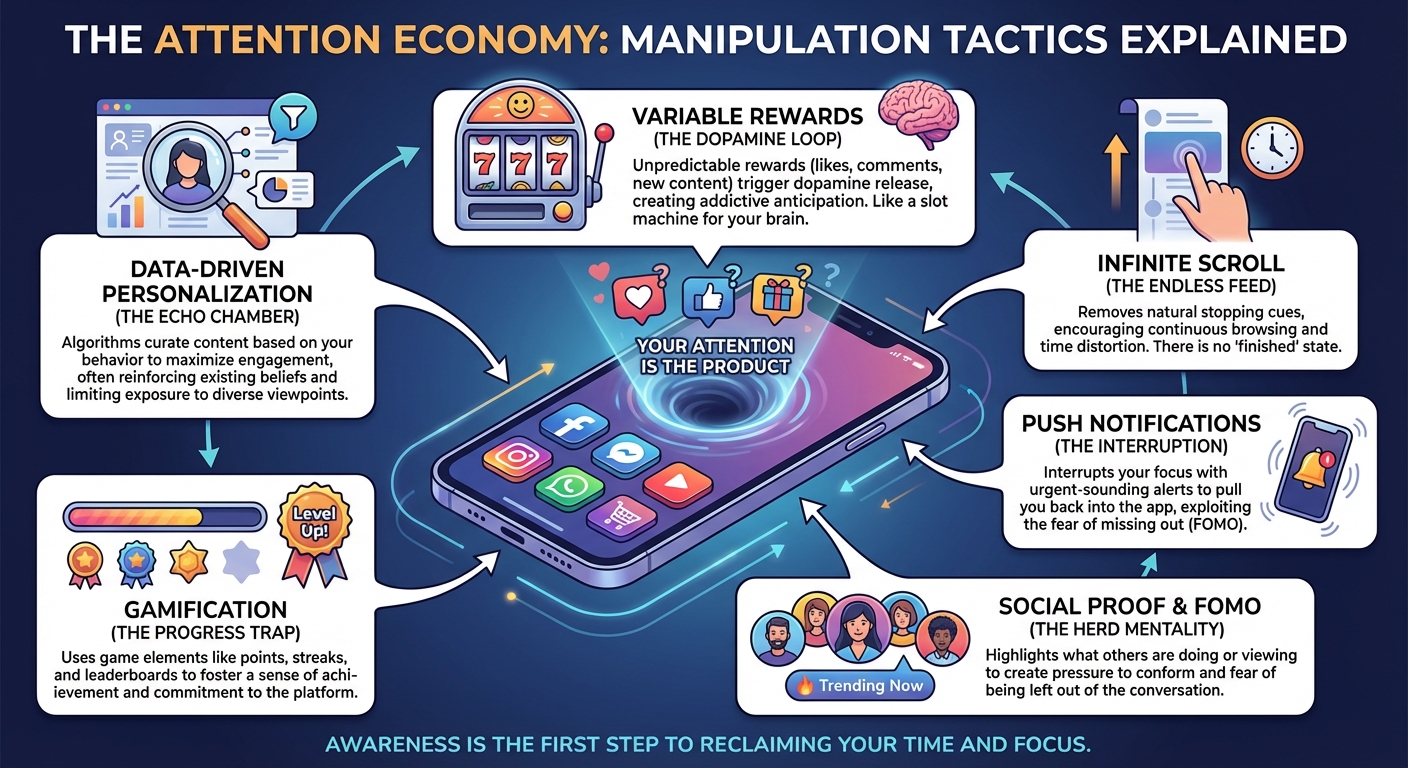
This ecosystem is known as the attention economy. In this marketplace, your focus is the product being sold to advertisers. To maximize inventory, technology companies have spent billions developing software that exploits psychological vulnerabilities, creating feedback loops that bypass rational decision-making. Tristan Harris, a former Google design ethicist who became a prominent critic of these practices, has described the situation bluntly: “Your phone in the morning is the new slot machine.”
The techniques are sophisticated and well-documented. Variable reward schedules, the same mechanism that makes gambling addictive, power features like pull-to-refresh and infinite scroll. You never know what you’ll see when you open the app, which keeps you checking repeatedly. Social validation through likes, comments, and followers taps into fundamental human needs for belonging and status. FOMO (fear of missing out) is engineered to make you feel you must check constantly or miss something important. Friction reduction, from one-click purchases to auto-playing videos, makes continued consumption effortless while any pause requires conscious effort.
Understanding that you’re up against systems designed by thousands of engineers using billions in research and development changes how you approach the problem. Relying on willpower alone is a strategy destined for failure against technology specifically optimized to overcome willpower. You need systematic defenses, structural changes to your environment and habits that don’t require constant vigilance to maintain.
The Real Costs of Constant Connectivity
The impacts of fragmented attention extend across cognitive, emotional, relational, and productive domains, creating compound effects that are easy to overlook when each individual check seems so brief and harmless.
Cognitively, constant connectivity degrades your capacity for deep work. Cal Newport’s research at Georgetown found that most knowledge workers spend less than 10% of their time in sustained, focused concentration. The remainder is consumed by context switching, checking email and messages, and shallow tasks that feel productive but don’t advance meaningful work. Each interruption, whether from a notification or a self-initiated check, fragments concentration and forces a restart of the cognitive ramp-up required for complex thinking. Over time, this pattern may actually reduce the brain’s capacity for sustained attention, essentially training yourself to be distractible.
The mental health impacts are particularly concerning for younger generations but affect everyone. A 2019 study published in JAMA Pediatrics found that adolescents who spent more than three hours daily on social media had double the risk of anxiety and depression symptoms compared to those with minimal use. Constant exposure to curated highlight reels triggers social comparison and feelings of inadequacy. The fear of missing out creates chronic low-grade anxiety. And the displacement of other activities, from exercise to in-person socializing to adequate sleep, removes protective factors that buffer against mental health challenges.
Relationships suffer in ways both obvious and subtle. Phubbing, the practice of checking your phone while in face-to-face conversation, has been studied extensively with consistent findings: it reduces relationship satisfaction for both parties, signals to the other person that they’re less important than whoever might be texting, and prevents the deep engagement that builds genuine connection. Perhaps more insidiously, the constant availability of digital stimulation means we’re less tolerant of the ordinary silences and slow moments that are actually where deeper relationships develop. When every pause can be filled with a scroll, we lose the patience for the unstructured time where real intimacy emerges.
Productivity impacts are measurable and significant. Research on context switching shows that multitasking between digital tools reduces cognitive performance by roughly 40% compared to sustained focus. The shallow work of processing email, responding to messages, and managing notifications creates a sense of busyness without meaningful progress on substantial goals. Decision fatigue from the constant micro-choices required by notifications and options depletes the mental resources needed for important decisions.
The Digital Minimalism Framework
Digital minimalism isn’t about smashing your smartphone or moving to a cabin in the woods. It’s a philosophy of technology use grounded in a simple premise: technology should serve your values, not subvert them. It requires shifting from a default assumption that more connection is always better to a more intentional evaluation of what actually improves your life.
The core insight is that connection has diminishing returns. At a certain point, the noise of low-quality digital interaction drowns out the signal of high-quality experience. The tenth hour of weekly social media scrolling provides less value than the first hour, and may actually provide negative value by displacing activities that would be more satisfying. Digital minimalism asks you to identify where those inflection points are and organize your technology use accordingly.
Three principles guide the practice. First, clutter is costly: each app, account, and digital commitment creates ongoing costs in attention, time, mental energy, and data exposure, even when you’re not actively using them. The notification you didn’t check still created anxiety. The account you never post to still creates cognitive overhead when you remember it exists. The default should be removal, not addition, with a high bar for what earns a place in your digital life.
Second, for tools you keep, optimization matters. How you use technology affects its impact as much as which technologies you use. Using Instagram to follow five close friends and check once daily is fundamentally different from using it to scroll a discover feed for hours. Defining specific, intentional use patterns for each tool, when you’ll use it, how you’ll use it, and how you’ll prevent drift into less intentional use, maximizes benefit while minimizing cost.
Third, intentionality itself is satisfying in a way that passive consumption isn’t. The feeling of deciding to use a tool for a specific purpose, using it, and then setting it aside is qualitatively different from the vague dissatisfaction of realizing you’ve been scrolling for 40 minutes without any clear purpose. Active, bounded use creates satisfaction; passive, endless consumption creates the opposite.

The 30-Day Digital Declutter
Trying to reduce screen time incrementally often fails because the addictive loops are too strong for gradual willpower-based reduction. You cannot simply decide to “use less” when the apps are engineered to maximize your usage. Cal Newport advocates for a more dramatic reset: a 30-day period of stepping away from optional technologies entirely, creating enough distance for your brain’s reward circuits to recalibrate and for you to discover what you actually miss.
The process begins with defining your rules. List all optional technology, anything not strictly required for work or essential communication. For each item, decide whether to eliminate it entirely for 30 days, keep it with strict usage rules, or keep it unrestricted (a category that should only include genuinely essential tools). Most people eliminate social media apps, news apps and websites, YouTube and entertainment streaming, games, and general web browsing on phones. You’re creating a temporary state of technological austerity, not because this is the permanent goal, but because you need distance to see clearly.
During the 30 days, pay attention to what you actually miss versus what’s merely habitual. Notice how you fill reclaimed time, whether anxiety or boredom peaks and then subsides, what changes in relationships and productivity and mood. This is data gathering, discovering your actual relationship with technology rather than your assumed one. Many people are surprised to find they don’t miss platforms they thought were essential, while genuinely valuing a few tools they’d underestimated.
After 30 days, you reintroduce selectively. Only bring back technology that clearly supports specific values you hold, can be used in an optimized way, and passes an honest cost-benefit analysis. For each tool you reintroduce, define explicitly how you’ll use it: when (specific times, not “whenever”), how (specific purposes, not “browsing”), and how much (clear limits). Most people reintroduce far less than they eliminated, finding that the elimination period revealed how much was habit rather than genuine value.
Practical Strategies for Long-Term Success
Once you’ve completed a reset and defined your relationship with technology, structural changes help maintain intentionality without requiring constant vigilance. The goal is to make good choices easy and bad choices hard, essentially reversing what Silicon Valley has done by making continued consumption effortless.
Phone-free mornings represent one of the highest-impact changes you can make. Not checking your phone for the first 60-90 minutes after waking means you start the day proactively, focused on your priorities rather than reactively responding to whatever arrived overnight. The practice reduces morning anxiety and protects the focus often available in early hours. Implementation is simple: charge your phone outside your bedroom and get a dedicated alarm clock. For more on creating protective morning routines, see our digital detox reset plan.
App deletion remains the most effective intervention for problematic platforms. Removing social media apps doesn’t mean giving up social media entirely; you can still access platforms via mobile browser if genuinely needed. But the friction of typing a URL and logging in, compared to the ease of tapping an icon, transforms the experience from compulsive to intentional. If you hesitate to delete an app entirely, move it off your home screen to a folder on the second or third page. The extra navigation required reduces mindless opening.
Notification management is essential. Turn off almost all push notifications, keeping only calls from contacts, perhaps messages from a small group of important people, and calendar reminders for actual commitments. Everything else becomes pull rather than push: you check when you choose rather than being interrupted when someone else posts or sends. Disable badge icons (the red circles showing unread counts) as well; they train compulsive checking behavior by creating a perpetual sense of something waiting.
Designating screen-free zones creates physical boundaries that support digital boundaries. The bedroom, the dining table, and transition spaces in your home can be declared phone-free, forcing you to practice presence in those contexts. Regular tech sabbaths, whether one evening weekly, one full day monthly, or vacation periods, provide recurring periods of complete disconnection that prevent drift back toward constant use.
Filling the Void
Digital detox fails when you don’t fill the reclaimed time with something compelling. The brain abhors a vacuum, and if you simply remove screens without adding alternative activities, you’ll face anxiety and boredom that eventually drive you back to the easy stimulation. Digital minimalism isn’t just about subtraction; it’s about creating space for activities that are genuinely more satisfying than scrolling.
High-quality leisure, activities that demand effort and skill but offer deep satisfaction in return, fills this space effectively. Physical activity, whether exercise, sports, or walking in nature, provides what humans did before screens and what our bodies evolved expecting. The practice of grounding or earthing, simply walking barefoot on natural surfaces, offers a particularly potent antidote to screen time by reconnecting you with the physical world. Face-to-face connection, actual conversation rather than text exchanges, game nights and coffee dates and shared activities, builds relationships in ways digital interaction cannot replicate. Hobbies that involve creation rather than consumption, from musical instruments to art to cooking to building things, engage parts of yourself that passive scrolling leaves dormant.
Solitude, increasingly rare in modern life, may be the most important thing you reclaim. Time alone with your thoughts, without input from podcasts or social media or news, provides essential processing time for mental health. Walking without headphones, journaling, or simply sitting and thinking may feel uncomfortable at first if you’re adapted to constant stimulation. But this discomfort is withdrawal, not a permanent state. The capacity for comfortable solitude returns with practice, and with it comes improved self-awareness, creative insight, and emotional regulation.
Initial boredom is normal and will pass. Your brain has adapted to constant stimulation and will protest its removal. Re-adaptation takes several weeks, during which boredom will surge and the phone will feel almost magnetically attractive. Sitting with this discomfort rather than relieving it is the practice. On the other side of this withdrawal period, you’ll discover a capacity for presence and contentment that constant connectivity was preventing.

The Bottom Line
Digital minimalism is a framework for intentional technology use in an environment designed to capture your attention by any means necessary. It acknowledges that willpower alone fails against systems specifically engineered to overcome willpower, and advocates for systematic defenses: structural changes, clear rules, and environment redesign that make good choices easy and bad choices hard.
The costs of constant connectivity are real and documented: fragmented attention, increased anxiety and depression, disrupted sleep, weakened relationships, and reduced capacity for deep work. These aren’t theoretical concerns but measurable impacts that affect quality of life and long-term wellbeing. The benefits of reclaiming attention are equally real: improved focus and productivity, reduced anxiety, better sleep, enhanced relationships, and greater life satisfaction. Combining digital minimalism with sleep optimization strategies creates a powerful foundation for cognitive performance and mental health.
Your Digital Minimalism Starting Point:
- Complete a 30-day digital declutter, eliminating all optional technology to reset your relationship
- Reintroduce selectively, only tools that clearly support your values with defined usage rules
- Implement structural changes: phone-free mornings, app deletion or relocation, notification elimination
- Create screen-free zones and regular tech sabbaths
- Fill reclaimed time with high-quality leisure that’s genuinely more satisfying than scrolling
The goal isn’t minimizing screen time for its own sake but creating a life where technology serves your purposes rather than commanding your attention. When you pick up your device, the question should be: are you the user or the used? Digital minimalism is about ensuring the answer is always the former.
Sources: Cal Newport (Deep Work, Digital Minimalism), Tristan Harris and Center for Humane Technology, Gloria Mark attention research (UC Irvine), JAMA Pediatrics social media and mental health studies, relationship satisfaction and phone use research, context-switching and productivity studies.