
Five regions in the world have unusually high concentrations of people living to 100+ years: Okinawa in Japan, Sardinia’s mountainous interior in Italy, the Greek island of Ikaria, the Nicoya Peninsula in Costa Rica, and Loma Linda in California among Seventh-day Adventists. These Blue Zones, identified and popularized by National Geographic researcher Dan Buettner, share lifestyle patterns despite being geographically and culturally distinct.
The commonalities are striking. These populations aren’t living longer because of superior genetics alone, though genes play a role. They’re living longer because of how they eat, move, connect, and structure daily life. The patterns are remarkably consistent: plant-dominant diets, natural daily movement, strong social connections, clear sense of purpose, and built-in stress reduction. When researchers look for the secrets to longevity, these five regions keep pointing toward the same answers.
The scientific validation has been substantial. Population studies, autopsy analyses, dietary surveys, and longevity record verification have documented what makes these regions exceptional. The findings have influenced public health recommendations worldwide and spawned a small industry of Blue Zone-inspired lifestyle interventions. Understanding what these populations actually do, and what they don’t do, provides a blueprint for longevity that doesn’t require expensive supplements, biohacking gadgets, or exotic interventions.
The Power of Natural Movement
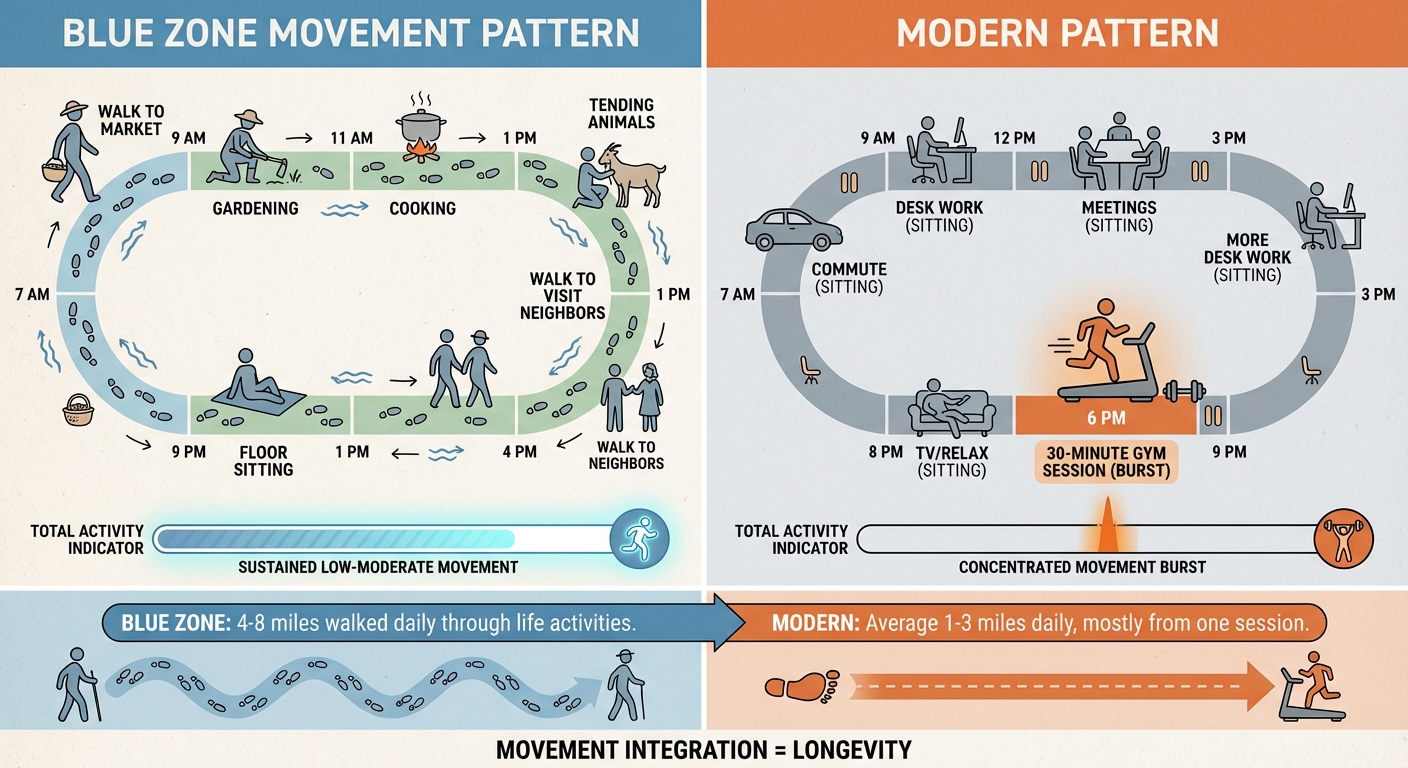
Every Blue Zone population incorporates movement into daily life, but not through structured exercise programs or gym memberships. They walk to get places rather than driving. They tend gardens and farms with hand tools. They perform manual labor and household tasks that modern conveniences have eliminated for most of us. Sardinian shepherds walk miles daily tending flocks in mountainous terrain. Okinawan elders traditionally sit on floor mats, rising and descending dozens of times daily, a form of squatting exercise built into normal life.
The key insight is that low-intensity movement throughout the day provides more health benefit than brief intense workouts followed by hours of sitting. Research from Dr. James Levine at Mayo Clinic on NEAT (Non-Exercise Activity Thermogenesis) supports this: the calories burned through daily movement, not dedicated exercise, explain much of the variance in metabolic health between populations. A Sardinian shepherd walking 8 miles daily while tending sheep burns more calories and maintains better cardiovascular health than an office worker who runs for 30 minutes then sits for 10 hours.
Modern application requires engineering movement into daily routines because our built environment discourages it. Walking or biking for transportation when possible, choosing stairs over elevators, gardening instead of purely ornamental landscapes, doing household tasks manually rather than outsourcing to machines, and standing during meetings or phone calls all accumulate movement throughout the day. The goal isn’t hitting a specific step count but creating a lifestyle where movement is constant and natural rather than confined to gym sessions.
The contrast with modern fitness culture is illuminating. Blue Zone residents don’t train for marathons or compete in CrossFit. They don’t track their steps or measure their VO2 max. Yet they maintain physical function into their 90s and beyond, capable of activities of daily living that many 60-year-olds in developed nations cannot manage. The lesson is clear: sustainable, daily, moderate movement beats sporadic intense exercise for longevity outcomes.
The Plant-Dominant Diet Pattern
Blue Zone populations derive 90-95% of calories from plant foods. While not strictly vegan, meat appears rarely, perhaps five times monthly in small portions, often reserved for celebrations or special occasions. The foundation is beans and legumes, which appear daily in virtually every Blue Zone diet: black beans in Nicoya, soybeans and tofu in Okinawa, chickpeas and lentils in Mediterranean zones. Whole grains, abundant and varied vegetables, daily small portions of nuts, and olive oil in Mediterranean zones complete the dietary foundation.
The consistency across geographically diverse populations is remarkable. Okinawans eating tofu and sweet potatoes, Sardinians eating minestrone and fava beans, Ikarians eating wild greens and potatoes, Nicoyans eating corn tortillas and black beans, all share the fundamental plant-dominant pattern despite completely different culinary traditions. Dr. Valter Longo at USC, whose research on fasting and longevity has identified optimal dietary patterns for lifespan, notes that the Blue Zone dietary pattern closely matches what his research suggests for longevity: primarily plant-based with modest protein intake concentrated in plant sources.
The protein question often concerns people considering plant-dominant diets. Blue Zone populations consume adequate protein, typically 10-15% of calories, but mostly from plant sources. When animal protein appears, it’s small portions of fish in coastal zones or occasional pork or goat in pastoral areas. The low meat consumption contradicts carnivore diet advocates who argue humans evolved as meat-eaters, but the longevity data from Blue Zones suggests that modest meat consumption isn’t harmful while excessive meat consumption may be.
Research validating these patterns is extensive. The Adventist Health Study, following over 96,000 participants from the Loma Linda Blue Zone, found that vegetarians and pescatarians lived significantly longer than regular meat-eaters, with reduced rates of diabetes, hypertension, and certain cancers. Mediterranean diet studies consistently show reduced cardiovascular mortality and improved cognitive function. The PREDIMED trial, a randomized controlled trial of Mediterranean diet supplemented with olive oil or nuts, showed 30% reduction in cardiovascular events compared to control diet.
The Okinawan Principle: Hara Hachi Bu
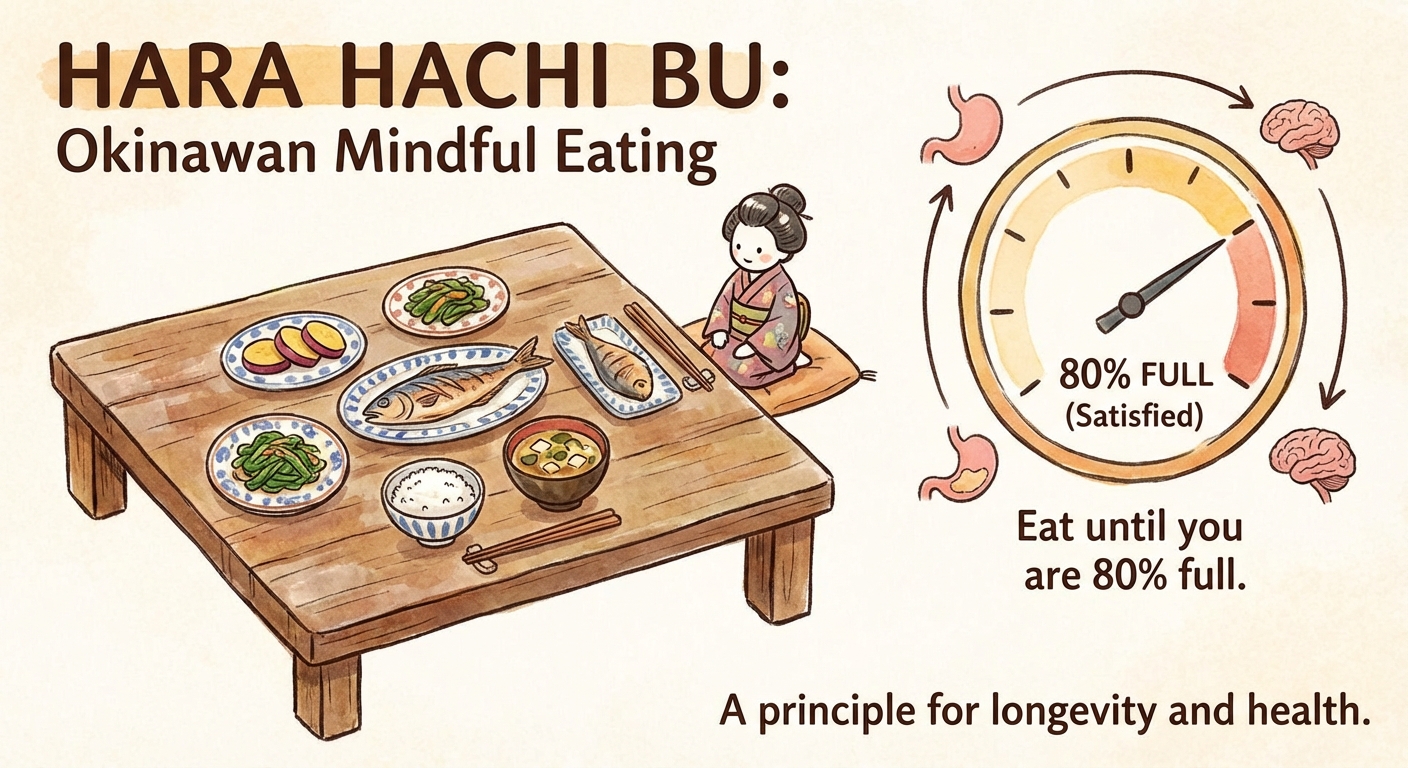
Okinawan culture includes a practice called “hara hachi bu,” an admonition spoken before meals as a reminder to stop eating when 80% full, not stuffed. This simple practice results in Okinawans traditionally consuming 10-15% fewer calories than needed for weight maintenance, a form of caloric restriction achieved through cultural practice rather than deliberate dieting.
Caloric restriction, consuming fewer calories while maintaining adequate nutrition, extends lifespan in every species studied from yeast to primates. The mechanisms involve reduced oxidative damage, improved insulin sensitivity, activation of cellular repair pathways, and reduced growth signaling through the mTOR pathway. Whether humans respond similarly remains under study, but the Blue Zone data suggest that moderate caloric restriction, achieved through cultural eating practices rather than restrictive dieting, contributes to exceptional longevity.
The practice works partly because it takes approximately 20 minutes for satiety signals from the gut to reach the brain. Eating slowly allows these signals time to register before overeating occurs. Blue Zone populations typically eat slowly, often in social contexts where conversation extends meal duration. They don’t eat standing up, in front of screens, or while rushing to the next activity. The ritual of eating provides natural pacing that prevents overconsumption.
Modern application doesn’t require adopting Japanese phrases. Eating slowly, paying attention to satiety cues, stopping before feeling stuffed, and avoiding distracted eating all accomplish similar results. Smaller plates, which studies show reduce portion sizes without conscious restriction, provide another tool. The goal is developing awareness of fullness and respecting it, rather than eating until physically uncomfortable, which has become normalized in food-abundant cultures.
Purpose and Social Connection: The Non-Physical Foundations
Blue Zone populations share psychological and social characteristics as consistent as their dietary patterns. Strong sense of purpose, called “ikigai” in Okinawa and “plan de vida” in Nicoya, characterizes these populations. Having a reason to wake up in the morning, a sense that your life matters and contributes to something beyond yourself, correlates powerfully with longevity. Research published in Psychological Science found that people with strong sense of purpose live 7-8 years longer on average than those without, an effect size comparable to major health behaviors like not smoking.
The social structures in Blue Zones embed people in communities from birth to death. Extended families live together or nearby, providing both care and caregiving roles throughout life. Religious or faith-based communities, present in all Blue Zones, provide regular social contact, shared rituals, and moral frameworks that structure behavior. In Okinawa, “moai” groups, social groups formed in childhood that meet regularly throughout life, provide lifelong friendship and support networks. Sardinian villages maintain evening social rituals where residents gather to share wine and conversation.
The health effects of social connection are profound and measurable. Meta-analyses show that strong social relationships reduce mortality by 50%, an effect as powerful as quitting smoking and stronger than exercise or weight loss alone. Loneliness and social isolation increase mortality risk by 26-32%, equivalent to smoking 15 cigarettes daily. Blue Zone populations aren’t immune to loss and grief, but they’re never socially isolated. The community structure ensures someone is always checking in, always present, always connected.
Modern Western societies have systematically dismantled these social structures. Nuclear families replaced extended families. Geographic mobility scattered communities. Digital communication substituted for face-to-face contact. The loneliness epidemic that public health officials now recognize as a crisis reflects this erosion of social infrastructure. Rebuilding social connection requires deliberate effort: joining communities, prioritizing in-person contact, maintaining friendships, and accepting interdependence as strength rather than weakness.
Stress Reduction Built Into Daily Life
All Blue Zones have built-in stress relief rituals, daily practices that shift the nervous system from sympathetic (stressed) to parasympathetic (relaxed) dominance. Ikarians take daily naps. Adventists observe Sabbath, a 24-hour weekly break from work stress. Sardinians gather for evening social rituals. Nicoyans have sunset contemplation traditions. Okinawan practice of ancestral reverence includes regular meditation and prayer.
The key distinction from modern stress management is that these are daily routines, not occasional interventions. A yearly vacation or weekend retreat can’t compensate for chronic daily stress. The Blue Zone approach embeds stress reduction into every single day, making parasympathetic activation as routine as meals. The breathing techniques used for stress management provide one modern tool for achieving similar daily downshifts.
Chronic stress has documented effects on nearly every health outcome: elevated cortisol damages hippocampal neurons, impairs immune function, promotes inflammation, disrupts sleep, and accelerates aging. The HPA axis, governing stress response, becomes dysregulated under chronic activation, losing the ability to return to baseline. Blue Zone populations, living without many modern stressors but also with cultural practices that manage the stressors they do face, maintain healthier stress physiology throughout life.
Building daily stress reduction into modern life requires treating it as non-negotiable rather than optional. Morning meditation, evening walks, daily prayer, regular nature exposure, breathing exercises during transitions between activities, whatever practices resonate, but practiced daily rather than sporadically. The consistency matters more than the specific practice.
What Blue Zones Don’t Have
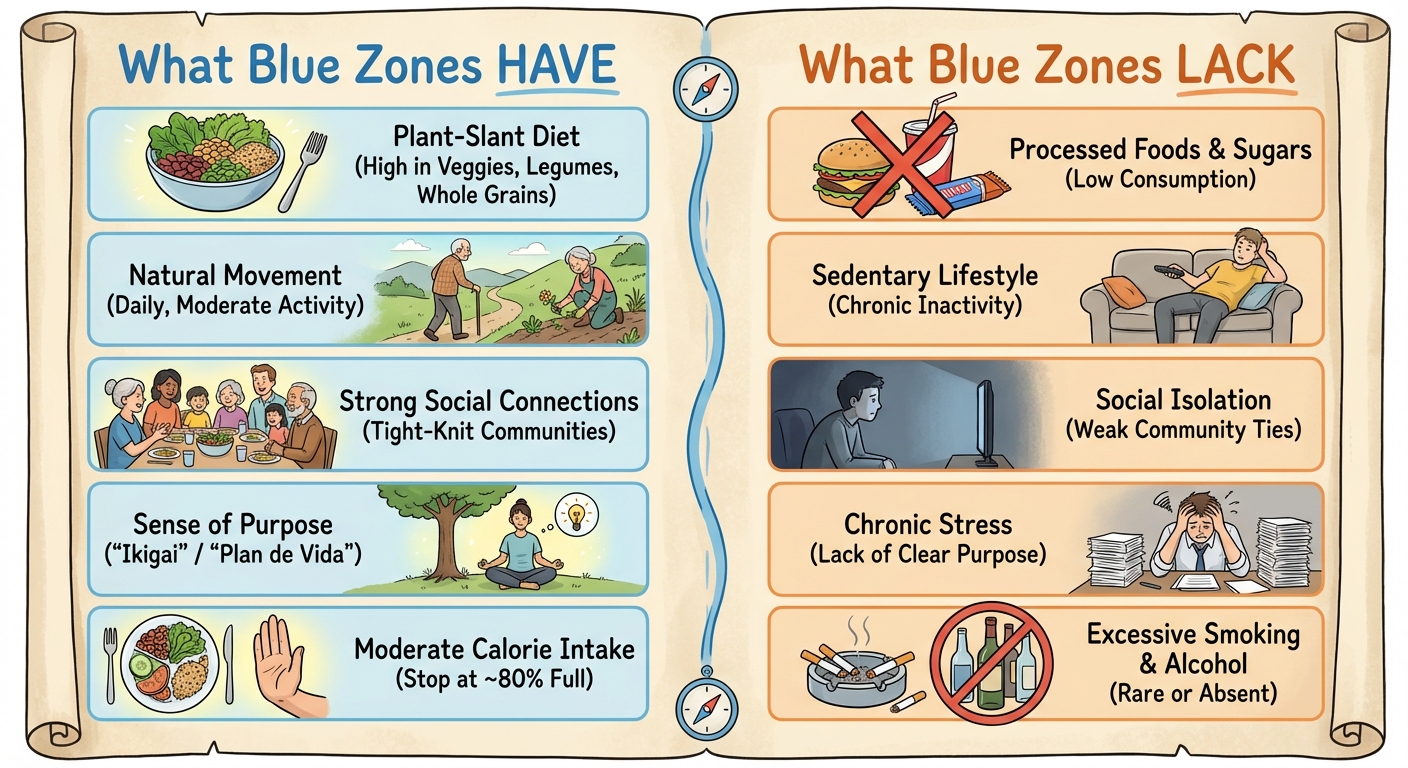
Equally instructive is what’s absent from Blue Zone lifestyles. These populations achieved exceptional longevity without gyms, fitness trackers, calorie counting apps, supplements, or biohacking interventions. They didn’t measure their ketones or track their macros. They didn’t take cold plunges or use infrared saunas. They didn’t consume protein shakes or creatine supplements. The centenarians in these regions never heard of intermittent fasting, though their eating patterns often resembled it.
This absence challenges the modern wellness industry’s assumption that optimal health requires expensive products and exotic interventions. The Blue Zone message is simpler: foundation matters more than optimization. Get the basics right, plants, movement, connection, purpose, stress management, and advanced interventions become largely unnecessary. The person obsessing over supplement stacks while lonely, sedentary, and eating processed food has the priorities inverted.
That said, modern interventions aren’t necessarily harmful. The Blue Zone pattern represents a different path to longevity, not the only path. Someone combining Blue Zone fundamentals with evidence-based optimization might achieve even better outcomes. The point is that fundamentals come first. No supplement compensates for social isolation. No biohack outperforms daily movement. No exotic intervention replaces plant-dominant diet eaten in moderation.
Valid Criticisms and Limitations
The Blue Zone concept has attracted legitimate scientific criticism that deserves acknowledgment. Some researchers question the accuracy of age records in regions where birth certificates were unreliable a century ago, potentially inflating centenarian counts. Survivorship bias may overstate lifestyle effects: we study those who lived long, not those who followed similar practices but died young. Genetics certainly contributes to longevity, and founder effects in isolated populations like Sardinia’s highlands may create genetic advantages independent of lifestyle.
Dr. Saul Newman at Australian National University has raised methodological concerns about Blue Zone data validation, arguing that some centenarian clusters may partly reflect poor record-keeping rather than true exceptional longevity. These concerns have validity, and researchers have responded with more rigorous age verification protocols. The Okinawan data, in particular, has withstood scrutiny better than some other regions due to Japan’s detailed record-keeping.
However, the lifestyle patterns identified across Blue Zones align with mechanistic understanding of what promotes longevity and with controlled research outside Blue Zone populations. The benefits of plant-dominant diets, regular movement, social connection, and stress management are validated through randomized controlled trials and prospective cohort studies independent of Blue Zone research. Whether every Blue Zone centenarian is precisely as old as claimed matters less than whether the lifestyle patterns they share genuinely promote longevity, and the evidence suggests they do.
The Bottom Line
Blue Zones teach us that longevity comes from lifestyle patterns that modern life has disrupted: natural daily movement rather than sedentary existence punctuated by exercise, plant-dominant diet eaten in moderation rather than calorie-dense processed food consumed to excess, embedded social connection rather than isolated individualism, clear sense of purpose rather than aimless consumption, and daily stress reduction rather than chronic cortisol activation.
These aren’t exotic interventions. They’re a return to patterns that characterized human life for millennia before industrialization, urbanization, and digital technology restructured daily existence. You can’t move to a Blue Zone, but you can adopt their principles where you live. More plants, more walking, more connection, more purpose, less stress, moderation in all things.
The simplicity is both the appeal and the challenge. There’s no pill to take, no gadget to buy, no quick fix to implement. The Blue Zone path to longevity requires restructuring daily life, which is harder than buying a supplement. But the evidence suggests it works, across five distinct populations, across different cultures and continents, across decades of research. Simple. Not easy. But proven.
Your Blue Zone Implementation Protocol:
- Add beans or legumes to at least one meal daily
- Walk for transportation whenever possible, not just recreation
- Eat plants at every meal, meat sparingly (5x monthly or less)
- Practice hara hachi bu: stop eating at 80% full
- Build daily stress reduction into your routine (10+ minutes)
- Join or create regular social gatherings with consistent community
- Identify and pursue your purpose, your reason for waking up
Sources: Blue Zones research by Dan Buettner and National Geographic, Adventist Health Study (Loma Linda University), PREDIMED trial, Okinawa Centenarian Study, Mayo Clinic NEAT research (Dr. James Levine), USC Longevity Institute research (Dr. Valter Longo), social connection and mortality meta-analyses, purpose and longevity research from Psychological Science.