In high-stakes environments, the ability to control your arousal level determines performance. When the sympathetic nervous system activates in response to threat or stress, a predictable cascade unfolds: heart rate spikes, breathing becomes rapid and shallow, fine motor skills degrade as blood shunts to large muscle groups, peripheral vision narrows into tunnel vision, and the prefrontal cortex, responsible for complex decision-making, partially shuts down in favor of faster, more primitive survival responses. This is the fight-or-flight response doing exactly what evolution designed it to do: prepare you to survive immediate physical danger.
The problem is that modern stressors rarely require physical combat or flight. A difficult conversation, a high-pressure presentation, an unexpected email, or looming deadline activates the same stress response that would prepare you to fight a predator or flee a fire. Your body doesn’t distinguish between physical danger and psychological threat; it responds the same way to both. And when you’re about to speak to a boardroom or make a critical decision, degraded fine motor skills, tunnel vision, and impaired executive function are exactly what you don’t need.
Elite performers across domains have converged on the same solution: controlled breathing as a manual override for the autonomic nervous system. Navy SEALs call it tactical breathing or combat breathing. First responders learn it in crisis intervention training. Athletes use it before competition. The technique goes by many names, but the most common protocol is Box Breathing: a simple, portable, equipment-free method for shifting your nervous system from sympathetic activation (stressed) to parasympathetic dominance (calm and focused) in under two minutes. Understanding why it works and how to apply it effectively provides one of the most valuable stress management tools available.
The Physiology of Breath Control
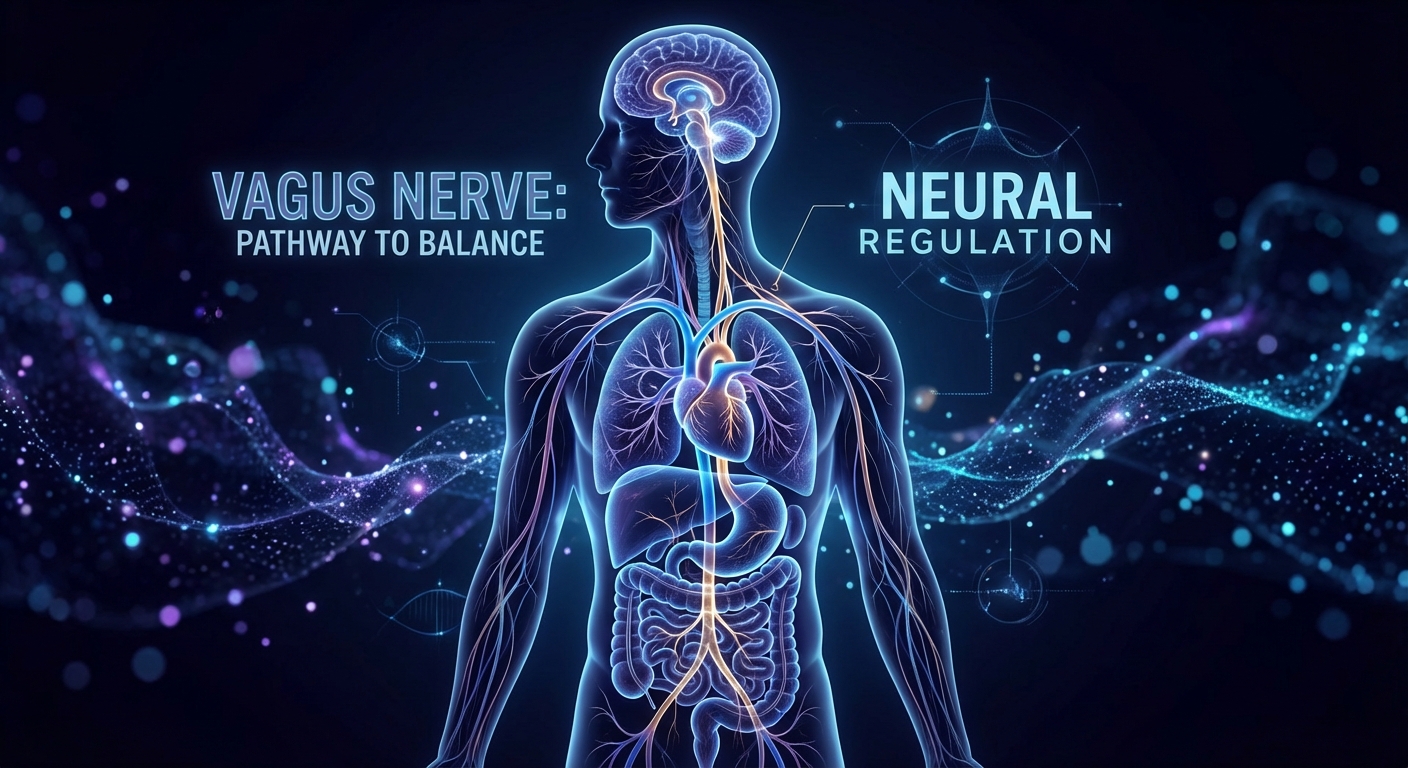
Your breath occupies a unique position in human physiology: it’s the only autonomic function you can voluntarily control. You can’t directly tell your heart to slow down, your blood pressure to drop, or your stress hormones to decrease. But you can tell your lungs to breathe slower and deeper. And because breathing is bidirectionally linked to other autonomic functions through the vagus nerve, changing your breath pattern changes everything downstream.
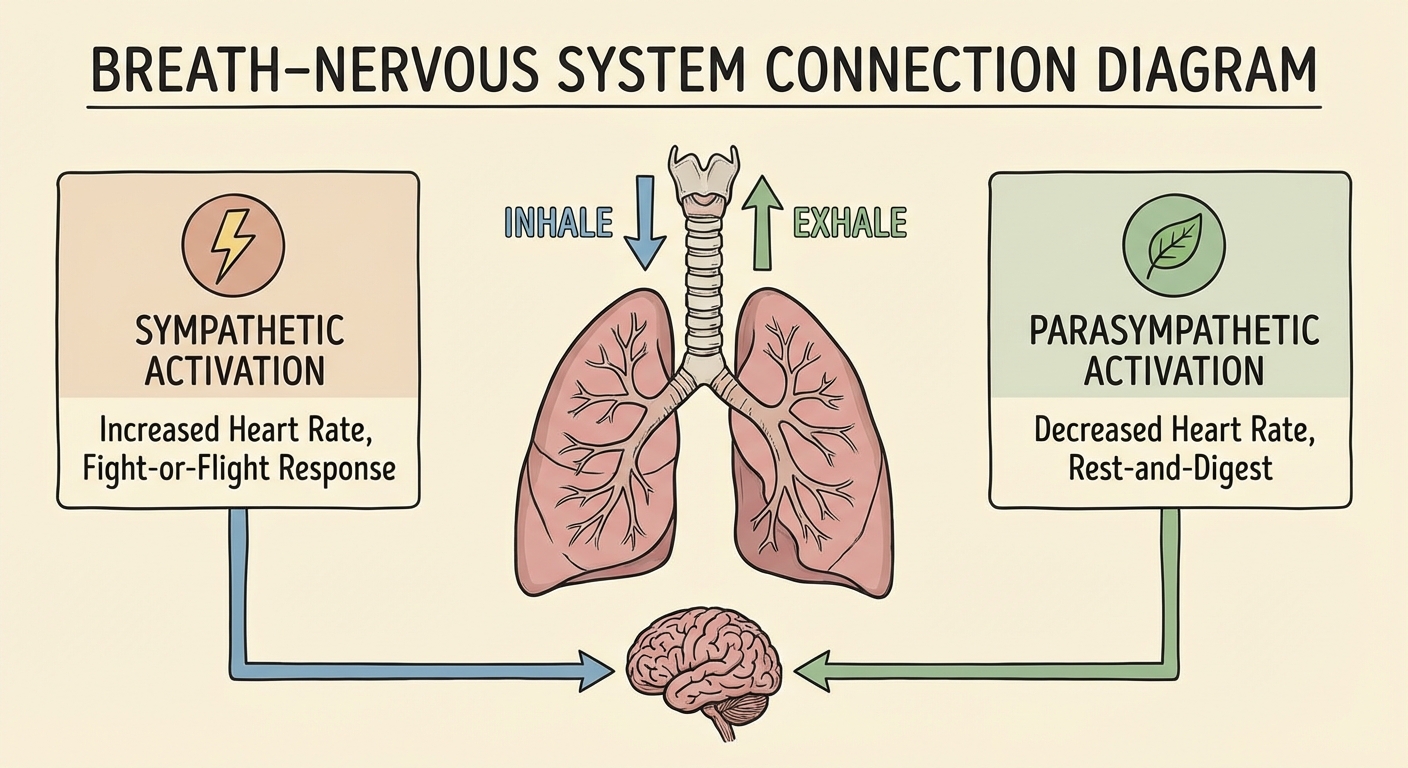
The mechanism involves what physiologists call Respiratory Sinus Arrhythmia (RSA), the natural variation in heart rate that occurs with breathing. When you inhale, your heart rate slightly increases as the sympathetic nervous system activates to pump oxygenated blood to tissues. When you exhale, your heart rate slightly decreases as the parasympathetic nervous system engages through vagal tone. This rhythmic variation is healthy and normal; its presence indicates a flexible, responsive autonomic nervous system.
Box breathing leverages RSA by extending and equalizing the breath phases. The extended exhale phases activate the parasympathetic response, slowing heart rate and signaling safety to the brain. The breath holds (both with lungs full and lungs empty) build carbon dioxide tolerance, which has its own anti-anxiety effects. The slow, controlled rhythm overrides the rapid, shallow breathing pattern characteristic of stress, sending a powerful signal to the nervous system that the threat has passed.
Dr. Andrew Huberman, a neuroscientist at Stanford who has extensively studied breathing and stress, describes the exhale as “the brake pedal” for the nervous system. “When you emphasize the exhale, you activate the parasympathetic pathway and slow heart rate,” he explains. “This is why sighing, which is a double exhale, is the body’s natural way of rapidly calming down. Box breathing systematizes this mechanism into a repeatable protocol.”
The 4-4-4-4 Protocol: Step by Step
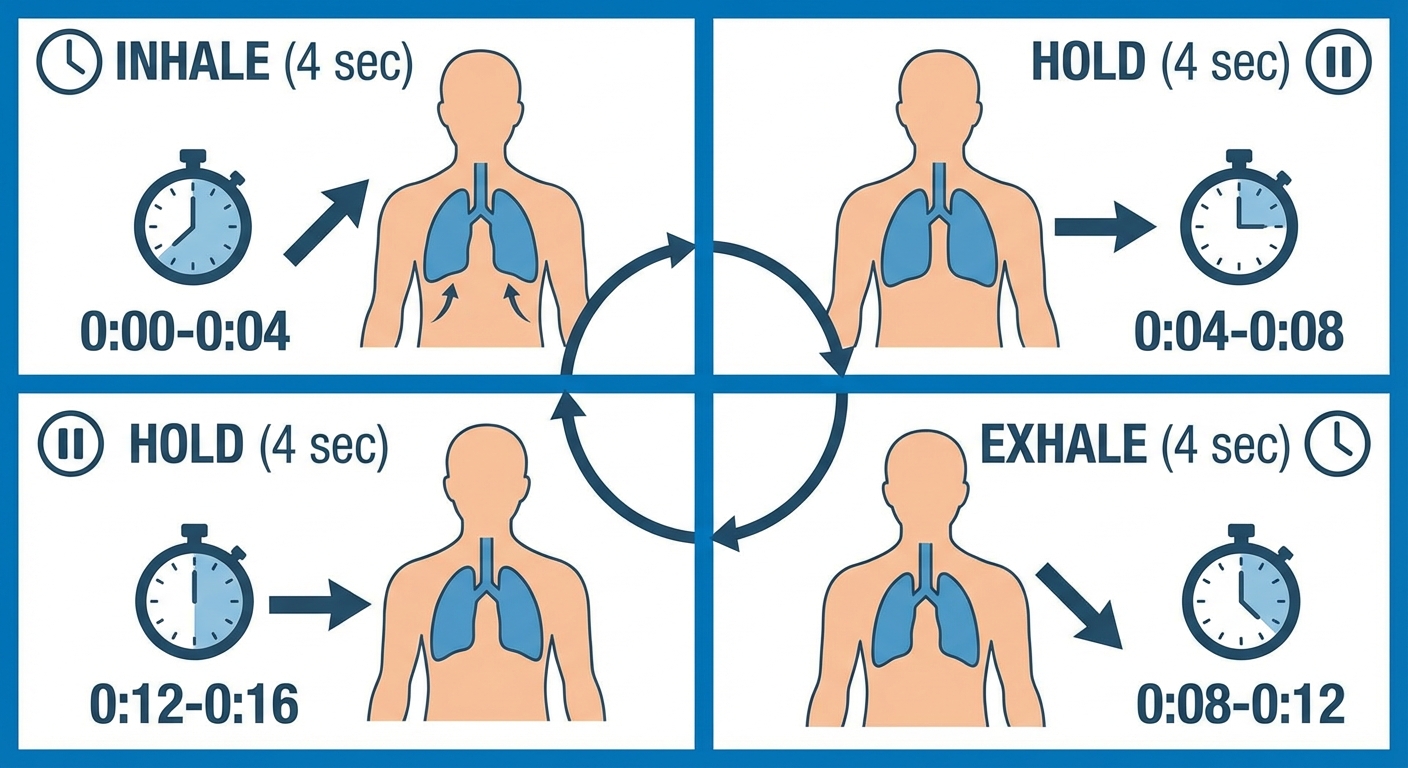
Box breathing gets its name from the visualization: imagine tracing a square, spending equal time on each of the four sides. The standard protocol uses four-second phases, creating a 16-second cycle that can be repeated as needed.
Phase 1: Inhale (4 seconds) Breathe in slowly through your nose. Focus on diaphragmatic breathing: expand your belly first, then your chest. The diaphragm should descend and push your abdomen outward. This engages the full lung capacity and maximizes oxygen intake while stimulating vagal tone. Avoid shallow chest breathing, which characterizes stress states and reinforces sympathetic activation.
Phase 2: Hold Full (4 seconds) With lungs comfortably full, suspend the breath. This is not a tight, clamped hold with a closed glottis; rather, it’s a gentle suspension where you simply don’t inhale or exhale. Relax your shoulders and face. The hold allows full oxygen exchange in the alveoli and begins building CO2 slightly, which primes the relaxation response.
Phase 3: Exhale (4 seconds) Release the air slowly and completely through your mouth (pursed lips) or nose. The exhale should be controlled, not a passive release. Empty your lungs fully by gently engaging your abdominal muscles at the end of the exhale. This complete exhale is where the parasympathetic activation is strongest.
Phase 4: Hold Empty (4 seconds) With lungs empty, pause before the next inhale. This is often the most challenging phase for beginners. The sensation of “air hunger” triggers a mild alarm response that your brain interprets as threat. Sitting with this sensation without reacting is powerful training for emotional regulation. You’re teaching your nervous system that mild discomfort is not danger.
Repeat the cycle for 4-6 rounds for acute stress management, or continue for 5-10 minutes for deeper parasympathetic shift and sustained calm.
When and How to Deploy Box Breathing
The versatility of box breathing makes it applicable across dozens of scenarios where stress management or focus enhancement is needed. Understanding when to deploy it maximizes its practical value.
Pre-event activation is one of the most powerful applications. Before a presentation, difficult conversation, athletic competition, or any high-stakes event, two to three minutes of box breathing can prevent the pre-event anxiety that often undermines performance. The technique works best when started 5-10 minutes before the event, allowing full parasympathetic shift before you need to perform. Many public speakers do box breathing in the bathroom or hallway immediately before taking the stage; the steadied voice and relaxed body language that result are immediately apparent.
Acute stress intervention addresses stress that’s already activated. When you feel your heart racing, your breath quickening, or anxiety rising, box breathing provides an immediate intervention. Even four rounds (about one minute) can significantly reduce physiological arousal. This is the “tactical” application from which the technique gets its military name: in crisis situations, first responders use it to remain functional when instinct would produce panic.
Mid-day reset offers an alternative to caffeine for afternoon energy. The “brain fog” and fatigue common at 2-3 PM often result from accumulated stress, shallow breathing, and mild hypoxia rather than genuine need for stimulation. Five minutes of box breathing clears this fog by increasing oxygen delivery and shifting nervous system state. Many people report that a breathing break provides more sustainable alertness than coffee, without the subsequent crash.
Sleep preparation leverages the parasympathetic shift to facilitate falling asleep. The empty-lung hold is particularly effective for racing thoughts at night; the mild CO2 buildup acts as a natural sedative. For those who wake at 3 AM with an activated mind, a few rounds of box breathing often allow return to sleep without the fully-awakening effect of getting up or checking phones. Combined with the strategies in our biohacking sleep guide, box breathing becomes a cornerstone of optimized rest.
Post-workout recovery accelerates the transition from sympathetic (exercise) state to parasympathetic (recovery) state. Beginning box breathing immediately after a workout enhances the body’s recovery processes by more rapidly restoring normal heart rate and breathing patterns. This application synergizes well with the vagal nerve activation techniques covered in our holiday stress management guide.
Progressive Overload: Training Your Breath
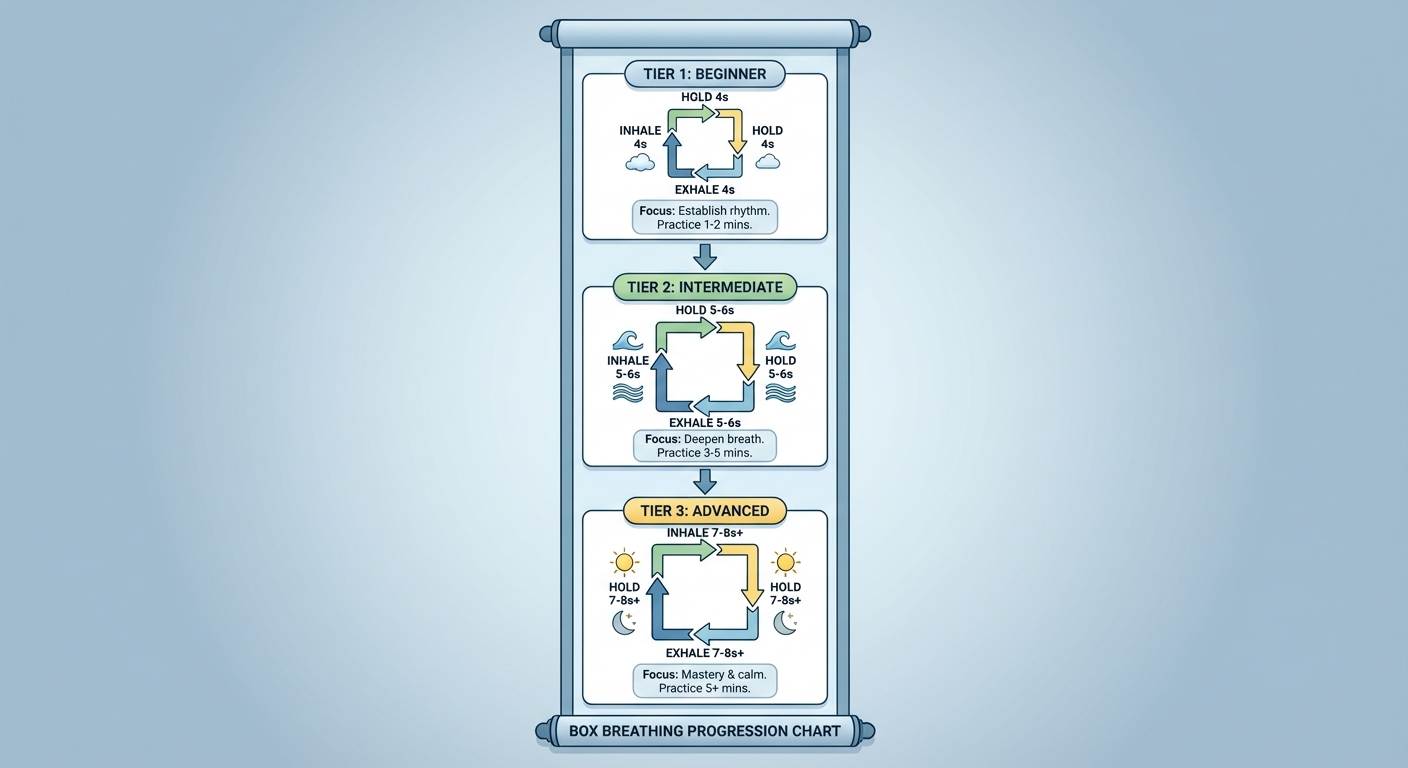
Just like strength training, you can progressively increase breathing capacity. The 4-4-4-4 protocol is a starting point, not a ceiling. As you become comfortable with four-second phases, extending the duration increases the training effect.
Progress to 5-5-5-5 once four-second phases feel easy. Then to 6-6-6-6. Advanced practitioners work with 8-8-8-8 or longer holds. Each extension increases CO2 tolerance, which correlates with improved emotional regulation under stress. The longer you can comfortably sit with air hunger, the more resilient your nervous system becomes to stress signals in general.
The empty-lung hold typically limits progression. Most people can extend inhale and exhale phases more easily than they can extend the bottom hold. Focus progressive training on this phase specifically: try 4-4-4-6, then 4-4-4-8, building tolerance for that specific sensation before extending other phases proportionally.
You can also vary the emphasis based on goals. For maximum calming effect, extend the exhale and post-exhale hold while keeping inhale and full hold standard: try 4-4-6-6 or 4-4-8-4. This extended exhale emphasis maximizes parasympathetic activation. For more energizing effect with maintained calm (useful before athletic performance), keep phases equal but increase overall pace slightly: 3-3-3-3 provides alertness with control.
CO2 tolerance training specifically involves breath holds beyond comfortable range. After exhale, hold as long as you can while remaining relaxed (not straining or gasping). Track your hold time over weeks; improvements in this metric correlate with reduced anxiety sensitivity and better stress tolerance. This training is done separately from standard box breathing practice, typically once daily.
The Science of CO2 Tolerance
The breath holds in box breathing do more than simply pace the breathing; they build what researchers call CO2 tolerance, and this adaptation has significant implications for anxiety and stress resilience.
When CO2 levels rise in your blood (as happens during breath holds), your brain’s chemoreceptors trigger the urge to breathe. This sensation of “air hunger” is not actually caused by lack of oxygen but by CO2 accumulation. The chemoreceptors are calibrated individually; some people panic at mild CO2 elevation while others can comfortably tolerate significant increases.
Research has shown that people with panic disorder and anxiety disorders tend to have low CO2 tolerance. They experience the normal sensations of elevated CO2 as threatening, which triggers anxiety that leads to hyperventilation, which lowers CO2, which then makes them even more sensitive to normal CO2 levels. It’s a vicious cycle that maintains anxiety.
Breath hold training gradually recalibrates these chemoreceptors. By repeatedly exposing yourself to elevated CO2 in controlled, safe conditions (like box breathing holds), you teach your brain that this sensation is not dangerous. Over weeks of practice, the threshold at which CO2 triggers panic rises, and the intensity of the panic response decreases. This is essentially exposure therapy for a fundamental physiological sensation.
Dr. Alicia Meuret, a researcher at Southern Methodist University who studies breathing and anxiety, has demonstrated that breathing retraining focused on CO2 tolerance produces clinically significant reductions in panic symptoms. Her protocols, while more intensive than basic box breathing, use the same underlying mechanism: teaching the brain that CO2 sensations are safe.
Beyond the Box: Integrating Breath Work
Box breathing is one protocol within a larger toolkit of breath-based interventions. Understanding how it relates to other techniques helps you select the right tool for specific situations.
Physiological sigh (double inhale followed by extended exhale) is faster acting than box breathing for acute stress. A single physiological sigh takes about 8-10 seconds and produces immediate calm. Use it when you need instant intervention; use box breathing when you have two or more minutes for deeper state change. For an even more powerful reset, consider pairing breathing work with cold shower exposure, which activates complementary stress resilience pathways.
4-7-8 breathing (inhale 4 seconds, hold 7 seconds, exhale 8 seconds) emphasizes exhale even more than standard box breathing and is particularly effective for sleep induction. The extended exhale creates strong parasympathetic activation, and the 7-second hold builds significant CO2.
Wim Hof method involves hyperventilation followed by breath holds, producing different effects than box breathing. It’s energizing rather than calming, and is used for cold exposure preparation and arousal rather than stress management. It’s not a substitute for box breathing but serves different purposes.
Alternate nostril breathing (pranayama) has different neurological effects, potentially balancing hemispheric activity, and is used more in contemplative practice than acute stress management. It requires more attention and technique than box breathing, making it less suitable for high-stress deployment.
Box breathing’s advantage is its simplicity and portability. You can do it with eyes open or closed, standing or sitting, in public or private. It requires no special position, no equipment, and no technique beyond basic counting. This accessibility makes it the go-to choice for tactical application across varied circumstances.
The Bottom Line
You carry the most powerful stress management tool in the world right under your nose. Your breath is the only voluntary input into your autonomic nervous system, the manual override switch that can shift you from sympathetic activation to parasympathetic calm in minutes. Box breathing systematizes this control into a simple, repeatable protocol that works in any environment, requires no equipment, and can be deployed invisibly even in social situations.
The 4-4-4-4 pattern, inhale four seconds, hold four seconds, exhale four seconds, hold four seconds, provides a foundational practice that most people can master quickly. From this base, you can progress to longer holds as your CO2 tolerance improves, or customize the pattern to emphasize calming or alerting effects based on situational needs.
Elite performers across domains have converged on breath control as essential. Navy SEALs use it to remain functional in combat. Surgeons use it to maintain fine motor control during procedures. Athletes use it to manage pre-competition anxiety. Public speakers use it to prevent voice trembling and racing thoughts. The same tool is available to you, requiring only the discipline to practice it consistently enough that it becomes automatic under pressure.
Next time you feel the pressure mounting, whether it’s a looming deadline, a difficult conversation, or the kind of diffuse anxiety that modern life generates continuously, remember the box: Inhale 4, Hold 4, Exhale 4, Hold 4. In that 16-second cycle lies access to a calmer, more focused, more capable version of yourself.
Your Box Breathing Protocol:
- Find a comfortable position (sitting or standing, eyes open or closed)
- Inhale slowly through your nose for 4 seconds, expanding belly first
- Hold with lungs full for 4 seconds, relaxing shoulders and face
- Exhale slowly for 4 seconds, emptying lungs completely
- Hold with lungs empty for 4 seconds, accepting air hunger
- Repeat for 4-6 rounds for acute stress, or 5-10 minutes for deeper shift
- Progress to 5-5-5-5 and beyond as the basic protocol becomes easy
Sources: Stanford neuroscience research (Dr. Andrew Huberman), Southern Methodist University breathing and anxiety studies (Dr. Alicia Meuret), Navy SEAL tactical breathing protocols, respiratory sinus arrhythmia and vagal tone research, Journal of Emergency Medical Services stress inoculation training, CO2 tolerance and panic disorder research.