Marcus, a 41-year-old software engineer, had tried meditation apps, morning routines, and productivity systems, all abandoned within weeks. When a friend mentioned cold showers, Marcus dismissed it as masochism dressed up in wellness language. But the friend persisted, citing research on mood and immunity, and Marcus decided to test it for exactly 30 days. The first week was brutal, gasping under water that felt like ice, counting seconds until he could escape. By week three, something shifted. The cold still bit, but the panic had transformed into something else, a kind of alertness that carried into his morning. By day thirty, Marcus was waking up earlier specifically to have time for his cold shower. The practice had become the anchor of his day.
Marcus’s experience reflects what thousands of cold shower practitioners report: an initial period of pure discomfort that gradually transforms into something actively sought. The practice isn’t masochism; it’s hormesis, the biological principle that appropriate stressors create beneficial adaptations. The same principle underlies exercise (muscle damage that rebuilds stronger), vaccination (controlled pathogen exposure that builds immunity), and intermittent fasting (metabolic stress that enhances insulin sensitivity). Cold water is another form of controlled stress that produces measurable, beneficial physiological responses.
The research supporting cold exposure has grown substantially over the past decade. Dutch researchers demonstrated that participants taking cold showers had 29% fewer sick days. Neuroscience studies document dramatic increases in norepinephrine and dopamine, neurotransmitters associated with mood, focus, and motivation. Metabolic research shows activation of brown adipose tissue, specialized fat that burns calories to generate heat. The effects are real, reproducible, and available to anyone with access to a shower and the willingness to tolerate temporary discomfort.
The Physiological Cascade
When cold water hits your skin, your body initiates a cascade of responses that evolved to survive sudden cold exposure. Understanding these responses helps explain both why cold showers feel the way they do and why the practice produces lasting benefits beyond the shower itself.
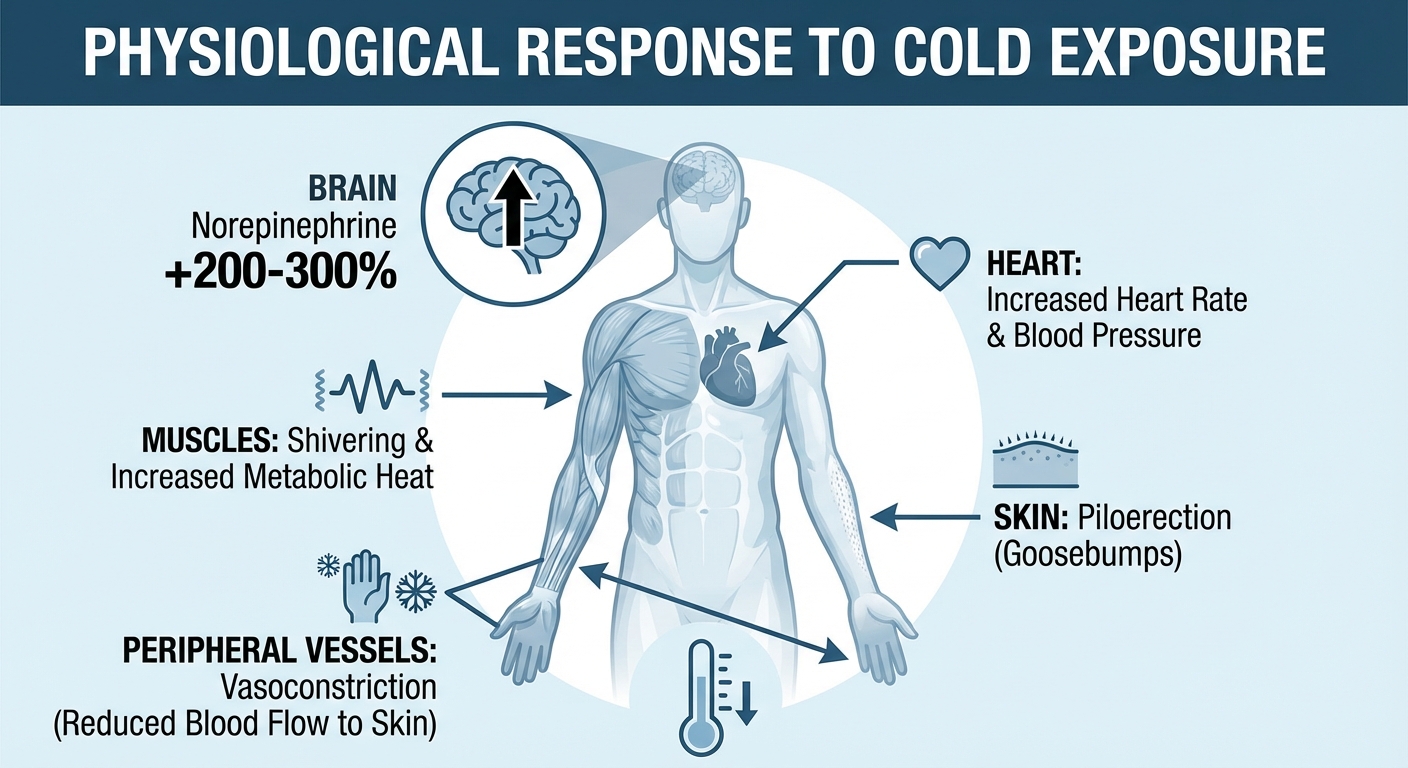
Blood vessels constrict immediately (vasoconstriction), redirecting blood flow from your skin and extremities toward vital organs to preserve core body temperature. Your heart rate increases as the cardiovascular system responds to the perceived threat. Breathing accelerates, and in untrained individuals, the gasp reflex produces sharp, uncontrolled inhalation. These are sympathetic nervous system responses, fight-or-flight activation in response to the cold stressor.
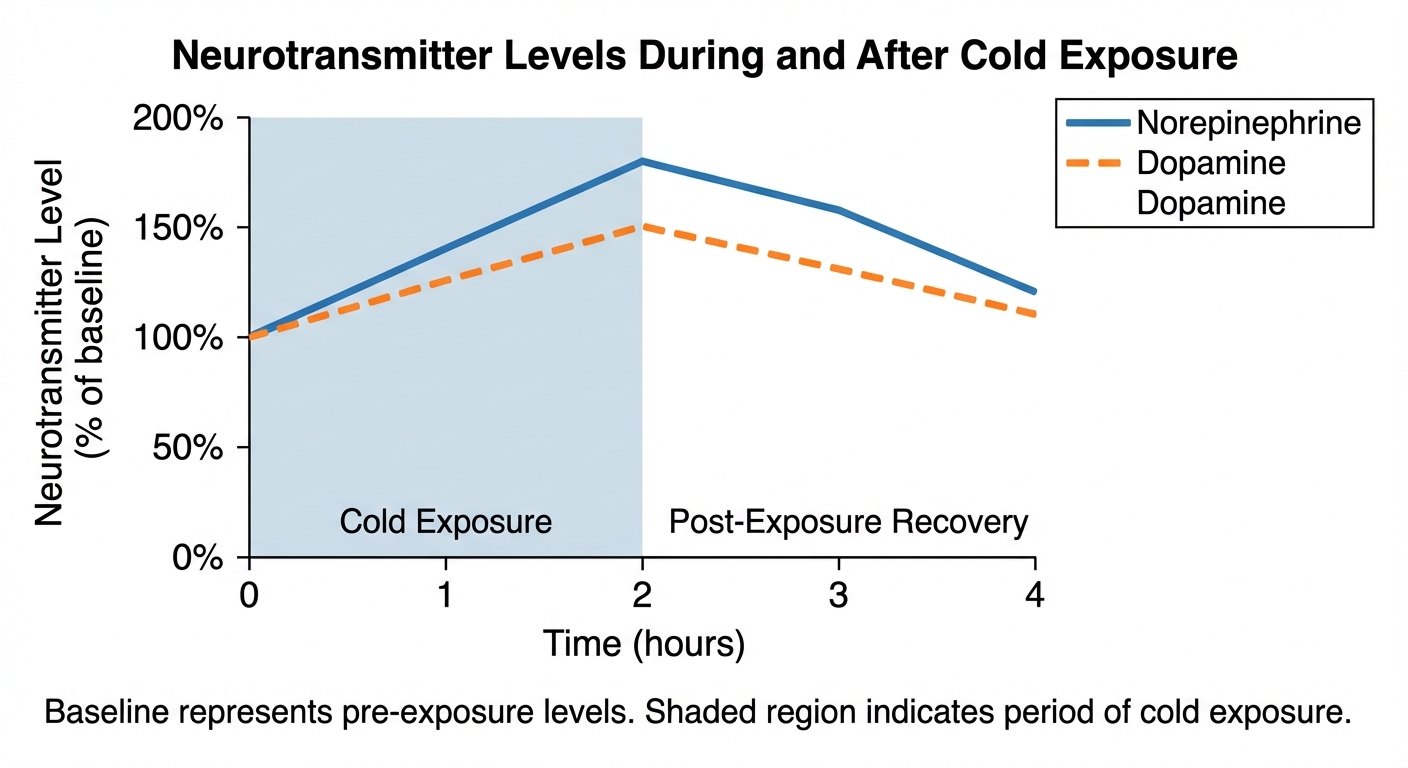
The neurotransmitter response is particularly dramatic. Norepinephrine, which increases arousal, alertness, vigilance, and focus, can rise 200-300% during cold exposure. This isn’t a subtle change; it’s a massive upregulation of the brain’s alertness system. Dopamine, the neurotransmitter associated with reward, motivation, and pleasure, elevates by up to 250% and remains elevated for several hours after cold exposure ends. This dopamine elevation helps explain the mood boost and sense of accomplishment that regular practitioners report. You’re not just imagining that you feel good after a cold shower; your neurochemistry has genuinely shifted.
Brown adipose tissue (BAT), unlike the white fat that stores energy, generates heat by burning calories. Adults retain small deposits of BAT primarily in the neck, upper back, and chest. Cold exposure activates this tissue, potentially burning 200-300 additional calories per session and improving insulin sensitivity. While cold showers won’t replace diet and exercise for weight management, they do engage metabolic pathways that thermoneutral environments leave dormant.
These acute responses, repeated consistently over weeks and months, create lasting adaptations. The cardiovascular system becomes more efficient at vasoconstriction and recovery. The nervous system learns to tolerate cold without panic. The neurochemical response pattern, high alertness and elevated mood, becomes a reliable morning boost rather than a stressful experience.
The Immunity Evidence
For generations, the belief that cold exposure strengthens immunity was dismissed as folk wisdom, confused with the myth that cold air causes colds (it doesn’t; viruses do). Modern immunology, however, has identified specific pathways through which controlled cold stress primes the body’s defense systems. The evidence isn’t theoretical; it’s been tested in rigorous clinical trials.
The landmark study came from the Netherlands in 2016, involving over 3,000 participants randomized into groups. The control group showered normally. Treatment groups added cold water finishes of 30, 60, or 90 seconds to their normal warm showers. Over three months, all cold exposure groups showed 29% reduction in sick leave days compared to controls. Remarkably, the duration didn’t matter: 30 seconds produced the same benefit as 90 seconds. The effect persisted regardless of participants’ baseline fitness level, suggesting that the immune benefit is available to everyone, not just the already healthy.
The mechanism involves white blood cell production, particularly natural killer (NK) cells that fight both infections and cancer. Cold exposure triggers a stress response that mobilizes immune resources, increasing circulating white blood cells and their activity levels. This transient activation functions like an immune system drill, keeping defenses alert and responsive without the chronic inflammation that prolonged stress produces.
The benefit appears to be reduced severity and duration of illness rather than complete prevention. Cold shower practitioners still catch colds and flu, but their immune systems respond more effectively, limiting symptoms and speeding recovery. This aligns with the hormetic model: the body, repeatedly exposed to mild stress, maintains heightened readiness that transfers to actual threats.
The Mental Health Dimension
The mood benefits of cold showers may ultimately be more transformative for most practitioners than the physical effects. The neurochemical changes, particularly the dopamine elevation, produce genuine improvements in mood, motivation, and mental resilience that extend throughout the day.
Depression involves disrupted neurotransmitter systems, often characterized by depleted norepinephrine and dopamine. Cold exposure produces precisely the neurochemical shift that depression depletes, a massive surge in both neurotransmitters through natural physiological response rather than pharmaceutical intervention. Research from the University of Portsmouth suggests that cold water immersion may help treat depression symptoms through this mechanism, with some case studies showing dramatic improvement in patients who had failed other treatments.
The psychological benefits extend beyond neurochemistry. Cold showers are voluntary discomfort, a daily practice of doing something difficult when you’d rather not. This builds what psychologists call self-efficacy, the belief in your ability to handle challenges. Completing a difficult task first thing in the morning creates momentum that carries into other challenges throughout the day. Many practitioners describe the cold shower as a reference experience: when they face something difficult later, they can compare it to the cold water and find it less daunting.
Anxiety often involves an overactive sympathetic nervous system, chronically elevated fight-or-flight activation. Cold exposure activates sympathetic response intensely but briefly, followed by parasympathetic recovery. This pattern trains the nervous system to return to baseline more quickly after stress activation. Regular cold exposure appears to improve stress resilience, making practitioners less reactive to daily stressors and faster to recover from unavoidable stress events.
The mental reset that cold water provides is immediate and undeniable. You cannot worry about your email inbox or ruminate about a difficult conversation when cold water is hitting your body. The cold demands complete presence, forcibly pulling attention into the immediate moment. For people plagued by anxious rumination, this brief but total interruption of thought loops can be profoundly relieving.
The Evidence-Based Protocol
The research on cold exposure provides clear guidance on what duration, temperature, and frequency produce benefits. The good news for those dreading ice-bath-level suffering: the evidence suggests that brief, moderate cold exposure delivers most of the benefit, and longer or more extreme exposure doesn’t necessarily improve outcomes.
Temperature should be “uncomfortably cold but tolerable,” typically 50-60°F (10-15°C). Most people can’t precisely control shower temperature, so the practical guideline is: cold enough that you want it to end but not so cold that you can’t control your breathing. For beginners, starting warmer (65-70°F) and gradually decreasing over weeks is both safer and more likely to build a sustainable habit. Extreme cold isn’t necessary; the Dutch study showing immune benefits used regular cold tap water, not ice.
Duration research from the Dutch study found that 30 seconds produced the same sick-day reduction as 90 seconds. The physiological responses, neurotransmitter elevation and brown fat activation, occur within the first minute or two. Optimal duration for most purposes is 1-3 minutes, long enough to fully activate the cold response but not so long that it becomes a test of endurance. More isn’t necessarily better; excessive cold exposure can suppress rather than stimulate immune function.
Frequency should be daily or at minimum 3-4 times weekly for consistent benefits. Consistency matters more than duration; 30 seconds daily produces better results than 10 minutes once weekly. The adaptations, both physiological and psychological, develop through repeated exposure, not single extreme sessions.
Timing preferences vary among practitioners. Morning cold showers are most popular because the alerting effect provides an energy boost to start the day, and the dopamine elevation improves mood through morning hours when many people feel least motivated. Post-workout cold showers can aid recovery by reducing inflammation, though some research suggests this may slightly blunt muscle growth signals, so serious strength athletes may want to separate cold exposure from training by several hours. Evening cold showers are generally avoided because the stimulating effect can interfere with sleep onset.
Building Tolerance Progressively
The gasp reflex and panic response that cold water triggers in beginners isn’t sustainable. If every cold shower feels like drowning, you’ll quit. The progressive approach that builds tolerance while maintaining consistency is essential for turning cold exposure into a lasting practice.
Weeks one and two should focus on establishing the habit rather than maximizing cold intensity. Finish your normal warm shower with 30 seconds of lukewarm or cool water, around 65-70°F. This is uncomfortable but not shocking. Focus on controlled breathing, continuing to breathe slowly and deliberately rather than gasping or holding breath. The goal is learning that you can stay calm under mild cold stress.
Weeks three and four extend duration to 60 seconds and lower temperature slightly. You’re building the neural patterns for tolerance, training your nervous system to recognize that cold water isn’t a survival threat. Practice relaxing your muscles rather than tensing against the cold; counterintuitively, relaxation reduces discomfort. Continue focusing on breath control.
Months two and three bring the full protocol: 1-2 minutes at genuinely cold temperature (50-60°F), with controlled breathing throughout. By this point, what once felt shocking should feel invigorating. The panic response has diminished through repeated exposure, replaced by controlled alertness. Many practitioners report that the cold becomes something they look forward to rather than dread.
Long-term practice stabilizes at 2-3 minutes at coldest tolerable temperature, typically with morning timing. The experience has transformed from suffering to be endured into a valued daily ritual. The neurochemical reward, the mood boost, the sense of accomplishment, all compound to make the practice self-reinforcing. This is when cold showers become part of identity rather than a willpower challenge.
The Breath Control Technique
Breathing is the primary tool for managing cold exposure. The body’s natural response to sudden cold, the gasp reflex followed by rapid shallow breathing, makes the experience worse and can create actual danger in cold water immersion. Controlled breathing is both the key to tolerating cold and the practice that builds nervous system resilience.
Before the cold water hits, take 2-3 deep breaths and exhale fully. This prepares the body and signals to the nervous system that you’re entering cold deliberately, not by accident. Mental preparation matters; you’re less likely to panic when you’ve prepared for what’s coming.
When cold water starts, focus on slow, deliberate breathing. The impulse will be to gasp and hyperventilate; resist it. A simple pattern works well: inhale for 4 counts, exhale for 4 counts. The counting gives your mind something to focus on besides the cold. The rhythm activates parasympathetic response even while sympathetic activation is occurring, training the nervous system to balance activation with control.
Muscle relaxation complements breath control. The natural response is to tense against cold, but this increases perceived suffering. Consciously relax your shoulders, jaw, and core while maintaining controlled breathing. The combination of slow breath and relaxed muscles transforms the experience from fighting against cold to observing cold, a meditative shift that makes the practice sustainable.
The breath control skills developed in cold showers transfer to other stressful situations. Practitioners report using the same breathing patterns during difficult conversations, before presentations, or when anxiety spikes. The cold shower becomes a daily training ground for nervous system regulation that applies throughout life.
Safety Considerations
Cold exposure is generally safe for healthy adults but stresses the cardiovascular system in ways that require caution for certain populations. The rapid vasoconstriction and heart rate increase that healthy people tolerate easily can be dangerous for those with underlying conditions.
Cardiovascular conditions require medical clearance before beginning cold exposure practice. The cardiac stress of cold water can trigger arrhythmias, dangerous blood pressure spikes, or cardiac events in people with heart disease, uncontrolled hypertension, or history of heart attack or stroke. This isn’t theoretical; cold water immersion has caused sudden cardiac deaths in people with undiagnosed heart conditions.
Raynaud’s disease causes extreme vasoconstriction in response to cold, potentially causing tissue damage in fingers and toes. People with Raynaud’s should avoid cold exposure or proceed only with medical guidance. Pregnancy warrants medical consultation before starting cold exposure. Cold urticaria, an allergic reaction to cold causing hives and potentially anaphylaxis, is a clear contraindication.
General safety practices include starting gradually (never beginning with ice-cold water), never forcing through severe discomfort (discomfort is expected; pain or extreme distress is not), and exiting immediately if experiencing chest pain, extreme dizziness, or numbness that doesn’t resolve. Warming up after cold exposure is appropriate and doesn’t eliminate benefits; the physiological response has already occurred.
For most healthy people, cold showers at normal tap water temperatures are entirely safe. The precautions apply primarily to those with cardiovascular risk factors and to more extreme cold exposure like ice baths and cold water swimming.
The Bottom Line
Cold showers produce measurable benefits including enhanced immune function (29% fewer sick days in controlled trials), elevated mood through dopamine and norepinephrine increase, brown fat activation for metabolic health, and stress resilience training through repeated voluntary discomfort. The effects are real, reproducible, and available to anyone willing to tolerate brief daily discomfort.
The evidence-based protocol is surprisingly accessible: 30 seconds to 3 minutes of cold water, 50-60°F, daily or 3-4 times weekly. Progressive building from warmer and shorter to colder and longer over 4-8 weeks creates sustainable practice. Controlled breathing is essential for tolerating cold and maximizing nervous system training benefits.
The practice that seems unbearable initially becomes tolerable, then invigorating, then sought after. The morning cold shower transforms from willpower challenge into valued ritual, a daily demonstration of self-discipline that sets the tone for everything that follows. The physical benefits are real and meaningful, but for many practitioners, the psychological transformation proves more valuable. For those ready to advance their cold exposure practice, explore our guide on ice bath protocols and how to pair cold with heat therapy.
Your Cold Shower Protocol:
- Start week 1-2: 30 seconds lukewarm/cool water at shower’s end; focus on breath control
- Progress weeks 3-4: 60 seconds, slightly colder; practice muscle relaxation
- Build to months 2-3: 1-2 minutes at cold temperature with controlled breathing throughout
- Maintain long-term: 2-3 minutes at coldest tolerable; morning timing for energy boost
- Use 4-count breathing pattern throughout: inhale 4, exhale 4
- If cardiovascular conditions exist, consult physician before starting
Sources: Dutch cold shower study (3,018 participants), norepinephrine and dopamine cold exposure research, brown adipose tissue activation studies, University of Portsmouth cold water and depression research, immune function and cold stress literature.