
You’ve probably walked past those glowing wooden boxes at your gym or seen influencers posting from their home sauna setups. Infrared saunas have exploded in popularity, with the global market projected to exceed $500 million by 2027. But behind the wellness marketing, is there actual science supporting infrared heat therapy?
The short answer: yes, but with important caveats. Research published in journals like Mayo Clinic Proceedings and the Journal of the American College of Cardiology demonstrates real cardiovascular benefits from heat therapy. The Finnish sauna tradition, studied extensively over 50+ years in cohort studies involving over 2,000 participants, shows that regular sauna users have significantly lower rates of cardiovascular disease and all-cause mortality. Infrared technology offers a different approach to achieving similar physiological effects, one that may be more accessible for people who can’t tolerate the extreme temperatures of traditional Finnish saunas.
Understanding what infrared sauna actually does to your body, separating marketing claims from evidence, and knowing how to use it effectively can help you decide whether this tool deserves a place in your health routine.
How Infrared Differs from Traditional Sauna
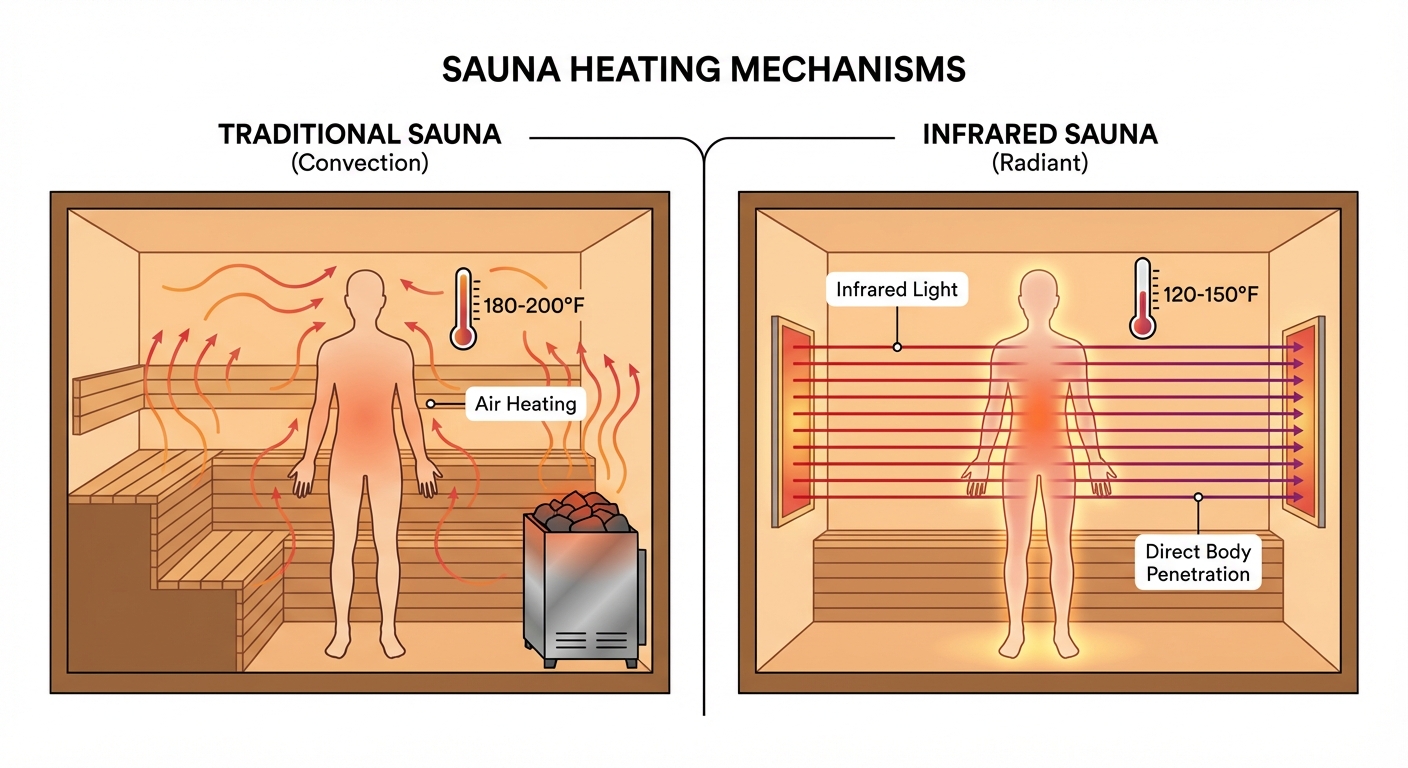
Traditional Finnish saunas heat the air around you to intense temperatures, typically 180-200°F (82-93°C). You sit in this superheated environment, and the ambient heat gradually warms your skin surface, triggering a cascade of thermoregulatory responses. Your blood vessels dilate, heart rate increases, and sweat pours out as your body fights to maintain its core temperature. This method is effective but demanding, many people find 10-15 minutes at these temperatures to be their maximum tolerance.
Infrared saunas operate through a fundamentally different mechanism. Instead of heating the air, infrared light panels emit electromagnetic radiation in the far-infrared spectrum (typically 5.6-15 micrometers wavelength) that directly heats your body tissues. This allows the sauna to operate at much lower air temperatures, usually 120-150°F (49-65°C), while still raising your core body temperature effectively. The experience feels gentler and more tolerable, enabling sessions of 30-45 minutes rather than the brief bursts required in traditional saunas.
Research comparing the two modalities suggests they trigger similar physiological cascades despite the different heating mechanisms. Both produce profuse sweating, elevated heart rate (typically 100-150 beats per minute), fluid and electrolyte loss, and the production of heat shock proteins. For those interested in contrast therapy, alternating infrared sauna with cold exposure techniques can amplify these adaptive responses. A 2018 study in Complementary Therapies in Medicine found that core body temperature elevation was comparable between infrared and traditional sauna when session duration was adjusted appropriately. The choice between them often comes down to personal preference and heat tolerance rather than one being objectively superior.
The three types of infrared wavelengths have different penetration depths and purported benefits. Far infrared (5.6-1000 micrometers) is the most common and penetrates deepest into tissues, potentially reaching 1-2 inches into muscle. Near infrared (0.7-1.4 micrometers) primarily affects skin surface and has been studied for wound healing and skin health. Full spectrum units combine multiple wavelengths, though the evidence for additive benefits remains limited.
Cardiovascular Benefits: What the Research Shows
The cardiovascular effects of sauna use represent the most well-documented benefits, with both traditional and infrared modalities demonstrating meaningful improvements in heart health markers. Heat exposure functions much like moderate cardiovascular exercise for your circulatory system, even while you remain stationary.
When you enter a sauna, blood vessels dilate through a process called vasodilation, improving endothelial function and circulation. Your heart rate rises to 100-150 beats per minute to pump blood toward the skin for cooling, providing a cardiovascular training stimulus. Blood pressure drops acutely during the session as vessels relax, and this effect can persist for hours afterward. Regular sessions appear to improve the flexibility and responsiveness of blood vessels, a key marker of cardiovascular health.
The landmark Finnish sauna studies, published in JAMA Internal Medicine (2015), followed 2,315 middle-aged men for an average of 20 years. Those who used the sauna 4-7 times weekly had a 50% lower risk of fatal cardiovascular events compared to once-weekly users. While this observational data can’t prove causation, the dose-response relationship (more sauna sessions = lower risk) and the magnitude of the effect suggest a genuine protective mechanism.

Infrared-specific research, while less extensive, shows similar cardiovascular benefits. A 2009 study in the Journal of the American College of Cardiology found that 2 weeks of daily infrared sauna sessions improved endothelial function in patients with coronary artery disease. Blood pressure reductions of 5-10 mmHg systolic have been documented in hypertensive individuals using infrared sauna regularly, an effect size comparable to some first-line blood pressure medications. A 2017 systematic review in Clinical Cardiology concluded that infrared sauna therapy is “a promising treatment option” for patients with cardiovascular disease risk factors.
The mechanisms underlying these benefits appear to involve heat shock protein production, improved nitric oxide bioavailability (which relaxes blood vessels), reduced oxidative stress, and potentially improved autonomic nervous system balance. These pathways overlap significantly with exercise adaptations, leading some researchers to describe sauna use as “passive cardiovascular conditioning.”
Recovery, Pain Relief, and Cellular Repair
Beyond heart health, infrared sauna shows particular promise for pain management and athletic recovery. The deep-penetrating heat increases blood flow to muscles and joints, delivering oxygen and nutrients while clearing metabolic waste products like lactate.
For chronic pain conditions, the evidence is encouraging. A 2005 study published in Internal Medicine followed 46 patients with chronic pain conditions including fibromyalgia and rheumatoid arthritis through a 4-week infrared sauna program. Pain scores decreased by 20-40%, and improvements in quality of life persisted for 6 months after treatment ended. The mechanism likely involves both reduced inflammation and the “pain gate” theory, where thermal sensations compete with pain signals for neural attention.
Athletic recovery represents another evidence-based application. Post-workout sauna sessions can reduce delayed onset muscle soreness (DOMS) and improve recovery markers. A 2015 study in the Journal of Athletic Training found that post-exercise sauna use decreased perceived muscle soreness and improved subsequent performance in endurance athletes. The proposed mechanisms include increased blood flow accelerating waste removal, heat shock protein production protecting against cellular damage, and muscle relaxation reducing residual tension.
At the cellular level, heat stress triggers a fascinating protective response. Heat shock proteins (HSPs), particularly HSP70 and HSP90, are produced in response to thermal stress. These proteins act as molecular chaperones, repairing misfolded proteins, protecting cells from oxidative damage, and maintaining cellular function under stress. HSP production declines with age, and some longevity researchers hypothesize that regular heat stress might help maintain youthful HSP levels, though this remains speculative in humans.
A timing note for strength athletes: Some research suggests that intense heat immediately after resistance training might blunt certain inflammatory signals necessary for muscle hypertrophy. If muscle building is your primary goal, consider separating sauna sessions from lifting by 3-4 hours, or using sauna on rest days rather than immediately post-workout. For endurance athletes or those focused primarily on recovery, post-workout timing appears beneficial.
The Detoxification Question
Detoxification is perhaps the most overstated claim in sauna marketing, but there’s a kernel of truth worth examining. Your liver and kidneys are your primary detoxification organs, processing and excreting the vast majority of toxins your body encounters. Sweating is a minor elimination pathway by comparison.
However, analysis of sweat composition does show that some compounds are preferentially excreted through perspiration. A 2012 study in the Journal of Environmental and Public Health analyzed sweat samples and found measurable concentrations of heavy metals including lead, mercury, cadmium, and arsenic. In some cases, sweat concentrations exceeded those found in urine, suggesting that sweating might provide an elimination route for certain toxins that the kidneys don’t efficiently handle.
Persistent organic pollutants (POPs) like BPA, phthalates, and certain flame retardants have also been detected in sweat. These compounds are fat-soluble and can accumulate in adipose tissue, making them difficult for the kidneys to eliminate. The heat-induced mobilization of fat stores during sauna use might release small amounts of these stored toxins for excretion through sweat.
But perspective is essential. Sweat is approximately 99% water and electrolytes. The quantities of toxins eliminated are tiny compared to what your liver processes daily. Infrared sauna should be viewed as a supportive tool that might marginally reduce total toxic burden, not a magical cleanse that purges years of accumulated poisons. Anyone claiming dramatic detoxification benefits is stretching the science beyond what the data supports.
The more meaningful health benefit of sweating is likely the cardiovascular and thermoregulatory challenge itself, not the specific substances excreted. If detoxification is your primary concern, supporting liver function through adequate protein intake, cruciferous vegetables, and limiting alcohol consumption will do far more than any sauna protocol.
Protocols for Optimal Benefit
Like exercise, heat therapy follows a hormetic dose-response curve: too little exposure produces no adaptation, optimal exposure triggers beneficial stress responses, and excessive exposure causes harm. Finding your personal “hormetic zone” requires some experimentation.
For general cardiovascular and wellness benefits, aim for 3-4 sessions per week, each lasting 30-45 minutes at 130-150°F. Consistency matters more than intensity; sporadic use provides temporary relaxation but fewer long-term physiological adaptations. The Finnish studies showing mortality benefits involved 4-7 sessions weekly, suggesting that frequency drives outcomes.

For athletic recovery, shorter sessions of 20-30 minutes at moderate temperatures (125-140°F) work well. Use these on rest days or several hours after training, rather than immediately post-workout if hypertrophy is a goal.
For pain management, longer sessions of 30-45 minutes may be beneficial, as sustained heat exposure appears to provide the most relief. Start conservatively and build tolerance gradually.
Hydration is non-negotiable. A 30-minute session can produce 1-2 pounds of sweat loss. Drink 16-20 oz of water before your session, sip water during if your sauna allows it, and rehydrate thoroughly afterward. Adding electrolytes (sodium, potassium, magnesium) is wise if you’re sweating heavily, especially with frequent use.
Safety precautions: Avoid sauna use if you have uncontrolled hypertension, unstable angina, or recent heart attack (consult your cardiologist). Pregnancy is a contraindication due to potential risks from elevated core temperature. Never use a sauna while intoxicated, as alcohol impairs thermoregulation and increases dehydration risk. If you feel dizzy, lightheaded, or nauseous, exit immediately.
The Bottom Line
Infrared sauna technology offers a legitimate, evidence-based tool for cardiovascular health, pain management, and recovery. While some marketing claims overstate benefits, particularly around detoxification, the core physiology of heat therapy is well-supported by decades of research.
The cardiovascular benefits appear real and meaningful: regular sauna users show improved endothelial function, better blood pressure control, and in observational studies, dramatically lower cardiovascular mortality. For chronic pain and athletic recovery, the evidence supports meaningful symptomatic relief and faster return to baseline function.
Next Steps:
- Start with 20-minute sessions at 125-130°F to assess your tolerance
- Gradually increase to 30-45 minutes at 140-150°F over 2-3 weeks
- Aim for 3-4 sessions weekly for optimal cardiovascular adaptation
- Hydrate aggressively before and after each session
- Consider blood pressure monitoring to track cardiovascular response
Whether you choose infrared or traditional sauna, the secret is consistency. Heat therapy works through cumulative adaptation, not single sessions. Find a modality you enjoy and can maintain, and the benefits will follow. For advanced protocols, consider combining sauna use with deliberate cold exposure and sleep optimization strategies for comprehensive recovery.
Sources: Mayo Clinic Proceedings cardiovascular research, JAMA Internal Medicine Finnish sauna studies (2015), Journal of the American College of Cardiology infrared sauna trials, Journal of Environmental and Public Health sweat analysis, Clinical Cardiology systematic reviews, heat shock protein research.