
You’re breathing right now. You’ve taken approximately 20,000 breaths today already, and you’ll take 20,000 more before you sleep tonight. But here’s a question most people never consider: are those breaths moving through your nose or your mouth? The answer has profound implications for your sleep quality, athletic performance, oxygen uptake, and potentially your long-term health.
If you’re a habitual mouth breather, you’re bypassing an elaborate air processing system that humans evolved over millions of years. Your nose doesn’t just let air in. It filters particles and pathogens, warms cold air to body temperature, humidifies dry air to protect your airways, and produces nitric oxide, a molecule that enhances oxygen absorption by 15 to 20 percent compared to mouth breathing. When you breathe through your mouth, you get none of these benefits. You’re essentially taking a shortcut that feels easier but delivers worse results.
The research on this is surprisingly robust. Chronic mouth breathers have higher rates of sleep apnea, snoring, dental problems, and worse athletic performance than nasal breathers. In children, chronic mouth breathing can even alter facial development, leading to narrower faces, smaller airways, and dental crowding. The good news is that breathing patterns can be retrained. Most people can transition from mouth breathing to nasal breathing within a few weeks of deliberate practice, and the benefits begin accruing immediately.
This sounds too simple to matter. But something you do 20,000 times daily, every day of your life, compounds into significant health effects. How you breathe is one of those small inputs that produces outsized outputs over time.
How Your Nose Processes Air
Your nasal passages aren’t just holes in your face for air to enter. They’re sophisticated air processing systems that prepare incoming air for optimal lung function through multiple simultaneous mechanisms that mouth breathing bypasses entirely.
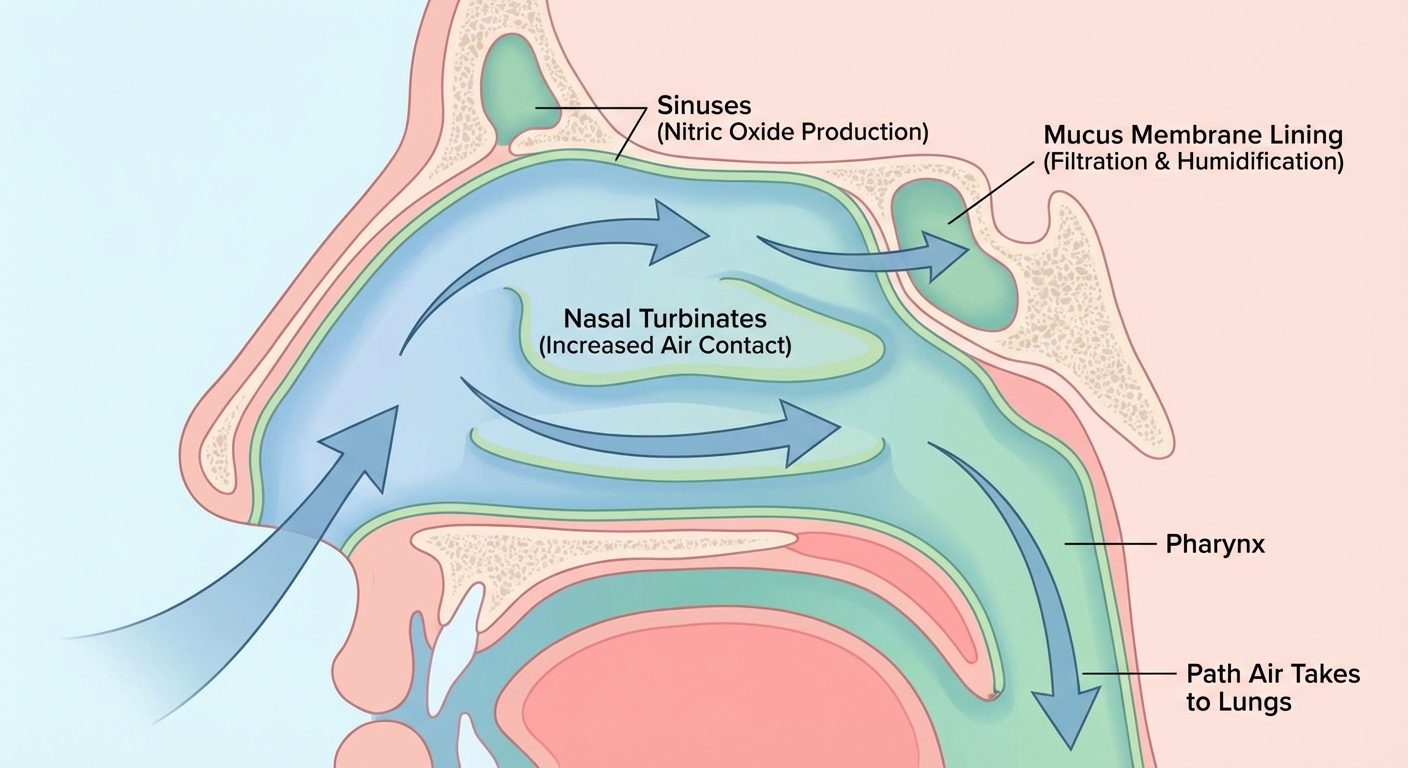
The first line of defense is physical filtration. Nose hair and the sticky mucus lining that coats your nasal passages trap particles, pathogens, allergens, and pollutants before they can reach your lungs. This isn’t trivial. Studies measuring particulate matter in inhaled air versus air reaching the lungs show that nasal breathing removes 80 to 90 percent of airborne particles. Mouth breathing delivers everything directly into your respiratory system with minimal filtration. If you live in a polluted city, work in dusty environments, or have allergies, this difference matters enormously.
The second function is humidification. Your nasal passages add moisture to incoming air, raising humidity levels toward the 100 percent saturation that your lungs prefer. Dry air irritates airways, triggers coughing, and can damage the delicate tissue lining your respiratory system. Mouth breathing delivers whatever humidity level exists in your environment, often far too dry, especially in winter when indoor heating dessicates the air. The chronic dry mouth and throat irritation that mouth breathers experience during sleep comes directly from this humidification bypass.
Third, the nasal turbinates, curved bones lined with vascular tissue inside your nose, warm incoming air to body temperature before it reaches your lungs. Breathing cold air through your mouth delivers that cold air directly to your airways, triggering the bronchospasm that asthmatics know as exercise-induced bronchoconstriction. Even in people without asthma, cold air reduces respiratory efficiency. Your nose prevents this problem by serving as a heat exchanger.
Perhaps most important, your paranasal sinuses produce nitric oxide, a molecule with multiple beneficial effects that mouth breathing completely foregoes. Nitric oxide dilates blood vessels, improving circulation throughout your body. It enhances oxygen absorption in your lungs by improving the matching between air flow and blood flow in the alveoli, increasing oxygen transfer to your blood by 15 to 20 percent compared to mouth breathing. This means nasal breathing delivers more oxygen despite feeling like you’re getting less air. Nitric oxide also has antimicrobial properties, helping kill pathogens in your airways, and plays a role in blood pressure regulation systemically.
The resistance created by breathing through your nose, which can feel like you’re not getting enough air compared to mouth breathing, actually serves essential physiological purposes. This back-pressure helps keep your airways open and improves gas exchange efficiency in your lungs. The feeling that mouth breathing is easier doesn’t mean it’s better. It just means it’s less work, while also being less effective.
Sleep Quality and Breathing Pattern
The consequences of breathing pattern become most apparent during sleep, when you have no conscious control over how you breathe and your body’s regulatory systems operate without interference from intentional override.
Mouth breathing during sleep worsens virtually every sleep quality metric. It increases snoring because the airway is less stable and more prone to collapse when the tongue drops back without the structural support that closed-mouth positioning provides. It contributes to obstructive sleep apnea for the same mechanical reasons, with airways collapsing during relaxed sleep states. Research shows mouth breathers spend less time in deep sleep and REM sleep, the restorative stages where physical repair and memory consolidation occur. They experience more frequent nighttime awakenings, whether conscious or not, that fragment sleep architecture. The dry mouth and throat irritation from unhumidified air causes discomfort that further disrupts sleep quality.
The cumulative effect is that mouth breathers wake feeling less rested despite spending adequate time in bed. They experience more daytime fatigue, worse cognitive performance, and the cascade of metabolic and hormonal disruptions that accompany chronic poor sleep. Many people with sleep quality complaints have never considered that their breathing pattern might be a root cause.

Mouth taping has emerged as a surprisingly effective intervention for converting mouth breathers to nasal breathers during sleep. The concept sounds alarming to most people initially: you apply surgical tape, specialized mouth tape products like Somnifix, or even simple 3M medical tape over your lips before sleep to mechanically prevent mouth breathing. If your nose is functional, you’ll breathe through it because you have no alternative.
Studies on mouth taping show remarkable results. Snoring reductions of 70 percent or more in some populations. Improved sleep quality metrics on polysomnography. Forced nasal breathing adaptation that eventually carries over into natural behavior even without the tape. The intervention is simple, costs essentially nothing, and addresses a root cause rather than treating symptoms.
The key caveat is that mouth taping requires a functional nasal airway. If you have severe nasal congestion, a deviated septum that prevents airflow, or other structural issues, you must address those before taping your mouth. Attempting to mouth tape with a blocked nose is uncomfortable at best and potentially dangerous at worst. If you can breathe comfortably through your nose while awake with your mouth closed, you’re likely a good candidate for mouth taping. If nasal breathing feels difficult or impossible, see an ENT specialist first.
For beginners, start with a small piece of tape positioned vertically over the center of your lips. If anxiety about restricted breathing arises, cut a small hole in the center of the tape. Progress to full coverage as you adapt and trust the process. Most people transition to comfortable full-night mouth taping within one to two weeks.
Athletic Performance and Breathing Efficiency
For decades, athletes were taught to breathe however felt natural during exertion, typically meaning mouth breathing as intensity increased. The logic seemed obvious: the mouth is a bigger opening, so it allows more air movement. During intense exercise, you need more air, so breathe through the bigger hole. This intuition is wrong in ways that cost performance.
While mouth breathing does move larger volumes of air, volume doesn’t equal oxygen absorption. Much of the air taken in through mouth breathing is exhaled before oxygen can be absorbed by the alveoli in your lungs. The air moves through too quickly, spending insufficient time in contact with the gas exchange surfaces where oxygen enters your bloodstream. Nasal breathing, by restricting airflow, forces air to stay in your lungs longer, allowing more complete oxygen extraction per breath.
The subjective experience of switching to nasal breathing during training feels like running with a restrictor plate on your engine. Initially, it seems impossible to get enough air, and you’ll feel forced to slow down or reduce intensity. This discomfort is real, but it’s also the stimulus for profound respiratory adaptation. Your body learns to extract oxygen more efficiently from each breath. Your tolerance for carbon dioxide, the primary trigger for the urge to breathe, increases. Your breathing rate decreases while oxygen delivery remains stable or improves.
The training effect compounds over time. Forcing nasal breathing during aerobic training improves respiratory efficiency across all conditions. When you eventually need to switch to mouth breathing for maximal efforts where nasal breathing genuinely cannot supply adequate air volume, you perform better than if you’d always mouth-breathed because your baseline respiratory efficiency is higher.
The practical protocol is straightforward. During easy to moderate intensity training, breathe exclusively through your nose. Accept that you’ll need to slow down initially. During high-intensity intervals or maximal efforts, mouth breathing is acceptable and often necessary. The goal isn’t nasal breathing at all times regardless of intensity; it’s nasal breathing as your default with mouth breathing reserved for genuine maximal efforts. Most endurance athletes who adopt this approach find their aerobic threshold, the intensity they can sustain nasally, increases substantially over 4 to 8 weeks of consistent practice.
For readers interested in optimizing aerobic fitness, our guide to VO2 max training covers complementary approaches to improving cardiovascular performance.
Facial Development and Structural Effects
The effects of breathing pattern on facial structure are most dramatic during childhood development, but the underlying principles of oral posture affect airway health and function at any age.
The skeleton is not a static structure that forms once and remains fixed. Bone continuously remodels in response to the forces applied to it, a process called Wolff’s Law that explains why astronauts lose bone density in space and why weight-bearing exercise builds stronger bones. In the face, the primary sculpting force during development is tongue position. When the mouth is closed and you breathe through your nose, your tongue naturally rests against the roof of your mouth, acting as an internal scaffold that provides upward force on the palate and maxilla (upper jaw).
When the mouth hangs open to breathe, the tongue drops to the floor of the mouth. Without that internal upward force, the cheek muscles push inward from the sides, narrowing the dental arch. The face grows downward rather than forward. Over years of development, this changes the trajectory of facial growth in ways that orthodontists and airway-focused dentists can identify instantly: a longer, narrower face shape, a recessed chin and jaw, a narrow palate that crowds teeth, and critically, a smaller airway.
Children who are chronic mouth breathers develop measurably different facial structure than children who breathe through their nose. The consequences extend beyond aesthetics to function: the smaller airway created by mouth-breathing-driven development predisposes these children to sleep apnea, snoring, and breathing difficulties that persist into adulthood. Early intervention through myofunctional therapy, which retrains tongue position and breathing patterns, can partially correct developmental trajectory if started young enough.
For adults, facial bone structure is essentially set and won’t change significantly regardless of breathing pattern. However, nasal breathing still matters for all the sleep quality, performance, and oxygen uptake benefits described above. The facial development window has closed, but the other benefits remain fully accessible.
Retraining Your Breathing Pattern
Breathing is unique among physiological functions because it’s both autonomic, happening automatically without conscious input, and somatic, able to be consciously controlled. This dual nature is exactly what makes retraining possible. You can deliberately override automatic patterns during waking hours until the new pattern becomes the automatic default.
The process resembles correcting bad posture. At first, maintaining the correct pattern requires constant attention. You’ll catch yourself reverting to the old pattern dozens of times daily. The goal isn’t immediate perfection but progressive reduction in how often you revert and how long before you notice and correct. Over weeks, the conscious effort required decreases as the new pattern becomes habitual.
The first step is addressing any structural or medical barriers to nasal breathing. If your nose is chronically blocked, you cannot retrain to nasal breathing until you resolve the blockage. Allergies may require antihistamines, avoidance of triggers, or immunotherapy. Structural issues like a deviated septum might require surgical correction for severe cases. Chronic inflammation from conditions like rhinitis can often be managed with saline rinses, steroid nasal sprays under physician guidance, or addressing underlying causes. You cannot breathe through your nose if airflow through your nose is blocked.
Once nasal breathing is physically possible, begin practicing during calm, low-demand situations. Sitting at your desk, walking casually, lying down before sleep. Notice when your mouth opens and consciously close it, returning to nasal breathing. Set random reminders on your phone to check your breathing pattern and correct if needed. The more frequently you notice and correct, the faster the new pattern establishes itself.
Progress gradually to nasal breathing during light physical activity, then moderate activity. Each intensity level requires adaptation because the air demand increases, but your nasal capacity expands with consistent use. Many people find that nasal passages that felt “too small” for breathing become significantly more open after weeks of consistent nasal breathing, a phenomenon sometimes called reversing disuse atrophy.
For sleep, attempt mouth taping only after you’ve become comfortable with nasal breathing while awake. If waking nasal breathing still feels difficult or strained, you’re not ready for taping. When you do begin taping, start with minimal coverage and increase as comfort develops.
The Buteyko Method and Advanced Breathing Practices
Dr. Konstantin Buteyko, a Soviet physician, developed a systematic approach to breathing retraining in the mid-20th century that challenged then-dominant assumptions about respiration. His core insight was counterintuitive: many people breathe too much, not too little, and this chronic hyperventilation creates problems that deliberate breathing reduction can resolve.
The mechanism involves carbon dioxide tolerance. CO2 is not merely a waste gas to be eliminated. It serves essential physiological functions, including triggering oxygen release from hemoglobin through the Bohr effect. When you hyperventilate, you blow off too much CO2, and paradoxically, your tissues receive less oxygen despite more air movement. Training your body to tolerate higher CO2 levels leads to calmer, more efficient breathing patterns with better oxygen delivery.
Buteyko exercises involve deliberate breath holds and reduced breathing volume to build CO2 tolerance. The control pause test, measuring how long you can comfortably hold your breath after a normal exhale before feeling the urge to breathe, provides a metric for tracking progress. Longer control pause indicates better breathing efficiency and higher CO2 tolerance.
Research on Buteyko methods shows improvements in asthma symptoms, anxiety levels, and sleep quality among practitioners. The evidence base isn’t as robust as for mainstream medical interventions, but multiple studies support efficacy for specific applications. Our guide to breathwork for anxiety covers Buteyko and other breathing techniques in detail.
A simpler practice with strong physiological basis is humming during exhale. Research shows that humming increases nitric oxide production in the sinuses by 15-fold compared to silent nasal breathing. The increased nitric oxide improves oxygen absorption, provides antimicrobial effects in the sinuses, and may reduce sinus infection frequency. A few minutes of humming practice daily, simply humming any tone while breathing out through your nose, is easy to implement and has measurable effects.
The Bottom Line
Nasal breathing is how humans evolved to breathe during most activities. Your nose provides filtration, humidification, warming, and nitric oxide production that mouth breathing completely bypasses. The consequences of chronic mouth breathing include worse sleep quality, reduced athletic performance, lower oxygen saturation, more dental problems, and in children, altered facial development.
Retraining from mouth breathing to nasal breathing takes conscious effort over several weeks, but the benefits begin immediately. Address any structural barriers first, then practice consciously during waking hours, progressing to mouth taping during sleep and nasal breathing during exercise.
Your Nasal Breathing Protocol:
-
Assess your current pattern: Notice how you breathe during the day, especially when focused on screens or tasks. Most mouth breathers are unaware of the habit.
-
Clear obstacles: If nasal breathing feels difficult, address allergies, congestion, or structural issues before attempting retraining.
-
Practice during calm states: Start with nasal breathing while sitting, then walking. Return to nasal breathing each time you notice mouth breathing.
-
Add mouth taping: Once waking nasal breathing feels natural, try mouth taping during sleep. Start with minimal tape, progressing to full coverage.
-
Train during exercise: Keep intensity low initially while breathing nasally. Increase intensity as your nasal capacity expands over 4-8 weeks.
-
Build CO2 tolerance: Practice breath holds after exhale to increase tolerance. Aim for a comfortable control pause of 40+ seconds over time.
Sources: Nasal physiology and nitric oxide research, sleep and breathing studies, Buteyko method clinical trials, facial development and breathing patterns research, athletic performance and respiratory efficiency studies.