
You wake up feeling heavy, puffy, and inexplicably sluggish. Your rings are tight on your fingers. Your ankles look slightly swollen by evening. You’re fighting off yet another cold, and your energy has been dragging for weeks. These seemingly disconnected symptoms might share a common root cause: your lymphatic system is struggling to keep up.
Your cardiovascular system has a dedicated pump, your heart, that circulates blood through 60,000 miles of vessels approximately 1,000 times per day. Your lymphatic system, which handles the equally critical task of clearing waste, toxins, and immune cells from your tissues, has no such pump. It relies entirely on muscle contractions, breathing, and manual manipulation to move lymph fluid through its network of vessels and nodes. When you sit at a desk for eight hours, barely moving and breathing shallowly, your lymphatic system essentially stalls. Waste products accumulate, immune surveillance suffers, and the symptoms start to pile up.
The good news is that supporting lymphatic health doesn’t require expensive treatments, special supplements, or extreme protocols. The most powerful interventions are remarkably simple: movement, breathing, and hydration. Understanding how this system works, and what it needs from you, unlocks a straightforward path to better immune function, faster recovery, and that elusive feeling of lightness and vitality.
How Your Lymphatic System Actually Works
The lymphatic system operates as your body’s drainage and filtration network, running parallel to your circulatory system but serving fundamentally different purposes. While blood delivers oxygen and nutrients, lymph carries away the cellular waste products, excess proteins, and fluid that accumulate in your tissues throughout the day. Think of it as the sanitation department of your body, constantly collecting garbage and ensuring it gets processed and removed.
Your body contains approximately 600 lymph nodes, small kidney-bean-shaped structures concentrated in your neck, armpits, and groin that act as filtration stations. As lymph fluid flows through these nodes, immune cells called lymphocytes scan for pathogens, damaged cells, and foreign particles. When you’re fighting an infection, your lymph nodes swell because they’re working overtime to filter and neutralize the threat. This is why the doctor checks your neck when you have a sore throat: those swollen nodes indicate your immune system is actively responding.
The system processes an impressive 2-4 liters of lymph fluid daily, eventually returning the cleaned fluid to your bloodstream through the thoracic duct near your left shoulder. Research published in Nature Reviews Immunology has demonstrated that the lymphatic system is far more than a passive drainage network. It actively participates in immune regulation, fat absorption from the gut, and even brain waste clearance through the recently discovered glymphatic system. Dr. Natalie Ahn, a lymphatic researcher at Stanford Medicine, describes it as “the body’s second circulatory system, one we’ve historically underappreciated.”
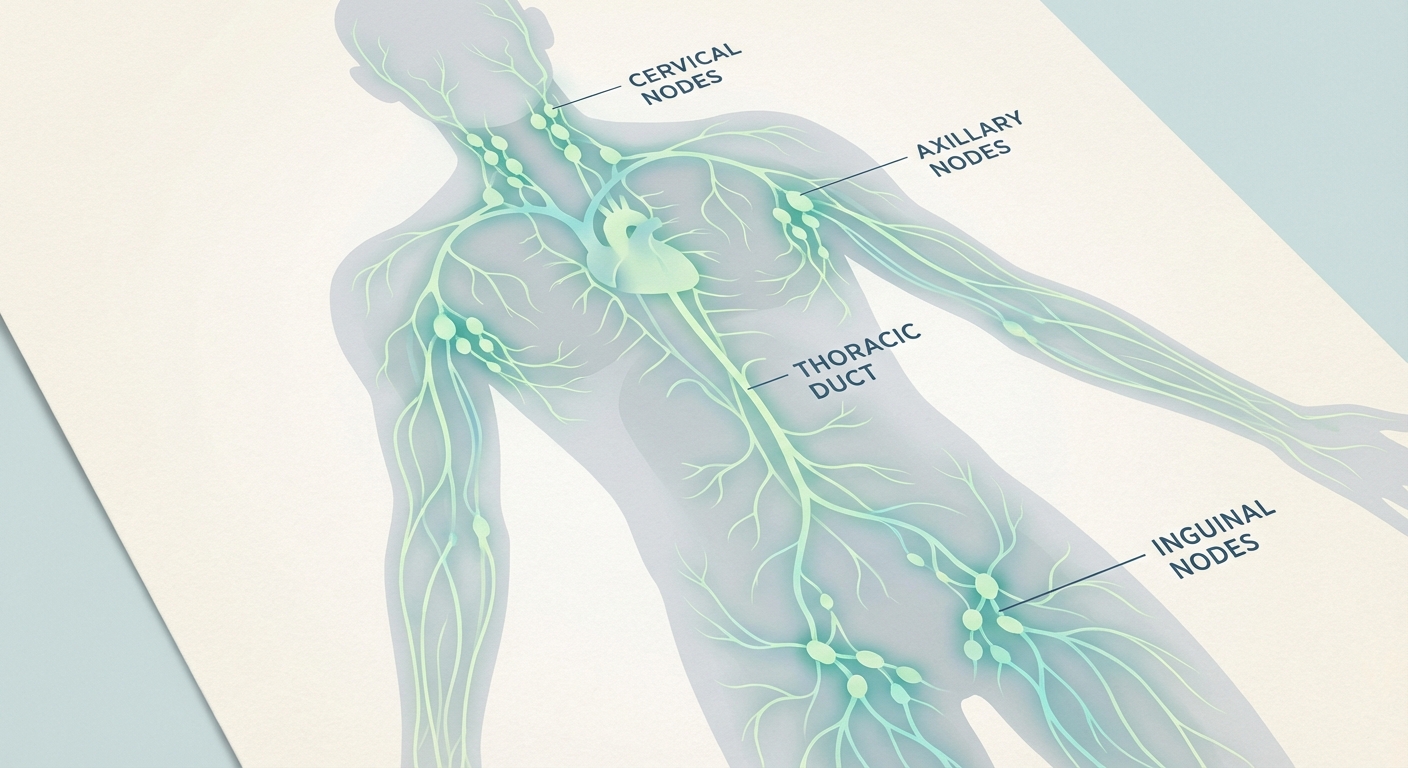
The critical difference between your blood circulation and lymphatic flow lies in propulsion. Your heart beats approximately 100,000 times daily, creating constant pressure that moves blood through arteries and veins. Lymph vessels have no such engine. They contain one-way valves that prevent backflow, but the actual movement of fluid depends entirely on external forces: the compression of surrounding muscles during movement, the pressure changes in your chest during breathing, and the gentle massaging effect of normal daily activity. When those external forces diminish, lymph flow slows dramatically.
Signs Your Lymphatic Flow Has Slowed
Because the lymphatic system operates quietly in the background, its dysfunction often manifests as a collection of vague symptoms that don’t seem connected. Unlike a heart problem that might cause chest pain or shortness of breath, a sluggish lymphatic system typically presents with complaints that sound almost too nonspecific to be real. Yet research from the Mayo Clinic confirms that these patterns often cluster together in people with compromised lymphatic function.
Fluid retention is the hallmark sign, but it rarely appears dramatically. Before visible swelling develops, you might notice that your face looks puffy in the morning, your rings feel tight by afternoon, or your ankles have slight indentations from your socks by evening. This phenomenon worsens with prolonged sitting or standing because gravity is winning the battle against your fluid transport system. A 2023 study in the Journal of Vascular Research found that office workers who sat for 6+ hours showed measurably reduced lymphatic flow in their lower extremities compared to those who moved regularly throughout the day.
Fatigue and brain fog often accompany poor lymphatic drainage. When waste products accumulate in tissues rather than being efficiently cleared, cellular function suffers. The brain is particularly sensitive to this effect. The glymphatic system, which clears metabolic waste from the brain primarily during sleep, relies on efficient lymphatic drainage. Research published in Science by Dr. Maiken Nedergaard at the University of Rochester demonstrated that impaired glymphatic function is associated with cognitive decline and may contribute to neurodegenerative conditions. If you consistently wake feeling unrefreshed despite adequate sleep hours, sluggish lymphatic flow could be contributing.
Frequent infections and slow recovery point to compromised immune surveillance. Your lymph nodes are where immune cells identify and respond to threats. When lymph flow slows, pathogens and abnormal cells may circulate longer before being detected. A 2022 review in Frontiers in Immunology documented that individuals with chronic lymphatic insufficiency show delayed immune responses and higher rates of recurring infections. If you’re the person who catches every cold going around or takes twice as long as others to recover from illness or exercise, your lymphatic system may need attention.

Movement as Your Primary Lymphatic Pump
The most powerful intervention for lymphatic health is also the simplest: move your body. Every time you contract a muscle, you compress the lymphatic vessels running through and around that tissue, squeezing fluid through the one-way valves and propelling it toward your lymph nodes. This is why any exercise, from walking to weight training, supports lymphatic function. The specific activity matters far less than the consistency of movement throughout your day.
Walking provides particularly effective lymphatic support because it engages muscles throughout your entire body in rhythmic, coordinated contractions. The calf muscles, often called your “second heart,” are especially important for returning both blood and lymph from your lower extremities against gravity. Research from the European Journal of Applied Physiology found that just 30 minutes of moderate walking increased lymphatic flow by approximately 300% compared to resting values. The effect persists for hours after the activity ends, making a morning walk a powerful way to set your lymphatic system up for the day.
Swimming offers unique benefits because water pressure provides continuous external compression on your body, essentially giving you a full-body lymphatic massage while you exercise. The horizontal position also eliminates gravity’s opposition to lymph flow, allowing fluid to move more freely. A study in Lymphatic Research and Biology documented improved lymphatic markers in patients with lymphedema who participated in aquatic exercise programs, with benefits exceeding those from equivalent land-based exercise.
Yoga and stretching support lymphatic flow through varied positioning and muscle engagement. Inversions like legs-up-the-wall pose use gravity to assist venous and lymphatic return from the lower body. Twisting poses compress and release abdominal tissues, promoting drainage from the gut-associated lymphatic tissues. Sun salutations and flowing sequences create the rhythmic muscle contractions that pump lymph through vessels. According to research conducted at MD Anderson Cancer Center, yoga practice significantly improved lymphatic function in breast cancer survivors, a population particularly vulnerable to lymphatic complications.
The critical insight is that any movement helps, and consistent movement throughout the day outperforms a single intense workout followed by hours of sitting. If you work at a desk, setting a timer to stand and move for two minutes every hour provides more lymphatic support than an hour at the gym followed by eight hours of immobility. Dr. Andrea Cheville, a physical medicine specialist at Mayo Clinic who researches lymphatic disorders, recommends what she calls “movement snacking”: brief bouts of walking, stretching, or even marching in place distributed throughout the day rather than concentrated in a single session.
The Science of Deep Breathing for Lymphatic Support
Your breathing pattern significantly influences lymphatic flow, particularly for the upper body, head, and neck regions. The thoracic duct, the largest lymphatic vessel in your body, runs through your chest and empties into the bloodstream near your left collarbone. When you breathe deeply using your diaphragm, you create pressure changes that act as a lymphatic pump for this critical drainage pathway.
During inhalation, your diaphragm descends into your abdomen, creating negative pressure in your chest cavity that draws lymph upward through the thoracic duct. During exhalation, the diaphragm rises and abdominal pressure increases, pushing lymph from the lower body toward the chest. This rhythmic pumping action is so significant that researchers estimate diaphragmatic breathing can increase thoracic duct flow by 10-15 times compared to shallow chest breathing. If you’re breathing shallowly into your upper chest all day, as most stressed, desk-bound workers do, you’re barely engaging this powerful lymphatic mechanism.
Diaphragmatic breathing practice is straightforward but requires attention because most adults have defaulted to chest breathing. Lie on your back with one hand on your chest and one on your belly. As you inhale slowly through your nose, your belly should rise while your chest remains relatively still. As you exhale through your mouth, your belly falls. Practice this for 5-10 breaths, several times daily, until belly breathing becomes more natural. The technique overlaps significantly with vagal nerve activation practices for stress management, as the vagus nerve runs alongside lymphatic vessels and responds to the same deep breathing patterns.
Box breathing and other structured breathing patterns provide similar lymphatic benefits while adding stress reduction and focus enhancement. The 4-4-4-4 box breathing pattern, where you inhale for four counts, hold for four, exhale for four, and hold for four, creates sustained pressure differentials that support lymphatic flow. Research from the International Journal of Yoga found that participants who practiced structured breathing exercises for 15 minutes daily showed improved lymphatic markers along with reduced cortisol levels. The combination of lymphatic support and stress reduction makes breathing practices particularly valuable, as chronic stress itself impairs lymphatic function through cortisol-mediated mechanisms.
Rebounding: The Lymphatic Exercise
While any movement supports lymphatic health, rebounding, jumping on a mini-trampoline, has gained attention for its particularly effective stimulation of lymphatic flow. The physics of rebounding create unique conditions that optimize the lymphatic pumping mechanism in ways that other exercises don’t quite replicate.
At the top of each bounce, your body experiences a brief moment of weightlessness as gravity momentarily releases its pull. At the bottom of the bounce, during deceleration, you experience increased G-force, typically 2-4 times your body weight depending on bounce intensity. This rapid oscillation between weightlessness and increased gravity creates a pumping action that opens and closes lymphatic valves throughout your body simultaneously. Unlike running, which primarily loads the lower body, rebounding subjects your entire system to these pressure changes.
Research on rebounding specifically for lymphatic support remains limited but encouraging. A small study published in the Journal of Sports Science and Medicine found that rebounding produced superior lymphatic clearance compared to walking at matched perceived exertion levels. NASA research on rebounding for astronaut reconditioning documented its efficiency for stimulating multiple body systems including lymphatic circulation. Dr. Morton Walker, who wrote extensively on the lymphatic benefits of rebounding in the Journal of Alternative Medicine, described it as “possibly the most effective form of exercise for improving lymph fluid circulation.”
Practical recommendations for rebounding don’t require intense workouts. Gentle bouncing, where your feet barely leave the mat, provides significant lymphatic benefit without the joint stress of high jumps. Start with 5-10 minutes daily, gradually increasing to 15-20 minutes as your body adapts. A basic rebounder costs $50-150, while professional-grade models run $200-400. The investment is modest compared to many fitness purchases, and the barrier to use is low since you can rebound while watching television or taking phone calls.

Hydration and Dietary Support
Your lymphatic fluid is approximately 95% water. When you’re dehydrated, this fluid becomes more viscous and moves more slowly through vessels and nodes. Proper hydration keeps lymph thin and flowing freely, reducing the workload on your lymphatic system. The relationship is direct: a 2% reduction in body water increases fluid viscosity significantly, and lymphatic flow is particularly sensitive to these changes because it lacks the pressure that drives blood circulation.
Hydration targets for lymphatic support align with general health recommendations but deserve attention because most adults are chronically mildly dehydrated. Aim for 8-10 cups (64-80 ounces) of water daily as a baseline, increasing to 10-12 cups if you’re physically active, live in a hot climate, or consume caffeine and alcohol, which promote fluid loss. Spreading intake throughout the day is more effective for lymphatic support than consuming large amounts at once because steady hydration maintains consistent fluid viscosity.
Anti-inflammatory eating patterns support lymphatic function indirectly but meaningfully. Chronic inflammation increases fluid accumulation in tissues, creating additional workload for the lymphatic system. Diets high in processed foods, refined sugars, and omega-6 fatty acids promote inflammatory states, while diets rich in vegetables, fruits, fatty fish, and whole foods reduce inflammation. The Mediterranean diet, consistently associated with reduced inflammatory markers in research, provides a practical template.
Specific foods don’t have magical lymphatic properties despite what supplement marketers claim, but certain nutritional factors matter. Adequate protein supports the production of immune cells that travel through lymphatic vessels. Omega-3 fatty acids from fish, flaxseed, and walnuts reduce systemic inflammation. Potassium-rich foods help maintain fluid balance, counteracting the water retention that excessive sodium promotes. However, the emphasis should be on overall dietary pattern rather than isolated superfoods, as no single food dramatically improves lymphatic function in the context of an otherwise poor diet.
What Doesn’t Work: The Detox Myth
The wellness industry has seized on the lymphatic system as a marketing opportunity, promoting expensive cleanses, supplements, and gadgets that promise to “detoxify” your lymph. It’s worth addressing this directly because these products waste money and distract from the simple interventions that actually help.
Your lymphatic system is already a detoxification system. It continuously collects and filters waste products, dead cells, and metabolic byproducts, delivering them to your lymph nodes for processing and eventually to your liver and kidneys for excretion. This process happens automatically, 24 hours a day, without special supplements or protocols. The system doesn’t accumulate toxic sludge that requires flushing any more than your blood vessels do.
Supplements marketed for lymphatic support typically contain herbs like red clover, echinacea, or astragalus. While some of these have mild immune-modulating properties in certain contexts, no rigorous research supports their use for improving lymphatic flow or function in healthy individuals. A 2021 review in Phytotherapy Research found no evidence that any commercially available “lymphatic cleanse” product provided meaningful benefit beyond placebo. Your money is better spent on a rebounder or swimming pool membership.
Expensive devices and treatments marketed for lymphatic drainage in healthy people are similarly unsupported. Pneumatic compression devices, infrared saunas marketed for detox, and various electronic gadgets may feel pleasant but don’t provide benefits beyond what movement and breathing accomplish for free. The exception is medical-grade compression therapy for diagnosed lymphedema, which is an established treatment prescribed by physicians, not a wellness product purchased online.
The bottom line is that supporting your lymphatic system doesn’t require buying anything. Movement, breathing, and hydration are free. If an approach costs significant money and promises dramatic lymphatic benefits, skepticism is warranted.
When to See a Doctor
While lifestyle interventions support lymphatic function in healthy individuals, certain conditions require medical attention. Understanding when self-care isn’t enough prevents delayed treatment of serious conditions.
Lymphedema, chronic swelling from damaged or absent lymph nodes, affects approximately 10 million Americans, many of them cancer survivors who’ve had lymph nodes removed during treatment. This condition doesn’t respond adequately to general wellness practices. It requires professional management including specialized manual lymphatic drainage, custom compression garments, and sometimes surgical intervention. If you have persistent, progressive swelling in a limb, particularly after cancer treatment, surgery, or radiation, see a physician.
Chronic venous insufficiency affects both blood and lymph flow in the legs and requires medical evaluation. Symptoms include leg heaviness, aching, visible varicose veins, and skin changes. While movement helps, treatment often includes prescription compression therapy, medications, or procedures to address underlying vein dysfunction.
Sudden lymph node swelling without apparent cause warrants investigation. While nodes commonly swell during infections, persistent enlargement lasting more than 2-3 weeks, or nodes that are hard, fixed, or painless, should be evaluated by a physician to rule out serious conditions including lymphoma.
The Bottom Line
Your lymphatic system is a remarkable network that clears waste, supports immunity, and maintains fluid balance throughout your body. Unlike your cardiovascular system, it has no dedicated pump, relying entirely on your movement, breathing, and daily activities to function optimally. When you understand this dependency, supporting lymphatic health becomes straightforward: move consistently throughout the day, breathe deeply and deliberately, stay well hydrated, and ignore expensive products promising miraculous lymphatic cleansing.
The interventions that matter most are simple and accessible. Walking for 30 minutes daily increases lymphatic flow by 300%. Diaphragmatic breathing several times daily supports thoracic drainage. Adequate water intake keeps lymph fluid flowing freely. Rebounding, if it appeals to you, provides particularly efficient lymphatic stimulation. None of these requires special equipment, expensive supplements, or professional treatments. For those seeking complementary recovery strategies, contrast therapy and cold exposure also support circulation and fluid movement.
Your lymphatic system will do its job if you give it the raw materials it needs: movement as the pump, breath as the secondary pump, and fluid as the medium. Everything else is optional.
Sources: Nature Reviews Immunology, Journal of Vascular Research, Frontiers in Immunology, European Journal of Applied Physiology, Lymphatic Research and Biology, Science (Nedergaard glymphatic research), Mayo Clinic lymphatic guidelines, Journal of Sports Science and Medicine, MD Anderson Cancer Center yoga research.