
You lost a single hour of sleep, but your body acts like it lost its entire operating manual. That disoriented, sluggish feeling after daylight saving time isn’t merely inconvenience or imagination; it’s your circadian rhythm actively fighting against an artificial time shift that your biology didn’t consent to. Research published in the Journal of Biological Rhythms shows that it can take up to three weeks for some people to fully adjust to the one-hour change. The good news? With the right approach, you can compress that adjustment period to approximately seven days.
Your circadian rhythm extends far beyond sleep timing. This internal biological clock orchestrates nearly every physiological system in your body, from hormone production schedules to metabolic efficiency, immune function timing to peak cognitive performance windows. When daylight saving disrupts this master clock, the effects ripple through your entire physiology in ways both obvious and subtle. The Monday following the spring time change sees a documented 24% increase in heart attacks and a 6% spike in car accidents. These aren’t minor inconveniences; they’re public health events caused by collective circadian disruption.
Understanding why a mere 60-minute shift causes such disproportionate problems requires examining how your biological clock actually works, what signals it relies upon to maintain accuracy, and how you can strategically manipulate those signals to accelerate adaptation. Your body wants to synchronize; you just need to provide the right cues at the right times.
Understanding Your Disrupted Internal Clock
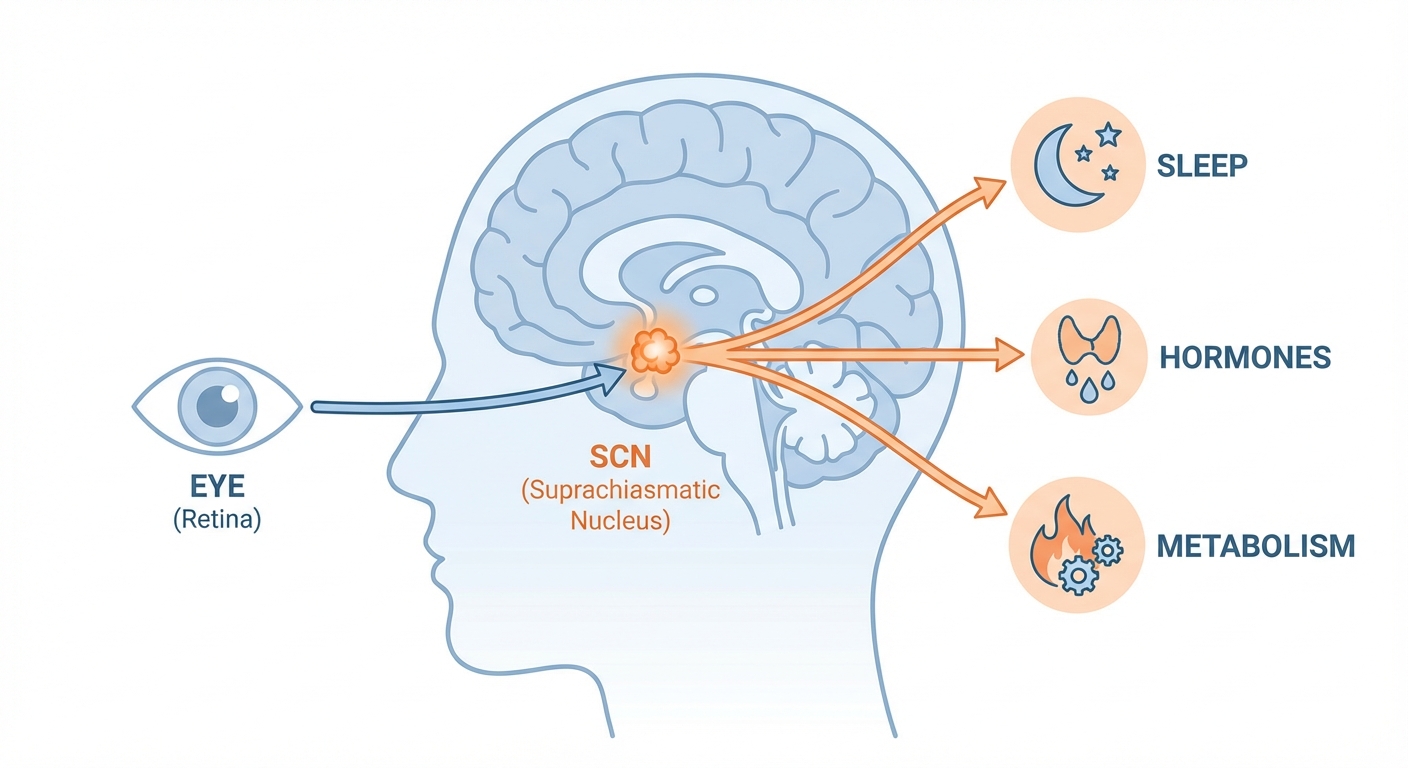
The one-hour shift might seem trivially small, but your body operates on a precision schedule refined over millions of years of evolution. Your suprachiasmatic nucleus, a cluster of approximately 20,000 specialized neurons located in your hypothalamus, functions as your master biological clock. This tiny region coordinates timing for everything from when you feel hungry to when your blood pressure begins rising in anticipation of waking, from when your immune cells are most active to when your reaction time peaks.
This biological timekeeper calibrates itself primarily through light exposure. Under normal circumstances, your SCN makes tiny daily adjustments, automatically syncing with the gradual seasonal changes in daylight that occur naturally throughout the year. But daylight saving forces an abrupt one-hour recalibration that your SCN wasn’t designed to handle. Dr. Till Roenneberg, a leading chronobiologist at Ludwig Maximilian University in Munich, describes this phenomenon as “social jet lag”: your biological clock remains locked on its original time schedule while society suddenly operates an hour ahead, creating an internal-external mismatch.
The disruption affects different people to varying degrees based on individual chronotype. Natural night owls, who prefer later bedtimes and wake times, typically struggle more with the spring transition when clocks move forward. Early birds find the fall change more challenging. Age plays a significant role as well: teenagers and young adults generally adapt faster due to more robust circadian systems, while middle-aged and older adults often require longer adjustment periods. Your baseline sleep debt, stress levels, and overall health status all influence how severely you experience the effects and how quickly your system recovers.
The 7-Day Reset Protocol
Your fastest path back to alignment leverages your body’s primary time-setting mechanism: light exposure to the retina. Stanford neuroscientist Dr. Andrew Huberman’s research on circadian biology demonstrates that viewing bright light at specific times can shift your circadian rhythm by up to three hours within days. The protocol below applies these findings specifically to daylight saving adjustment, accelerating what would otherwise take weeks into approximately one week.
The foundation of rapid adjustment is morning light exposure occurring within 30 minutes of your new target wake time. This isn’t casual window gazing or glancing outside while making coffee; you need direct outdoor light exposure for 10-15 minutes minimum, even on overcast days. Outdoor light measures 10,000 to 25,000 lux on cloudy days, compared to just 200-500 lux in a well-lit indoor space. This intensity difference matters enormously because it determines whether the light signal is strong enough to trigger the cascade of hormonal changes your brain needs to reset its clock.
Evening light management proves equally critical for successful adjustment. Starting approximately three hours before your target bedtime, systematically dim all screens and overhead lights. Switch to warm-toned bulbs rated 2700K or lower and keep overall illumination below 40 lux, roughly equivalent to candlelight or a single dim lamp. This dramatic reduction in light exposure signals your pineal gland to begin melatonin production earlier than it would otherwise, effectively pulling your sleep phase forward to match the new clock time.
Days 1-3: Aggressive Intervention Phase
Morning Protocol (beginning at your target wake time):
Wake at your intended new wake time regardless of how much sleep you actually obtained. Immediately upon rising, expose yourself to bright light: either spend 10-15 minutes outside, ideally in direct sunlight, or position yourself in front of a 10,000-lux light therapy box at 16-24 inches from your face for 20-30 minutes. Eat a protein-rich breakfast within an hour of waking to help anchor your metabolic circadian rhythm. Morning exercise, even just 10 minutes of walking or movement, amplifies the circadian reset signal significantly.
Evening Protocol (beginning around 8 PM or 3 hours before target bedtime):
Dim all household lights and activate night mode with blue-light filters on all devices. Take 200-400mg of magnesium glycinate, which research demonstrates can improve sleep quality and reduce circadian adjustment time. Avoid eating after this point to prevent metabolic signals from conflicting with your sleep drive. If you must use screens for work or communication, wear blue-blocking glasses that filter 99% of wavelengths below 550nm; these appear orange or red-tinted.
Supplement Support:
Consider 0.5mg of melatonin taken 2-3 hours before your desired bedtime. Research from MIT’s melatonin studies shows that this microdose proves more effective for phase shifting than the common 3-5mg doses sold in stores. The smaller dose mimics your body’s natural melatonin rise pattern rather than overwhelming receptors with supraphysiological amounts. More is not better for melatonin; it’s actually worse.

Days 4-7: Stabilization Phase
Consistency Becomes Critical:
Maintain exact wake and sleep times even on weekends during this adjustment period. Your SCN requires repetition of timing cues to lock in the new pattern firmly. Continue morning light exposure but can reduce duration to 10 minutes if your adjustment feels solid. Consider adding 2-5 minutes of cold exposure, either a cold shower or simply splashing cold water on your face, immediately after waking. The temperature shock reinforces cortisol rhythm and amplifies the wake signal.
Fine-tuning Based on Feedback:
Monitor your energy patterns throughout each day. If you experience an afternoon crash earlier than your usual time, take a 10-minute walk outside rather than napping. This light boost bridges the energy gap without disrupting nighttime sleep drive. If falling asleep at your target time remains difficult despite good light hygiene, try the cognitive shuffle technique: spend 8-10 minutes randomly visualizing unconnected, boring objects (a red wagon, a tennis ball, a wooden spoon) to quiet the default mode network and reduce pre-sleep rumination.
Nutrition Timing for Faster Adaptation
When you eat matters almost as much as when you sleep for complete circadian alignment. Your peripheral clocks, located in organs like the liver, pancreas, and throughout the digestive system, operate semi-independently from your master clock in the brain. Food timing provides powerful signals that help synchronize these peripheral oscillators with your central clock.
Research from the Salk Institute demonstrates that time-restricted eating within a consistent 10-12 hour daily window accelerates circadian adaptation following any schedule disruption. During your adjustment week, eat your first meal within an hour of waking and finish your last meal at least three hours before your target bedtime. This creates clear metabolic signals that reinforce your new schedule from multiple directions simultaneously.
Specific nutrients can support the transition process. Tryptophan-rich foods consumed with your evening meal, including turkey, eggs, and cheese, provide precursor material for melatonin synthesis overnight. B-vitamins, particularly B12 and B6, support the enzymatic processes involved in neurotransmitter and hormone regulation. Complex carbohydrates at dinner can facilitate tryptophan crossing the blood-brain barrier by triggering insulin release that clears competing amino acids, but keep portions moderate to avoid blood sugar spikes that interfere with sleep onset. The goal is to support your sleep architecture through strategic nutrition, not override it with supplements.
Managing the Transition Symptoms
The adjustment period often brings temporary discomfort: daytime fatigue that coffee doesn’t touch, mood fluctuations, digestive irregularities, and concentration problems that make focused work difficult. These symptoms reflect your various biological systems operating out of sync with each other, a phenomenon called internal desynchrony. Specific interventions can minimize their impact while you wait for full alignment.
For daytime fatigue, resist the temptation to dramatically increase caffeine intake. Instead, maintain your regular coffee consumption but shift the timing 30 minutes earlier to match your new wake time. If you need an afternoon boost, green tea provides gentler stimulation than coffee along with L-theanine to prevent jitters and anxiety. Strategic 10-20 minute naps before 2-3 PM can provide recovery without delaying evening sleep drive, but naps longer than 20 minutes or taken later than mid-afternoon will extend your adjustment period.

Digestive issues commonly arise because your gut microbiome operates on its own circadian rhythm that takes time to adjust. Probiotic supplementation during the transition week may help, particularly strains like Lactobacillus acidophilus that research suggests have circadian-modulating properties. Avoid heavy, high-fat meals during the adjustment period, as these require more digestive effort when your system is already stressed. Lighter meals with adequate protein and fiber will cause fewer symptoms while your gut clock catches up to your new schedule.
Technology and Tools That Actually Work
While dozens of apps claim to optimize your circadian rhythm, only specific tools have meaningful research supporting their effectiveness. Light therapy boxes meeting the 10,000-lux standard at 12-18 inches distance effectively substitute for morning sunlight when outdoor exposure isn’t feasible. Look for units that filter UV rays completely and provide full-spectrum white light rather than blue-only devices, which can cause eye strain and don’t appear to work better despite marketing claims.
Sleep tracking devices provide useful biofeedback during the adjustment period. Devices that measure heart rate variability can indicate when your autonomic nervous system has adapted to the new schedule: look for your HRV to return to your personal baseline levels, which typically takes 5-7 days with active intervention. Core body temperature rhythm, measurable with continuous monitoring devices like the Oura ring, offers another objective marker of circadian alignment. Your temperature minimum should occur approximately 2-3 hours before natural wake time when properly aligned.
Smart bulbs that automatically adjust color temperature support your evening wind-down protocol without requiring manual intervention. Program them to shift from 5000K (daylight white) in the morning to 2700K (warm sunset tones) in the evening to 2000K (dim candlelight) in the hour before bed. This gradual transition mimics the natural light changes your ancestors experienced daily, providing subtle but consistent circadian cues that reduce the cognitive burden of remembering to dim lights manually. Light therapy devices designed specifically for circadian support can provide more targeted intervention than generic smart bulbs.
Special Considerations for Shift Workers and Parents
Shift workers face unique challenges during daylight saving transitions, essentially experiencing double disruption. If you work nights, maintain your reversed light exposure pattern but shift everything by the hour change. Use complete blackout curtains and sleep masks to create absolute darkness during daytime sleep periods. Consider discussing with occupational health about maintaining consistent shift timing for two weeks following any time change rather than rotating schedules during the adjustment period.
Parents managing children’s sleep schedules need graduated approaches rather than the abrupt shift that adults can tolerate. Young children cannot cognitively override their biological drives the way adults can force themselves to comply with new schedules. Shift your child’s bedtime by 15 minutes every two days rather than forcing the full hour immediately. Maintain extremely consistent routines including bath, story, and bed sequences, as these behavioral cues help compensate for circadian disruption. Morning light exposure remains crucial for children but might require creative solutions like eating breakfast on the porch or walking to school instead of driving.
The Bottom Line
Daylight saving time disrupts your circadian rhythm through an arbitrary social convention that ignores biological reality, but you’re not powerless against its effects. The seven-day reset protocol, anchored by strategic light exposure, consistent meal timing, and targeted supplementation where appropriate, can reduce your adjustment period from potentially weeks to approximately one week. The key is treating the transition seriously rather than hoping discomfort will resolve on its own.
Start your reset immediately upon the time change rather than waiting until Monday or next week. Every day of continued misalignment compounds sleep debt and metabolic disruption, making recovery progressively harder. The morning light exposure protocol alone will provide noticeable benefits within 48 hours, with full circadian adaptation typically achieved by day seven if you maintain consistency with the full protocol. Your circadian system actively wants to synchronize properly; you simply need to provide it with the right signals at the right times.
Next Steps:
- Set your alarm for your target wake time tomorrow, even if it means less sleep initially
- Identify a 10-15 minute outdoor location for morning light exposure or purchase a 10,000-lux light therapy box
- Install dimmer switches or use lamps with warm bulbs for evening lighting
- Consider 0.5mg melatonin for the first 3-4 nights, taken 2-3 hours before target bedtime
- Track your energy levels and sleep quality daily to monitor adjustment progress
Your circadian rhythm represents millions of years of evolutionary refinement. A one-hour social convention shouldn’t be able to disrupt it for weeks, and with the right intervention, it won’t.
Sources: Journal of Biological Rhythms, Stanford Huberman Lab Circadian Research, Salk Institute for Biological Studies Panda Lab, Ludwig Maximilian University Chronobiology Department, MIT Department of Brain and Cognitive Sciences Melatonin Studies.