You’ve probably seen the videos: a tech entrepreneur stares at a blank wall for 24 hours, eats nothing but rice and water, and emerges claiming superhuman focus and productivity. Welcome to “dopamine detox,” the wellness trend that promises to reset your brain’s reward system by eliminating all pleasurable stimuli. The concept has exploded across social media, with millions of views on TikTok and YouTube tutorials explaining how to “empty your dopamine tank” and refill it fresh.
There’s just one problem: almost everything these videos claim about dopamine is scientifically wrong. Dopamine isn’t a toxin you can detox from. It’s not a fuel tank that empties and refills. You cannot, and would not want to, stop your brain from producing dopamine. If you actually depleted your dopamine, you wouldn’t feel focused, you’d develop symptoms resembling Parkinson’s disease, including tremors, rigidity, and profound difficulty initiating movement.
Yet here’s the twist: while the neuroscience explanations are garbage, the underlying practice often works. People who take structured breaks from hyper-stimulating technology frequently report improved focus, reduced anxiety, and renewed interest in “boring” activities like reading or conversation. The benefits are real, but the mechanism is completely different from what influencers describe. Understanding what’s actually happening in your brain reveals why these breaks help and how to structure them effectively.
What Dopamine Actually Does
Dopamine is a neurotransmitter, a chemical messenger that neurons use to communicate. It’s involved in movement, motivation, reward processing, memory formation, and attention. Contrary to popular belief, dopamine is not the “pleasure chemical.” It’s more accurately described as the “wanting” or “motivation” chemical.
Dr. Anna Lembke, a psychiatrist at Stanford University and author of Dopamine Nation, explains this distinction: “Dopamine is released in anticipation of reward, not from the reward itself. It’s what makes you want to check your phone, not what makes checking your phone feel good.” This is why you can feel compelled to scroll social media for hours even though it doesn’t actually make you happy. The dopamine drives the seeking behavior, not the satisfaction.
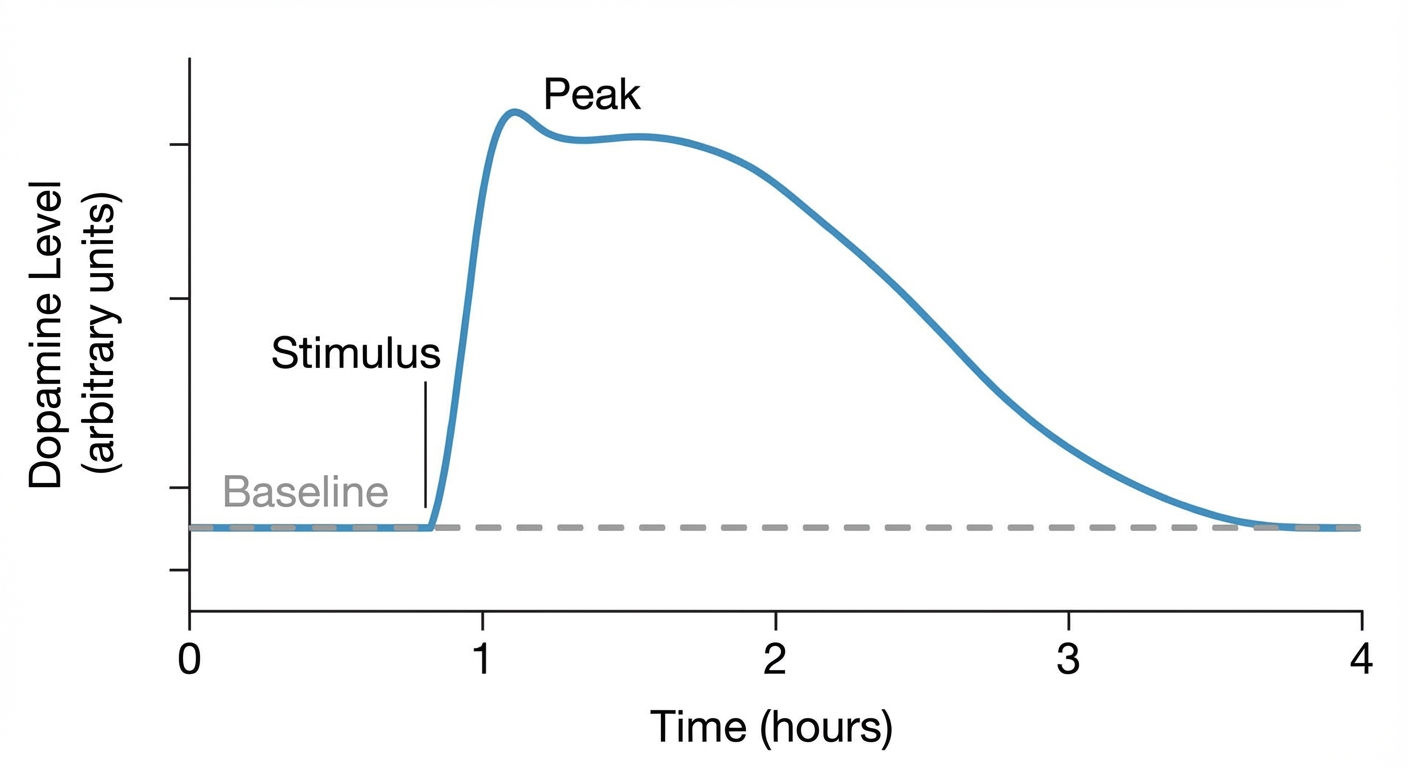
Your brain maintains baseline dopamine levels that fluctuate throughout the day. When you encounter something rewarding, dopamine spikes above baseline, creating motivation and reinforcing the behavior. After the spike, dopamine temporarily dips below baseline before returning to normal. This dip is what creates the “wanting more” feeling after pleasurable experiences.
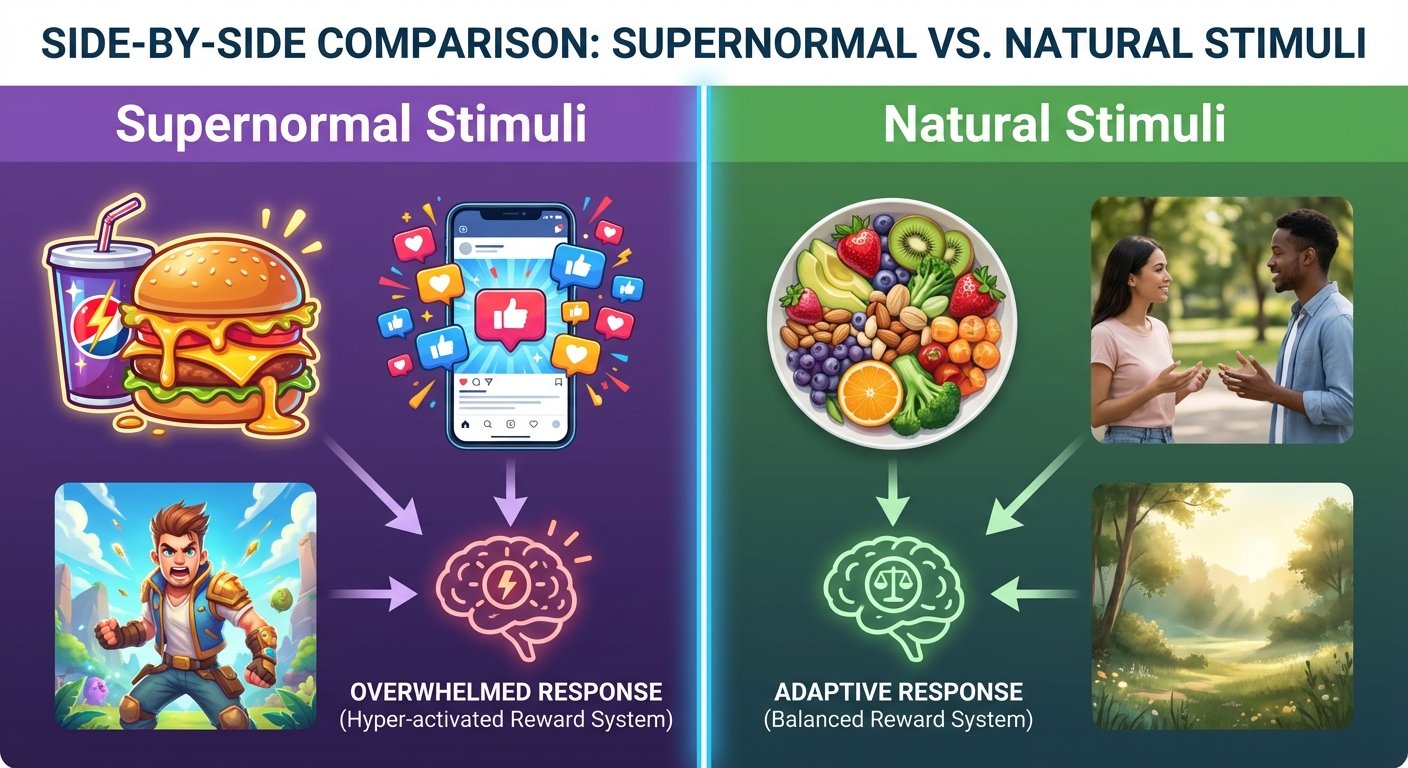
The problem isn’t dopamine itself, it’s what happens when your brain is chronically exposed to supernormal stimuli that trigger massive, repeated dopamine spikes.
The Real Mechanism: Receptor Downregulation
Your brain constantly seeks homeostasis, a balanced state. When you repeatedly flood your reward system with unnaturally high dopamine levels from activities like rapid-fire social media scrolling, pornography, video games, or highly processed foods, your brain adapts to protect itself from overstimulation.
This adaptation happens through a process called receptor downregulation. Your brain reduces the number of dopamine receptors (particularly D2 receptors) or makes them less sensitive. It’s similar to how your ears adjust to a loud room by reducing sensitivity, except this neural adaptation takes days or weeks to develop and reverse.
The consequence is that you need more stimulation to feel the same reward. Activities that once felt engaging, like reading a book, having a face-to-face conversation, or taking a walk in nature, no longer register as rewarding because your baseline for stimulation is calibrated to TikTok-level intensity. In clinical terms, this state approaches anhedonia, the inability to feel pleasure from normally enjoyable activities.
A 2011 study published in PNAS by Dr. Nora Volkow, Director of the National Institute on Drug Abuse, used PET imaging to demonstrate that individuals with behavioral addictions to video games showed significantly reduced D2 receptor availability in the striatum compared to controls. Similar patterns appear in studies of social media overuse, suggesting that even non-substance behaviors can reshape the brain’s reward circuitry.
This is what people are actually addressing when they do a “dopamine detox.” They’re not lowering dopamine levels. They’re allowing dopamine receptors to upregulate and resensitize by removing the supernormal stimuli that caused the downregulation.
Why the First 24-72 Hours Feel Terrible
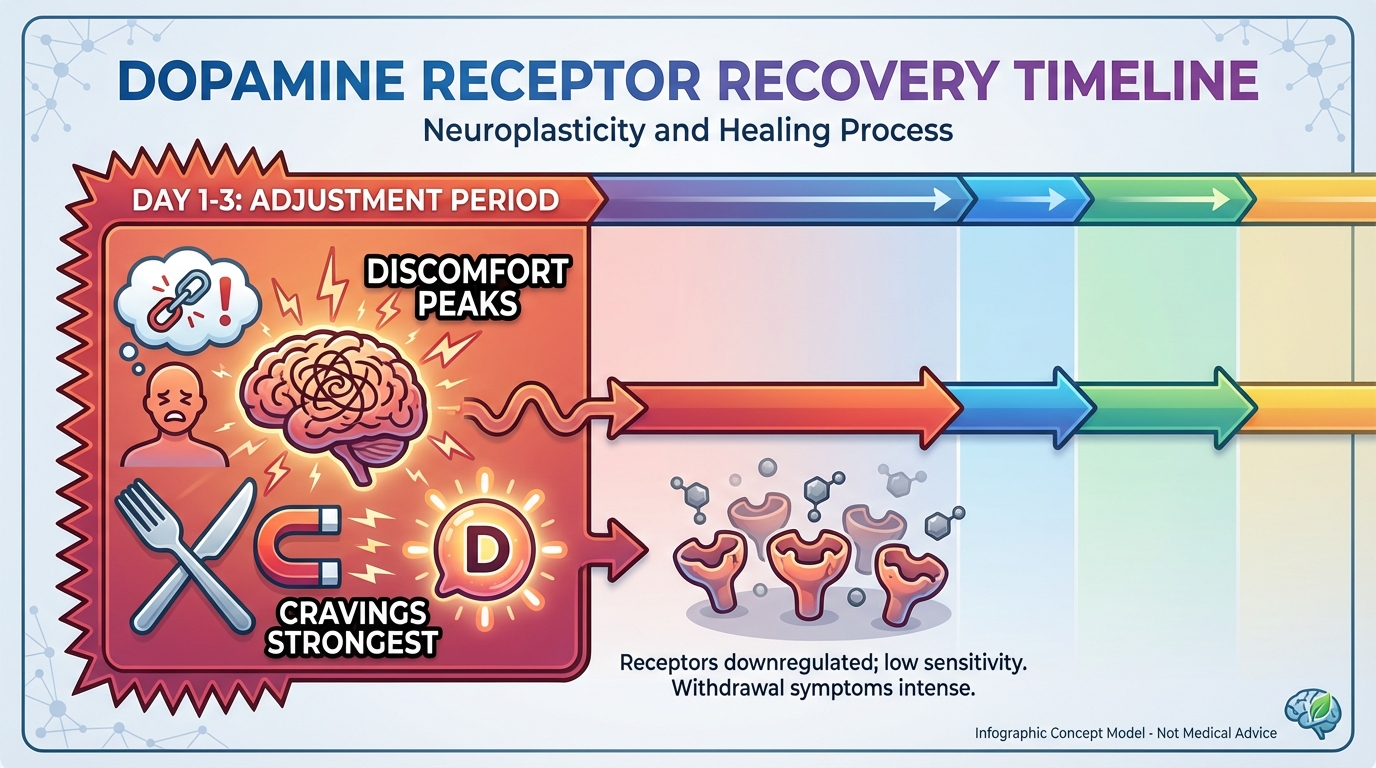
If you’ve ever tried to drastically reduce screen time, you know the first day or two can feel genuinely awful. You feel restless, irritable, anxious, and profoundly bored. Your mind races, searching for the stimulation it’s accustomed to receiving every few seconds.
This experience isn’t withdrawal in the pharmacological sense, but it shares characteristics with it. Your brain has adapted to expect constant dopamine hits, and when they don’t arrive, the contrast feels deeply uncomfortable. Dr. Lembke describes this as your brain’s “opponent process,” the compensatory mechanism that counterbalances pleasure with discomfort.
The discomfort is actually the point. By sitting with boredom and resisting the urge to reach for your phone, you’re doing two things simultaneously. First, you’re allowing receptor upregulation to begin. Second, you’re retraining your prefrontal cortex, the brain region responsible for impulse control and executive function. Every time you notice an urge to check your phone and choose not to act on it, you strengthen the neural pathways associated with self-regulation.
A 2020 study in Nature Communications found that just one week of reduced smartphone use led to measurable changes in gray matter volume in the anterior cingulate cortex, a region involved in self-control and emotional regulation. The brain adapts quickly when given the opportunity.
Two Approaches: Hard Reset vs. Digital Minimalism
There are two legitimate frameworks for implementing a technology break, and they serve different purposes.
The 24-48 Hour Hard Reset is the intensive approach popularized in Silicon Valley. For one to two days, you eliminate all highly stimulating inputs: screens, music, podcasts, social interaction beyond basic necessity, flavorful food, caffeine, and any other “cheap” dopamine sources. You’re left with water, bland food, walking, writing with pen and paper, and sitting with your thoughts.
This approach is useful for breaking acute compulsive patterns, for example, if you’ve noticed you literally cannot put your phone down, if you’re reaching for it during conversations, or if the first thing you do upon waking is check notifications. The extreme contrast forces awareness of just how dependent you’ve become on constant stimulation. It’s uncomfortable by design.
Dr. Cameron Sepah, a clinical psychologist at UCSF who helped popularize the term “dopamine fasting,” clarifies that the original framework was never about literal dopamine manipulation: “The goal is to reduce impulsive behavior by restricting external triggers. It’s cognitive-behavioral therapy principles, not neuroscience magic.”
Digital Minimalism is the sustainable long-term approach, articulated most thoroughly by Cal Newport in his book of the same name. Rather than eliminating all stimulation temporarily, you permanently remove the “junk food” inputs, specifically infinite-scroll social media, algorithmic content feeds, and notification-driven apps, while intentionally replacing them with higher-quality alternatives.
Newport’s approach involves a 30-day “declutter” where you remove optional technologies, followed by careful reintroduction of only those that serve genuine values. The goal isn’t to avoid technology but to use it intentionally rather than compulsively. Long-form content (books, documentaries, meaningful podcasts), real-world hobbies, and face-to-face relationships replace the scroll.
For most people, Digital Minimalism provides better long-term results because it addresses the environmental triggers that cause compulsive use in the first place.
The Critical Reintroduction Phase
Whether you choose a short hard reset or a longer minimalist declutter, the reintroduction phase determines whether your efforts produce lasting change or just a brief respite before returning to old patterns.
If you complete a 24-hour technology fast and immediately binge TikTok for four hours, you’ve accomplished nothing. The receptor downregulation you began to address will immediately reverse. Worse, the contrast between the deprivation and the binge may actually strengthen the compulsive associations.
Effective reintroduction requires structural changes to your environment and habits. Remove social media apps from your phone entirely, accessing them only through a browser on a computer if at all. Implement a “no screens for 60 minutes after waking” rule to protect your morning attention before it gets hijacked. Use app blockers and screen time limits not as suggestions but as hard boundaries. Charge your phone outside the bedroom.
These environmental modifications matter more than willpower. Research on behavior change consistently shows that modifying your environment is more effective than relying on self-control in the moment. Make the desired behavior easy and the undesired behavior difficult.
Who Actually Benefits
Not everyone needs a dopamine fast. If you use technology intentionally, can put your phone down during conversations, don’t feel compelled to check notifications constantly, and still find satisfaction in offline activities, your reward system is probably functioning normally.
The people who benefit most from structured technology breaks typically show several warning signs. You check your phone within seconds of waking. You feel anxious when separated from your device. You find yourself scrolling without remembering deciding to pick up your phone. Offline activities that used to engage you now feel boring. You have difficulty sustaining attention on a single task for more than a few minutes.
If these patterns describe you, a structured break combined with environmental modification can produce meaningful improvements. The research supports this: a 2022 study in Cyberpsychology, Behavior, and Social Networking found that participants who took a one-week break from social media reported significant improvements in well-being, depression, and anxiety compared to controls who continued normal use.
However, if you’re experiencing persistent anhedonia, inability to feel pleasure, or symptoms of depression, technology use may be a symptom rather than a cause. These situations warrant evaluation by a mental health professional rather than self-directed fasting protocols.
A Practical Protocol
Based on the research and clinical frameworks, here’s a reasonable approach for someone wanting to recalibrate their relationship with technology:
Start with assessment. Track your screen time for a week without trying to change it. Note which apps consume the most time and when you feel most compelled to use them. Identify your triggers, often boredom, stress, or specific times of day.
For a mild reset, implement a weekend technology sabbath. From Friday evening to Sunday morning, eliminate social media, algorithmic content, and news entirely. Keep phone use limited to calls and texts. Fill the time with planned activities: cook a meal from scratch, read a physical book, take a long walk, have extended face-to-face conversations.
For a more intensive reset, extend to 5-7 days of minimal technology use. This isn’t about suffering, it’s about creating space for your brain to recalibrate. Plan engaging offline activities in advance so you’re not just white-knuckling through boredom.
After any reset period, implement permanent environmental changes: no phones in the bedroom, no screens for the first hour of the day, social media only on computer browser, app blockers on problematic applications. These structural changes maintain the benefits you’ve gained.
The Bottom Line
“Dopamine detox” is a scientifically inaccurate name for a scientifically valid process. You’re not detoxing a neurotransmitter; you’re allowing overstimulated receptors to resensitize by removing the supernormal stimuli that caused downregulation in the first place.
The practice works, but not through the mechanisms TikTok influencers describe. By understanding what’s actually happening, increased receptor sensitivity and strengthened prefrontal control, you can design more effective interventions than staring at a wall for 24 hours.
The goal isn’t to eliminate dopamine or even to eliminate technology. It’s to recalibrate your reward system so that the subtle pleasures of ordinary life, a good conversation, a walk outside, a well-written paragraph, become perceptible again. When your baseline isn’t set to algorithmic-content-level intensity, the signal-to-noise ratio of real life improves dramatically. For sustainable strategies, explore our guides on digital minimalism and digital detox practices.
Your Next Steps:
- Track your baseline – Use your phone’s screen time feature to see actual usage for one week
- Identify problem apps – Which ones consume time without providing value?
- Start small – Try a screen-free morning (first 60 minutes after waking) for one week
- Plan alternatives – Have offline activities ready so you’re not just resisting urges
- Make structural changes – Move apps, use blockers, charge phone outside bedroom
Sources: Dopamine Nation by Dr. Anna Lembke (Stanford), PNAS (2011) Dr. Nora Volkow imaging studies, Nature Communications (2020) smartphone-brain structure study, Cyberpsychology, Behavior, and Social Networking (2022), Dr. Cameron Sepah (UCSF) dopamine fasting framework, Cal Newport Digital Minimalism.