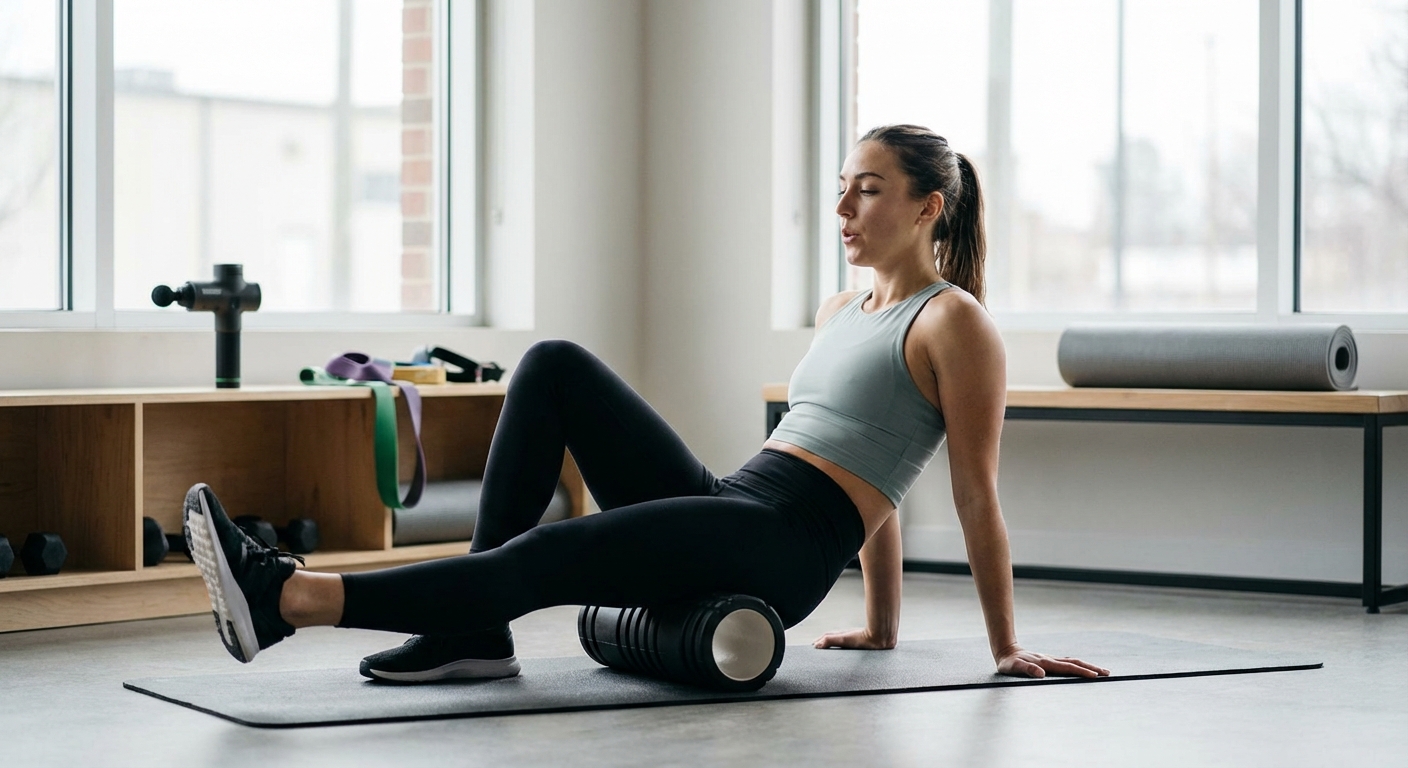
You crushed yesterday’s workout. Legs are sore, but you’ve done this before. The training plan says intervals today, so you lace up, hit the track, and spend 45 minutes wondering why every rep feels like running through wet concrete. Your pace is slow, your perceived effort is maxed out, and you finish feeling worse than when you started. What went wrong?
Your body was screaming for rest, but you couldn’t hear it. This is the central problem with subjective recovery assessment: by the time you “feel” overtrained, you’re already weeks into accumulated fatigue. The damage is done, and digging out takes longer than prevention would have. Elite athletes solved this problem years ago with a metric that cuts through perception and delivers objective data about your nervous system’s readiness: Heart Rate Variability (HRV).
HRV isn’t just another fitness tracking fad. It’s a direct window into your autonomic nervous system, the unconscious control center that regulates everything from digestion to stress response. When you understand how to read and respond to HRV data, you transform from someone who trains hard into someone who trains smart, maximizing adaptation while minimizing the injury and burnout that sideline so many dedicated athletes.
The Science of Heart Rate Variability
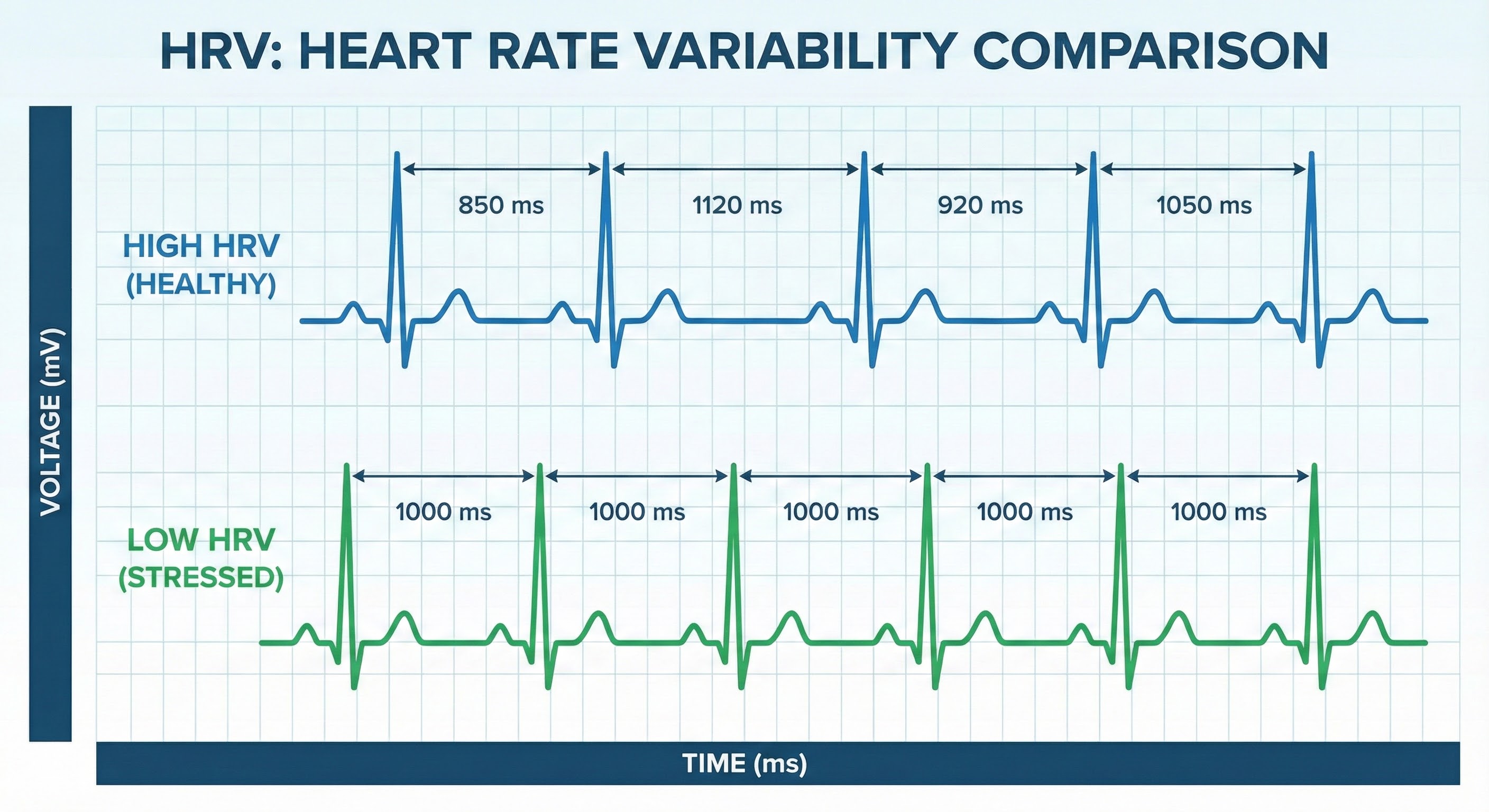
Your heart doesn’t beat like a metronome. If your resting heart rate is 60 beats per minute, those beats don’t arrive precisely one second apart. Instead, the intervals between beats constantly fluctuate: 0.92 seconds, then 1.08 seconds, then 0.96 seconds. This beat-to-beat variation, measured in milliseconds, is Heart Rate Variability.
High HRV means your heart rhythm is highly variable, which counterintuitively indicates health and resilience. This variability reflects a nervous system that’s responsive and adaptable, able to shift quickly between sympathetic activation (fight-or-flight) and parasympathetic dominance (rest-and-digest). Think of it like a car with both a powerful engine and excellent brakes: the best vehicles can accelerate rapidly and stop on a dime. A highly variable heart rate indicates a nervous system with that same responsive flexibility.
Low HRV means your heartbeat has become metronomic and rigid. This occurs when the sympathetic nervous system dominates, locking your body into a chronic stress state that overrides the subtle parasympathetic inputs. Your nervous system has lost its flexibility, stuck with the accelerator pressed down even when you need to brake. This state correlates with increased cardiovascular disease risk, slower recovery from exercise, impaired cognitive function, and reduced ability to adapt to training stress.
The measurement itself comes from analyzing the R-R intervals on an electrocardiogram (the time between successive heartbeats). Most consumer wearables calculate rMSSD (Root Mean Square of Successive Differences), a metric that specifically captures parasympathetic nervous system activity and responds quickly to changes in recovery status. Medical settings often use SDNN (Standard Deviation of NN intervals) for longer-term assessments, but for daily training decisions, rMSSD-based scores provide the most actionable information.
Why Your Absolute Number Doesn’t Matter
Here’s where most people go wrong with HRV: they see their number, Google “good HRV score,” and either celebrate or panic based on population averages. This approach misses the point entirely. HRV is highly individual, influenced by genetics, age, fitness level, and baseline autonomic tone in ways that make cross-person comparisons meaningless.
Some elite endurance athletes walk around with HRV scores in the 30s. Some relatively sedentary individuals naturally register in the 90s. Neither number indicates who’s healthier or more fit. What matters is how your HRV today compares to your own baseline, typically calculated as a 7-day or 30-day rolling average of your morning readings.
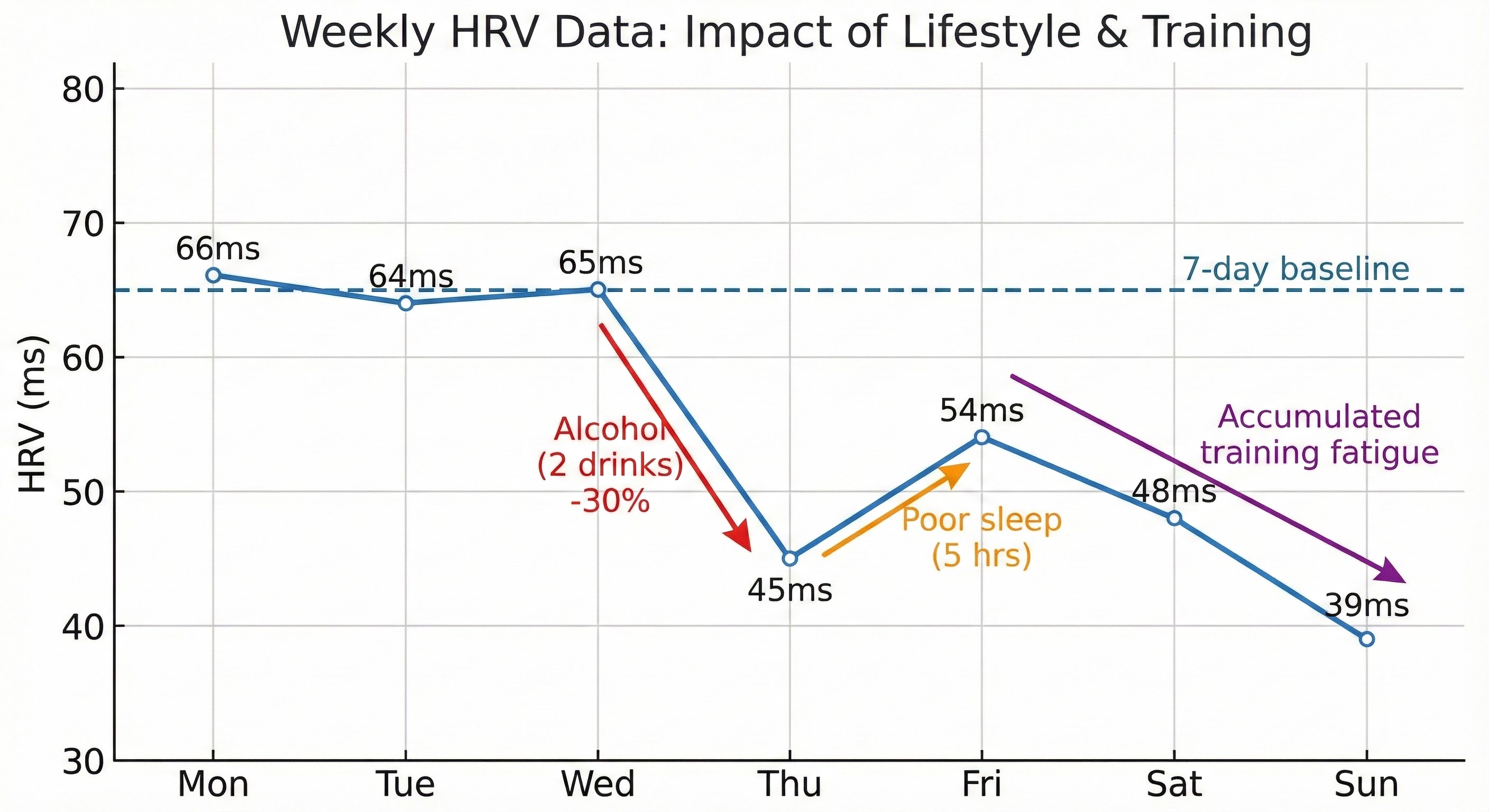
A 20% drop below your personal baseline is the warning signal that demands attention. If your rolling average is 65ms and you wake up at 52ms, your body is telling you something important regardless of whether 52 is “good” by some external standard. Conversely, readings at or above your baseline indicate readiness to train hard and absorb adaptation stress.
Most wearable devices handle this contextualization automatically, presenting recovery scores or readiness percentages rather than raw HRV numbers. Whoop uses a 0-100% recovery score derived from HRV along with sleep and other factors. Oura Ring provides daily “Readiness” scores. Apple Watch shows HRV trends relative to your history. These processed metrics are more actionable than raw numbers for most users, though serious athletes often benefit from tracking the underlying HRV data to understand what drives their scores.
Consistency in measurement timing matters enormously. HRV fluctuates throughout the day based on meals, activity, stress, and circadian rhythms. Morning measurements taken immediately upon waking, before getting out of bed, before coffee, and before checking stressful emails, provide the most reliable and comparable data points. Evening readings or random measurements throughout the day introduce too much noise to be useful for training decisions.
What Tanks Your HRV (And How Fast It Rebounds)
Understanding the factors that suppress HRV helps you distinguish between genuine overtraining signals and explainable acute stressors. Some HRV drops are warnings to back off; others are expected responses to known inputs that will resolve quickly.
Alcohol is the single most potent HRV suppressor for most people. Even two drinks can drop HRV by 20-40% that night and into the following day. The mechanism involves sympathetic activation as your liver metabolizes ethanol, suppression of REM sleep, dehydration, and inflammatory responses. Research published in the Journal of Clinical Sleep Medicine demonstrated that alcohol consumption reduced HRV during sleep even at moderate doses, with effects persisting for 24-48 hours depending on amount consumed. If you had drinks last night and your HRV is tanked this morning, that’s explanatory data, not a training emergency. For more on managing alcohol’s effects on your body, see our guide on alcohol recovery and HRV.
Late eating suppresses HRV because digestion is metabolically demanding. Eating a large meal within 2-3 hours of sleep keeps your heart rate elevated and your sympathetic system active as your body processes nutrients. A 2019 study in Nutrients found that late-night eating significantly reduced nocturnal HRV compared to earlier meal timing. The fix is simple: finish eating at least 3 hours before bed, especially if tomorrow is a key training day.
Poor sleep directly impacts HRV because sleep is when your parasympathetic system should dominate and your body should recover. Reduced sleep duration, fragmented sleep, or sleep that’s missing key stages (particularly deep sleep and REM) all suppress morning HRV. Most wearables track sleep quality alongside HRV for this reason, as the two metrics are deeply interrelated.
Training load obviously affects HRV. Hard workouts appropriately stress the body, temporarily suppressing HRV as part of the adaptation signal. This is normal and expected. The concern arises when HRV stays suppressed for multiple days after training, indicating incomplete recovery. A single low reading after a hard session is fine; three consecutive low readings suggest you’re accumulating fatigue faster than you’re recovering.
Illness often causes HRV to drop 24-48 hours before you feel symptoms. Your immune system activation triggers inflammatory responses that the autonomic nervous system detects before your conscious awareness catches up. This “early warning” function is one of HRV’s most valuable applications. If your HRV suddenly tanks without obvious explanation (no alcohol, good sleep, reasonable training), consider that you may be fighting off a bug and act accordingly.
The Traffic Light System: Training Based on HRV
Raw HRV data becomes actionable through decision frameworks. The most widely used approach is a simple traffic light system that matches training intensity to recovery status. While various coaches and apps implement slight variations, the core logic remains consistent across methodologies.
Green (at or above baseline): Your nervous system has recovered from previous stressors and is ready to absorb new training load. This is when you do your hardest sessions: high-intensity intervals, heavy strength training, competitive efforts, or any workout that creates significant physiological stress. These sessions require recovery capacity, and green status indicates you have it available.
Yellow (5-15% below baseline): You’re in a gray zone where caution is warranted. The nervous system is somewhat suppressed but not critically so. Training can proceed, but dial back intensity. Focus on aerobic work, technical skill development, mobility, or moderate strength training at reduced loads. Avoid maximum efforts that require full recovery capacity. Think of yellow as a day to maintain fitness without digging a deeper recovery hole.
Red (more than 15-20% below baseline): Your body is sending a clear signal that it needs rest, not more stress. Hard training in this state doesn’t just fail to produce adaptation; it actively causes harm by accumulating fatigue, increasing injury risk, and potentially pushing you toward overtraining syndrome. Red status calls for active recovery (walking, gentle mobility work), extra sleep, and addressing whatever suppressed your HRV in the first place.
The percentages vary by individual and context. Elite athletes with years of data might fine-tune their thresholds based on experience. Beginners should err on the conservative side, treating anything below baseline as a yellow or red signal until they understand their personal patterns. The key insight is that training is only productive when your body can recover from it. Pushing through red signals is how dedicated athletes end up injured, sick, or burnt out.
Some coaches advocate for “HRV-guided training” taken to its logical extreme: never planning workouts in advance, instead deciding each morning based on that day’s reading. This approach maximizes responsiveness but sacrifices the periodization structure that many athletes need for psychological preparation and logistical planning. A middle path, having a training plan but being willing to swap sessions based on recovery status, captures most of the benefit while maintaining structure.
Training Your HRV: The Vagal Nerve Connection
HRV isn’t just something that happens to you; it’s trainable. The parasympathetic nervous system operates primarily through the vagus nerve, a sprawling neural highway that connects your brain to your heart, lungs, gut, and other organs. Vagal tone, the baseline activity level of this nerve, largely determines your resting HRV. Higher vagal tone means higher HRV, better stress resilience, and faster recovery.
Resonance frequency breathing is the most direct intervention for improving vagal tone and raising baseline HRV. This technique involves breathing at a specific rate, typically 5.5-6 breaths per minute (inhale for 5 seconds, exhale for 5 seconds), that synchronizes heart rate oscillations with respiratory oscillations. When these rhythms align, they amplify each other in a phenomenon called respiratory sinus arrhythmia, creating a “workout” for the parasympathetic nervous system.
Research published in Applied Psychophysiology and Biofeedback demonstrated that regular resonance breathing practice (10-20 minutes daily for 4-10 weeks) significantly increased resting HRV and improved stress resilience. The effects aren’t immediate; like physical training, vagal toning requires consistent practice over weeks to produce measurable adaptations. Apps like Elite HRV, Breathe+, and others provide guided resonance breathing sessions with visual pacing cues.
Cold exposure also stimulates vagal tone, though through different mechanisms. The “dive reflex” triggered by cold water on the face activates parasympathetic pathways that slow heart rate and increase HRV. Regular cold exposure (cold showers, ice baths, cold plunges) appears to train this response, improving baseline vagal tone over time. If you’re already practicing deliberate cold exposure for other benefits, enhanced HRV is an additional adaptation to expect.
Aerobic fitness correlates strongly with HRV. Endurance training increases stroke volume (the amount of blood pumped per heartbeat), allowing the heart to deliver the same cardiac output with fewer beats. This efficiency reduces resting heart rate and increases the parasympathetic influence on heart rhythm, raising HRV. Consistent aerobic training over months produces measurable HRV improvements independent of other interventions.
Sleep optimization has profound effects on HRV because the deepest parasympathetic activation occurs during sleep. Improving sleep quality through consistent timing, optimal sleep environment, and addressing sleep disorders directly raises HRV. For many people, sleep improvement produces larger HRV gains than any other single intervention.

Practical Implementation: Getting Started with HRV
If you’re new to HRV tracking, the barrier to entry has never been lower. Most modern fitness wearables include HRV measurement, though quality and methodology vary. Here’s how to establish a useful HRV practice:
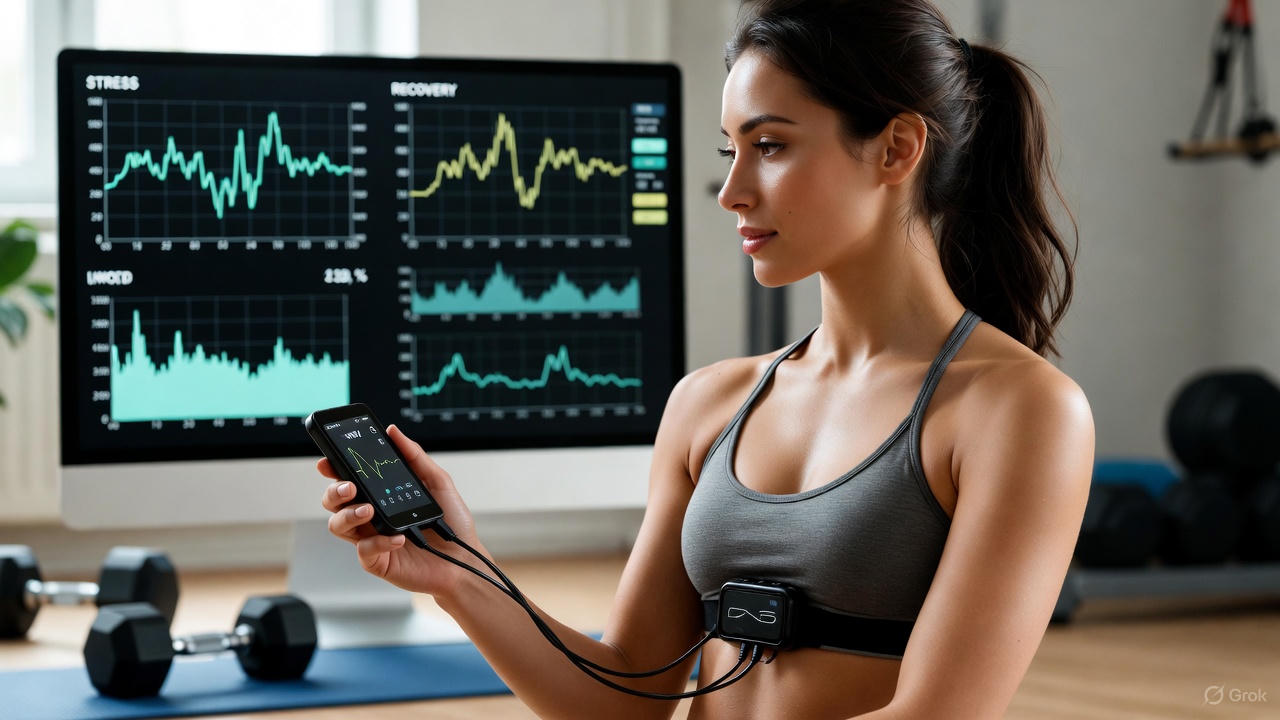
Choose your device. The gold standard for HRV measurement remains a chest strap heart rate monitor paired with a dedicated HRV app (Elite HRV, HRV4Training). Chest straps detect the electrical signal directly and provide medical-grade accuracy. Wrist-based optical sensors (Apple Watch, Oura Ring, Whoop, Garmin) are less accurate but more convenient for daily tracking. For training decisions, the convenience of wrist-based devices usually outweighs the accuracy advantage of chest straps.
Establish measurement protocol. Measure every morning, immediately upon waking, before getting out of bed. Empty your bladder first if needed, but don’t eat, drink coffee, or check your phone before measuring. Lie still for 1-3 minutes (device-dependent) in a consistent position. Morning-to-morning consistency matters more than the specific protocol, so whatever routine you establish, maintain it.
Build baseline data. Your first 1-2 weeks of data are for establishing baseline, not making training decisions. Don’t panic at day-to-day variation; this is exactly what HRV measures. After 7-14 days of consistent measurement, your rolling average becomes meaningful, and deviations from it become actionable.
Start conservative. When you first begin using HRV for training decisions, err on the side of caution. Treat yellow readings as red until you understand your personal patterns. Some people have naturally high day-to-day variability; others are remarkably stable. Understanding your personal variation prevents both under-responding and over-responding to daily fluctuations.
Track context. Most HRV apps allow notes or tags for each reading. Record anything relevant: alcohol consumption, poor sleep, hard training, illness, travel, stress events. Over time, this context data reveals your personal HRV triggers and helps distinguish signal from noise.
Be patient. HRV-guided training produces benefits over months and years, not days. The athletes who’ve used HRV successfully have typically done so for years, accumulating data and refining their understanding of personal patterns. Quick wins are possible (catching illness early, avoiding a breakdown workout), but the real value compounds over extended consistent use.
The Bottom Line
HRV transforms training from guesswork into science. Instead of wondering whether you’re recovered enough for today’s hard session, you have data. Instead of pushing through fatigue until injury or illness forces rest, you have early warning. Instead of accepting your stress resilience as fixed, you have trainable interventions.
Your HRV action plan:
- Start measuring. Use whatever device you have access to. Consistency matters more than accuracy, so pick something you’ll actually use every morning.
- Build baseline. Track for 2 weeks before making training decisions based on the data. Note context factors (sleep, alcohol, training) alongside readings.
- Apply the traffic light. Green (baseline or above) means train hard. Yellow (slightly below) means train easy. Red (significantly below) means rest and recover.
- Train your vagal tone. Add 10-20 minutes of resonance breathing (5.5-6 breaths per minute) several times per week. Consider cold exposure if it fits your lifestyle.
- Play the long game. HRV’s value compounds with consistent use over months and years. Trust the data, respect the signals, and watch your training become more effective with fewer setbacks.
You don’t get fitter when you train. You get fitter when you recover from training. HRV tells you when that recovery has happened and when you’re just digging a deeper hole. Listen to it.
Sources: Journal of Clinical Sleep Medicine on alcohol and HRV, Nutrients on meal timing and HRV (2019), Applied Psychophysiology and Biofeedback on resonance frequency breathing, European Journal of Applied Physiology on HRV and training adaptation, Whoop and Oura Ring validation studies, Dr. Andrew Huberman protocols on vagal tone training.