The phenomenon psychologists call “regression” explains why even the most emotionally sophisticated adults sometimes feel like teenagers again at family gatherings. You walk through your parents’ front door, smell the familiar cooking, and within minutes find yourself reacting to old patterns with an intensity that surprises you. The criticism that would roll off your back from a colleague somehow lands with devastating force when delivered by a sibling. The passive-aggressive comment that you’d easily deflect at work triggers a defensive spiral that can consume an entire holiday meal.
This regression isn’t weakness or immaturity; it’s a neurological reality. Your childhood home, the voices of family members, and even specific holiday foods activate neural pathways laid down decades ago. These pathways were formed before your prefrontal cortex fully developed, before you learned the emotional regulation strategies you now use daily. When surrounded by the sensory cues of your childhood, your brain partially bypasses the adult coping mechanisms you’ve built, dropping you into older, more reactive patterns of response.
Understanding this process is the first step toward managing it. Boundaries with family feel difficult precisely because the stakes seem higher than in other relationships. These people shaped who you are, for better or worse. Their opinions matter in ways that colleagues’ and friends’ opinions don’t. And unlike workplace conflicts that end at 5 PM, family stress follows you into the night, replaying in your mind as you try to sleep in your childhood bedroom or the hotel you booked specifically to have an escape.
The strategies outlined below draw from evidence-based therapeutic approaches including Dialectical Behavior Therapy (DBT), Internal Family Systems, and assertiveness training. They won’t transform your family into a conflict-free unit, but they will help you navigate the holiday season with your peace and relationships more intact than if you simply white-knuckled through each gathering hoping for the best.
The Neuroscience of Family Triggers
Before developing boundary strategies, understanding why family interactions trigger such intense responses helps contextualize the challenge. Your brain processes familiar family members differently than it processes strangers or even close friends. The neural networks associated with family were formed during critical periods of development when your brain was exceptionally plastic and when the opinions of caregivers literally determined your survival.
Mirror neurons, the cells that fire both when we perform an action and when we observe someone else performing it, are particularly active in family settings. When your mother sighs disapprovingly, your brain partially simulates that disappointment as if you were experiencing it yourself. When your brother rolls his eyes, your brain registers the dismissal almost as intensely as if you’d been explicitly criticized. This mirroring happens automatically and below conscious awareness, which is why family members can “get to you” without saying anything explicitly offensive.
The amygdala, the brain’s threat-detection center, holds emotional memories from early life that influence current reactions. If criticism from your father preceded punishment or withdrawal of affection in childhood, your adult amygdala still flags his critical comments as potential threats. The stress response activates before your rational cortex can evaluate whether the current criticism actually threatens anything important. You’re flooded with adrenaline and cortisol before you’ve consciously processed the comment, making a measured response nearly impossible.
Research from UCLA’s Social Cognitive Neuroscience Laboratory demonstrates that social rejection activates the same brain regions as physical pain. The dorsal anterior cingulate cortex, which lights up when you stub your toe, also activates when you experience social exclusion or criticism from people who matter. Family criticism hurts more than stranger criticism not because you’re being oversensitive, but because your brain literally processes it as more painful.
This neurological reality suggests that traditional advice to “just let it go” or “stop caring what they think” fundamentally misunderstands the challenge. Your caring is wired in at a level beneath conscious choice. The strategies that work acknowledge this wiring rather than fighting it, focusing on managing your responses to inevitable activation rather than somehow eliminating the activation itself.

The “I Statement” Shield: Assertiveness Without Attack
When tensions rise at family gatherings, often over politics, lifestyle choices, or parenting decisions, the natural response is defensive. We want to argue facts, to prove the other person wrong, to win the debate. But facts rarely resolve emotional conflicts, and winning arguments with family members typically means losing the relationship, at least for the remainder of the holiday.
The “I Statement” technique from assertiveness training redirects conflict without escalation by focusing on your experience rather than the other person’s behavior. Instead of “You’re wrong about that,” which invites argument, you say, “I feel overwhelmed when we discuss this topic, and I need to take a break from it to enjoy our time together.” Instead of “You always criticize my career choices,” you say, “I notice I’m getting defensive, and I’d rather hear about what’s new in your life.”
The structure is simple: I feel [emotion] when [situation], and I need [request]. The power lies in its incontestability. No one can argue with how you feel. You’re not attacking their position or behavior; you’re owning your reaction and making a clear request. Even the most argumentative family member finds it difficult to respond with “No, you don’t feel that way.”
Practical implementation requires preparation. Before the gathering, identify your most likely trigger topics and prepare I Statements for each. If you know your aunt will ask about your relationship status, prepare: “I appreciate that you care about my happiness. I feel a bit put on the spot when this comes up at family events, and I’d love to talk about something else right now.” If political debates reliably derail Thanksgiving, prepare: “I notice these discussions usually lead to hurt feelings for everyone. I’d rather focus on what we have in common today.”
The key word is “and,” not “but.” Saying “I appreciate your concern, but I’d rather not discuss this” subtly negates the appreciation. Saying “I appreciate your concern, and I’d rather focus on something else” maintains both truths simultaneously. This linguistic nuance significantly affects how your statement lands.
The Grey Rock Method: Disengaging from Drama
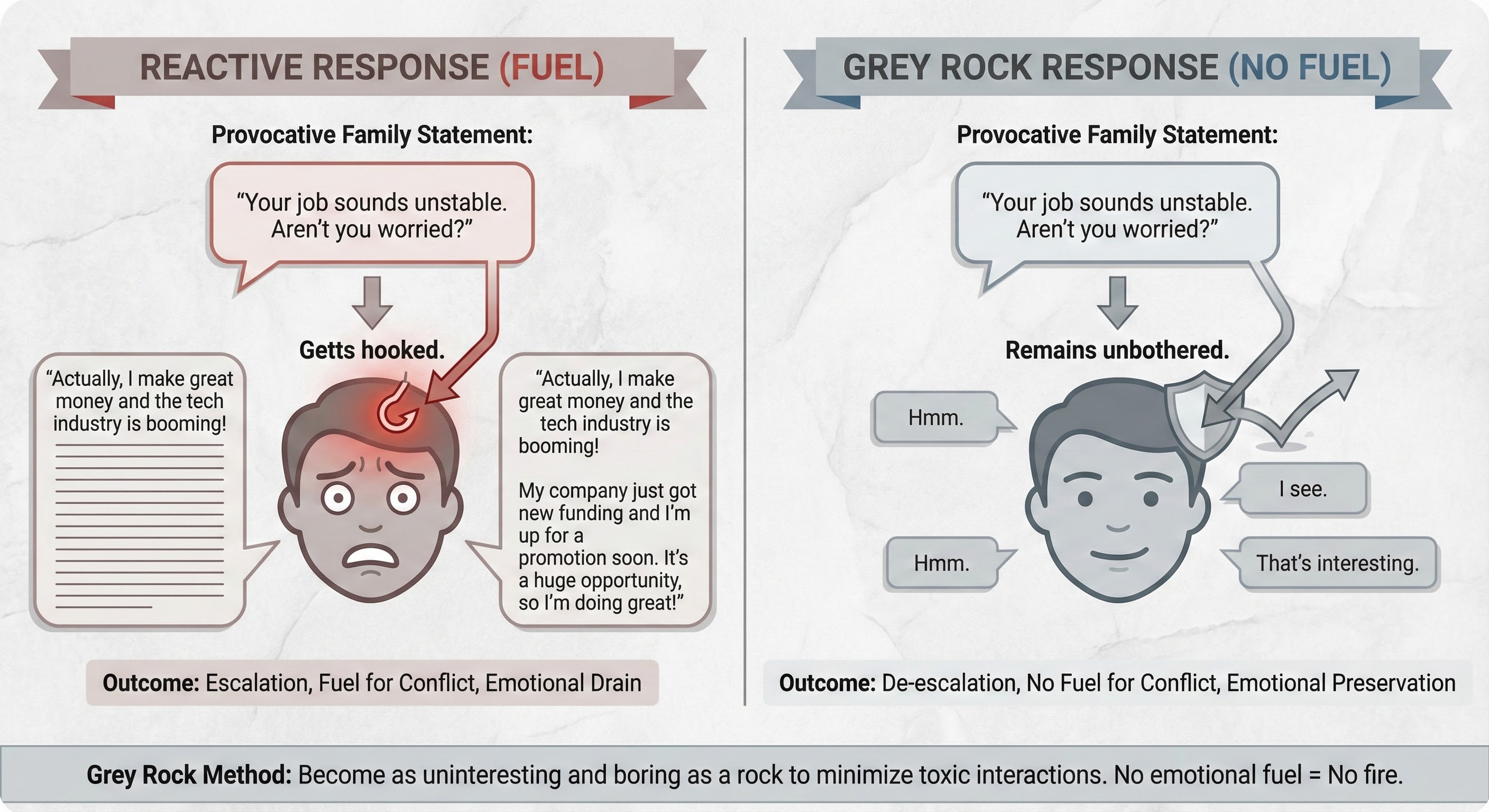
Some family members seem to thrive on conflict. They probe for reactions, make provocative statements, and seem energized by the drama they create. Whether this pattern reflects narcissistic tendencies, unresolved personal issues, or simple boredom, engaging with it on its terms ensures you’ll leave every gathering exhausted and emotionally depleted.
The Grey Rock method, developed in the context of managing relationships with individuals who have personality disorders, provides a strategy for disengaging without open conflict. The goal is to become as boring and unreactive as a grey rock, providing no emotional feedback that could fuel continued provocation.
Implementation involves keeping responses short, neutral, and non-committal. When the drama-seeking family member makes a provocative statement about your life choices, respond with “Interesting,” “I see,” or simply “Hmm.” Do not explain yourself. Do not defend your position. Do not offer personal details they could use as ammunition later. When they press for more reaction, repeat your neutral response without elaboration.
The technique works because drama-seekers need fuel. Your emotional reaction, whether positive or negative, provides that fuel. Outrage, defensiveness, even enthusiastic agreement gives them something to work with. Neutral responses offer nothing. Without fuel, most drama-seekers eventually lose interest and move to another target or topic.
Grey Rock is particularly useful when the I Statement approach might escalate things further. Some family members interpret any expression of feelings or needs as weakness to exploit or as a new avenue of attack. With these individuals, providing less information proves more protective than asserting boundaries directly. You’re not giving them the satisfaction of knowing they got to you, and you’re not providing material for their next volley.
The technique does require practice because neutral responses feel unnatural during emotional activation. Role-play challenging scenarios before the gathering, practicing your neutral delivery until it feels automatic. When the actual moment comes and your amygdala is firing, you’ll have the muscle memory to fall back on.
The Exit Strategy: Planned Escapes
Feeling trapped amplifies anxiety. When you’re stuck in a difficult conversation with no way out, your stress response intensifies because the threat seems inescapable. Conversely, simply knowing that you can leave if needed dramatically reduces anxiety, even if you never actually exercise that option. The exit strategy isn’t about running from problems; it’s about maintaining the psychological safety that allows you to engage more calmly.
The Micro-Exit is your first-line escape valve. Before stress accumulates to intolerable levels, extract yourself briefly with a socially acceptable excuse. “I’m going to step outside for a few minutes of fresh air.” “I need to make a quick phone call.” “I’ll take a short walk to help digest.” These brief departures, typically 10 to 15 minutes, allow your nervous system to reset before returning to the gathering. Use the time for deep breathing, a quick call to a supportive friend, or simply standing in silence away from the sensory triggers inside.
The key is using the Micro-Exit before you explode, not after. Pay attention to your early warning signs: increased heart rate, muscle tension, the urge to argue, that familiar sinking feeling in your stomach. When you notice these signals, excuse yourself immediately rather than pushing through. Waiting until you’re fully flooded makes calm return nearly impossible without a much longer recovery period.
The Macro-Exit requires advance planning. Whenever possible, maintain control of your own transportation. If you drove separately, you can leave when you need to rather than waiting for others. If you’re staying with family, have a backup plan like a hotel reservation, a friend’s house, or even knowing which nearby hotels have availability. The mere existence of this option reduces anxiety even if you never use it.
For overnight stays, establish a morning routine that provides structured alone time. “I’m an early riser, and I’ll be taking a walk at 7 AM before everyone wakes up.” “I have a morning meditation practice I need to maintain.” These protected hours ensure you start each day with some reserves rather than beginning the gauntlet already depleted.
Alcohol: The False Buffer
The temptation to use alcohol to “take the edge off” family stress is nearly universal. A glass of wine seems to smooth social interactions and quiet the internal critic that notices every slight. The first drink may indeed provide temporary relief as alcohol’s initial effects include mild euphoria and reduced anxiety.
However, alcohol as a coping mechanism for family stress creates more problems than it solves. The pharmacology is straightforward: alcohol suppresses the prefrontal cortex, your brain’s executive function center responsible for impulse control, judgment, and emotional regulation. These are precisely the faculties you need most during challenging family interactions. After a drink or two, the comment you would have let pass sober suddenly demands a response. The boundary you planned to hold firmly becomes negotiable. The exit you intended to take gets delayed because your judgment about what you can tolerate is impaired.
Research from Massachusetts General Hospital on alcohol and emotional reactivity shows that moderate alcohol consumption increases amygdala response to negative emotional stimuli. Rather than calming your threat-detection system, alcohol actually sensitizes it, making you more reactive to the provocations you’re trying to ignore. The subjective sense that alcohol helps reflects impaired metacognition, reduced awareness of your own emotional state, rather than actual improvement in that state.
The practical alternative involves having a drink in hand without relying on alcohol’s effects. Sparkling water with lime looks enough like a cocktail to avoid the “why aren’t you drinking?” interrogation. If you do drink, strict limits help: one drink maximum before dinner, alternating with water, and stopping alcohol entirely at least two hours before any conversation you know will be difficult. Your prefrontal cortex is too valuable a resource to chemically impair during these high-stakes interactions.
For those who find family gatherings genuinely require alcohol to be tolerable, this is worth examining more deeply. Our guide on tactical breathing techniques offers physiologically-based alternatives that calm the nervous system without the cognitive impairment that alcohol brings. Similarly, a brief digital detox before gatherings can reduce the baseline stress you bring into the room.
Post-Event Decompression: Returning to Baseline
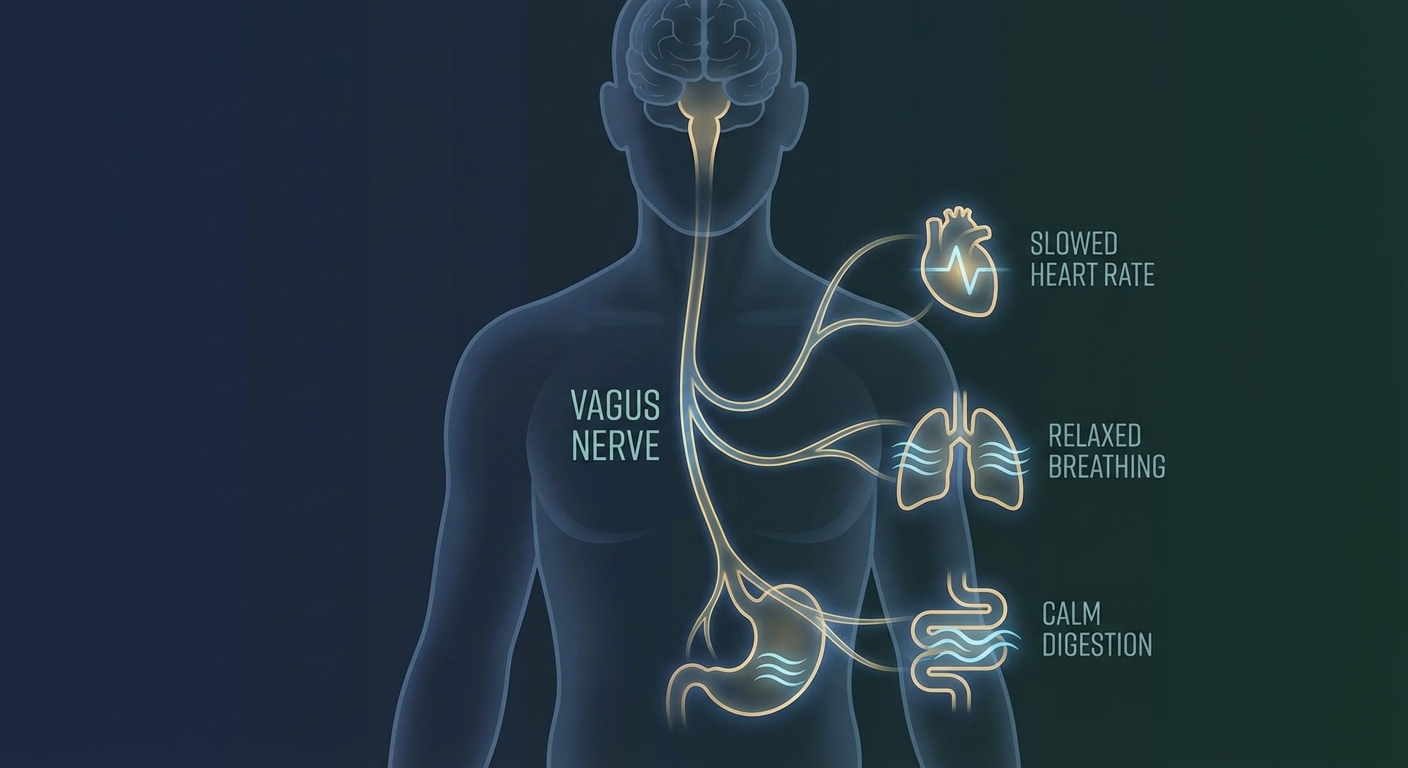
When you finally leave a stressful family gathering, the threat isn’t actually gone; it’s still running in your nervous system. You may feel “wired but tired,” hypervigilant despite being exhausted, unable to sleep despite desperately wanting to. This state reflects a sympathetic nervous system that hasn’t received the “all clear” signal that allows parasympathetic recovery mode to take over.
Planned decompression rituals provide that signal. The transition from family space to safe space should be marked by physical actions that tell your nervous system the threat has passed. Change your clothes, specifically into items that are only worn at home. Take a hot shower, which both physically relaxes muscles and symbolically washes off the event. Perform a brief breathing exercise: four counts in, seven counts hold, eight counts out, repeated four to six times.
Verbal processing helps discharge residual activation. Call a trusted friend, partner, or therapist who has agreed in advance to be available. Narrating what happened externalizes the experience, moving it from a swirl of internal activation to an organized story that your brain can begin to file away. This isn’t the same as venting, which can sometimes reinforce and amplify distress. Effective processing includes both describing what happened and identifying what strategies worked or didn’t work.
Sleep is the ultimate nervous system reset, but stress often disrupts it precisely when you need it most. Prepare for this by having your sleep environment optimized in advance. Blackout curtains or a sleep mask, earplugs if needed, room temperature around 65-68 degrees. Avoid screens for the hour before bed, as the blue light disrupts melatonin production and the content often reactivates the mind. Consider a guided body scan meditation or progressive muscle relaxation recording to help shift from sympathetic to parasympathetic dominance.
The goal isn’t to pretend the stress didn’t happen or to judge yourself for finding family gatherings difficult. The goal is to process and recover efficiently so that residual activation doesn’t compound across multiple holiday events. Each gathering metabolized and released is one that doesn’t add to a cumulative burden that could otherwise build to a breaking point.

Building Long-Term Resilience
Individual gatherings become more manageable when embedded within a larger context of emotional resilience. The coping strategies above are essentially acute interventions, useful for surviving specific stressful events. Longer-term work on family dynamics, your own emotional patterns, and the relationship between past and present can gradually reduce how triggered you become in the first place.
Consider therapy between holiday seasons, not just when you’re in crisis. Modalities like Internal Family Systems (IFS) help identify the younger parts of yourself that are activated by family dynamics and develop more productive relationships with those parts. EMDR (Eye Movement Desensitization and Reprocessing) can reduce the emotional charge of specific family memories that currently function as land mines. Even brief cognitive-behavioral work on distorted thinking patterns can shift how you interpret family members’ comments.
Regular mindfulness practice builds the meta-awareness that allows you to notice activation without being swept away by it. The meditator who has logged hundreds of hours observing thoughts and emotions has a fundamentally different relationship with their internal experience than someone who identifies completely with every feeling. This practice doesn’t make difficult emotions disappear, but it creates space between stimulus and response that enables choice rather than reaction.
Physical preparation matters too. The same nervous system that manages family stress also responds to sleep deprivation, blood sugar dysregulation, and caffeine overdose. Arriving at a family gathering already depleted from poor sleep, skipped meals, and excessive stimulants dramatically lowers your threshold for activation. Treating the days before major gatherings as preparation time, prioritizing sleep, eating regular meals, and moderating caffeine, sets you up for a calmer baseline from which to operate.
The Bottom Line
Your peace is ultimately your responsibility. You cannot change your family members, their opinions, their behavior patterns, or their capacity for self-reflection. What you can change is your response to them: the boundaries you set, the strategies you employ, the exits you take, and the recovery you practice afterward.
Boundaries are not walls. They don’t mean cutting off family or refusing to engage. They’re more like gates that allow you to control what comes in and what stays out. Setting a boundary isn’t selfish; it’s the prerequisite for sustainable relationship. A version of you that white-knuckles through every family gathering, accumulating resentment and exhaustion, isn’t capable of genuine connection anyway.
It’s okay to say no. It’s okay to leave early. It’s okay to skip certain events entirely if the cost to your mental health exceeds the benefit of attendance. These choices don’t mean you’ve failed at family; they mean you’ve chosen to protect something valuable, including your capacity to engage with family in the future.
Your Boundary-Setting Toolkit:
- Prepare I Statements in advance for predictable trigger topics
- Practice Grey Rock responses for drama-seeking family members
- Plan both Micro-Exits (brief breaks) and Macro-Exits (departure options)
- Limit alcohol to maintain prefrontal cortex function when you need it most
- Establish a post-event decompression ritual to signal safety to your nervous system
- Invest in therapy and mindfulness practice between holiday seasons
Sources: UCLA Social Cognitive Neuroscience Laboratory neuroimaging research, Dialectical Behavior Therapy assertiveness training protocols, Internal Family Systems therapy framework, Massachusetts General Hospital alcohol and emotional reactivity studies, Harvard Medical School stress physiology research.