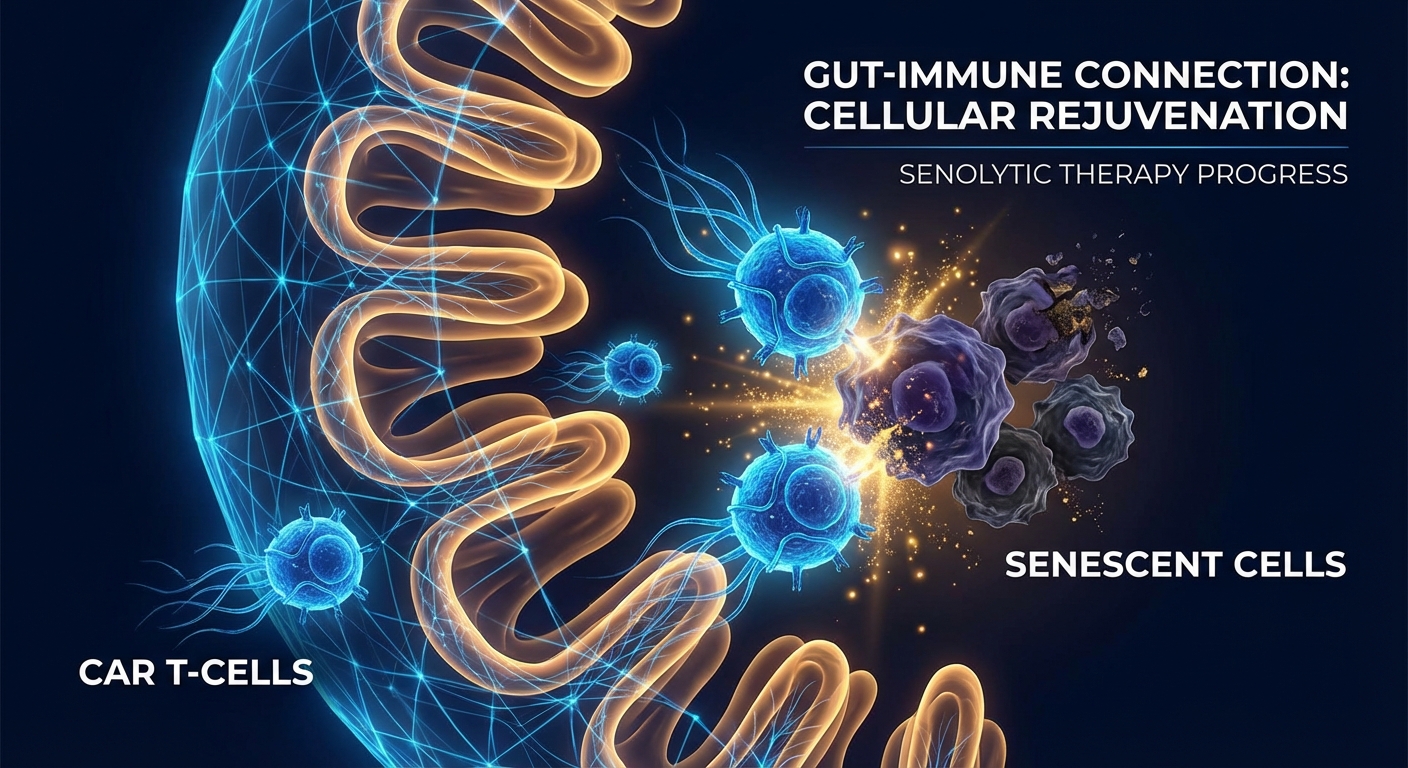
Your gut loses its regenerative power as you age, and scientists may have found a way to give it back. New research published in Nature Aging demonstrates that a single administration of CAR T-cell therapy can reverse age-related decline in intestinal function, with benefits lasting up to a year in mice. The treatment targets senescent cells, those damaged, inflammation-promoting cells that accumulate with age and impair the gut’s ability to heal itself.
This is not another incremental finding. The research from Cold Spring Harbor Laboratory and the Howard Hughes Medical Institute shows that engineered immune cells can restore gut barrier function, improve nutrient absorption, reduce chronic inflammation, and even protect against radiation damage. Perhaps most remarkably, these improvements persisted long after the initial treatment, suggesting a durable rejuvenation of intestinal tissue rather than a temporary fix.
For the millions of older adults struggling with digestive issues, nutrient deficiencies, and the cascade of health problems that stem from gut dysfunction, this research offers a glimpse of a future where cellular-level interventions might address root causes rather than just manage symptoms.
The Aging Gut Problem
Your intestinal lining is one of the most dynamic tissues in your body. The gut epithelium, the single layer of cells lining your digestive tract, completely regenerates every four to five days. This remarkable turnover is driven by intestinal stem cells (ISCs) that continuously divide and differentiate to maintain the gut barrier. When this system works well, your gut efficiently absorbs nutrients, keeps pathogens out, and communicates effectively with your immune system.
As you age, this regenerative machinery begins to falter. Intestinal stem cells lose their proliferative capacity, the gut barrier becomes “leaky,” and chronic low-grade inflammation sets in. The result is a cascade of problems that extend far beyond digestion. Poor nutrient absorption can lead to deficiencies that affect everything from bone density to cognitive function. Increased intestinal permeability allows bacterial products to enter the bloodstream, contributing to systemic inflammation that accelerates aging throughout the body.
The gut microbiome, that community of trillions of bacteria that plays a crucial role in health, also shifts unfavorably with age. Research has shown that while healthy centenarians tend to maintain more “youthful” microbiome profiles with greater diversity, most aging individuals experience a decline in beneficial bacteria and an increase in opportunistic pathogens. This dysbiosis, or microbial imbalance, creates a feedback loop that further impairs gut function. Understanding the gut-brain axis and its role in health provides important context for why intestinal function matters so much for overall wellness.
What drives this decline? One key culprit appears to be cellular senescence, a state in which damaged cells stop dividing but refuse to die. These “zombie cells” accumulate in aging tissues and secrete a cocktail of inflammatory molecules that damage surrounding healthy cells. In the intestine, senescent cells appear to impair the stem cell niche, the microenvironment that supports intestinal stem cell function, leading to reduced regenerative capacity.

How CAR T-Cell Therapy Works
CAR T-cell therapy has revolutionized cancer treatment over the past decade. The approach involves extracting a patient’s T cells, the immune system’s primary attack cells, and genetically engineering them to recognize and destroy specific targets. In cancer, these engineered cells hunt down tumor cells marked by particular surface proteins. The same principle can be applied to senescent cells.
The researchers, led by Dr. Corina Amor Vegas at Cold Spring Harbor Laboratory in collaboration with Assistant Professor Semir Beyaz, focused on a protein called uPAR (urokinase plasminogen activator receptor). Previous research had identified uPAR as a marker of senescent cells, making it an ideal target for selective elimination.
The team developed anti-uPAR CAR T cells capable of recognizing and destroying uPAR-positive senescent cells while leaving healthy cells intact. When administered to aging mice, these engineered immune cells effectively cleared senescent cells from the intestinal tissue. Unlike small-molecule senolytic drugs that have shown promise but often lack specificity, CAR T cells can be precisely targeted and persist in the body as a living therapy.
“In both cases, we see really significant improvements,” Dr. Amor Vegas explained in a statement from Cold Spring Harbor Laboratory. “They’re able to absorb nutrients better. They have much less inflammation. When irritated or injured, their epithelial lining is able to regenerate and heal much faster.”
The elegance of this approach lies in its precision. CAR T cells function as a “living drug” that actively seeks out and eliminates specific targets. Once the senescent cells are cleared, the CAR T cells remain in the body at low levels, ready to eliminate any new senescent cells that arise. This creates what the researchers describe as prophylactic protection against future senescent cell accumulation.
The Study Results
The study, titled “Anti-uPAR CAR T cells reverse and prevent aging-associated defects in intestinal regeneration and fitness,” examined both therapeutic and prophylactic applications of the treatment. The findings exceeded expectations in several key areas.
In aged mice receiving anti-uPAR CAR T cells, the researchers observed comprehensive improvements in intestinal function. Gut barrier integrity improved significantly, meaning fewer bacterial products and toxins could escape into the bloodstream. The regenerative capacity of intestinal stem cells increased, allowing the gut lining to repair itself more effectively after injury. Chronic inflammation, a hallmark of the aging gut, decreased substantially.

The improvements extended to the gut microbiome. Treated mice showed more favorable microbial compositions, with increases in beneficial bacteria and decreases in potentially harmful species. This microbiome restoration suggests that removing senescent cells helps recreate a healthier environment for beneficial gut bacteria to thrive.
Perhaps most striking was the durability of these benefits. A single administration of CAR T cells improved gut health for at least one year, a significant portion of a mouse’s lifespan. The CAR T cells persisted at low levels in the treated animals, providing ongoing surveillance and elimination of any newly arising senescent cells.
The team also investigated whether CAR T cells could protect against radiation-induced intestinal damage, a common and often severe side effect of cancer treatment. Mice pre-treated with anti-uPAR CAR T cells showed significantly better outcomes after radiation exposure, maintaining gut function that would otherwise be severely compromised.
Beyond mice, the researchers demonstrated that anti-uPAR CAR T cells could effectively target senescent cells in human intestinal organoids, miniature gut models grown from human cells. This suggests the approach may translate to human applications, though significant research remains before clinical trials.
Why This Matters for Human Aging
The implications of this research extend well beyond the gut itself. The intestine serves as a critical interface between the external environment and the rest of the body. About 70% of your immune system resides in or around the gut, and the gut-brain axis, the bidirectional communication pathway between your digestive system and your brain, influences everything from mood to cognitive function.
Age-related gut dysfunction contributes to a vicious cycle of declining health. Poor nutrient absorption leads to deficiencies in vitamins, minerals, and amino acids essential for maintaining muscle, bone, and brain health. Increased intestinal permeability allows inflammatory molecules to enter systemic circulation, contributing to conditions ranging from cardiovascular disease to neurodegeneration. Microbiome dysbiosis impairs immune function and may accelerate cognitive decline through the gut-brain axis.
Research on centenarians and healthy aging populations has consistently highlighted the importance of gut health. Studies of individuals who surpass 100 years of age have found that they tend to maintain gut microbiomes that more closely resemble those of younger adults, with greater diversity and higher proportions of beneficial bacteria that produce anti-inflammatory compounds. The ability to maintain gut health may be one of the distinguishing factors between healthy longevity and declining health in later life.
If CAR T-cell therapy can restore youthful gut function in humans as effectively as it does in mice, the downstream benefits could be substantial. Improved nutrient absorption could help prevent age-related muscle loss (sarcopenia), maintain bone density, and support cognitive function. Research on muscle mass and brain aging has highlighted the interconnected nature of these systems. Reduced intestinal inflammation could lower systemic inflammatory markers associated with age-related diseases. A healthier gut microbiome could enhance immune function and resilience against infections.

Current Limitations and Future Directions
While the research is promising, significant hurdles remain before CAR T-cell therapy for aging could reach clinical use. The therapy currently requires extracting a patient’s T cells, engineering them in a specialized facility, and reinfusing them. This process is expensive, time-consuming, and requires sophisticated medical infrastructure. For cancer patients with life-threatening diseases, these barriers are justifiable. For treating aging-related gut dysfunction, the economics and accessibility present challenges.
Safety considerations also require careful evaluation. CAR T-cell therapy can cause cytokine release syndrome, a potentially dangerous inflammatory response, as well as neurotoxicity in some patients. While the anti-uPAR approach appears well-tolerated in preclinical studies, extensive safety testing in humans will be necessary.
The researchers are exploring ways to make the therapy more accessible. One avenue involves developing “off-the-shelf” CAR T cells derived from healthy donors that could be manufactured at scale and administered without the need for personalized cell engineering. Another approach involves identifying small molecules or other interventions that might mimic the benefits of senescent cell clearance without requiring cell therapy.
Alternative senolytic approaches are also advancing rapidly. Small-molecule senolytics, combinations of drugs that selectively kill senescent cells, have shown promise in preclinical studies and early human trials. While these drugs may lack the precision of CAR T cells, they offer advantages in terms of cost, ease of administration, and scalability. Future treatments might combine approaches, using broad senolytics for initial clearance followed by CAR T cells for ongoing surveillance.
The gut may be just the beginning. Senescent cells accumulate throughout the body with age, contributing to dysfunction in organs from the heart to the brain. If the principles demonstrated in this research prove generalizable, targeted senolytic therapies could eventually address aging at multiple sites simultaneously.
What You Can Do Now
While CAR T-cell therapy for aging remains years from clinical availability, the research underscores the importance of gut health for overall wellness as you age. Evidence-based strategies can help maintain gut function and potentially slow the accumulation of senescent cells.
Dietary approaches play a central role in gut health maintenance. Fiber-rich foods, particularly those containing prebiotic fibers like inulin and resistant starch, feed beneficial gut bacteria and promote the production of short-chain fatty acids that nourish intestinal cells. Studies of longevity populations consistently find high intake of diverse plant foods, as explored in research on fiber as the new protein for gut health. Fermented foods like yogurt, kefir, sauerkraut, and kimchi provide beneficial bacteria directly and have been associated with improved gut health markers.
Regular physical activity has been shown to favorably modify gut microbiome composition and reduce systemic inflammation. Even moderate exercise, such as regular walking, provides benefits. Research suggests that exercise increases gut microbial diversity and promotes the growth of bacteria that produce beneficial metabolites.
Managing chronic stress matters because the gut-brain axis operates bidirectionally. Chronic psychological stress can impair gut barrier function and promote unfavorable shifts in the microbiome. Practices like adequate sleep, stress management techniques, and maintaining social connections may indirectly support gut health.
Avoiding known gut-damaging factors also helps preserve intestinal function. Excessive alcohol consumption, chronic use of certain medications (particularly NSAIDs and antibiotics when not medically necessary), and highly processed diets have all been associated with gut barrier dysfunction and microbiome disruption.
The Bottom Line
The discovery that CAR T-cell therapy can reverse age-related gut dysfunction represents a significant advance in our understanding of how to address aging at the cellular level. By selectively eliminating senescent cells, researchers restored gut regeneration, reduced inflammation, improved nutrient absorption, and favorably shifted the microbiome in aging mice, with benefits lasting up to a year from a single treatment.
While this therapy remains in preclinical stages, the research validates the broader concept that targeting senescent cells can rejuvenate aging tissues. As the technology develops and becomes more accessible, it may eventually offer a way to address one of the root causes of age-related decline rather than simply managing symptoms.
In the meantime, the findings reinforce what we already know about the importance of gut health for healthy aging. The interventions available today, including fiber-rich diets, fermented foods, regular exercise, and stress management, work through some of the same pathways that CAR T-cell therapy targets. While they may not eliminate senescent cells directly, they can help create an environment less conducive to cellular damage and more supportive of ongoing gut regeneration.
Next Steps:
- Prioritize gut health through daily fiber intake (aim for 25-35g from diverse plant sources)
- Include fermented foods regularly (1-2 servings daily of yogurt, kefir, or fermented vegetables)
- Maintain regular physical activity (at least 150 minutes moderate activity weekly)
- Follow ongoing research in senolytics, as this field is advancing rapidly toward clinical applications
Sources: Nature Aging (January 2026), Cold Spring Harbor Laboratory, Journal of Biomedical Science 2025, Frontiers in Microbiology 2025, PLOS Biology 2025.