In the landscape of mental health advice, “practice gratitude” often sounds like toxic positivity wearing a therapeutic mask. When you’re struggling with anxiety, depression, or the accumulated stress of modern life, being told to “focus on the positive” can feel dismissive, a suggestion to paper over genuine pain with forced optimism. Critics rightfully note that gratitude culture can shame people for their suffering, implying that if you’re unhappy, you’re simply not grateful enough.
But neuroscientists view gratitude through an entirely different lens. Far from being about ignoring negative experiences, gratitude practice is a cognitive training protocol that structurally reorganizes the brain. The same neuroplasticity that allows learning a language or mastering an instrument applies to emotional processing. Gratitude practice doesn’t make your problems disappear; it changes how your brain processes and responds to both problems and opportunities, building resilience that operates below conscious awareness.
The evidence for gratitude’s neurological effects is substantial and growing. Neuroimaging studies demonstrate measurable changes in brain activity and structure after consistent practice. Randomized controlled trials show improvements in depression, anxiety, and life satisfaction that persist long after the intervention ends. This isn’t wishful thinking or self-help fluff; it’s a trainable skill with documented biological mechanisms that anyone can develop.
The Negativity Bias: Understanding What You’re Working Against
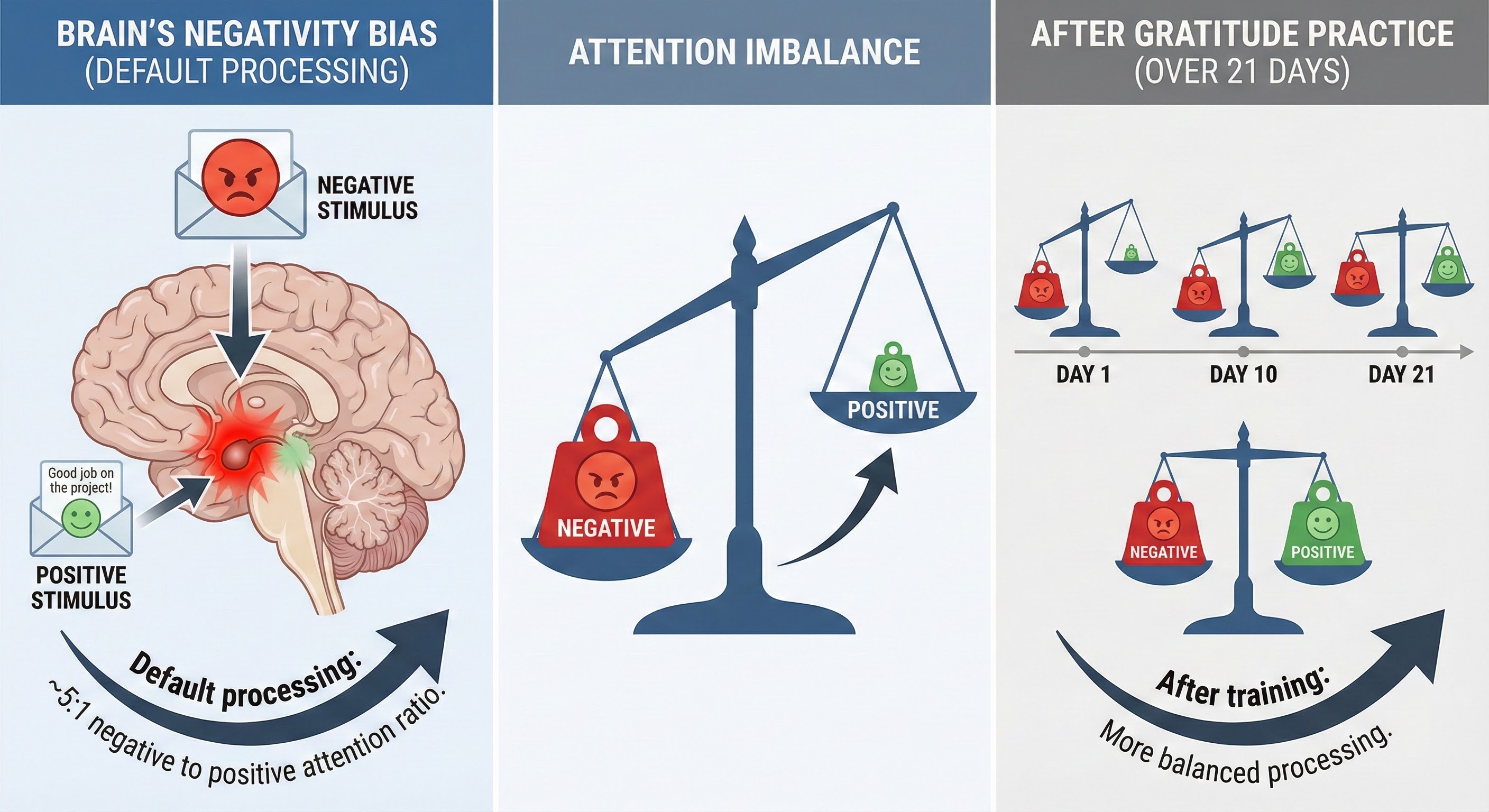
Your brain evolved to survive, not to flourish. For the vast majority of human history, noticing threats was more critical than appreciating beauty. The ancestor who failed to notice the tiger in the bushes was removed from the gene pool; the ancestor who failed to appreciate the sunset merely missed an aesthetic experience. This asymmetry produced the “negativity bias,” a fundamental feature of human cognition where negative information receives preferential processing.
Neuroimaging research demonstrates that negative stimuli produce larger and more rapid amygdala activation than positive stimuli of equivalent intensity. Your brain literally responds faster and more strongly to threats than to rewards. This bias extends to attention, memory, and decision-making: negative events are noticed more quickly, remembered more vividly, and weighted more heavily in judgments than comparable positive events.
The negativity bias was adaptive in ancestral environments where most threats were physical and immediate. But in modern life, where physical threats are rare but psychological stressors are constant, this same bias becomes maladaptive. Your brain treats the angry email with the same threat-processing architecture it would use for a predator attack. The result is chronic activation of stress systems designed for acute threats, contributing to the anxiety and rumination that characterize modern mental health challenges.
Gratitude practice is essentially a counter-programming for this bias. By repeatedly directing attention toward positive aspects of experience, you’re not denying the negative; you’re providing balance to a system that’s inherently skewed toward threat detection. The goal isn’t to stop noticing problems but to also notice what’s working, what you have, what’s going well. Your brain isn’t automatically going to do this; it requires deliberate training.
The Tetris Effect: Training Your Attentional Filter
Psychologists have documented a phenomenon called the “Tetris Effect,” named after the classic video game. Researchers found that people who played Tetris for extended periods began seeing the real world through a Tetris lens: they’d notice how shapes in their environment could fit together, mentally rotating grocery items or architectural features as if they were falling blocks. Their brains, having spent hours focused on shape-fitting, continued allocating background processing to this task even when the game was off.
This effect illustrates a fundamental principle of neural function: the brain is a prediction machine that allocates resources based on what it deems relevant. Whatever you repeatedly focus on, your brain assumes is important and begins scanning for automatically. If you spend your days noticing problems, incompetence, and threats, your brain helpfully provides more of these by filtering your perception to emphasize them. This isn’t pessimism as a personality trait; it’s a trained pattern of attention allocation.
Gratitude practice exploits this same mechanism in the opposite direction. By consistently scanning your day for things that went well, moments of connection, or simple pleasures you might otherwise overlook, you’re training your Reticular Activating System (RAS), the brain’s filtering valve, to let positive information through. After sufficient repetition, this scanning becomes automatic. You begin noticing good things not because you’re forcing yourself but because your brain has learned that good things are relevant and worth attending to.
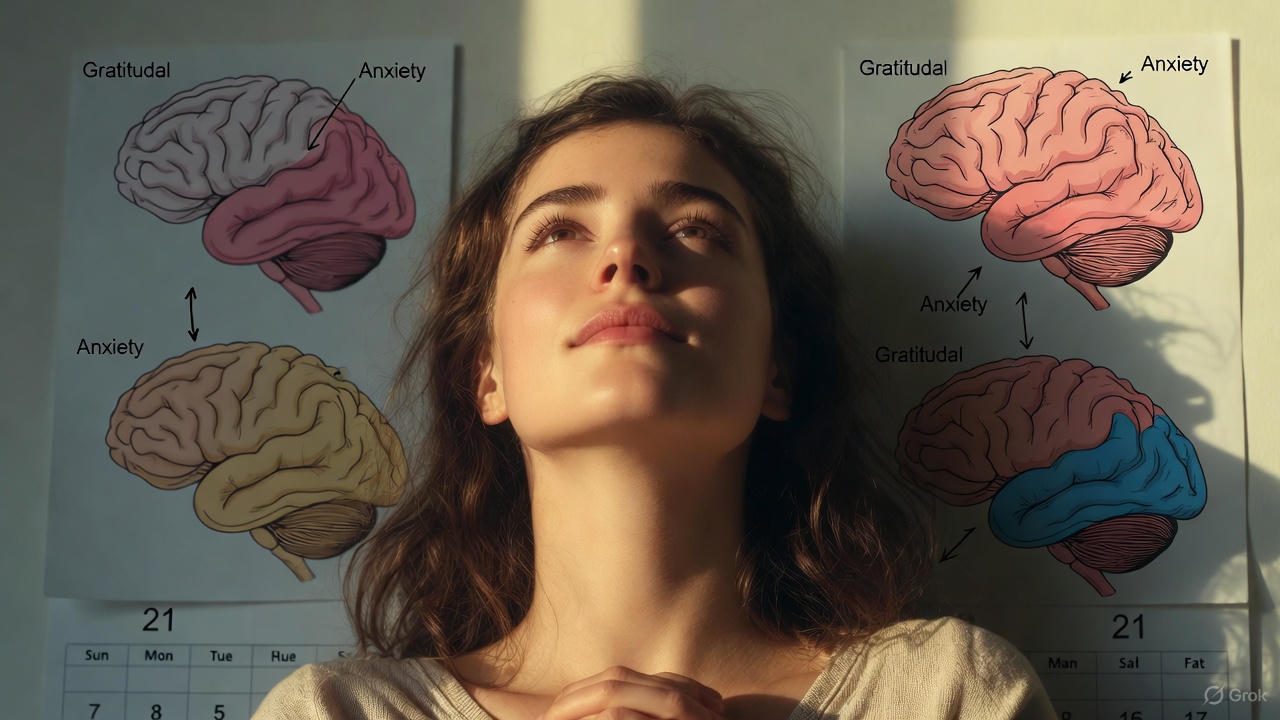
The 21-day timeframe commonly cited for gratitude practices reflects the approximate period required for new behavioral patterns to become somewhat automatic. This isn’t a magic number derived from neuroscience but rather a practical guideline. The underlying principle is that consistent repetition over weeks produces more lasting change than intense practice over days. Daily practice for three weeks builds the neural pathways that make positive attention allocation increasingly effortless.
Importantly, this training is domain-general. Once your brain learns to scan for positives in your journal practice, this skill generalizes to other contexts. You may find yourself noticing the helpful colleague, the functioning infrastructure, or the small kindness from a stranger without consciously trying. The gratitude practice creates momentum that extends beyond the specific exercise.
The Neuroscience of Appreciation: What Happens in Your Brain
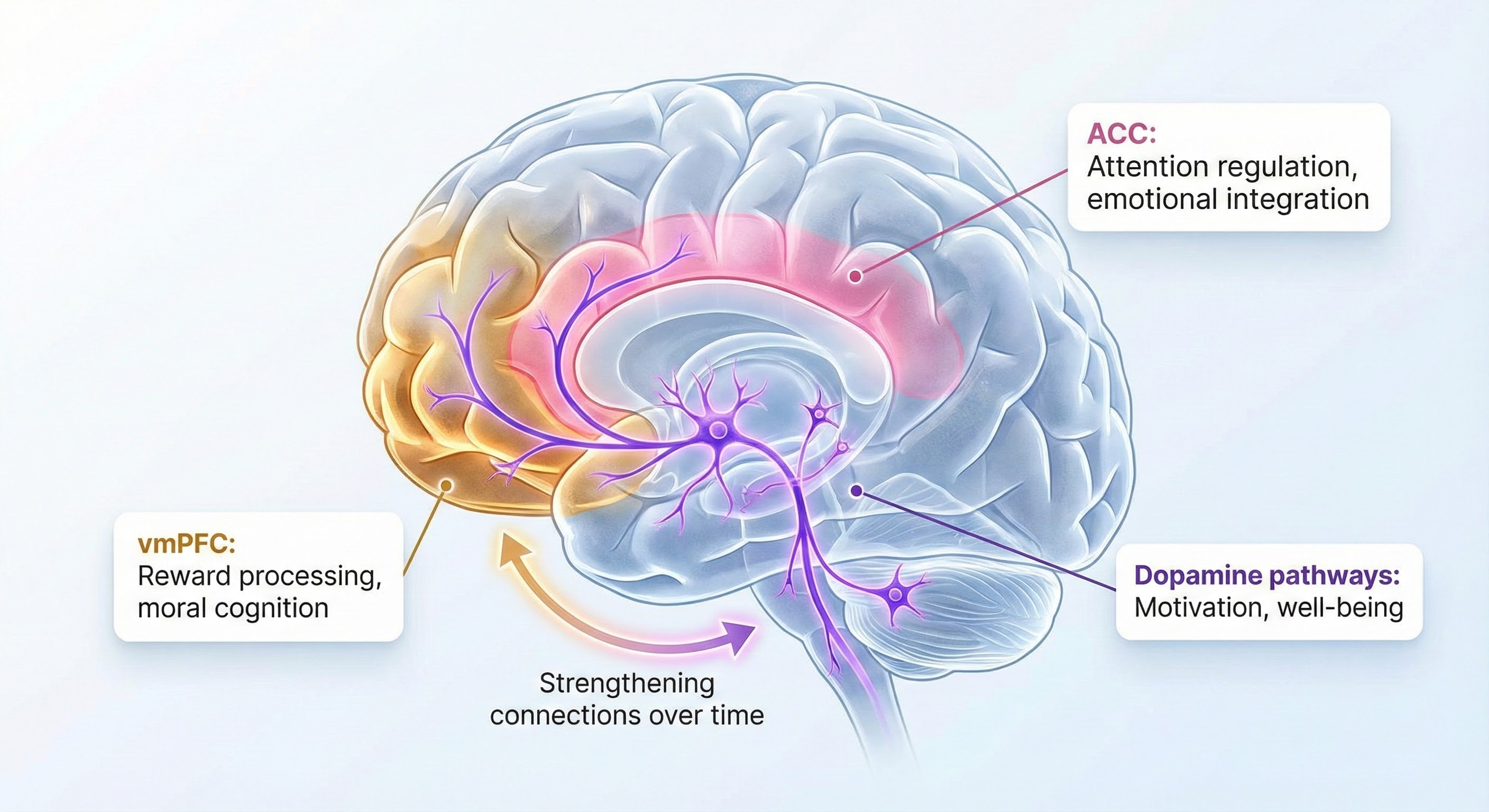
When you actively engage in gratitude, specific neural systems activate that produce both immediate and long-term effects. The ventromedial prefrontal cortex (vmPFC), a region associated with reward processing and moral cognition, shows increased activation during gratitude experiences. This region connects to the brain’s dopamine reward pathways, explaining why genuine appreciation produces a subtle but real sense of pleasure.
The anterior cingulate cortex (ACC), involved in attention regulation and emotional processing, also activates during gratitude. This region helps integrate cognitive and emotional information, suggesting that gratitude isn’t purely a thought or purely a feeling but an integrated experience that bridges both domains. ACC engagement may explain why gratitude feels qualitatively different from simply listing facts about your life.
Long-term changes appear with consistent practice. Research from the Greater Good Science Center at UC Berkeley found that participants who completed gratitude writing exercises showed increased activation in the medial prefrontal cortex when later asked to think about generous behavior. More strikingly, this increased activation was still present three months after the intervention ended. The brain had been structurally altered by the practice.
Hebb’s Law, the foundational principle of neuroplasticity stating that “neurons that fire together, wire together,” explains these lasting changes. By repeatedly activating gratitude-related neural circuits, you strengthen the synaptic connections within those circuits. The pathways become more efficient, requiring less activation energy to engage. What initially feels like effortful focus gradually becomes the brain’s default processing mode for the attended domains.
The neurochemical effects are also significant. Gratitude practice has been associated with increased dopamine and serotonin activity, the same neurotransmitters targeted by common antidepressant medications. This doesn’t mean gratitude replaces medication for clinical depression, but it does suggest that gratitude activates some of the same beneficial pathways through behavioral rather than pharmaceutical means.
The Three Good Things Protocol: Evidence-Based Practice
Among the many gratitude exercises studied, the “Three Good Things” protocol developed by Martin Seligman and colleagues has accumulated the most robust research support. The exercise is simple: each evening, write down three things that went well that day and why they went well. The “why” component distinguishes this from simple listing and appears to be crucial for the intervention’s effectiveness.
The specificity matters enormously. “I’m grateful for my family” is too abstract to engage the neural systems described above. “I’m grateful that my daughter laughed at my terrible pun at dinner and it made me feel connected to her” activates memory systems, emotional processing, and reward pathways simultaneously. The detail creates a richer mental representation that your brain can actually work with.
The explanatory component, writing why the good thing happened, adds a layer of cognitive processing that deepens the exercise’s impact. Attributing good events to stable causes (“my daughter laughs at my jokes because we have a good relationship”) produces more lasting mood effects than attributing them to unstable causes (“she must have been in a good mood tonight”). The way you explain positive events influences whether they feel like flukes or like features of a life worth living.
Research on the Three Good Things protocol shows that participants report increased happiness and decreased depression symptoms, with effects building over the three-week practice period and persisting for six months after the formal exercise ends. The intervention is among the most replicated findings in positive psychology, with effects demonstrated across cultures, age groups, and delivery formats.
For maximum benefit, complete the exercise at approximately the same time each day, ideally in the evening when the day’s events are fresh but you’ve had time to process them. Write by hand rather than typing if possible; the slower pace of handwriting appears to support deeper reflection. Aim for entries long enough to capture real detail but short enough that the practice remains sustainable, typically three to five sentences per item.
Gratitude in Crisis: What to Do When Everything Feels Bad
The reasonable criticism of gratitude practice is that it seems impossible when life is genuinely hard. How do you list three good things on the day you lose your job, receive a frightening diagnosis, or experience relationship breakdown? Gratitude advice often seems designed for people whose problems are merely ordinary, not for those facing genuine adversity.
The answer isn’t to deny your pain or pretend things are better than they are. Toxic positivity, the insistence on positive thinking in situations that warrant other responses, is psychologically harmful. Gratitude in crisis operates differently: it finds footholds of stability within the storm without claiming the storm isn’t real.
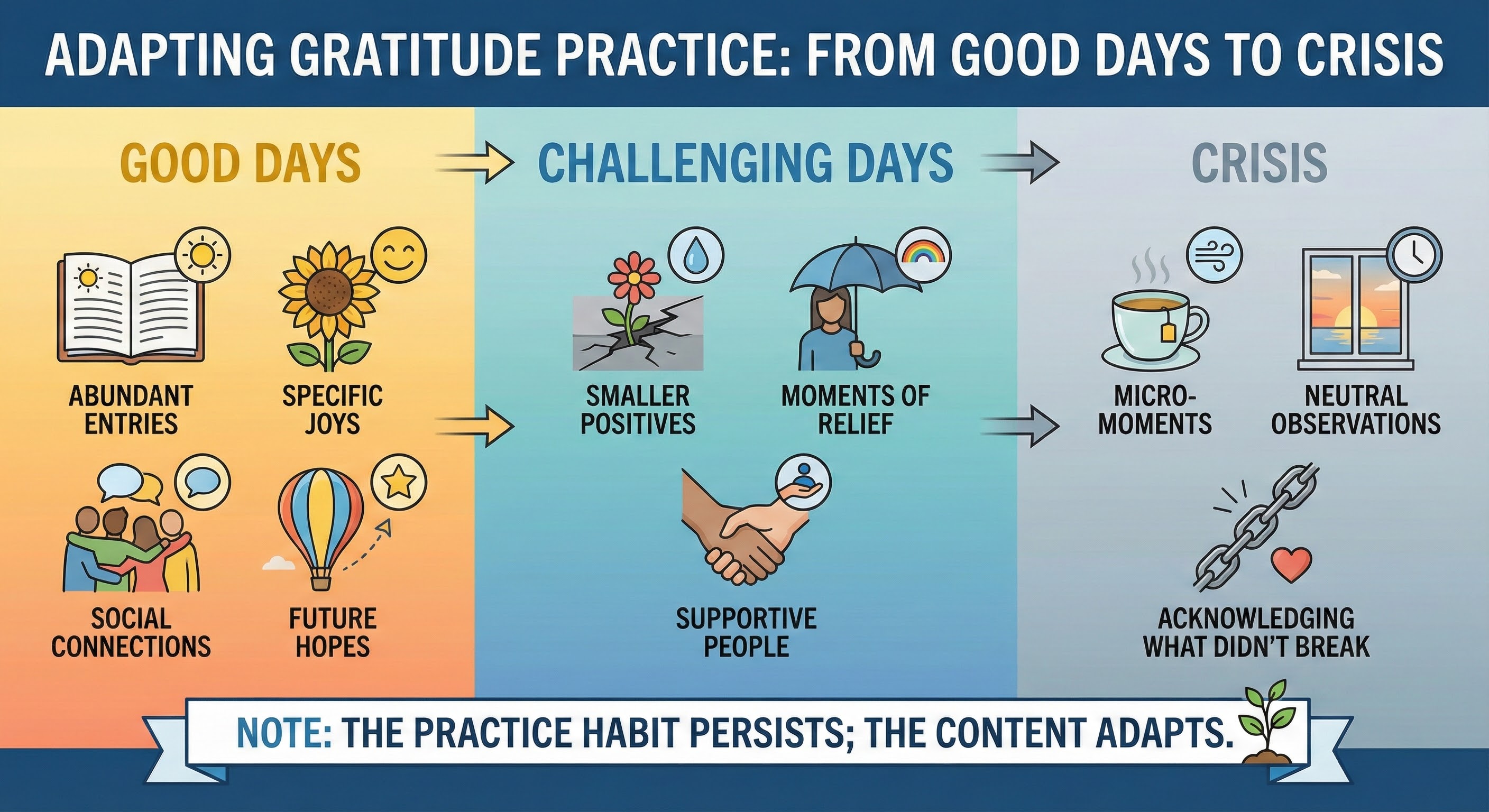
When major things are bad, look for the microscopic. The warmth of the blanket you’re under right now. The fact that your lungs are breathing without conscious effort. The text from a friend checking on you. These aren’t reasons to dismiss your larger problems; they’re anchors preventing complete psychological capsizing. Viktor Frankl, the psychiatrist who survived Nazi concentration camps, wrote about finding moments of beauty even in that extreme horror. The capacity for gratitude even in adversity may be part of what allows humans to survive and eventually recover from trauma.
Avoid what psychologists call the “At Least” trap. “At least you still have your health” or “At least it’s not cancer” invalidates your actual suffering by comparative minimization. Instead, hold both truths simultaneously: “This situation is genuinely terrible, AND I am grateful for the friend who showed up today.” The “and” is crucial. It acknowledges pain while also acknowledging support. Both are real; neither negates the other.
On the hardest days, the practice may shift from finding positives to simply noticing neutrals. “My body got through today.” “I ate something.” “The sun set and rose again.” These aren’t the enthusiastic gratitudes of a good day, but they maintain the practice habit and the scanning orientation even when genuine positives feel inaccessible. When circumstances improve, the habit remains in place, ready to resume its fuller function.
Integration with Other Practices
Gratitude practice doesn’t exist in isolation; it integrates synergistically with other evidence-based mental health practices. When combined with mindfulness, physical exercise, and sleep optimization, the effects compound in ways that exceed what any single intervention achieves alone.
Mindfulness meditation and gratitude share neural territory and appear to reinforce each other. Mindfulness builds the capacity for present-moment awareness that makes noticing positive experiences easier. The non-judgmental attention cultivated in meditation makes the gratitude practice less effortful because you’re not simultaneously criticizing yourself for having problems or second-guessing whether your gratitudes are “good enough.” Regular meditators often find gratitude practice more natural and more effective.
Physical exercise, through mechanisms still being explored, amplifies neuroplasticity. BDNF (brain-derived neurotrophic factor), a protein that supports neural growth and connection, increases after exercise. This heightened plasticity may make the brain changes from gratitude practice more pronounced. The practical implication is that maintaining consistent exercise during your 21-day gratitude protocol may enhance its effects.
Sleep optimization is particularly important because sleep consolidates learning and emotional processing. The memories formed during the day, including the gratitude entries you wrote, are consolidated into long-term storage during sleep. Poor sleep impairs this consolidation, potentially reducing the lasting impact of your practice. Prioritizing seven to eight hours of quality sleep during your gratitude training period supports the neural changes you’re attempting to create.
Physical exercise, as explored in our guide on the science of walking, amplifies the neuroplastic benefits of gratitude practice by increasing BDNF levels. For those interested in optimizing the sleep that consolidates these neural changes, our article on biohacking your sleep provides evidence-based strategies for enhancing sleep quality.
Building Your 21-Day Protocol
A successful 21-day gratitude protocol requires structure, consistency, and realistic expectations. Here’s how to design a practice that fits your life and produces lasting change.
Choose your vehicle. A dedicated gratitude journal works well for many people because it creates a physical artifact of the practice. Digital apps like Happify or Gratitude365 provide structure and reminders. Voice memos work for those who process verbally. The specific format matters less than consistency; choose whatever you’ll actually do for 21 consecutive days.
Set a consistent time and trigger. Habit research shows that new behaviors are more likely to stick when linked to existing routines. “After I brush my teeth at night” or “With my morning coffee” creates an automatic trigger that reduces the decision-making required to practice. The practice takes approximately five minutes once you’re familiar with it, brief enough to fit into any schedule.
Start where you are. On day one, your entries may feel forced or superficial. This is normal. You’re training a skill you haven’t previously developed; awkwardness is expected. By week two, you’ll notice scanning for positives becoming more natural. By week three, you may find gratitudes arising spontaneously throughout the day, not just during your dedicated practice time.
Track your mood. Consider using a simple 1-10 mood rating each day alongside your entries. This creates data that can reveal patterns over time. Many practitioners are surprised to discover that their average mood rating shifts meaningfully over the 21 days, a concrete validation that the practice is working even when changes feel subtle.
Plan for obstacles. Days when you feel too tired, too stressed, or too busy are inevitable. Have a minimum viable practice: even writing one thing in one sentence maintains the habit chain. The goal isn’t perfection; it’s consistency sufficient to produce neuroplastic change. Twenty-one imperfect days beats seven perfect days followed by abandonment.
The Bottom Line
You’re not ignoring the negative; you’re training your brain to stop ignoring the positive. This reframe is essential for understanding what gratitude practice actually does. The negativity bias means your brain automatically emphasizes problems, threats, and failures. Gratitude practice provides the counterweight this system lacks by default, building neural architecture that allows positive information to receive proportional processing.
The 21-day protocol is a starting point, not a finish line. Many practitioners continue indefinitely because the benefits persist only as long as the practice does, or at least as long as the trained neural pathways remain active. Like physical fitness, the effects require ongoing maintenance, though the maintenance dose may be lower than the initial training dose.
This is one of the highest-ROI investments you can make for your mental health. Five minutes daily, requiring no equipment, no cost, and no special training, produces documented improvements in depression, anxiety, and life satisfaction that rival many formal interventions. The barrier to entry is essentially zero; the potential returns are substantial. Commit to 21 days and observe what changes.
Your 21-Day Gratitude Protocol:
- Choose a consistent time linked to an existing habit (morning coffee, evening teeth-brushing)
- Write three specific good things from your day, including why each happened
- Use detail: “My daughter laughed at my joke” beats “family” every time
- On hard days, look for micro-positives or simple neutrals
- Track your mood daily with a 1-10 rating to observe change over time
- Complete the full 21 days before evaluating whether to continue
Sources: UC Berkeley Greater Good Science Center neuroimaging studies, Martin Seligman positive psychology research (University of Pennsylvania), Journal of Positive Psychology gratitude intervention meta-analyses, Social Cognitive and Affective Neuroscience brain structure studies, American Psychologist foundational research on negativity bias.