
Your smartphone probably has a step counter. Your fitness tracker definitely does. Both likely default to 10,000 steps as the daily target, and you’ve probably felt guilty when you fall short. Here’s what the research actually shows: the 10,000 step target originated not from scientific study but from a 1960s Japanese marketing campaign for a pedometer called “manpo-kei,” which literally translates to “10,000 step meter.” The company chose the number because it sounded motivating, and the target spread globally through cultural momentum rather than evidence.
The good news is that the arbitrary number happens to fall within a reasonable range. The better news is that substantial health benefits begin far below it. A landmark 2019 study published in JAMA Internal Medicine followed nearly 17,000 older women and found that mortality risk dropped by 41% when comparing those who averaged 4,400 steps daily to those who averaged 2,700 steps. The relationship continued improving up to about 7,500 steps, then plateaued. Additional steps beyond that provided diminishing returns, not zero benefit, but nothing like the dramatic gains from simply moving from sedentary to moderately active.
Walking is the closest thing to a miracle drug that exists in medicine. It costs nothing, requires no equipment, carries virtually no injury risk, and produces benefits that rival pharmaceutical interventions for cardiovascular disease, diabetes, depression, and cognitive decline. The evidence isn’t marginal or contested; it’s some of the most robust and consistent data in all of exercise science. Here’s what walking actually does for your body and how much you need.
The Mortality Data: Walking as Lifespan Extension
In medicine, most interventions follow a U-shaped curve where too little is harmful, too much is also harmful, and some middle ground is optimal. Walking appears largely immune to this pattern. The safety profile is unparalleled because it’s low-impact, self-regulating (you naturally slow down when tired), and virtually impossible to overdose on. When researchers examine large population data sets, they consistently find a near-linear relationship: more steps equals longer life, with no clear upper limit where walking becomes harmful.
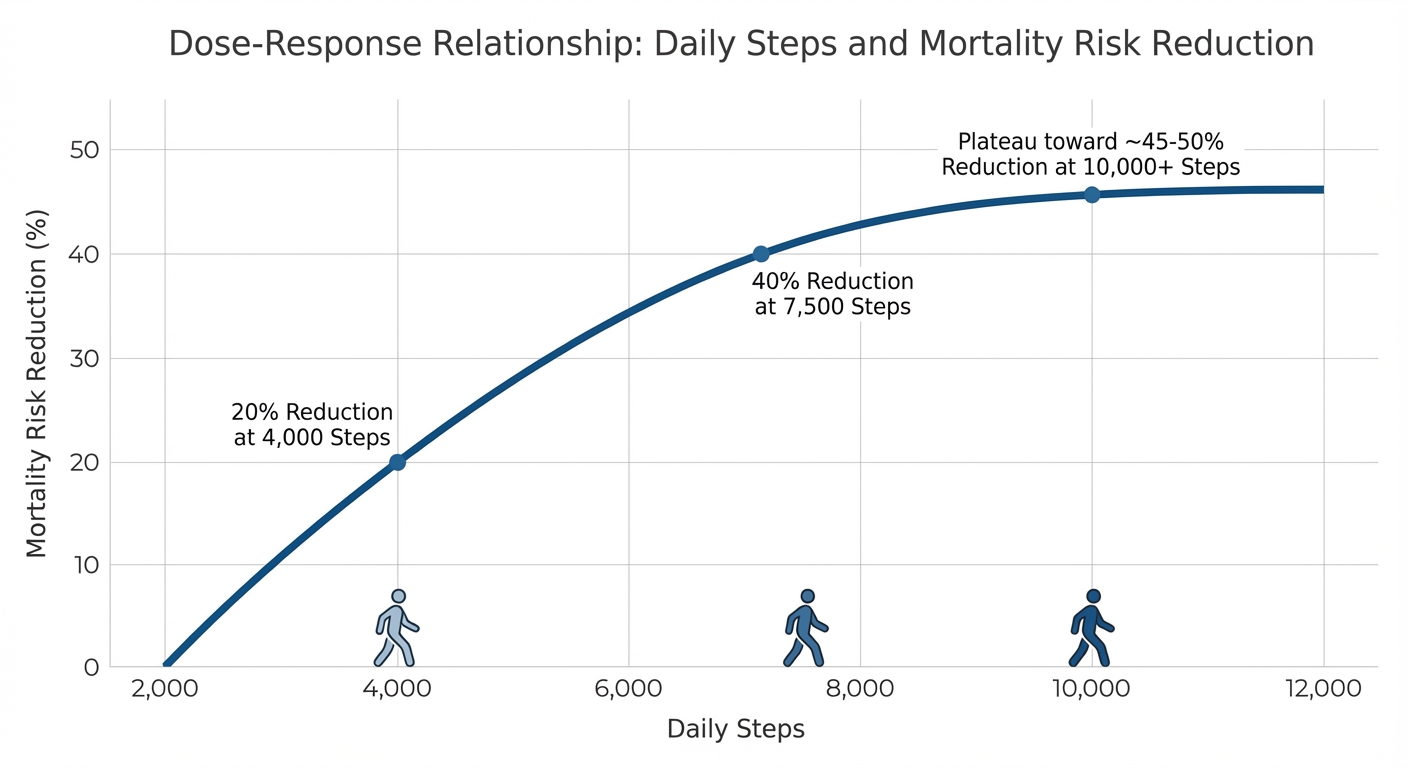
The Harvard Alumni Health Study followed graduates for over 30 years and found that walking 9 miles weekly, roughly 4,500 steps daily, reduced mortality risk by 22% compared to minimal walking. The Women’s Health Study tracked 16,000 women for four years and found that those taking 4,400 steps daily had 41% lower mortality than those taking 2,700 steps. The JAMA meta-analysis pooled data from 15 studies with 47,000 participants and quantified the step-mortality relationship with precision: compared to 2,000 daily steps, mortality risk dropped 20% at 4,000 steps, 30% at 6,000 steps, 40% at 8,000 steps, and 45-50% at 10,000+ steps. The curve flattens around 7,000-10,000 for most populations.
For older adults over 60, the benefit plateau occurs earlier, around 6,000-8,000 steps, with significant mortality reduction starting at just 3,000-4,000. This makes intuitive sense: baseline activity levels are lower in older populations, so each additional step represents a larger relative increase in activity. A 70-year-old going from 2,000 to 4,000 steps makes a bigger physiological demand than a 30-year-old making the same increase. The practical implication is that older adults shouldn’t feel discouraged by lower step counts; they may be getting proportionally more benefit per step than younger people.
Cardiovascular and Metabolic Effects
Walking is low-intensity aerobic exercise that strengthens your heart, improves circulation, and enhances metabolic function through mechanisms distinct from high-intensity training. The steady, sustained nature of walking trains your cardiovascular system for efficiency rather than peak output, which is arguably more relevant for daily health than maximal performance.
Blood pressure responds reliably to regular walking. A meta-analysis published in the British Journal of Sports Medicine found that walking programs reduced systolic blood pressure by 4-8 mmHg, comparable to many antihypertensive medications. The effects are dose-dependent, with more walking producing better blood pressure control, and they persist as long as the walking continues. Unlike medications, walking has no adverse side effects and actually improves other health markers simultaneously.
Cholesterol profiles improve with moderate walking. Research shows regular walkers have 5-8% higher HDL (the “good” cholesterol that removes arterial plaque) and 10-15% lower triglycerides compared to sedentary counterparts. The mechanism involves enhanced lipid metabolism in skeletal muscle and liver, trained by the regular energy demands of walking. Heart disease risk drops substantially: multiple large studies show 30-minute daily walks reduce heart attack and stroke risk by 25-35%, effects that rival statin medications for primary prevention.
Post-meal walking provides particularly potent metabolic benefits. Even 15 minutes of walking after eating reduces blood glucose spikes by 20-30% according to research from George Washington University. This matters because repeated glucose spikes contribute to insulin resistance, the precursor to type 2 diabetes. The study found that three 15-minute walks after meals produced better glucose control than a single 45-minute walk in the morning, suggesting that timing matters as much as total volume. For diabetes prevention, a large prospective study showed that each 2,000 steps daily reduced type 2 diabetes risk by approximately 8%; people walking 8,000-10,000 steps had 40-50% lower diabetes risk than those under 2,000.
Mental Health and Cognitive Protection
The effects of walking extend well beyond physical health. Your brain benefits from walking through multiple mechanisms: increased blood flow delivering oxygen and nutrients, enhanced BDNF production promoting neuroplasticity, reduced inflammation affecting mood centers, and the natural meditative quality of rhythmic movement.
Depression responds remarkably well to walking interventions. A meta-analysis in JAMA Psychiatry found that 30 minutes of daily walking reduced depression symptoms by 26%, an effect size comparable to antidepressant medications in mild to moderate cases. The mechanisms likely include endorphin release, inflammation reduction, improved sleep quality, and the behavioral activation that comes from getting outside and moving. Unlike medications, walking has no adjustment period, no side effects, and no withdrawal. For anxiety, similar effects emerge: walking activates the parasympathetic nervous system, lowering cortisol and promoting the calm alertness that anxiety sufferers often lack.
Cognitive function benefits accumulate over time. A 2023 study in JAMA Neurology followed over 78,000 participants tracked by wearable devices and found that each additional 2,000 daily steps associated with 8-13% lower dementia risk. The relationship continued up to about 10,000 steps, with 9,826 being the optimal number identified. But even achieving the more modest threshold of 3,826 steps daily was associated with 25% reduced dementia risk. Walking increases blood flow to the brain, stimulates release of brain-derived neurotrophic factor (BDNF) that promotes neuronal health, and may reduce the beta-amyloid accumulation associated with Alzheimer’s disease.

Creativity and problem-solving receive a reliable boost from walking. Research from Stanford University found that walking increased creative output by 60% compared to sitting, with the effect persisting for several minutes after the walk ended. Many people report solving stubborn problems or having unexpected insights during walks that eluded them while sitting at their desks. The mechanism may involve the default mode network, a brain system that activates during unfocused activity and facilitates the associative thinking underlying creativity. Walking provides just enough stimulation to prevent boredom while remaining automatic enough to free mental resources for background processing.
The Dose-Response: How Much Is Actually Enough
The relationship between walking and health benefit isn’t linear, which has important practical implications. The steepest part of the curve, where you get the most benefit per additional step, occurs at the lowest activity levels. If you’re currently sedentary at around 2,000 steps daily, getting to 4,000 steps produces massive risk reduction. The incremental benefit from 8,000 to 10,000 steps, while still positive, is much smaller.
2,000 to 4,000 steps represents the transition from sedentary to minimally active. This is the single most important range to target if you’re currently inactive. Two 15-minute walks daily typically achieves 3,000-4,000 steps when combined with normal daily movement. That’s 30 minutes total, achievable for virtually everyone who prioritizes it. The mortality benefit from just this change is remarkable.
4,000 to 7,000 steps continues the improvement curve with incremental but meaningful gains. Each additional thousand steps reduces mortality risk further, improves cardiovascular markers, and enhances metabolic function. This range is achievable through a combination of dedicated walks and active choices throughout the day: parking farther from destinations, taking stairs, walking during phone calls, choosing to walk to nearby errands rather than driving.
7,000 to 10,000 steps brings you into the plateau zone where additional steps help but with diminishing returns. For general health, achieving 7,000-8,000 daily steps captures most of the benefit without requiring heroic effort. The 10,000 target isn’t wrong, but don’t stress about hitting it exactly. A person averaging 7,500 steps is in excellent territory and shouldn’t feel they’re falling short because marketing departments chose a round number 60 years ago.
Walking Speed: Pace Matters, But Not How You Think
Faster walking provides some additional cardiovascular benefit, but the relationship between pace and health is more complex than “faster is better.” Research shows that self-selected walking pace predicts health outcomes independent of total step count, but this likely reflects reverse causation: people who can walk faster tend to be healthier overall, not necessarily that walking faster made them healthier.
Pace categories provide useful benchmarks. Slow walking is under 2 mph (30+ minutes per mile), typical of casual strolling or people with mobility limitations. Moderate pace is 2.5-3.5 mph (17-24 minutes per mile), a comfortable walk you could sustain for an hour. Brisk walking is 3.5-4.5 mph (13-17 minutes per mile), noticeably faster with elevated heart rate but still conversational. Power walking exceeds 4.5 mph, which most people can only sustain briefly.
For cardiovascular fitness improvement specifically, brisk walking provides stimulus that slow walking doesn’t. The heart needs to be challenged to adapt. But for longevity, metabolic health, and mental wellbeing, slower walking still provides substantial benefit. The recommendation is simple: walk as briskly as comfortable while still able to maintain conversation. That “talk test” pace typically corresponds to 60-70% of maximum heart rate, the zone where you’re challenging your cardiovascular system without overreaching. If walking more slowly is all you can manage due to fitness level, injury, or age, do that. Some walking beats no walking at every speed.
Practical Strategies for Increasing Daily Steps
If you’re currently averaging 2,000-3,000 steps (typical for a sedentary desk worker), increasing to health-optimal levels requires both dedicated walks and environmental changes that accumulate movement throughout the day. Neither approach alone is typically sufficient, but combining them makes the target easily achievable.
Environmental design makes walking the default choice. Park at the far end of lots rather than circling for the closest spot. Take stairs instead of elevators for trips of a few floors. Walk to nearby errands, anything within a mile is reasonable walking distance, instead of driving by default. Get off public transit one stop early and walk the remaining distance. These changes add steps without requiring dedicated walking time and reinforce walking as a normal part of daily life rather than a chore to be scheduled.
Dedicated walks provide the foundation. A 10-20 minute morning walk adds 1,000-2,000 steps while improving mood and energy for the day through light exposure and gentle cortisol elevation. A 15-30 minute lunch walk breaks up prolonged sitting, reduces post-lunch glucose spikes, and adds 1,500-3,000 steps during the workday. An evening walk of 20-30 minutes after dinner aids digestion, improves sleep quality, and adds another 2,000-3,000 steps. Three short walks daily easily achieves 6,000-8,000 steps before counting any incidental movement.

Social walking transforms exercise into connection. Walking meetings, where you take phone calls or one-on-one meetings while walking instead of sitting, accumulate steps while working. Family walks after dinner combine exercise with quality time. Walking with friends provides accountability and enjoyment that makes walking feel like leisure rather than obligation. Dog owners have built-in walking accountability, studies show dog owners average significantly more daily steps than non-owners because the dog requires walks regardless of how motivated the owner feels.
Walking Within a Complete Fitness Program
Walking isn’t a replacement for all other exercise, but it’s the most valuable single activity for general health and longevity. A complete fitness program ideally includes walking plus strength training plus occasional higher-intensity cardiovascular work. However, if you’re only doing one thing, walking provides the broadest benefits with the lowest barriers and risks.
What walking provides: sustainable daily movement that you can do every day without recovery, extremely low injury risk, accessibility to all fitness levels, requires no equipment or special locations, and doesn’t need careful programming or periodization. You can walk while tired, while sore from lifting weights, while traveling, while old, while injured. This sustainability is walking’s superpower.
What walking doesn’t provide: significant muscle building (requires resistance training), high-intensity cardiovascular adaptation (requires intervals or sustained moderate-hard effort), or maximum bone loading (requires impact or resistance). For comprehensive fitness including muscle preservation and metabolic health, walking should be combined with resistance training at least twice weekly and occasional higher-intensity work.
The hierarchy for people with limited time: if you can only do one thing, walk. If you can do two things, walk and lift weights. If you can do three things, add intervals or other vigorous cardio. Walking is the foundation because its risk-to-benefit ratio is unmatched and its barriers to consistent execution are minimal.
The Compound Interest of Consistent Walking
Walking doesn’t provide dramatic short-term results. You won’t lose 20 pounds in a month or build visible muscle from walking alone. This is precisely why so many people undervalue it, they’re looking for rapid transformation and walking delivers gradual accumulation. But the person who walks consistently from age 40 to 80 will be dramatically healthier and more functional than the person who doesn’t, even if other lifestyle factors are similar.
Think of walking as compound interest for your body. Small daily deposits, 30-60 minutes of movement, create massive long-term returns through mechanisms that compound over decades. Better cardiovascular health prevents the heart attack at 65. Maintained bone density prevents the hip fracture at 75. Preserved cognitive function maintains independence at 85. Lower inflammation reduces cancer risk throughout life. Each day of walking contributes marginally to all these outcomes, with the full effect only visible in retrospect.
The person who starts walking at 40 has 40 more years to accumulate benefit. The person who starts at 60 has less time but still gains substantially. The person who starts at 70 after a heart attack still improves their prognosis. There’s no age at which walking stops helping and no age at which it’s too late to start. The best time to begin was 20 years ago. The second best time is today.
The Bottom Line
Walking is the closest thing to a miracle drug that exists: free, accessible, low-risk, and profoundly effective for nearly every aspect of health. It reduces all-cause mortality by 15-20% at modest doses, with benefits beginning far below the arbitrary 10,000 step target that dominates fitness culture. The steepest benefit curve occurs between 2,000 and 4,000 daily steps, meaning sedentary people get the most relative improvement from the smallest absolute change.
You don’t need 10,000 steps, though it’s a fine target if achievable. You need something like 6,000-8,000 daily, which translates to 3-4 miles or about 60-90 minutes of walking broken into multiple sessions throughout the day. If that feels like too much initially, start with 4,000 steps, two 15-minute walks, and build from there. The benefits at this level are still substantial, and the habit, once established, naturally tends to expand.
Just walk. Regularly. Consistently. For the rest of your life. Pairing walking with other recovery practices like infrared sauna sessions can enhance the cardiovascular benefits while supporting muscle recovery on more active days. Your 70-year-old self will thank the choices you make today, not through any single dramatic transformation but through the steady accumulation of thousands of unremarkable days where you simply put one foot in front of the other.
Sources: JAMA Internal Medicine step count studies, Harvard Alumni Health Study, Women’s Health Study, British Journal of Sports Medicine blood pressure meta-analysis, JAMA Psychiatry depression research, JAMA Neurology dementia and walking study, George Washington University post-meal walking research, Stanford creativity and walking studies.