The average American consumes roughly 4,500 calories on Thanksgiving Day, with Christmas and New Year’s Eve following close behind. This isn’t because hunger levels spike threefold during holidays; it’s because the conditions surrounding holiday eating systematically disable the brain’s satiety signaling systems. The result is consumption driven by environment, emotion, and social cues rather than physiological need.
Understanding the neuroscience of satiety, how your brain normally regulates food intake and why holiday conditions override those mechanisms, provides a foundation for eating with awareness rather than on autopilot. This isn’t about restriction or guilt. It’s about recognizing when you’re eating because you’re hungry versus eating because the food is there, the situation is stressful, or everyone around you is eating. That recognition is the first step toward making conscious choices.
Mindful eating isn’t a diet or a set of rules. It’s a skill set that allows you to engage your brain’s natural regulatory systems rather than bypassing them. During the holidays, when external pressures to overconsume are highest, these skills become most valuable. The goal isn’t perfect adherence to some idealized eating pattern but rather the ability to notice what’s happening and make choices aligned with how you actually want to feel.
The Satiety Signaling System: How Fullness Works
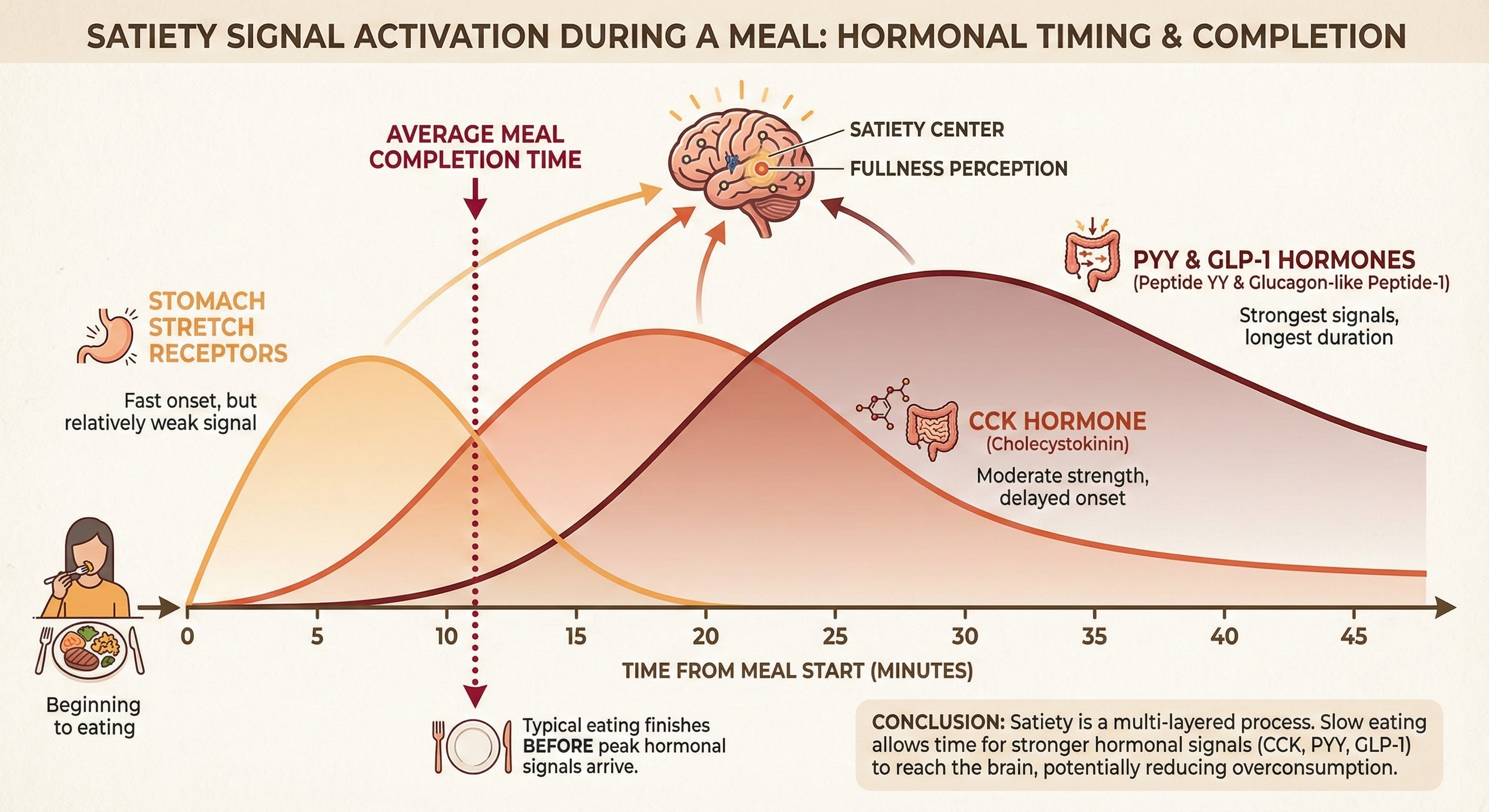
Your body has multiple overlapping systems for signaling when you’ve eaten enough, creating redundancy that in normal circumstances prevents overconsumption. These systems operate on different timescales, from immediate mechanical stretch receptors to hormones that take 20 to 30 minutes to register, and understanding their timing explains why eating speed matters so much.
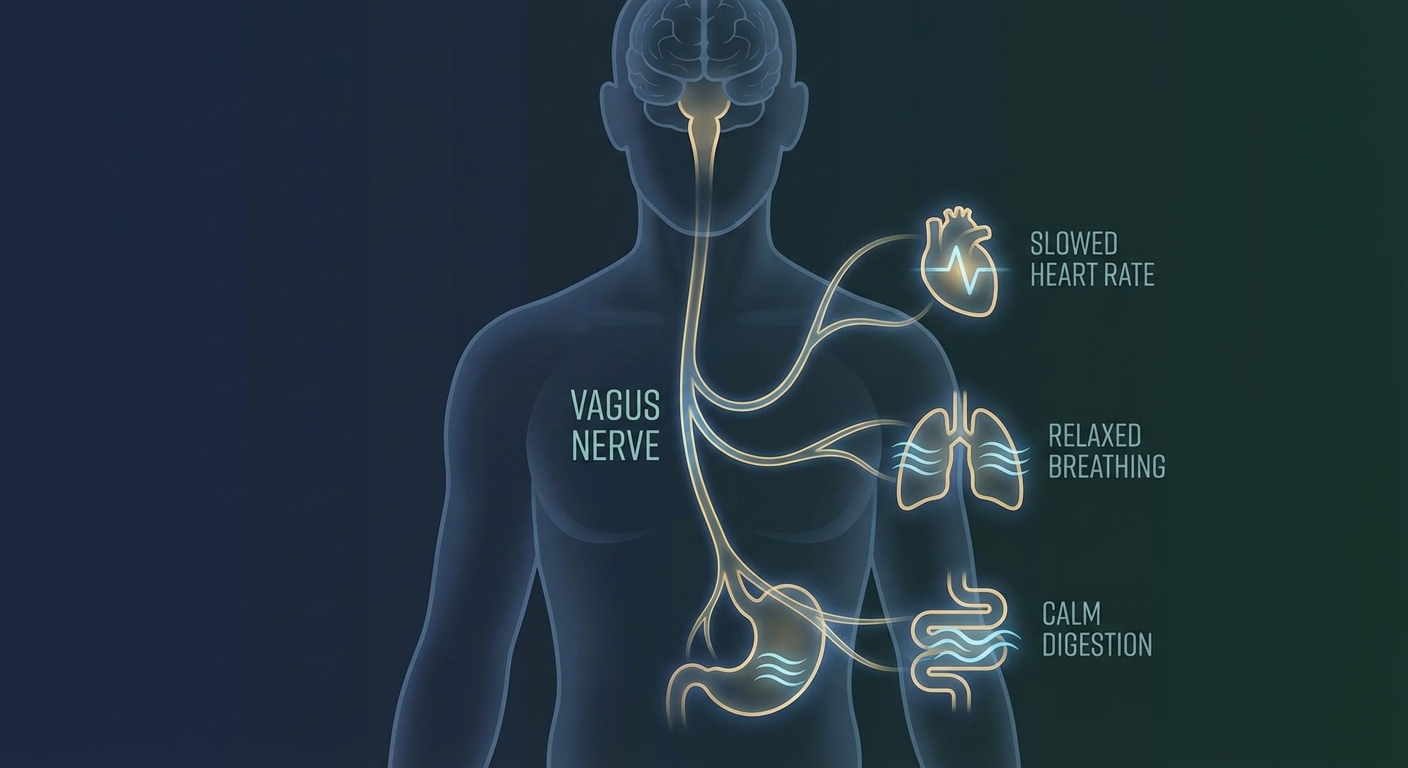
The first signal comes from mechanoreceptors in the stomach wall that detect stretching as food enters. These signals travel via the vagus nerve to the brainstem, where they contribute to the sensation of fullness. This system responds quickly, within minutes, but is easily overridden by eating faster than the stretch signals can accumulate or by consuming calorie-dense foods that provide substantial energy in small volumes.
The second major signal comes from hormones released as nutrients enter the digestive system. Cholecystokinin (CCK), released from the small intestine as fats and proteins arrive, signals satiety to the brain. Peptide YY (PYY) and glucagon-like peptide-1 (GLP-1) follow, with their levels peaking 15 to 30 minutes after eating begins. These hormonal signals are why eating slowly produces greater satiety than eating quickly, even with identical foods. Fast eating finishes before the hormonal signals arrive; slow eating allows them to accumulate and influence behavior.
Leptin, the long-term satiety hormone produced by fat tissue, provides a baseline signal of energy stores. Its effects are more subtle and chronic, influencing overall appetite rather than meal-specific satiety. During periods of overconsumption, leptin levels rise, but the brain can become resistant to its signal, allowing continued overconsumption despite high leptin levels.
The remarkable aspect of this system is how effectively it usually works. In controlled conditions without hyperpalatable foods or environmental manipulation, most people naturally regulate intake quite well. The problem isn’t that the system is broken; it’s that modern food environments, and holiday conditions in particular, are designed to override it.
Why Holiday Conditions Override Satiety
Holiday eating environments contain nearly every factor known to increase consumption while suppressing satiety awareness. Understanding these factors isn’t about blame; it’s about recognizing the forces at play so you can respond consciously rather than reactively.
Variety dramatically increases intake. Research from the University of Pennsylvania demonstrates that people eat significantly more when presented with multiple different foods than when offered the same total calories in a single form. This “sensory-specific satiety” means that becoming full of one food doesn’t prevent continued consumption of a different food. Holiday tables with 10 or 15 different dishes exploit this mechanism thoroughly, as each new food resets your satiety meter to some degree.
Social facilitation increases eating duration and quantity. Studies show that people eating with others consume 40 to 50 percent more than when eating alone. The mechanism involves extended meal duration (you keep eating as long as others are eating), social norming (matching the intake of those around you), and distraction from internal satiety cues. Large holiday gatherings maximize all three effects.
Stress and emotional triggers bypass rational eating decisions. The holiday season combines financial pressure, family dynamics, time scarcity, and disrupted routines into a perfect storm of cortisol elevation. Elevated cortisol increases preference for highly palatable, energy-dense foods while simultaneously impairing the prefrontal cortex functions involved in impulse control. You want the comfort food more while having less capacity to moderate your response.
Hyperpalatable food formulations override satiety signals through carefully engineered combinations of sugar, fat, and salt that trigger dopamine release beyond what whole foods produce. Holiday foods are typically more processed and engineered than everyday eating, hitting the “bliss point” combinations that food scientists design to maximize consumption. These foods essentially hack the reward system, producing pleasure signals that override the fullness signals trying to stop you.
The combination of these factors explains why willpower-based approaches to holiday eating so often fail. You’re not fighting against a lack of discipline; you’re fighting against evolutionary programming, neurochemistry, social pressure, and food engineering all operating simultaneously. The deck is thoroughly stacked.
The Awareness Gap: What Mindfulness Actually Does
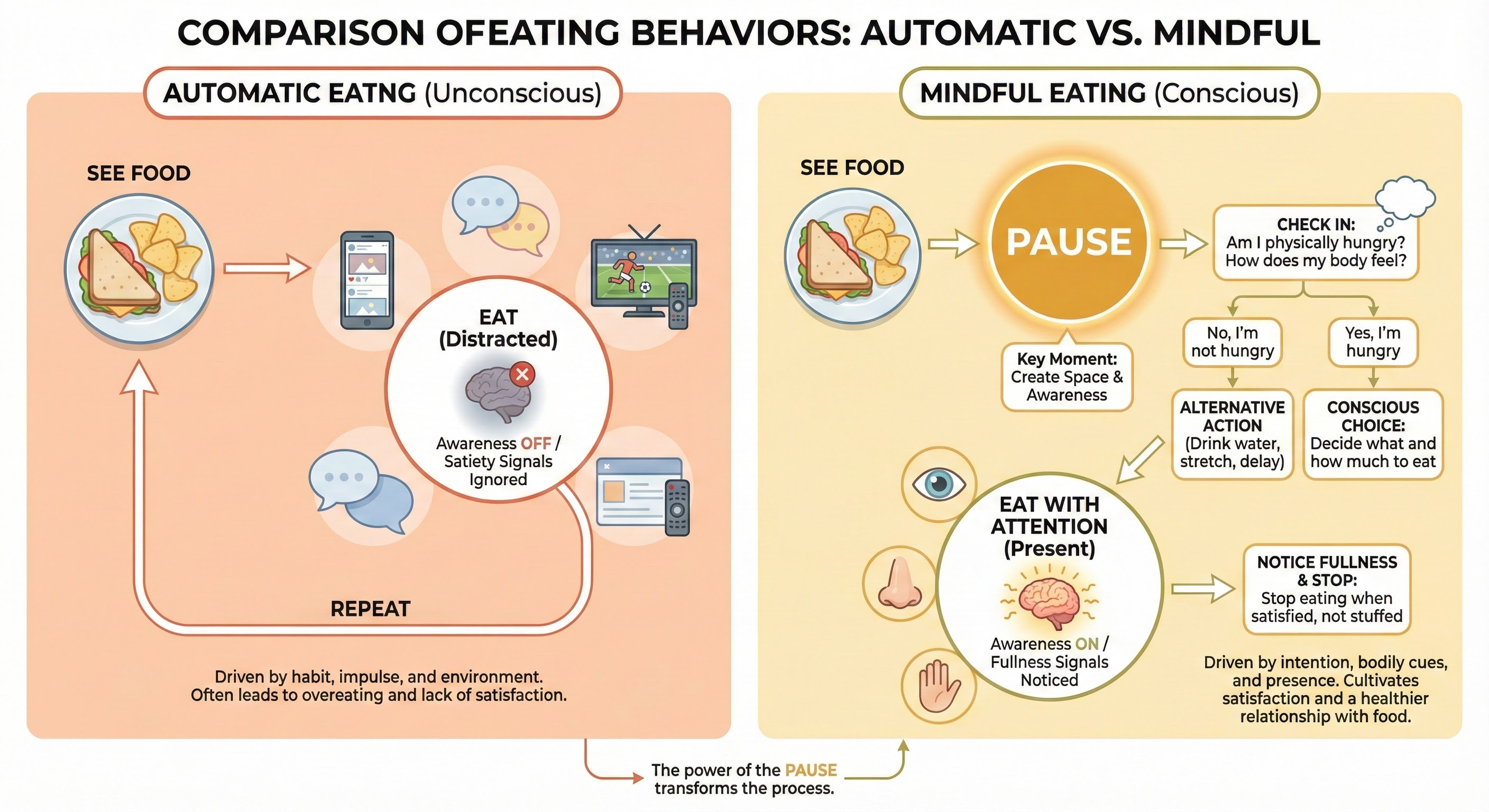
Mindful eating doesn’t add willpower or suppress appetite. What it does is restore awareness of internal signals that are otherwise drowned out by external factors. This awareness creates a gap between stimulus and response, a moment of choice that automatic eating doesn’t provide.
The practice involves directing attention to the sensory experience of eating: taste, texture, temperature, and the act of chewing and swallowing. This attention accomplishes several things simultaneously. It slows eating pace, allowing satiety hormones time to accumulate. It increases satisfaction from smaller quantities by fully experiencing what you consume. And it interrupts the automatic, distracted eating that allows consumption to continue well past satiety.
Research from Indiana State University found that mindful eating interventions reduced binge eating episodes by 75 percent in participants with binge eating disorder. While holiday eating typically doesn’t reach clinical binge levels, the same attentional mechanisms that interrupt pathological overeating can moderate normal overconsumption.
A key insight is that mindful eating isn’t about restriction; it’s about choice. You might mindfully choose to eat a second helping of something you love, fully present to the experience. That’s different from mechanically shoveling food while conversing, then realizing you’ve consumed far more than you intended without actually tasting any of it. Both scenarios involve the same food; the difference is whether you’re choosing or defaulting.
The holiday application focuses on creating moments of awareness within the meal rather than attempting to maintain continuous attention (which is unrealistic in social settings). A brief pause before refilling your plate to check in with hunger and fullness. A few fully present bites at the beginning of each course. A moment of noticing when you transition from genuine hunger to recreational eating. These discrete check-ins can shift the entire experience without requiring monastic concentration.
Practical Techniques for Holiday Meals
Moving from understanding to practice requires specific techniques adapted for the realities of holiday eating. These aren’t about perfect execution but about adding moments of awareness to situations that otherwise proceed entirely on autopilot.
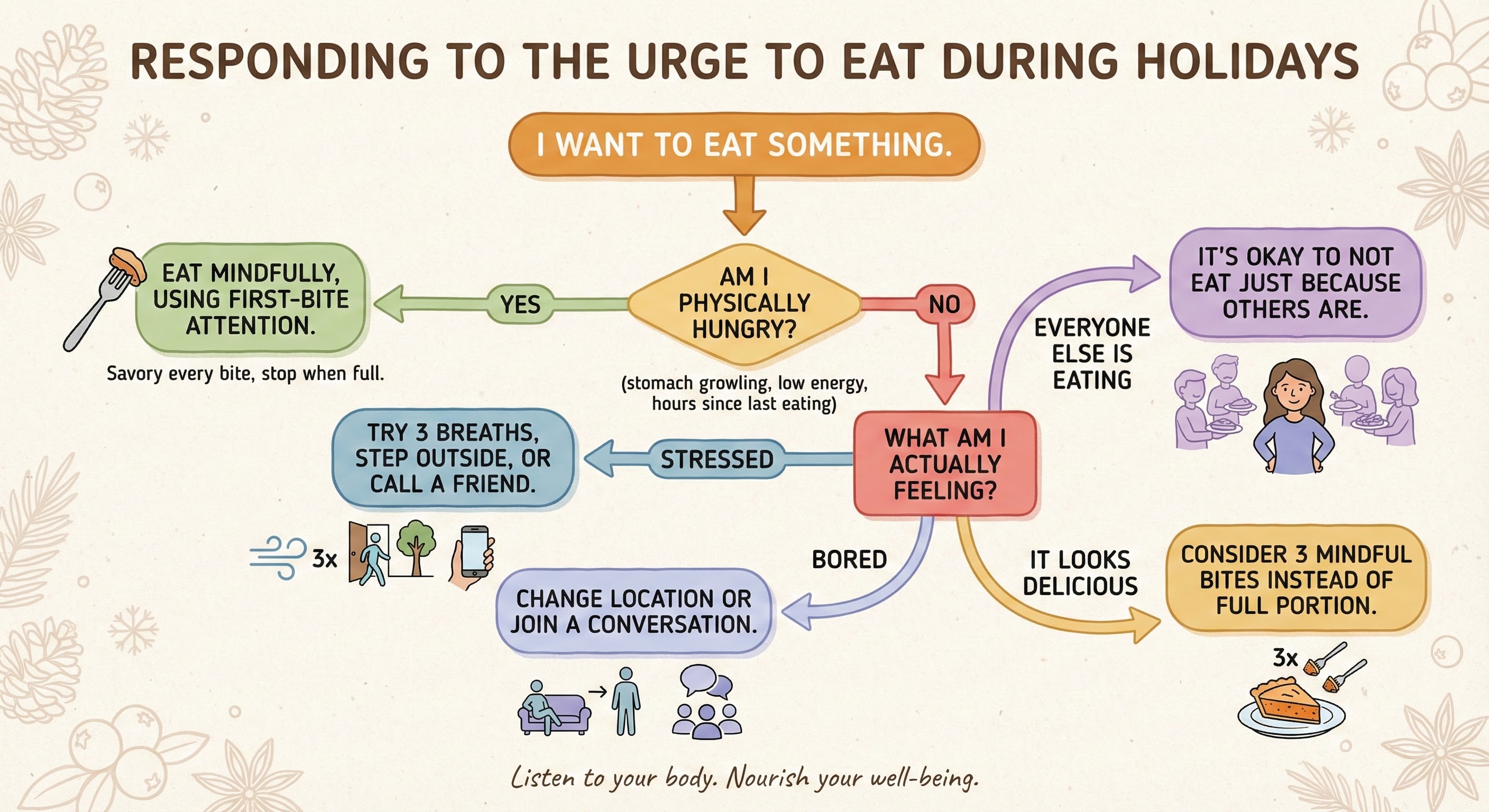
The three-breath plate pause is perhaps the most practical intervention. Before taking your first bite of a new plate of food, take three slow breaths while looking at what you’ve chosen. This brief pause accomplishes multiple things: it slows initial eating speed, it creates an opportunity to notice what and how much you’ve served yourself, and it shifts you from automatic to attentive mode. Three breaths takes perhaps 15 seconds, short enough to be socially invisible but long enough to register.
First-bite attention involves eating the first three bites of each food with complete attention to the sensory experience. Notice the texture as your teeth break through the surface. Identify the specific flavors hitting different parts of your tongue. Feel the temperature and consistency as you chew. This attention is impossible to sustain for an entire meal, but concentrating it in the first bites increases satisfaction and naturally slows your pace.
The halfway check-in uses the natural break when your plate is half-empty to assess where you stand on the hunger-fullness spectrum. On a scale from 1 (starving) to 10 (painfully stuffed), where are you? The goal is to finish eating somewhere around a 7, which is satisfied but not stuffed. Most holiday eating ends at 9 or 10 because the check-in never happens. A brief moment of internal attention at the halfway point can interrupt the trajectory before you reach discomfort.
Putting utensils down between bites is a classic technique that remains effective despite its simplicity. The physical act of placing fork and knife on the plate requires you to finish chewing and swallowing before preparing the next bite, automatically slowing pace. It also creates brief pauses in which attention can return to internal signals. The technique is visible to others but reads as polite, unhurried eating rather than anything unusual.
Buffet strategy addresses the particular challenge of holiday buffets, where variety maximizes the sensory-specific satiety effect. The approach involves surveying the entire buffet before selecting anything, then choosing three to five items that genuinely appeal rather than sampling everything. Taking smaller initial portions with the possibility of returning for more prevents the “clean plate” mentality from forcing consumption of foods you didn’t really want.
Emotional Eating and the Holiday Context
Holiday eating often serves emotional functions beyond hunger satisfaction. Food provides comfort during stressful family interactions, connection during celebration, and distraction during uncomfortable conversations. Recognizing these functions allows for conscious choice about whether food is the tool you want to use for each situation.
The stress-eating mechanism involves cortisol’s effects on both food preference and reward sensitivity. Under stress, the brain prioritizes immediate reward over long-term consequences, making high-calorie comfort foods both more attractive and more reinforcing. This explains why people consistently report “craving” specific foods during stress rather than just eating more, as the craving reflects the brain seeking specific neurochemical effects.
Awareness of emotional eating doesn’t require eliminating it entirely. Sometimes eating a favorite food during a difficult family gathering is a reasonable coping strategy. The problem arises when emotional eating is the only coping strategy, or when it proceeds without awareness and leaves you feeling worse than before.
Alternative coping resources deserve preparation before they’re needed. Having a planned “stress response” that doesn’t involve food, perhaps stepping outside for fresh air, sending a text to a supportive friend, or practicing one minute of deep breathing in the bathroom, provides options when you notice the emotional eating impulse arising. The goal isn’t to white-knuckle through every craving but to have choices available.
Our guide on managing holiday stress through vagal nerve activation provides specific techniques for calming the nervous system during difficult family situations, addressing the stress that drives emotional eating at its source rather than only managing its food-related symptoms.
The Pleasure Optimization Perspective
Mindful eating is sometimes framed as ascetic or joyless, as if paying attention to food somehow diminishes the experience. The reality is precisely the opposite: attention increases pleasure while distracted eating diminishes it. The mindful approach to holiday eating seeks to maximize genuine enjoyment rather than to restrict it.
Consider the typical holiday eating pattern: you serve a large portion, begin eating while engaged in conversation, look down to find the plate empty without clear memory of the flavors, then feel uncomfortably full afterward. This pattern produces minimal pleasure relative to the calories consumed. You didn’t really taste most of what you ate, and the aftermath is physical discomfort rather than satisfaction.
The mindful alternative involves smaller portions eaten with complete attention, producing vivid sensory experience of each bite, followed by comfortable fullness rather than distension. Total calories may be lower, but total pleasure is typically higher because you actually experienced what you consumed. Quality of eating experience has replaced quantity.
This reframe is important because it positions mindful eating as enhancement rather than deprivation. You’re not denying yourself holiday foods; you’re ensuring you actually enjoy them rather than consuming them mindlessly. The person who eats three truly savored bites of pie may derive more pleasure than the person who consumes a full slice while scrolling their phone.
Integration with Overall Holiday Wellness
Mindful eating doesn’t exist in isolation; it’s one component of a broader approach to holiday wellbeing. Sleep quality, stress management, physical activity, and eating patterns all influence each other, creating either virtuous or vicious cycles.
Sleep deprivation elevates ghrelin (hunger hormone) while suppressing leptin (satiety hormone), making next-day eating regulation dramatically harder. Prioritizing sleep during the holidays directly supports eating awareness. Our guide on sleep hygiene during short winter days addresses the circadian challenges that can undermine sleep during this season.
Physical activity moderates the stress and sedentary patterns that contribute to overconsumption. Exercise also seems to enhance interoceptive awareness, the ability to notice internal body signals including hunger and fullness. Maintaining movement during the holidays supports the internal awareness that mindful eating depends on.
Stress management reduces the cortisol-driven cravings that lead to emotional and reactive eating. The nervous system regulation techniques that help with holiday family dynamics also help with holiday eating, since both challenges stem from stress activation.
This integration means that mindful eating practices are more likely to succeed when embedded within a broader commitment to holiday wellness. Attempting to eat mindfully while severely sleep-deprived, chronically stressed, and sedentary is fighting uphill. Addressing the supporting factors makes the eating piece substantially easier.
The Bottom Line
Your brain has sophisticated systems for regulating food intake that work remarkably well under normal conditions. Holiday conditions systematically override these systems through variety, social facilitation, stress, and hyperpalatable foods. Mindful eating restores awareness of internal signals, creating the possibility of conscious choice rather than reactive consumption.
The practices are simple but not easy: pausing before eating, attending to the first few bites, checking in halfway through, and putting utensils down between bites. Perfection is neither expected nor required. The goal is adding moments of awareness to a process that otherwise proceeds entirely on autopilot, giving you the information you need to make choices aligned with how you actually want to feel.
Holiday eating should be pleasurable. Mindful eating doesn’t diminish that pleasure; it concentrates it. Three fully experienced bites of something you love produce more genuine enjoyment than an entire plate consumed while distracted. The approach is about optimization of pleasure, not restriction of it.
Your Holiday Mindful Eating Toolkit:
- Use the three-breath plate pause before beginning any new plate of food
- Apply first-bite attention to the initial three bites of each dish
- Conduct a halfway check-in: On a 1-10 scale, where is your fullness?
- Put utensils down between bites to naturally slow your pace
- Survey buffets completely before selecting, then choose 3-5 items rather than sampling everything
- Prepare non-food coping strategies for stressful moments before you need them
Sources: University of Pennsylvania sensory-specific satiety research, Indiana State University mindful eating intervention studies, Journal of the American Dietetic Association meal duration and social eating research, Appetite journal hormonal satiety signaling studies, Physiology & Behavior stress and food preference research.