By mid-December, residents of northern latitudes experience fewer than nine hours of daylight. In Seattle, the sun rises after 7:45 AM and sets before 4:20 PM. Chicago sees similar patterns. Even southern cities like Atlanta experience significantly reduced light exposure compared to summer months. This dramatic shift in light availability doesn’t just affect mood. It fundamentally disrupts the circadian system that governs sleep timing, hormone release, and metabolic function.
Research from Harvard Medical School’s Division of Sleep Medicine demonstrates that light is the most powerful zeitgeber, or time-giver, for the human circadian system. The suprachiasmatic nucleus in the hypothalamus, often called the body’s master clock, requires specific light inputs to maintain proper 24-hour cycling. When winter darkness limits natural light exposure, this master clock begins to drift, typically delaying sleep onset and making morning waking increasingly difficult.
Dr. Charles Czeisler, chief of the Division of Sleep and Circadian Disorders at Brigham and Women’s Hospital, has shown that even individuals without diagnosed seasonal affective disorder experience measurable changes in sleep architecture, alertness, and cognitive function during winter months. The good news: strategic light exposure can counteract these effects, resetting circadian timing and restoring healthy sleep patterns. For those experiencing more significant mood changes alongside sleep disruption, our comprehensive guide on seasonal affective disorder treatments explores additional interventions beyond light therapy.
Understanding Circadian Disruption in Winter
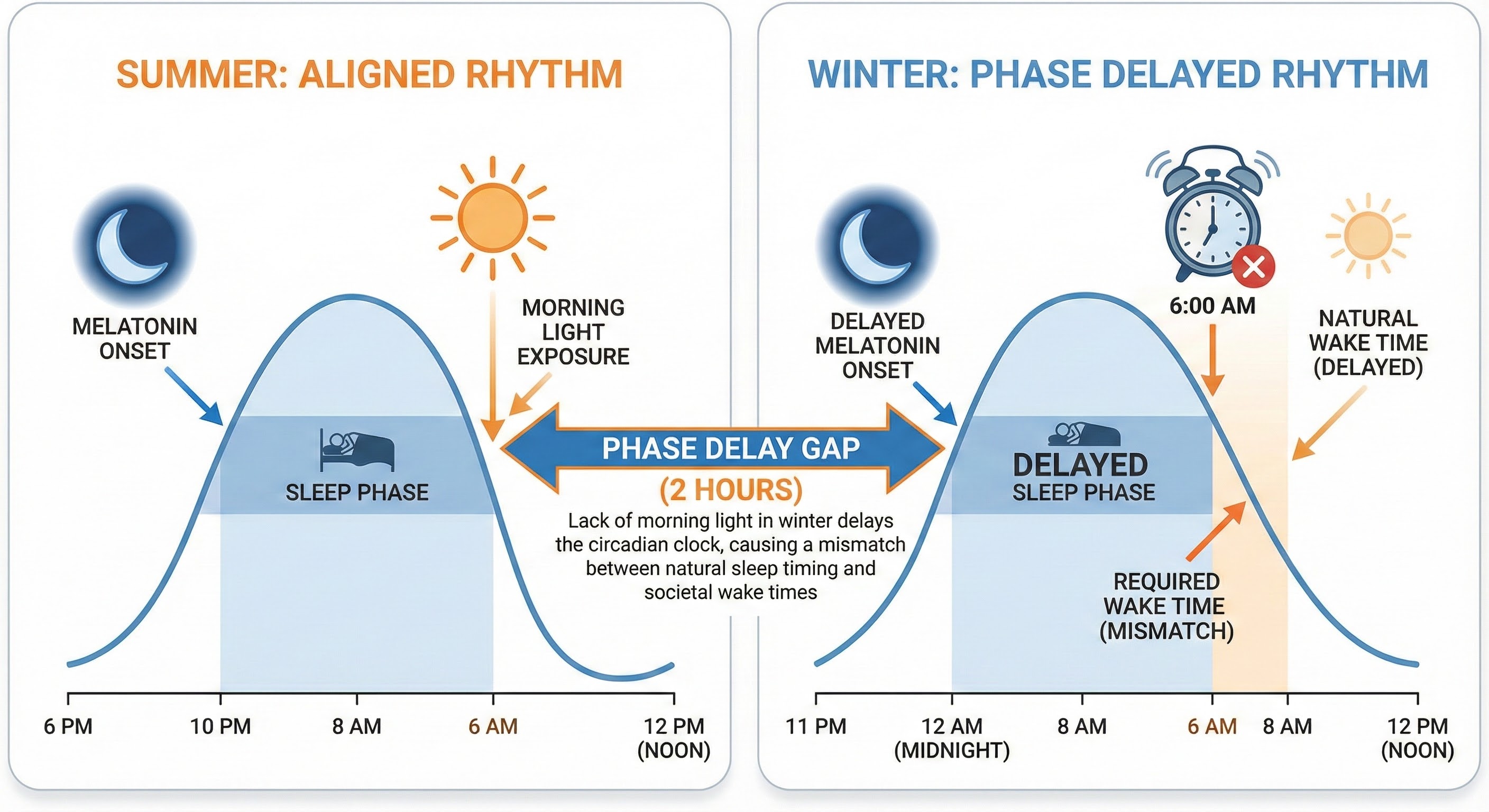
The circadian system operates on a roughly 24.2-hour cycle, slightly longer than the solar day. Without external time cues, this internal clock would drift progressively later. Light exposure, particularly in the morning, serves as the reset signal that pulls the clock earlier each day, synchronizing internal biology with the external world.
During winter, two problems emerge simultaneously. First, morning light is either absent or significantly delayed during typical waking hours. Second, artificial evening light from screens and indoor lighting sends confusing signals that can push the clock even later. This combination creates a circadian phase delay, where your body wants to sleep later and wake later than your schedule allows.
The consequences extend beyond feeling groggy in the morning. Research published in the Proceedings of the National Academy of Sciences found that circadian misalignment impairs glucose tolerance, alters appetite hormones, and reduces cognitive performance. A 2023 study in Current Biology demonstrated that even one week of circadian disruption produced metabolic changes associated with increased diabetes risk.
Sleep quality itself deteriorates under circadian stress. The drive to sleep depends on both accumulated sleep pressure, which builds throughout waking hours, and circadian timing. When you force sleep during a circadian wake period, sleep becomes lighter and more fragmented. This explains why winter mornings often feel more exhausting despite adequate time in bed.
Light Therapy Fundamentals
Light therapy works by providing the bright light signals that natural winter mornings cannot deliver. The goal is simulating the intensity and timing of summer morning light to reset circadian phase and enhance alertness.
Effective light therapy requires understanding several key parameters. Intensity matters enormously. Indoor lighting typically provides 300 to 500 lux, far below the 10,000 lux available on an overcast day outdoors or the 100,000 lux of direct sunlight. The circadian system responds minimally to dim indoor light, which explains why simply being awake in a lit room doesn’t prevent winter circadian drift.
Spectrum also influences effectiveness. Research from Rensselaer Polytechnic Institute’s Lighting Research Center shows that blue wavelengths around 480 nanometers have the strongest effect on circadian photoreceptors called intrinsically photosensitive retinal ganglion cells (ipRGCs). These specialized cells project directly to the suprachiasmatic nucleus, unlike the rods and cones used for vision. Many light therapy devices now incorporate blue-enriched light to maximize circadian impact.
Timing determines direction of circadian shift. Light exposure in the early morning, during the one to three hours after your natural wake time, advances the circadian clock earlier. Evening light, particularly after sunset, delays the clock later. For most winter sleep complaints involving difficulty waking and evening alertness, morning light provides the appropriate correction.
Duration follows a dose-response relationship. Dr. Michael Terman at Columbia University’s Center for Light Treatment and Biological Rhythms has established that 30 minutes of 10,000-lux light produces reliable phase advances in most individuals. Longer exposures or brighter light may produce stronger effects, but with diminishing returns beyond 45 to 60 minutes.
Building Your Light Therapy Protocol
Implementing effective light therapy requires matching the timing and intensity to your specific sleep patterns and schedule constraints. The following protocol adapts to typical winter schedules while maximizing circadian reset.
Step 1: Determine Your Target Wake Time Identify when you need to wake on weekdays. This becomes your anchor point for light exposure. Consistency matters more than the specific time. Waking at 6:30 AM every day produces better circadian entrainment than 6:00 AM on workdays and 9:00 AM on weekends.
Step 2: Position Light Exposure Begin light therapy within 30 minutes of your target wake time. The closer to waking, the stronger the phase-advancing effect. For a 6:30 AM wake time, light exposure should start by 7:00 AM at the latest.
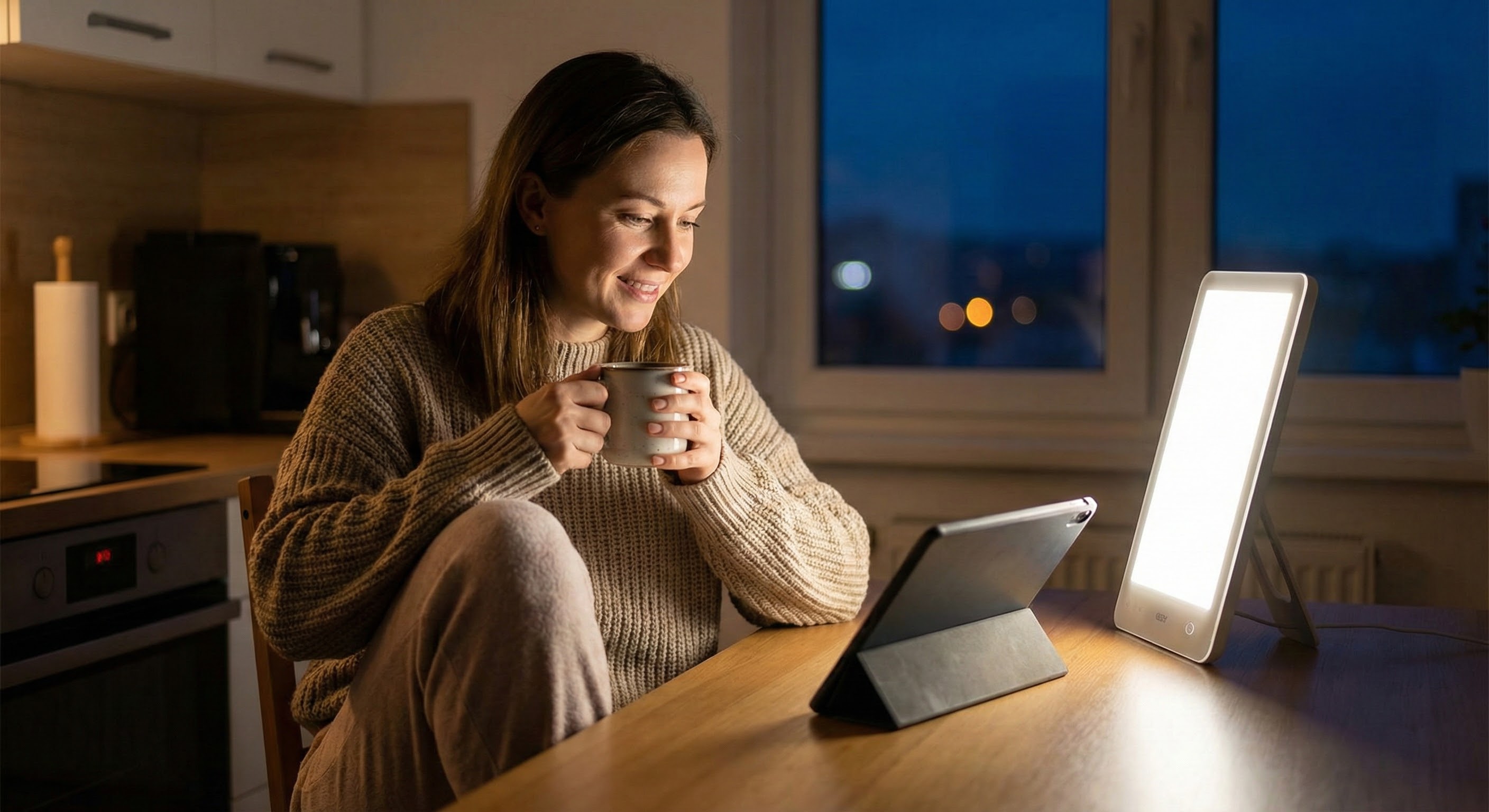
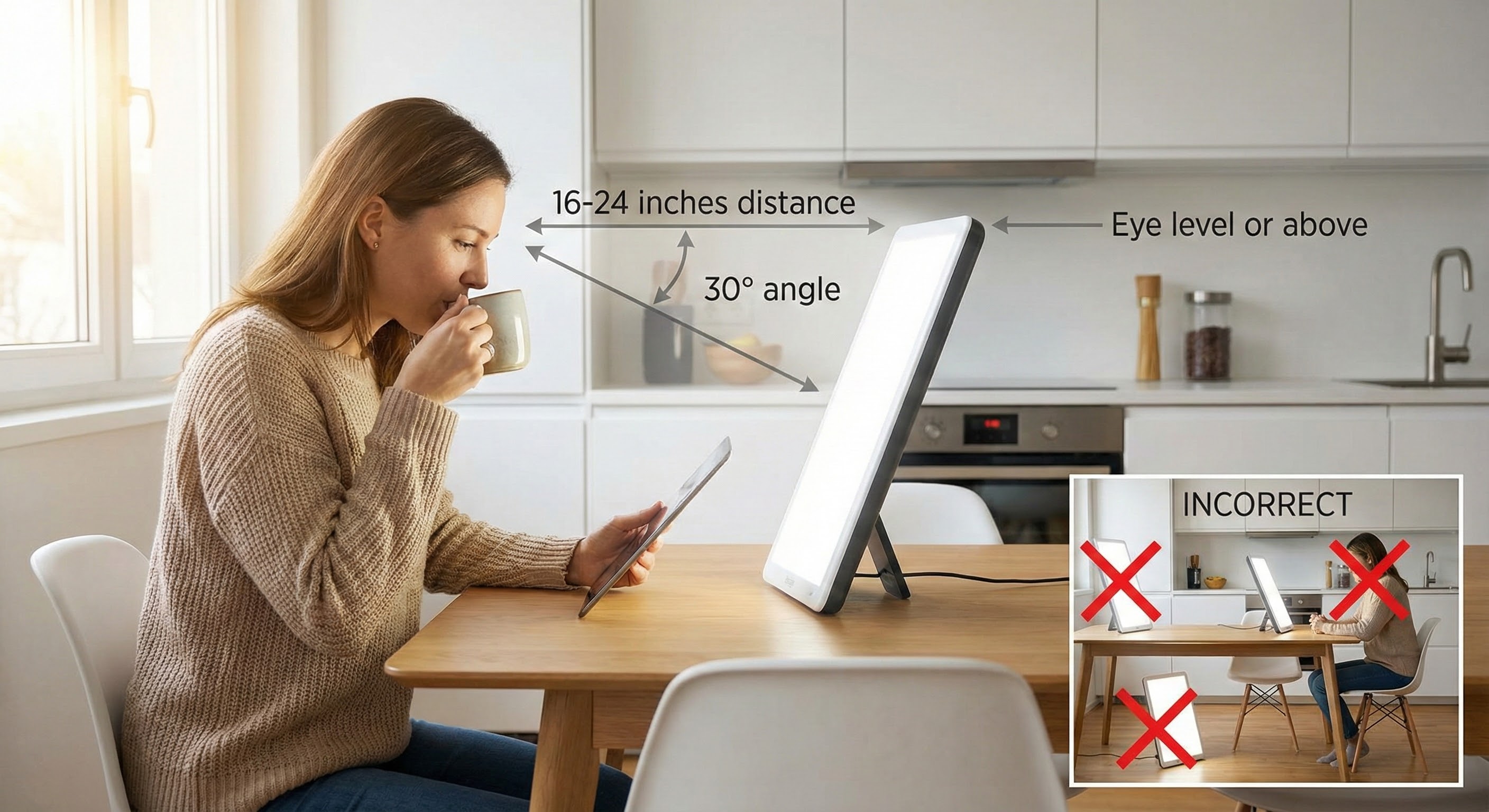
Step 3: Set Up Your Environment Place a 10,000-lux light therapy box at arm’s length, positioned slightly above eye level and off to the side. You don’t need to stare at the device. The goal is allowing light to reach your eyes while you perform morning activities like eating breakfast, reading, or checking email.
Step 4: Duration and Consistency Maintain exposure for 20 to 30 minutes. Shorter durations may be insufficient, while longer sessions show limited additional benefit. Consistency across days matters more than occasional long sessions. Five 25-minute sessions produce better results than two 60-minute sessions.
Step 5: Manage Evening Light The morning protocol loses effectiveness if evening light undermines it. After sunset, reduce screen brightness, use blue-light-filtering apps or glasses, and dim indoor lighting. This contrast between bright mornings and dim evenings strengthens circadian amplitude. Our 3-2-1 evening routine guide provides a comprehensive framework for optimizing the hours before bed.
Equipment Recommendations
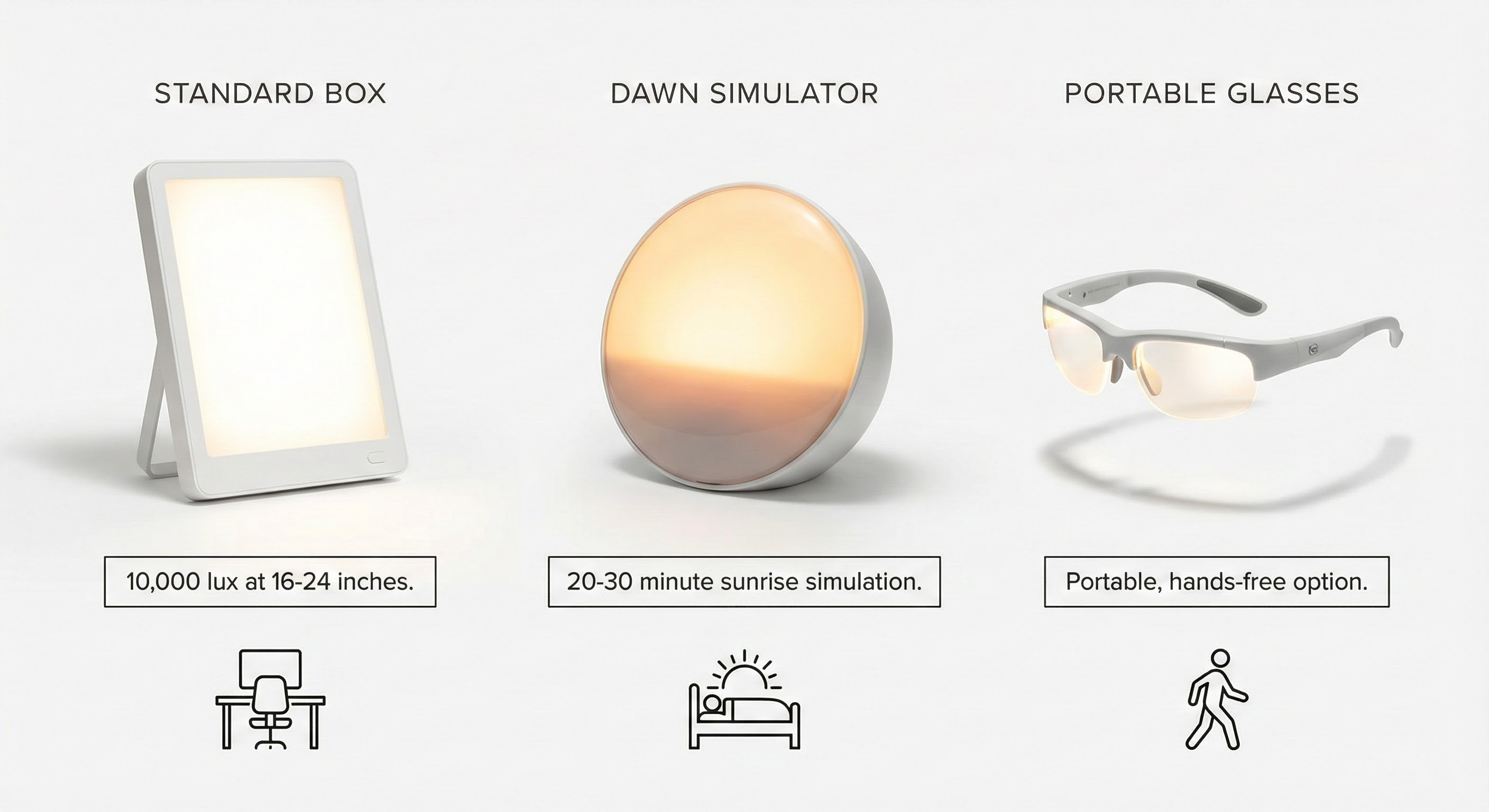
Light therapy devices range from specialized 10,000-lux boxes to dawn simulators and portable options. Each serves different needs and lifestyles.
Standard Light Boxes remain the gold standard for circadian reset. Models from Verilux, Carex, and Northern Light Technologies provide 10,000 lux at the recommended distance and have been used in clinical research. Expect to spend $40 to $80 for an effective unit. Look for devices that filter UV light and provide uniform illumination across the light surface.
Dawn Simulators gradually increase light intensity over 20 to 30 minutes before your wake time, mimicking natural sunrise. Research from Terman’s lab shows these devices improve winter waking ease and mood, though they may be slightly less effective than 10,000-lux boxes for significant phase shifts. Dawn simulators work particularly well for individuals who struggle to begin light therapy immediately upon waking.
Light Therapy Glasses offer portability for travel or when standard boxes aren’t practical. Devices like the Luminette or AYO provide light exposure while you move around. Intensity is typically lower than stationary boxes, so longer exposure may be necessary.
Natural Light Alternatives shouldn’t be overlooked. On clear winter mornings, 15 to 20 minutes of outdoor light exposure, even under overcast skies, provides substantial circadian input. A morning walk, even brief, can supplement or replace artificial light therapy on suitable days.
Special Considerations for Shift Workers and Travelers
Holiday travel across time zones compounds winter circadian challenges. The protocols above require modification for these situations.
For eastward travel across multiple time zones, pre-exposure to morning light for several days before departure helps advance the circadian clock toward the destination time zone. Begin waking and starting light therapy 30 to 60 minutes earlier each day for three to four days before travel.
For westward travel, the opposite applies. Delay light exposure and seek bright light in the evening hours to push the circadian clock later.
Shift workers face particular challenges during winter. Those working night shifts should seek bright light during the first half of their shift to promote alertness and wear dark glasses during the morning commute home to prevent circadian resetting at the wrong time.
Combining Light Therapy with Sleep Hygiene
Light therapy produces optimal results when integrated with comprehensive sleep hygiene practices. Neither approach alone matches the effectiveness of combining both.
Temperature regulation supports the circadian light signal. Core body temperature naturally drops during the biological night. Keep bedrooms cool, around 65 to 68 degrees Fahrenheit, and use hot showers or baths one to two hours before bed to trigger the cooling rebound that facilitates sleep onset.
Caffeine timing interacts with circadian phase. Caffeine blocks adenosine receptors that accumulate sleep pressure, but it also has direct circadian effects. Avoid caffeine within six hours of bedtime, and consider limiting morning caffeine to the hour following light exposure to avoid masking the natural alerting effect of light.
Meal timing serves as a secondary circadian cue. Eating breakfast within an hour of waking and avoiding heavy meals within three hours of bedtime reinforces the light-based circadian signal.
Exercise timing provides another zeitgeber. Morning or early afternoon exercise supports circadian advancement, while late evening intense exercise can delay sleep onset. During winter, even brief morning movement following light exposure strengthens the wake signal. For those interested in optimizing their sleep through data, our guide on heart rate variability and recovery explains how to use HRV to assess sleep quality and readiness.
Monitoring Progress and Adjusting
Most individuals notice improved morning alertness within three to five days of consistent light therapy. Full circadian entrainment typically requires one to two weeks. Track the following markers to assess effectiveness:
Sleep onset time should gradually move earlier if you’ve been falling asleep late. A 30 to 60 minute shift over two weeks indicates successful phase advancement.
Morning wake quality improves as circadian phase aligns with wake time. You should feel more alert upon waking, with reduced sleep inertia, that groggy period immediately after the alarm.
Energy consistency throughout the day becomes more stable as circadian amplitude strengthens. The mid-afternoon energy crash should diminish.
If progress stalls after two weeks, consider increasing light exposure duration to 45 minutes or moving the exposure earlier. Some individuals with significantly delayed circadian phase may need to gradually shift wake time and light exposure rather than attempting an abrupt reset.
The Bottom Line
Winter’s reduced daylight creates predictable circadian disruption that impairs sleep quality, morning alertness, and overall function. Strategic light therapy, providing 10,000-lux exposure within 30 minutes of waking for 20 to 30 minutes daily, resets the circadian system and restores healthy sleep patterns. Combined with evening light reduction and comprehensive sleep hygiene practices, this approach effectively counteracts the biological challenges of short winter days.
The investment is minimal. A basic light therapy box costs less than a month of caffeine purchases, and the time commitment fits within existing morning routines. The return, improved sleep, better energy, and enhanced cognitive function, compounds throughout the winter months.
Action Steps:
- Purchase a 10,000-lux light therapy box or identify a natural light alternative
- Set up a consistent wake time that works across weekdays and weekends
- Begin 25-minute light exposure within 30 minutes of waking
- Dim lights and reduce screen brightness after sunset
- Track sleep onset time and morning alertness for two weeks to assess progress
Sources: Harvard Medical School Division of Sleep Medicine, Brigham and Women’s Hospital (Dr. Charles Czeisler), Columbia University Center for Light Treatment (Dr. Michael Terman), Rensselaer Polytechnic Institute Lighting Research Center, Proceedings of the National Academy of Sciences, Current Biology.