It’s 6:47 PM on a Tuesday. You’re standing in front of an open refrigerator, exhausted from work, staring at a half-empty container of hummus and some wilting lettuce. Your phone buzzes with a DoorDash notification, reminding you that Thai food is 28 minutes away. The salad you planned to make this morning feels impossibly far from reality now.
This moment, repeated millions of times daily across households worldwide, represents the fundamental flaw in relying on willpower for nutrition. The problem isn’t your discipline or your intentions. The problem is that you’re asking your depleted evening brain to make good decisions when all the easy options are bad ones. Research from the Journal of Nutrition Education and Behavior shows that people who rely on in-the-moment meal decisions consume an average of 300 more calories daily and significantly less produce than those who plan ahead. The difference between chaotic eating and consistent nutrition isn’t motivation. It’s systems.
Meal preparation, when done strategically, removes the decision point entirely. You’re not choosing between cooking and takeout at 6:47 PM because the choice was already made on Sunday afternoon when your prefrontal cortex was fully fueled and your energy was high. The food is already prepared, portioned, and waiting. The path of least resistance shifts from “order delivery” to “reheat what’s in the container.” This is the core insight that separates sustainable meal preppers from the millions who try it once, find it overwhelming, and abandon the practice by week three.
The Research Behind Meal Preparation Benefits
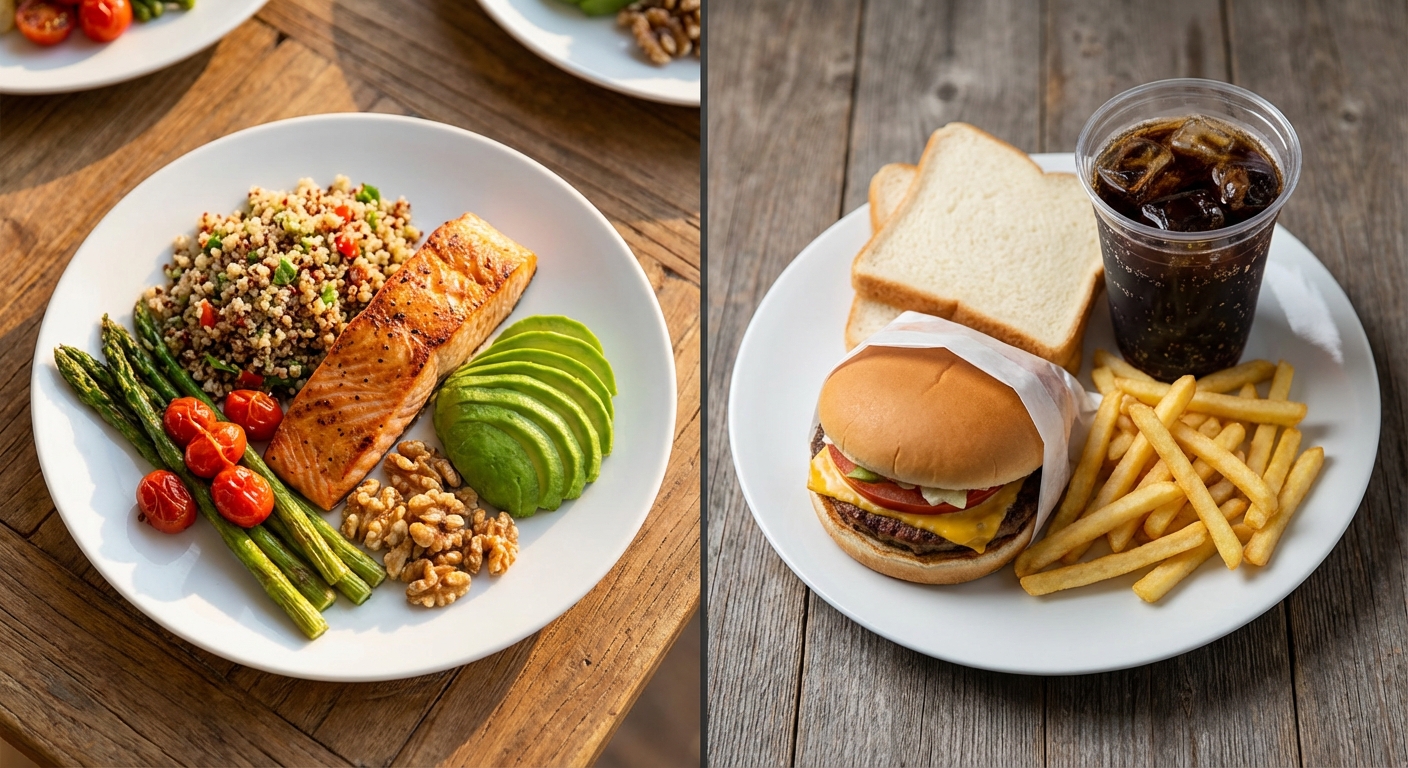
The evidence supporting meal preparation extends far beyond anecdotal success stories. A 2017 study published in the International Journal of Behavioral Nutrition and Physical Activity analyzed the eating habits of over 40,000 adults and found that individuals who spent more time on food preparation consumed significantly more vegetables, fruits, and salads compared to those who relied primarily on convenience foods or restaurants. They also consumed less fast food and had higher overall diet quality scores, even after controlling for income, education, and time availability.
Weight management outcomes improve substantially with meal preparation practices. Research from the American Journal of Preventive Medicine found that people who prepared meals at home at least five times weekly were 28% less likely to have overweight BMI and 24% less likely to have excess body fat compared to those who prepared home meals fewer than three times weekly. The mechanisms are straightforward: home-prepared meals tend to be lower in calories, sodium, and saturated fat while higher in fiber and micronutrients. Portion sizes are controlled rather than restaurant-inflated, and you’re not contending with the appetite-stimulating additives that food manufacturers engineer into processed products.
The financial benefits compound over time. According to data from the Bureau of Labor Statistics, the average American household spends approximately $3,500 annually on food away from home. Families who consistently meal prep report 25-40% reductions in their total food spending, primarily through reduced restaurant visits, decreased food waste, and more efficient use of bulk ingredients. The upfront investment in quality containers and storage solutions typically pays for itself within the first month of consistent practice.
Perhaps most underappreciated is the psychological benefit. Decision fatigue is a well-documented phenomenon: the quality of our choices deteriorates as we make more decisions throughout the day. A study in the Proceedings of the National Academy of Sciences found that judges made more lenient parole decisions early in the day and after food breaks, defaulting to status-quo denials when mentally depleted. Your food choices operate on similar neural circuitry. When meal prep eliminates the daily “what should I eat?” calculation, you preserve cognitive resources for decisions that actually matter while simultaneously protecting yourself from the poor choices that tired brains inevitably make.
The Three Fundamental Approaches
Meal preparation isn’t a monolithic practice. The Instagram image of twenty identical containers stacked with chicken, broccoli, and rice represents just one end of a broad spectrum, and frankly, it’s the approach most likely to fail for typical home cooks. Successful long-term meal prep requires matching your methodology to your personality, your schedule constraints, and your tolerance for repetition. The three primary approaches each offer distinct tradeoffs between convenience, variety, and time investment.
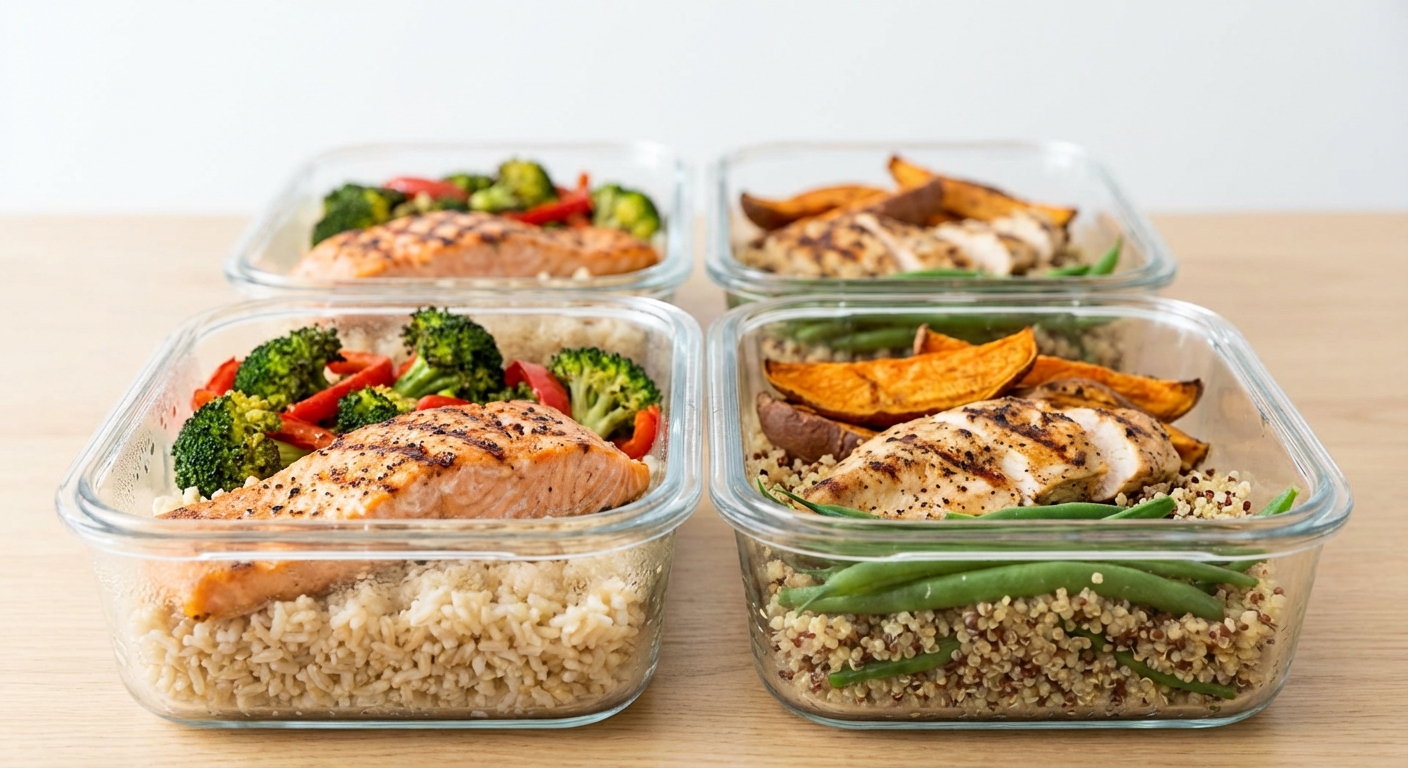
Batch cooking involves preparing complete meals in large quantities, portioning them into individual containers, and storing them for consumption throughout the week. This is the bodybuilder approach: maximum efficiency, minimum daily effort, but significant repetition. You might cook four to six portions each of three different recipes on Sunday, then simply grab and reheat throughout the week. The advantages are substantial for people who genuinely don’t mind eating the same meal multiple times, who prioritize zero daily cooking time, or whose schedules are so demanding that even ten minutes of meal assembly feels impossible. The disadvantages are equally real: texture degradation when reheating certain foods, potential food fatigue by day four or five, and the significant three-to-five hour time commitment required for weekly prep sessions.
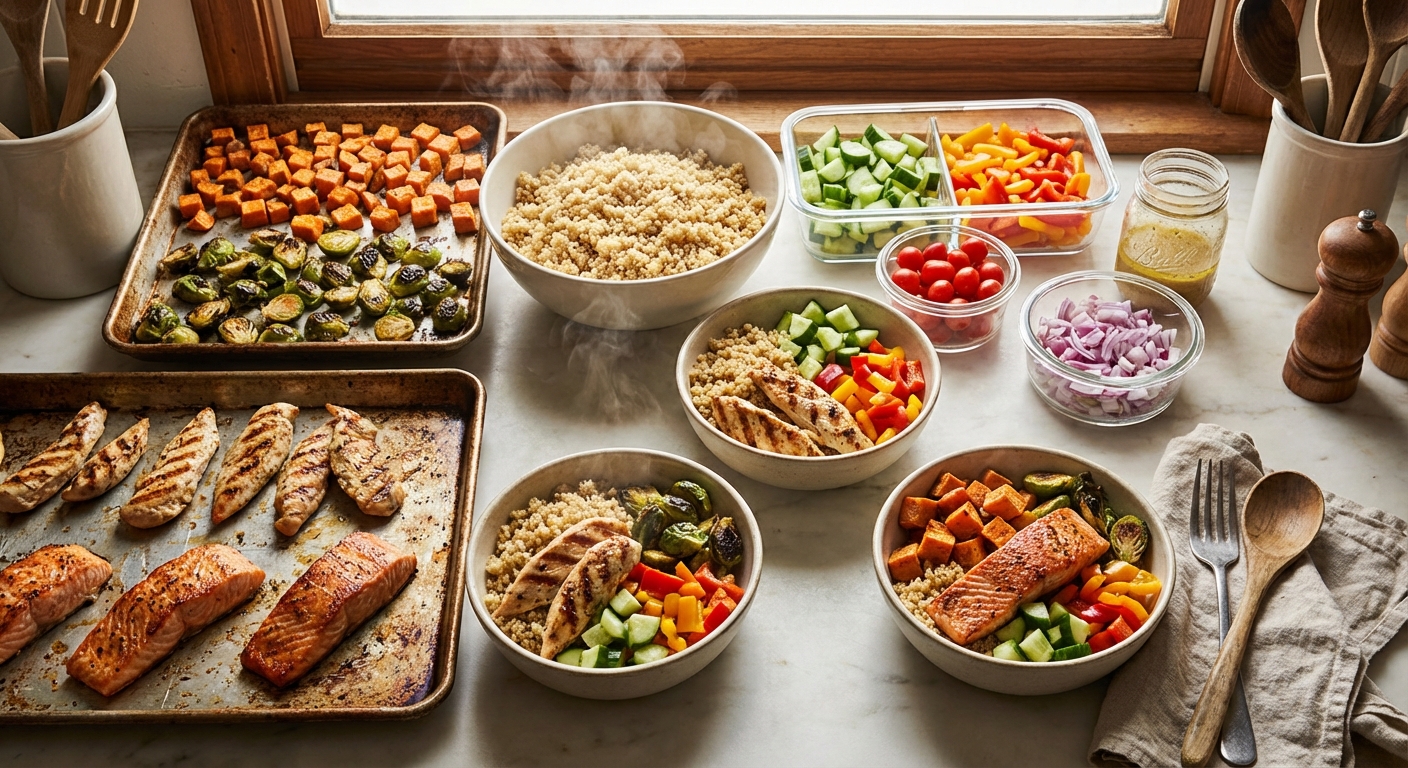
Ingredient preparation, sometimes called component prep or buffet-style prep, flips the approach entirely. Instead of cooking complete meals, you prepare individual ingredients that can be combined in various configurations throughout the week. You might roast several sheet pans of vegetables, grill a variety of proteins, cook multiple grains, wash and chop salad components, and prepare two or three sauces or dressings. Each day, you assemble a different meal from these prepared components. This approach respects the reality that you might not know on Sunday what you’ll be craving on Thursday. It preserves more food texture since components are stored separately rather than as assembled dishes. It works beautifully for households where different family members have different preferences, since everyone can customize their plate from the same ingredient pool.
The hybrid approach combines elements of both strategies based on meal occasion. For most people, this represents the sustainable sweet spot. You might batch-cook breakfasts completely, since morning time pressure is often highest and variety matters less. Overnight oats, egg muffin cups, or breakfast burritos can be fully prepared and simply grabbed on the way out the door. Lunches might be batch-cooked or component-based depending on your workplace situation. Dinners, where most people have more time and where food enjoyment matters most, might rely primarily on ingredient prep for flexible, fresh-feeling assembly. This tiered approach lets you apply rigidity where you need efficiency and flexibility where you value enjoyment.
Building Your System From the Ground Up
The most common meal prep failure mode is attempting too much too fast. First-time preppers often try to prepare every meal for the entire family starting from day one, spend five hours creating elaborate recipes, and burn out completely by week three. Sustainable meal prep develops gradually, building competence and routine incrementally rather than attempting transformation overnight.
Start by mastering a single meal category before expanding. If mornings are your chaos point, focus exclusively on breakfast prep for the first two to three weeks. Learn what recipes work for you, refine your timing and workflow, and let the habit solidify before adding complexity. Only after breakfast prep feels automatic should you introduce lunch preparation. Dinner can follow when both breakfast and lunch systems are running smoothly. This progressive approach might take two to three months to fully develop, but the resulting habits will be far more durable than any attempt at immediate wholesale change.
Recipe selection determines prep success more than any other factor. Not all foods reheat well, and learning this lesson through five days of soggy vegetables or rubbery protein is demoralizing. Soups, stews, and chilis are essentially foolproof, often tasting better after flavors meld in the refrigerator. Grain bowls built on rice, quinoa, or farro maintain their texture well when stored properly and reheated correctly. Roasted root vegetables and cruciferous vegetables hold up admirably. Sheet-pan proteins like baked chicken thighs or roasted salmon fare well for three to four days. In contrast, leafy green salads wilt within hours of dressing, crispy foods lose their texture immediately when refrigerated, avocado browns rapidly once cut, and cream-based sauces tend to separate. Store these problematic items separately or prepare them fresh daily while prepping everything else in advance.
The physical workflow of prep day matters enormously for efficiency and sustainability. Rather than cooking each recipe sequentially, batch similar tasks together. Start with items requiring the longest cooking time, typically oven-roasted proteins or slow-cooker dishes. While these cook unattended, move to chopping all vegetables for the week. Once chopping is complete, start grains that cook passively on the stovetop. Use the oven for multiple sheet pans simultaneously, roasting vegetables alongside proteins when temperatures align. Prepare sauces and dressings during the final cooking phase when most items are in ovens or on stoves. End with cooling, portioning, and storage. This parallel-processing approach compresses what might take five hours of sequential cooking into two to three hours of efficient workflow.
Equipment That Reduces Friction
You can theoretically meal prep with a single pot, a knife, and some plastic wrap. However, fighting your equipment adds friction to an already demanding task, and friction is the enemy of sustainable habits. Strategic equipment investment pays dividends rapidly through reduced effort and improved results.
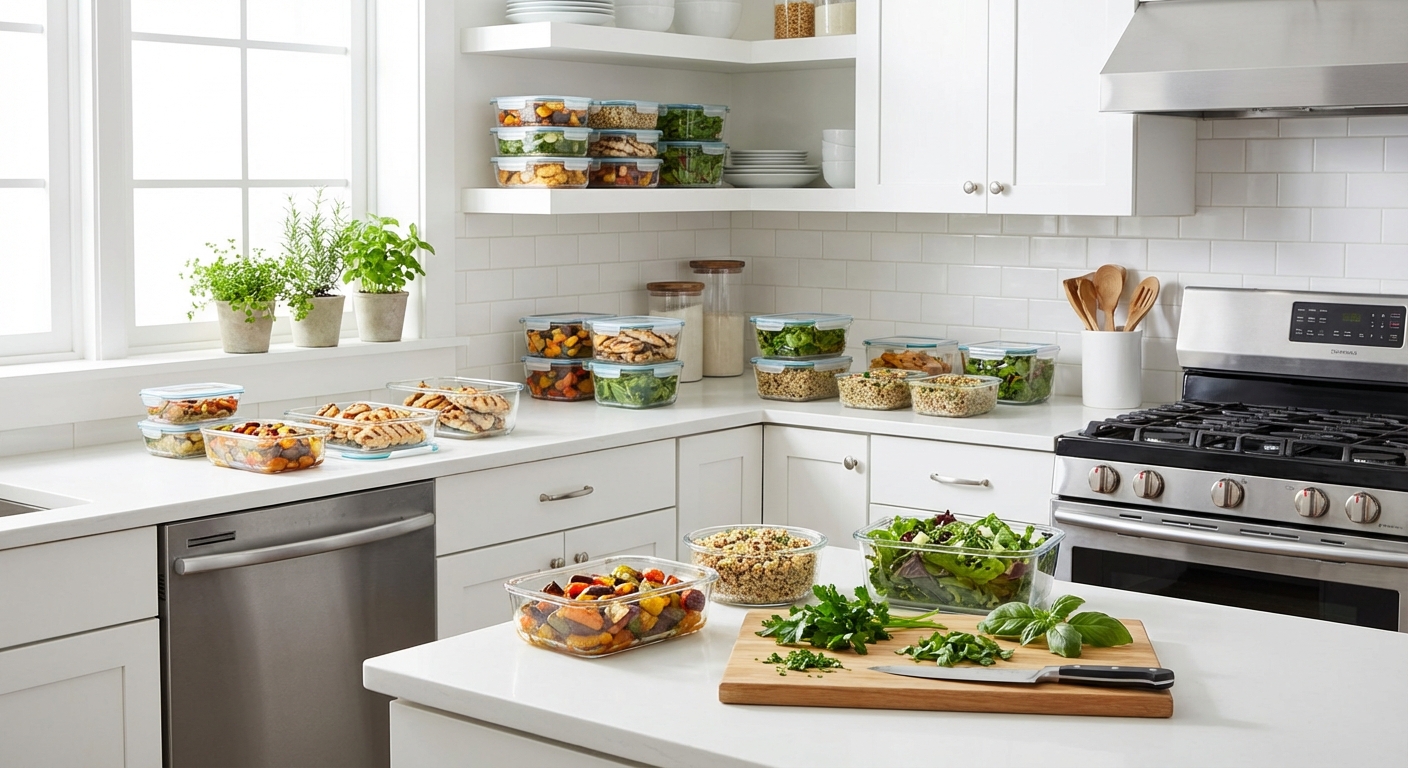
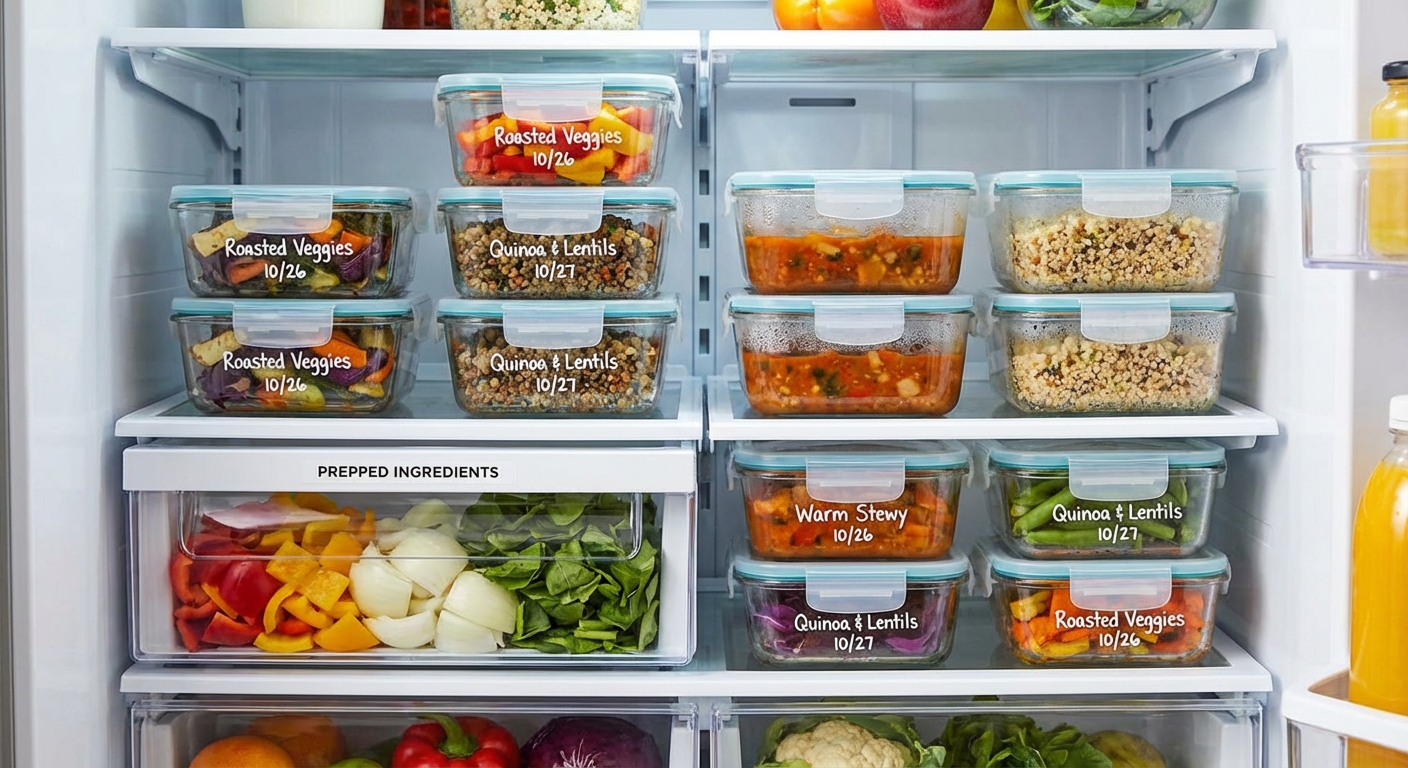
Containers represent the single most important equipment category. Glass containers with locking lids are worth the additional expense for several reasons: they don’t absorb odors or stains, they transition safely from refrigerator to microwave to dishwasher, and they last essentially forever with reasonable care. The visibility of glass also matters psychologically, since you can see exactly what’s inside without opening containers. Plan for ten to fifteen individual meal-sized containers minimum for solo weekly prep, scaling upward for families. Include several larger containers for batch soups or component storage, plus small containers for sauces, dressings, and snacks. Matching lids that actually fit their containers prevents the frustrating “lid roulette” that plagues many kitchens.
Sheet pans enable the backbone of efficient meal prep: high-volume roasting. Three or four half-sheet pans allow simultaneous cooking of multiple items, dramatically reducing active prep time. Look for commercial-weight aluminum pans with rolled edges that won’t warp at high temperatures. Silicone baking mats or parchment paper makes cleanup trivial and prevents sticking without additional oil.
A sharp knife and large cutting board seem obvious but are often undervalued. Dull knives slow prep dramatically and create frustration. A single high-quality chef’s knife, properly maintained with a honing steel and occasional professional sharpening, outperforms a drawer full of mediocre blades. Your cutting board should be large enough to hold a reasonable volume of chopped ingredients without overflowing, typically at least 18 by 24 inches for serious prep work.
Optional but valuable additions include an Instant Pot or similar electric pressure cooker for hands-off protein and grain cooking, a food processor for rapid vegetable chopping when volume demands it, and a kitchen scale for those tracking macronutrients precisely. None of these are essential, but each can meaningfully accelerate workflow once basic systems are established.
Food Safety Protocols for Batch Cooking
When cooking a single meal for immediate consumption, food safety risks are minimal. Batch cooking introduces a larger window for bacterial growth if cooling and storage protocols aren’t followed carefully. Understanding and implementing proper food safety practices protects your health without creating unnecessary paranoia.
The temperature danger zone between 40°F and 140°F is where pathogenic bacteria multiply most rapidly. Food should spend as little time as possible in this range. After cooking, don’t leave food at room temperature for extended periods while you finish other prep tasks or clean up. Instead, actively cool hot foods before refrigeration using appropriate methods. Spread items across sheet pans to increase surface area and accelerate cooling. Divide large batches of soup or stew into smaller, shallower containers that cool faster. An ice bath can rapidly cool pots of liquid-based dishes. The goal is reaching refrigerator temperature within two hours of cooking completion.
Storage duration varies by food type and storage temperature. In a refrigerator maintained at 40°F or below, cooked proteins remain safe for three to four days, cooked grains for four to six days, and cooked vegetables for three to five days. Soups and stews should be consumed within three to four days. For anything you won’t consume within these windows, freeze immediately after cooling rather than refrigerating first and freezing later. Frozen prepared meals maintain quality for two to three months and remain safe indefinitely at 0°F, though texture may degrade with extended storage.
Label everything with preparation date. The confident belief that you’ll remember when something was made invariably proves false by day five when multiple containers of similarly colored contents sit in your refrigerator. A simple piece of masking tape with a Sharpie date takes seconds and prevents both food waste and potential illness. When in doubt about whether something is still good, default to discarding it. The cost of a thrown-away meal is negligible compared to foodborne illness.
Preventing the Week Three Burnout
The enthusiasm curve for meal prep follows a predictable pattern. Week one feels exciting and productive. Week two maintains momentum. Week three often brings the crash, as the novelty wears off and the effort starts feeling like an additional obligation rather than a helpful system. Understanding and anticipating this burnout pattern allows you to design countermeasures before they’re needed.
Excessive repetition causes the most common form of burnout. If you’re eating identical meals five days straight, food fatigue sets in rapidly regardless of how much you enjoyed the first serving. Build variety into your system from the start: prep three or four different options rather than a single recipe in massive quantity. Rotate cuisines and flavor profiles across weeks. The component prep approach inherently provides more variety than batch cooking, since the same proteins and vegetables can combine into Mediterranean bowls, Asian-inspired stir-fries, Mexican-style preparations, or simple American plates depending on which sauces and seasonings you add.
Perfectionism creates another burnout pathway. The Instagram version of meal prep features perfectly arranged containers, precisely portioned macros, and photogenic food styling. Real-world sustainable meal prep often looks messier, with imperfect portions and foods that photograph less impressively. Embracing “good enough” prevents the psychological drain of striving for perfection. Meals that are 80% optimized nutritionally and actually consumed beat perfectly optimized meals that you abandon after three weeks.
Rigid rules without flexibility create fragility. Systems that demand perfect adherence, where missing a single prep day feels like total failure, collapse easily when life happens. Build slack into your approach: keep emergency frozen meals available for weeks when prep doesn’t happen, maintain a list of quick healthy restaurant options for when the system fails, and accept that some weeks will be less organized than others. The goal is long-term average behavior improvement, not perfect weekly compliance. A system you maintain 70% of weeks for years outperforms a system you maintain perfectly for six weeks before abandoning entirely.
Customization for Specific Goals
Your meal prep strategy should align with your specific nutritional objectives, since the approaches that optimize for weight loss differ somewhat from those optimizing for muscle gain or simple cost reduction.
For weight loss, pre-portioning is particularly valuable since it removes the temptation to serve yourself larger quantities when hungry. Include high-volume, low-calorie foods like roasted vegetables and leafy greens that provide physical fullness without caloric excess. Prepare healthy snacks in advance so that when hunger strikes between meals, the convenient option is celery with portioned hummus rather than whatever’s in the vending machine. Control calorie-dense additions like sauces, oils, and dressings by portioning them separately rather than mixing them into meals. Aim for 400-600 calorie portions for main meals depending on your total daily targets, with visible protein (30-40g per meal) to support satiety.
For muscle building, prioritize protein quantity and distribution. Each meal should deliver 30-45g of protein to cross the leucine threshold necessary for maximum muscle protein synthesis stimulation. Include complex carbohydrates for training fuel and recovery support. Prepare post-workout meals that are immediately accessible when returning from the gym, since protein timing within the two-hour post-exercise window optimizes muscle protein synthesis. Higher-fat foods support testosterone production and overall caloric sufficiency. Target 500-700 calorie portions with emphasis on protein and carbohydrate density.
For families with varying preferences, component prep shines. Prepare base ingredients that accommodate different tastes: plain grains that can be seasoned individually, proteins cooked simply that accept various sauces, and vegetables that work across cuisines. Let family members assemble their own combinations from the prepared ingredient pool. This approach prevents battles over meal choices while still providing the efficiency benefits of advance preparation. Include some kid-friendly items that can serve as defaults while adults enjoy more adventurous combinations.
For budget optimization, plan meals around sale items and seasonal produce. Protein costs per gram vary dramatically, with eggs, canned fish, chicken thighs, and legumes providing far better value than chicken breasts, beef steaks, or fresh seafood. Grains bought in bulk, particularly from warehouse stores or ethnic grocery stores, cost a fraction of individual packages. Frozen vegetables often cost less than fresh while providing equivalent nutrition and superior convenience for meal prep purposes. The simple act of planning before shopping reduces impulse purchases and the food waste that results from buying ingredients without clear usage plans.
The Minimum Viable Approach
Some weeks don’t allow for elaborate prep sessions. Travel, illness, work crises, or simple exhaustion can make the full prep routine impossible. Rather than viewing these as failures requiring abandonment of the system, develop a minimum viable version that maintains the habit’s core benefits with drastically reduced effort.
The minimum prep takes thirty to forty-five minutes and focuses exclusively on the items that provide the greatest return on time investment. Cook two to three pounds of a simple protein: baked chicken thighs, ground turkey in a skillet, or hard-boiled eggs require minimal active attention. Make a large batch of a single grain: rice cooker rice or pressure cooker quinoa cook hands-off. Chop vegetables for the week without cooking them, since raw vegetables are still faster to use than unprepped ones. Prepare one simple sauce or dressing, even if it’s just olive oil mixed with lemon juice and minced garlic.
These minimal components allow ten-minute meal assembly each day: combine protein, grain, and vegetables with sauce for a nutritionally reasonable meal. It’s not the carefully planned, macro-optimized ideal, but it keeps you eating home-prepared food rather than defaulting to delivery apps. Maintaining the weekly prep habit, even in diminished form, prevents the complete system collapse that often follows a single missed week.
The psychology of “something is better than nothing” matters more than the specific nutritional content. Skipping prep entirely for one week often cascades into multiple weeks as the habit loses momentum. A minimal prep session maintains the behavioral pattern even when circumstances prevent the full version. Protect the habit first; optimize later when conditions improve.
The Bottom Line
Meal preparation works not because it requires superhuman discipline, but because it removes the need for discipline at the moment of decision. By front-loading effort to times when you’re energized and thinking clearly, you make healthy eating the default rather than the aspiration. The specific approach matters less than finding a system that matches your preferences, your schedule, and your tolerance for repetition.
The research is clear that people who prepare meals at home eat better, weigh less, and spend less money on food. But these outcomes require consistency over time, and consistency requires systems that don’t burn you out. Start small with a single meal category, select recipes that actually reheat well, build routines that batch similar tasks efficiently, and accept that imperfect weeks are part of any sustainable practice. For specific nutritional targets, consider how meal prep can help you close the fiber gap and incorporate anti-inflammatory eating patterns.
Your Next Steps:
- Choose one meal category (breakfast is often easiest) to prep for the next two weeks
- Select two to three simple recipes you genuinely enjoy eating that reheat well
- Acquire appropriate storage containers (ten glass containers with locking lids is a reasonable starting point)
- Block two hours on your calendar for your first prep session
- After two weeks of successful single-meal prep, add a second meal category
The best meal prep system is the one you’ll actually maintain. Optimize for sustainability over perfection, for consistency over intensity, and for systems over motivation. The six-PM-standing-in-front-of-the-refrigerator moment will come regardless of your intentions. What you’ll find there depends entirely on what you built when you had the energy to build it.
Sources: International Journal of Behavioral Nutrition and Physical Activity, American Journal of Preventive Medicine, Journal of Nutrition Education and Behavior, Bureau of Labor Statistics food expenditure data, USDA food safety guidelines, behavioral economics research on decision fatigue.