
For the past decade, the fitness industry has been obsessed with intensity. High-Intensity Interval Training promised maximum results in minimum time, spawning a culture where if you weren’t gasping for air and questioning your life choices, the workout didn’t count. Boutique fitness studios built their entire business model around the dopamine hit of high-heart-rate finishes, and social media amplified the message that suffering equaled progress. But exercise physiologists, elite endurance coaches, and longevity researchers know a different truth: the foundation of aerobic health and metabolic resilience is built at a pace that feels almost embarrassingly easy.
This is Zone 2 training, a specific metabolic state where your body becomes extraordinarily efficient at burning fat for fuel while developing the cellular infrastructure that supports all other physical activities. Far from being “junk miles” or wasted time, Zone 2 represents the metabolic sweet spot that drives adaptations no amount of high-intensity work can replicate. Professional endurance athletes spend 75-85% of their total training volume in this zone precisely because they understand what the general population often doesn’t: intensity has diminishing returns, but base-building is the gift that keeps giving.
The science supporting Zone 2 has strengthened considerably in recent years, particularly as researchers have explored its role beyond athletic performance. A 2024 study published in Cell Metabolism found that consistent low-intensity aerobic exercise promoted mitochondrial biogenesis and improved insulin sensitivity more effectively than matched-volume high-intensity training, with effects persisting for weeks after the training period ended. For longevity, metabolic health, and sustainable fitness, the easy path turns out to be the most effective one.
Understanding the Metabolic Zones
Exercise physiologists divide cardiovascular intensity into five or six zones based on heart rate, lactate accumulation, and subjective effort. Zone 2 occupies a narrow but crucial band: the highest intensity at which your body can still primarily rely on aerobic fat oxidation rather than anaerobic carbohydrate burning. Technically, it’s defined as the intensity at which blood lactate remains below approximately 2 mmol/L, a threshold that indicates your slow-twitch muscle fibers are doing the heavy lifting and your mitochondria are keeping pace with energy demands.
In this metabolic state, your type I (slow-twitch) muscle fibers are recruited almost exclusively. These fibers are packed with mitochondria, the cellular power plants that convert oxygen and fatty acids into ATP (adenosine triphosphate, the energy currency of cells). Because fat is an almost unlimited fuel source even in lean individuals, Zone 2 represents a form of energy production that can be sustained for hours, unlike the rapid but limited carbohydrate burning that dominates higher intensities. This is the cleanest, most efficient energy metabolism your body possesses, and training it makes the entire system more robust.
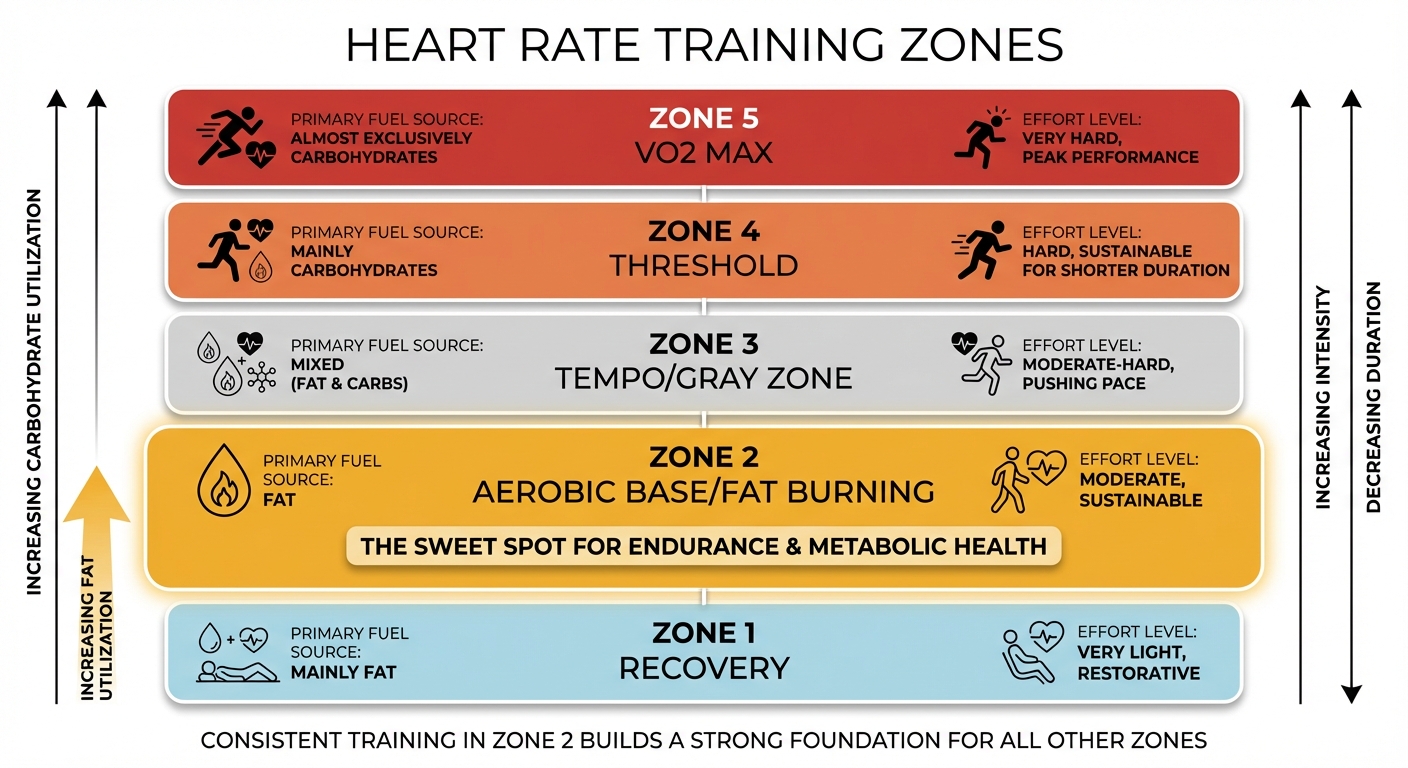
When you push harder, crossing into Zone 3 and beyond, the energy demand outpaces what oxygen-dependent metabolism can supply. Your body shifts toward glycolysis, burning stored muscle glycogen and blood glucose because it’s faster, but this process produces lactate as a byproduct. While lactate itself isn’t the villain it was once thought to be (it’s actually recycled as fuel), its accumulation indicates that you’ve exceeded your aerobic capacity and shifted into territory that requires recovery rather than supporting adaptation. This is the “gray zone” that many recreational exercisers unknowingly inhabit: hard enough to create fatigue but not hard enough to elicit the specific peak-performance adaptations of true high-intensity intervals.
The Mitochondrial Revolution
The transformative power of Zone 2 training happens at the cellular level, inside the mitochondria that power every function of your body. Consistent training at this low intensity sends a biochemical signal that triggers two remarkable adaptations: your body produces more mitochondria (mitochondrial biogenesis), and the existing mitochondria become more efficient at processing fuel. This improved mitochondrial density is perhaps the single strongest biomarker associated with longevity and metabolic health across decades of research.
Dr. Iñigo San Millán, a professor at the University of Colorado School of Medicine and exercise physiologist for professional cycling teams, has been instrumental in bringing Zone 2 research to mainstream attention. His work demonstrates that metabolically healthy individuals can efficiently switch between burning fat and burning carbohydrates based on demand, a capability called “metabolic flexibility.” People with dysfunctional mitochondria, common in aging, sedentary lifestyles, and metabolic syndrome, lose this flexibility. Their cellular engines become “stuck” in glucose-burning mode, unable to access the vast fat stores that should be available for sustained energy.
By training consistently in Zone 2, you’re essentially rehabilitating and expanding your mitochondrial network. Each session provides the stress signal that triggers adaptation without the cellular damage that requires extended recovery. Over months of consistent training, resting heart rate drops (often by 5-15 beats per minute), exercise capacity at any given heart rate increases, and the body becomes measurably more efficient at fat oxidation. These changes are visible not just in performance but in metabolic blood markers: improved fasting glucose, lower triglycerides, and enhanced insulin sensitivity.
The implications extend well beyond athletic performance. Dr. Peter Attia, a physician focused on longevity medicine, considers Zone 2 training one of the most powerful interventions available for extending healthspan. In his clinical practice, he prescribes 150-200 minutes of weekly Zone 2 exercise as foundational to metabolic health, arguing that the mitochondrial adaptations it produces are protective against age-related diseases including cardiovascular disease, type 2 diabetes, and neurodegenerative conditions. The mitochondria in your brain, heart, and muscles all benefit from the same training stimulus.
Finding Your Zone Without a Lab
The gold standard for identifying Zone 2 is a blood lactate test performed in an exercise physiology laboratory, where small blood samples are drawn at increasing exercise intensities to precisely map the lactate curve. For most people, however, this testing is neither accessible nor necessary. Your body provides several reliable signals that correlate well with the underlying metabolic reality, and learning to read these signals is actually more valuable than relying solely on a heart rate number that fluctuates based on sleep, caffeine, stress, and hydration.

The Talk Test: This simple but remarkably accurate method requires no equipment. During Zone 2 exercise, you should be able to hold a conversation in complete sentences, but it should feel slightly strained, requiring periodic pauses for breath. If you can chat effortlessly about anything and everything without any respiratory constraint, you’re likely in Zone 1, too easy to drive meaningful adaptation. If you can only get out a few words before needing to breathe, you’ve drifted into Zone 3, too hard for optimal base-building. The sweet spot is conversational but requires attention, you could tell a story but couldn’t sing a song.
Nasal Breathing: Another reliable indicator is your ability to breathe exclusively through your nose throughout the session. The nasal passages impose a natural rate-limiter on air intake. If you can maintain your pace while breathing only through your nose without feeling like you’re suffocating, you’re almost certainly in Zone 2 or below. The moment you feel the irresistible urge to open your mouth and gulp air, you’ve likely crossed the lactate threshold into Zone 3. Some practitioners use this as their primary pacing tool, running or cycling at “nasal breathing pace” rather than monitoring heart rate at all.
The MAF 180 Formula: Developed by Dr. Phil Maffetone, who coached elite triathletes including Mark Allen, this formula provides a reasonable starting estimate for maximum Zone 2 heart rate. The calculation is simple: 180 minus your age. Adjustments apply for training history and health status: subtract 5-10 beats if you’re returning from illness, injury, or prolonged inactivity; add 5 beats if you’ve been training consistently for two or more years without setbacks. For a healthy 40-year-old with consistent training background, the target would be approximately 140-145 beats per minute as an upper limit.
Heart Rate Variability During Exercise: For those using more advanced monitoring, the stability of heart rate during steady-state exercise provides useful information. In true Zone 2, heart rate should remain relatively stable for the duration of the session, perhaps drifting up by 5-10 beats due to cardiac drift over a long session but not spiking or fluctuating wildly. If your heart rate is erratic or continues climbing despite consistent effort, you’re likely pushing too hard.
Structuring Your Zone 2 Practice
The most common mistake people make with Zone 2 training is impatience, both in the micro sense of individual sessions and the macro sense of expecting rapid results. Because the intensity is low, the duration must be substantial to trigger the desired adaptations. The metabolic signaling pathways for mitochondrial biogenesis don’t meaningfully activate until approximately 45 minutes into continuous aerobic activity. A quick 20-minute jog may feel good but won’t produce the cellular changes that make Zone 2 so valuable.
Duration: Each Zone 2 session should last a minimum of 45-60 minutes to ensure you’re stimulating the mitochondrial adaptation pathways. For those with time available, 60-90 minute sessions provide even stronger stimulus. These longer durations are where the magic happens, as the body progressively depletes easier fuel sources and becomes increasingly reliant on fat oxidation, reinforcing exactly the metabolic flexibility you’re trying to develop.
Frequency: To see meaningful physiological changes, aim for three to four Zone 2 sessions per week. This frequency provides enough cumulative volume to drive adaptation while allowing recovery between sessions. Because Zone 2 work is genuinely low-stress by design, it shouldn’t interfere with recovery from strength training or higher-intensity interval work; in fact, it often enhances recovery by promoting blood flow without creating additional fatigue.
Modality: Choose any steady-state cardio that allows you to maintain consistent output at the target intensity. Cycling is often the easiest entry point because it eliminates the impact forces of running and allows precise heart rate control through gearing. Running works well for those without joint issues but requires discipline to slow down enough, many runners find their “easy” pace is actually Zone 3. Rowing, rucking, elliptical training, and swimming all work if you can maintain the target intensity consistently.
Progression: Unlike strength training, where progressive overload is the primary driver of adaptation, Zone 2 improvement manifests as increased output at the same heart rate rather than tolerance for higher heart rates. After 8-12 weeks of consistent training, you should notice that the pace you can maintain at your Zone 2 heart rate has increased. A cyclist who started at 150 watts might find they can sustain 175 watts at the same heart rate. This is the fitness adaptation made visible.
The Ego Check
Perhaps the greatest barrier to effective Zone 2 training is psychological rather than physiological. For anyone with competitive tendencies or a history of intense exercise, the required pace can feel almost insultingly slow. Runners may need to incorporate walking intervals to keep heart rate in range. Cyclists may need to spin in their easiest gears on flat terrain. The internal voice that equates suffering with productivity becomes a liability, urging you to push harder when the whole point is to stay comfortable.
This is where the talk test becomes a psychological tool as much as a physiological one. Training with a partner and actually holding conversations forces you to stay honest about intensity. Solo practitioners can try calling a friend during a session or listening to podcasts rather than pump-up music, choosing environmental cues that support easy effort rather than maximum intensity. Some athletes deliberately leave their watch at home periodically, training purely by perceived exertion to break the habit of chasing numbers.
The rewards for this ego surrender are substantial. Within 6-8 weeks, most people notice that their resting heart rate has dropped, a sign that the cardiovascular system is becoming more efficient. Within 3-4 months, the pace achievable at Zone 2 heart rate often increases by 10-15%. Perhaps most noticeably, daily energy levels stabilize as metabolic flexibility improves, blood glucose regulation becomes more robust, and the afternoon energy crashes that plague many people diminish or disappear entirely.
The Bottom Line
Zone 2 cardio is the unglamorous foundation that makes everything else possible, the metabolic infrastructure that supports high-intensity efforts, daily energy demands, and long-term health alike. By training at an intensity that feels “too easy,” you’re triggering mitochondrial adaptations that improve fat oxidation, enhance insulin sensitivity, lower resting heart rate, and build endurance capacity that translates to every physical activity you perform.
Next Steps:
- Calculate your estimated Zone 2 heart rate using the MAF 180 formula (180 minus age, adjusted for training status)
- Schedule 3-4 sessions of 45-60 minutes per week on your calendar as non-negotiable appointments
- Choose a modality that allows consistent heart rate control (cycling is often easiest for beginners)
- Practice the talk test during your first few sessions to calibrate perceived exertion
- Track your pace or power at target heart rate monthly to observe progression
For related reading, see our guide on strength training after 50 for how to balance cardio with resistance work, and explore how the science of walking provides an accessible entry point to Zone 2 training. Understanding how Zone 2 fits into a complete training program helps you balance base-building with the targeted intensity work that complements it.
Sources: Cell Metabolism (2024, low-intensity exercise and mitochondrial biogenesis), Dr. Iñigo San Millán research on metabolic flexibility and Zone 2, Dr. Phil Maffetone MAF 180 formula and low-heart-rate training methodology, Dr. Peter Attia clinical protocols for longevity medicine, Journal of Applied Physiology (lactate threshold research).