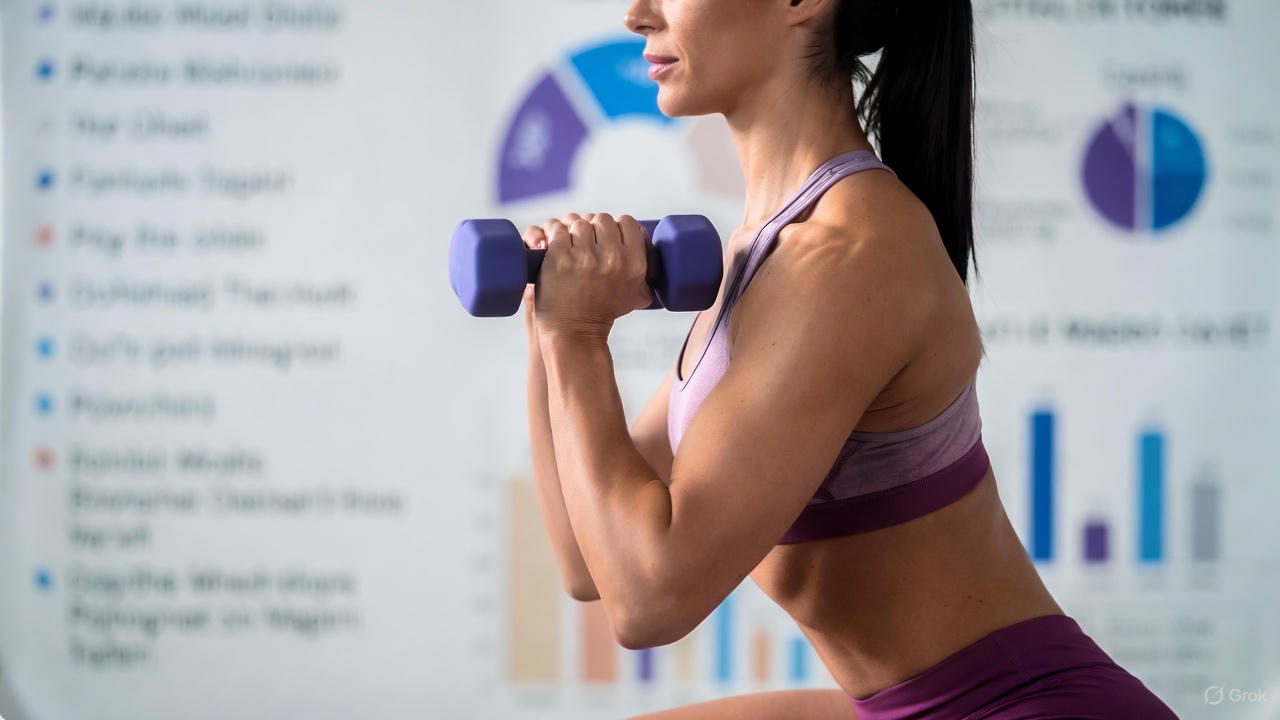
Watch a toddler pick up a toy from the floor and you’ll witness a perfect squat: hips dropping low, torso upright, heels flat, knees tracking naturally over tiny feet. This pattern is encoded in human movement from birth. Somewhere between childhood and adulthood, most of us lose it. Years of sitting in chairs, driving cars, and working at desks tighten the hip flexors, stiffen the ankles, and weaken the core muscles that should stabilize our spine during deep flexion. By the time adults attempt to relearn the squat in a gym, the pattern has degraded so significantly that loading it with a barbell often creates more problems than it solves.
Enter the goblet squat, a deceptively simple exercise that has become the single most effective movement for restoring proper squat mechanics. Popularized by legendary strength coach Dan John, who has spent four decades training everyone from high school athletes to Olympians, the goblet squat uses the counterbalancing effect of a front-loaded weight to essentially force the body into correct positioning. The exercise doesn’t just build strength; it teaches movement. For anyone struggling with squat depth, forward lean, heel lift, or knee cave, the goblet squat provides immediate kinesthetic feedback that rewires motor patterns in ways that verbal coaching alone cannot achieve.
The Biomechanics of Front-Loading
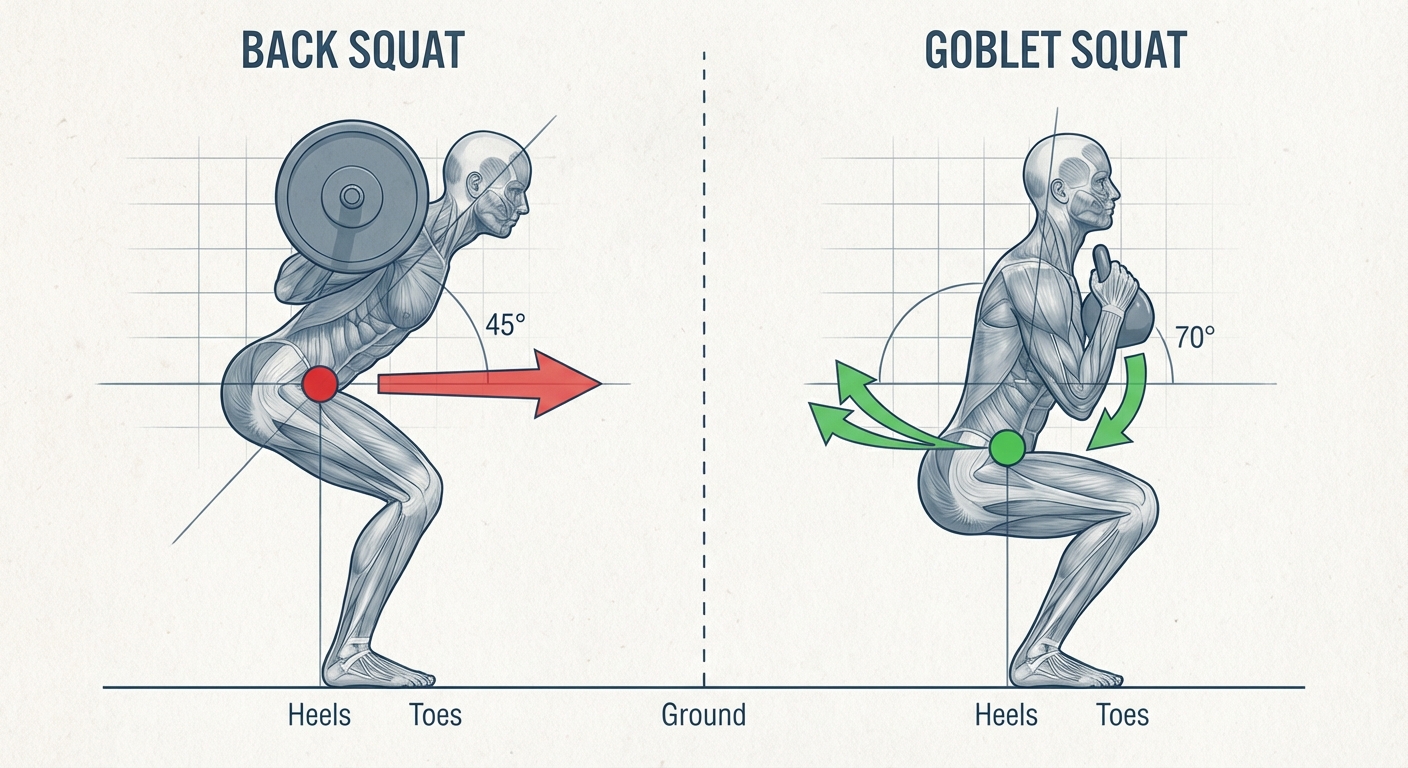
Understanding why the goblet squat works requires examining the physics of human movement during squatting. When you squat with a barbell on your back, your center of mass must remain over your base of support (your feet) to maintain balance. The barbell, positioned behind your center of mass, naturally wants to pull you backward. To compensate, most people shift their weight forward onto their toes and lean their torso toward the ground. This compensation creates excessive spinal loading, reduces squat depth, and often leads to knee or lower back discomfort.
The goblet squat inverts this equation. By holding a weight in front of your chest, you shift the combined center of mass forward. Your body naturally responds by shifting weight back onto the heels to maintain balance. This automatic correction addresses the most common squat fault, heel lifting, without any conscious effort from the lifter. The counterbalance effect also enables a more upright torso position because the forward weight prevents the chest from collapsing toward the floor.
A 2019 study published in the Journal of Strength and Conditioning Research comparing front-loaded and back-loaded squats found that front-loaded positions produced significantly less forward lean and reduced shear forces on the lumbar spine. The researchers noted that front-loaded squatting may be particularly beneficial for individuals with a history of lower back issues or those learning the squat pattern. Dan John himself has stated that he has used the goblet squat to fix “tens of thousands” of broken squats over his coaching career, calling it “the best corrective exercise I’ve ever found.”
Perfecting the Movement Pattern
Executing a proper goblet squat requires attention to detail from setup through completion. The quality of your first rep sets the standard for every rep that follows, so establishing correct positioning before you begin the descent is essential. Start by gripping a kettlebell by the horns (the vertical handles) or cupping a dumbbell at one end with both hands, holding it tight against your sternum. The weight should feel like part of your body, not something you’re loosely balancing. Your elbows should tuck close to your ribcage, pointing straight down rather than flaring to the sides.
Position your feet at shoulder width or slightly wider, with toes angled outward between 15 and 30 degrees. This toe-out position accommodates the natural anatomy of the hip joint, allowing the femur head to clear the rim of the hip socket as you descend into deep flexion. Some lifters require more toe-out, others less; experiment to find the position that allows the deepest squat while keeping your heels flat and knees tracking over your toes. The goal is to find your body’s natural squat stance rather than forcing a textbook position that doesn’t match your anatomy.
Initiate the descent by thinking about sitting “between” your legs rather than simply bending your knees. Open your hips as if you’re making room for your torso to drop straight down between your thighs. Maintain a proud chest throughout the movement; if the weight starts to pull you forward, you’ve lost the position. Descend under control until your elbows touch the inside of your thighs. This elbow contact provides valuable feedback and creates an opportunity to gently push your knees outward, reinforcing the correct tracking pattern.
From the bottom position, drive aggressively through your entire foot, imagining you’re pushing the floor away rather than simply standing up. Visualize spreading the floor apart with your feet; this cue activates the hip external rotators that prevent knee valgus during the ascent. Complete the rep by squeezing your glutes at the top to lock out the hips, but avoid hyperextending your lower back. The finish position should feel strong and stable, with a neutral spine and engaged core.
Common Faults and Corrections
Despite the goblet squat’s self-correcting nature, several form breakdowns can occur, particularly as fatigue accumulates during a set. Identifying these faults early prevents them from becoming ingrained habits that limit progress and increase injury risk. The most common issues relate to knee tracking, spinal position, and weight distribution.
Knee valgus, or “knee cave,” occurs when the knees collapse inward during the ascent. This fault places significant stress on the medial collateral ligament and anterior cruciate ligament while indicating weakness in the hip abductors and external rotators. The correction involves consciously driving the knees outward throughout the movement, particularly during the difficult transition out of the bottom position. Thinking about “spreading the floor” with your feet cues the necessary muscle activation. If knee valgus persists despite cueing, resistance band work targeting the gluteus medius and hip external rotators should become a regular part of your warm-up routine.
“Butt wink,” the posterior pelvic tilt and lumbar flexion that occurs at the very bottom of some people’s squats, usually signals mobility limitations rather than technique errors. When the pelvis tucks under, the lower back rounds, placing the lumbar discs in a vulnerable position under load. The solution isn’t to force depth beyond your current capability but to descend only as far as you can maintain a neutral spine. Over time, consistent practice at your current range combined with dedicated mobility work will gradually increase safe depth.
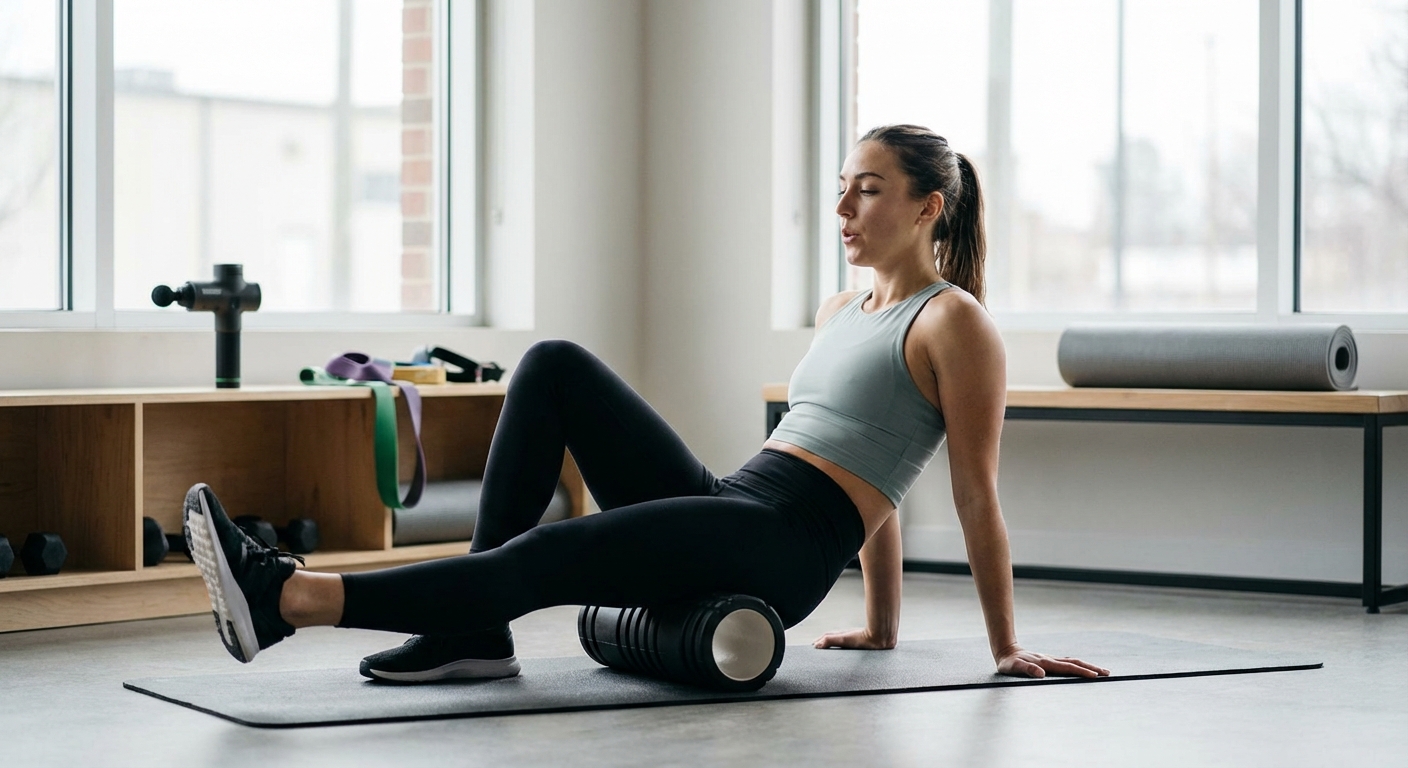
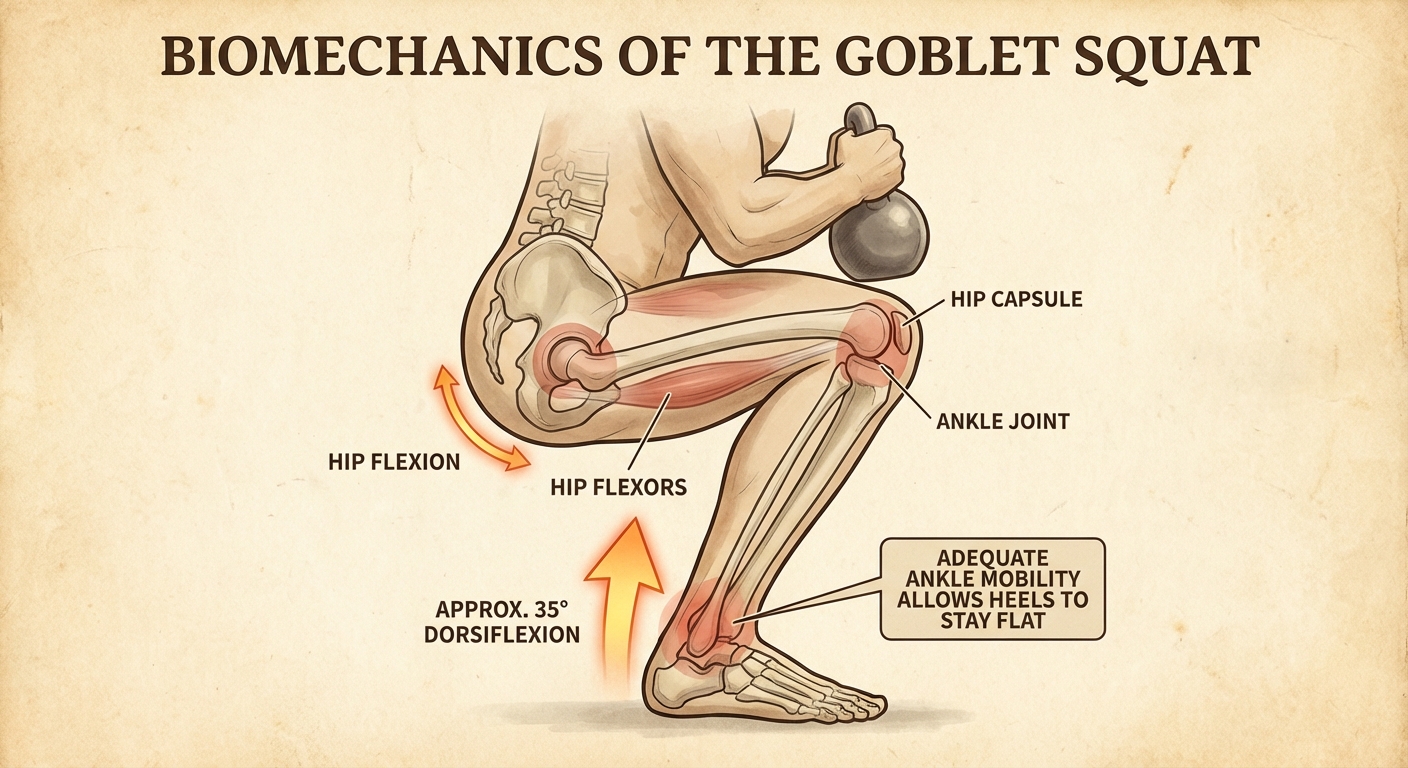
Heel lifting during the descent indicates ankle mobility restrictions. The forward lean this creates compounds as weight increases, eventually limiting how much load you can handle with good form. A temporary mechanical fix involves placing small weight plates (2.5 or 5 pounds) under your heels, effectively creating the same angle provided by weightlifting shoes. While this allows productive training in the short term, dedicated ankle mobility work should address the underlying restriction. Foam rolling the calves, performing wall ankle stretches, and practicing deep squat holds with heels elevated can improve dorsiflexion over several weeks.
Programming for Different Goals
The goblet squat’s versatility extends across training goals, from movement restoration to serious strength development. How you program the exercise depends on what you’re trying to achieve and where you are in your training journey.
For beginners or those using the goblet squat as movement restoration, start with a weight light enough to hold comfortably for 10 to 15 repetitions. The focus at this stage is pattern quality, not loading. Perform 3 sets of 8 to 10 reps two to three times per week, spending extra time in the bottom position of each rep. Try pausing at the bottom for a 2 to 3 second count, using this time to assess your position: Are your heels flat? Is your chest up? Are your knees tracking over your toes? This isometric hold reinforces correct positioning and doubles as a mobility drill.
Intermediate lifters ready to use the goblet squat for strength development can progressively load the movement. A 100-pound goblet squat is a legitimate feat of strength that produces significant hypertrophy and muscular endurance in the quadriceps, glutes, and core. At heavier weights, the upper back and arm fatigue often becomes the limiting factor before the legs give out, which is actually desirable because it trains trunk stability under load. Program 3 to 4 sets of 6 to 12 repetitions with a weight that challenges the final 2 to 3 reps of each set.
For those using the goblet squat as a warm-up or primer before heavier barbell work, 2 sets of 5 to 8 reps with a moderate weight prepares the movement pattern without creating fatigue. The goblet squat also excels in metabolic conditioning circuits, where its full-body engagement and relatively low skill demand allow high-quality reps even under fatigue. Pairing goblet squats with pushing movements like push-ups or pressing, and pulling movements like rows, creates an efficient full-body training effect.
For specific programming that complements the goblet squat, our guide on strength training after 50 covers age-appropriate loading strategies, and the concept of exercise snacking shows how brief movement sessions throughout the day can reinforce movement patterns while building cumulative training volume.
Beyond the Gym: Functional Carryover
The goblet squat produces physical adaptations that extend far beyond the weight room. The movement quality and mobility you develop transfers directly to activities of daily living, sports performance, and injury prevention. Understanding these broader applications helps contextualize why this seemingly simple exercise deserves a permanent place in your training.
The deep squat position maintained during goblet squats mirrors positions required in numerous real-world scenarios: picking up children or grandchildren, working in the garden, cleaning under furniture, or simply rising from a low chair. Cultures that maintain deep squatting throughout life, common in Asia and parts of Africa, show significantly lower rates of hip and knee osteoarthritis compared to Western populations that have lost this movement capacity. Restoring your ability to achieve and load a deep squat position may offer protective effects for joint health over the long term.
For athletes, the goblet squat builds the foundation for more advanced loading patterns. The motor control, mobility, and core stability developed through consistent goblet squatting transfer directly to barbell front squats, back squats, cleans, and sport-specific movements like tackling in football or defensive positioning in basketball. Coaches at the high school and collegiate levels increasingly use the goblet squat as a progression tool before introducing barbell variations, recognizing that attempting to load a broken pattern only reinforces dysfunction.
The core strength developed through front-loaded squatting deserves particular emphasis. Because the weight positions in front of your body, your abdominals must work continuously to prevent your torso from folding forward. This anti-flexion demand trains the core in its primary functional role: resisting forces that would disrupt spinal position. This type of core training produces more carryover to real-world activities and sports than traditional flexion-based exercises like crunches or sit-ups.
The Bottom Line
The goblet squat stands as one of the most valuable exercises available to any fitness level. For beginners, it teaches proper squat mechanics more effectively than any verbal instruction. For intermediate and advanced trainees, it builds legitimate strength while reinforcing movement quality. For those recovering from injury or dealing with movement limitations, it provides a safe avenue for loaded training while mobility improves.
If your squat feels broken, if your heels lift off the ground, if your lower back hurts during barbell squatting, stop fighting the barbell and spend six to eight weeks focused on the goblet squat. Use this time to rebuild the movement pattern from the ground up. When you return to barbell work, you’ll bring the motor control, mobility, and stability that makes heavy loading possible without compensation.
Your Next Steps:
- Assess your current squat: Film yourself from the side and check for heel lift, forward lean, and butt wink
- Start with a weight you can control for 3 sets of 10 with a 2-second pause at the bottom
- Practice 3 times per week for 4 to 6 weeks, progressively adding load as form allows
- Incorporate dedicated ankle and hip mobility work on off days
- Reassess with video after 6 weeks and compare to your starting point
Sources: Journal of Strength and Conditioning Research squat mechanics studies, Dan John’s training methodology, National Strength and Conditioning Association position stands on resistance training technique, biomechanical analysis from the American College of Sports Medicine.