Modern fitness culture obsesses over aesthetics. We chase the visible six-pack, the vascular arms, the perfectly rounded glutes that photograph well in gym mirrors. Entire training programs are designed around “sculpting” muscles for appearance rather than performance. But spend time around anyone who has served in special operations, completed military selection courses, or worked in tactical professions, and you’ll encounter a fundamentally different philosophy. These individuals don’t care whether their muscles look impressive. They care whether those muscles work when it matters.
Military fitness, by necessity, prioritizes durability over display. In the field, looking good is irrelevant. Being able to carry 80 pounds of gear over rough terrain for 12 hours, then dig a defensive position, then remain alert through the night, is what matters. The body must be a reliable tool that performs under stress, fatigue, environmental extremes, and unpredictable conditions. This requirement shapes training approaches that differ markedly from typical gym programming, and those approaches offer valuable lessons for civilians seeking genuine physical capability rather than cosmetic enhancement.
On Veterans Day, it’s worth examining what military fitness actually involves and how its core principles translate to civilian life. These methods build bodies that don’t just look capable but actually are capable, bodies resistant to injury, adaptable to varied demands, and able to perform when circumstances aren’t optimal. By shifting focus from “show” muscles to “go” muscles, you develop resilience that serves you whether you’re helping a friend move furniture, hiking difficult terrain, or simply maintaining independence and physical confidence as you age.
Rucking: The Foundation of Tactical Fitness
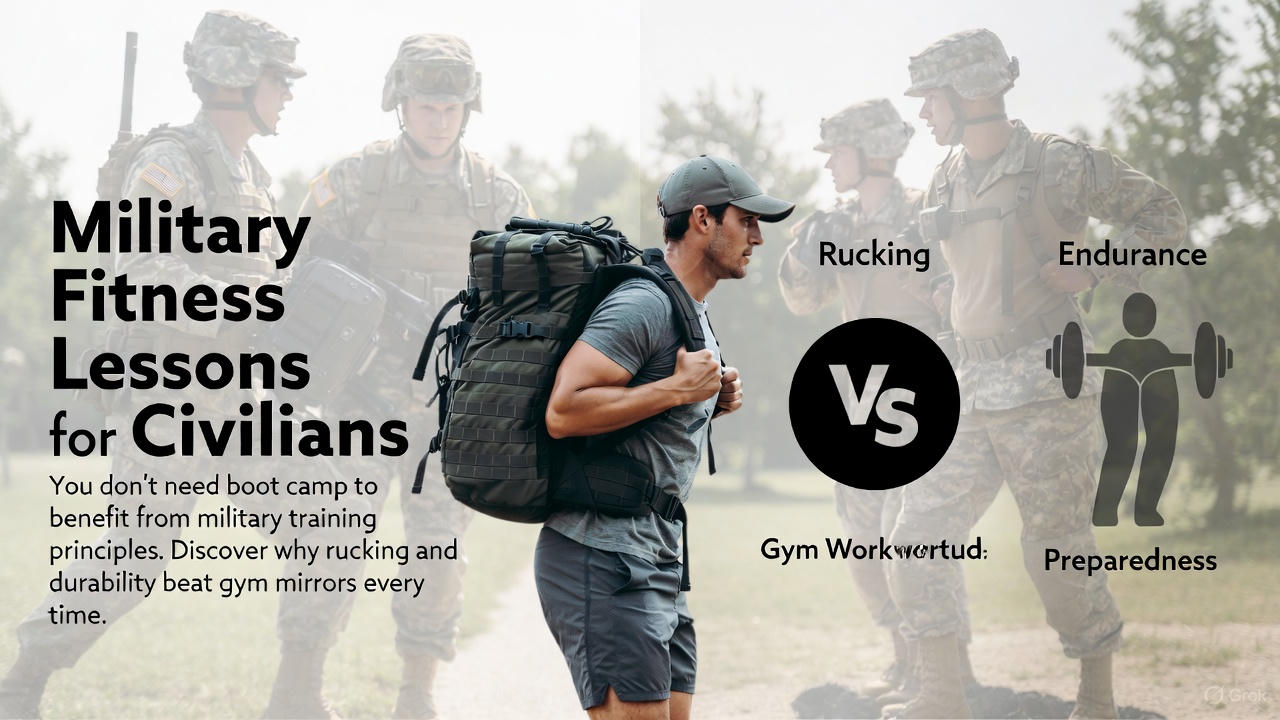
If there’s one training modality the military does better than any commercial gym, it’s rucking. At its simplest, rucking is walking with a weighted backpack. It’s the foundation of special forces selection programs worldwide, the backbone of infantry training, and the activity that separates candidates who can theoretically perform physical tasks from those who actually can. The Special Forces Assessment and Selection (SFAS) program, the grueling course that determines who becomes a Green Beret, famously involves ruck marches of 12+ miles with 45+ pounds of weight, often at night, over terrain you can’t preview.
Rucking occupies a unique metabolic space between traditional cardio and strength training. Walking with 30-50 pounds elevates your heart rate into Zone 2 or Zone 3 aerobic conditioning (depending on pace and terrain) while simultaneously placing significant load on your posterior chain: glutes, hamstrings, lower back, and the stabilizing muscles of your hips and core. This combination produces cardiovascular adaptations similar to jogging while building load-bearing capacity that running doesn’t develop.
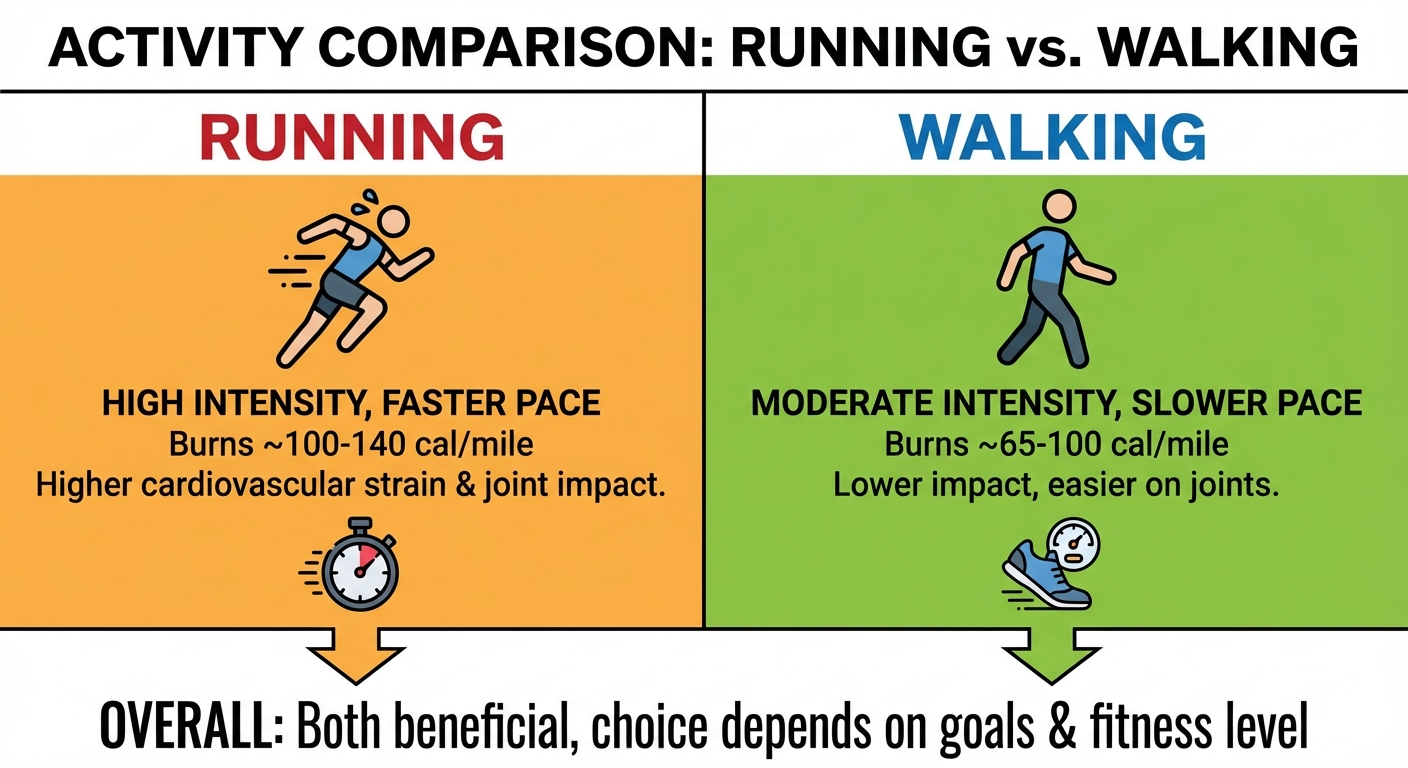
The caloric expenditure is substantial. Research from military studies shows that rucking burns approximately 2-3 times more calories per hour than walking at the same pace without weight. A 180-pound person walking at 3.5 mph burns roughly 300 calories per hour; the same person carrying 40 pounds burns approximately 450-500 calories. Unlike running, which subjects knees and ankles to repetitive high-impact forces (2-3 times body weight with each stride), rucking maintains ground contact throughout the gait cycle, reducing impact stress while still providing significant training stimulus.
Perhaps most valuable for modern desk workers, rucking functions as a powerful posture corrector. Contemporary life pulls us forward: we slump over phones, hunch over keyboards, and round our shoulders while driving. A loaded backpack pulls backward, and to stay upright without excessive forward lean, you must engage your core, retract your shoulder blades, and maintain thoracic extension. You’re effectively forced into proper posture for the duration of the ruck, building strength in the exact muscles that counteract the postural degradation of sedentary work.
The Civilian Rucking Protocol
You don’t need military-grade equipment to start rucking. A sturdy backpack you already own, filled with 20-30 pounds of weight, is sufficient. The weight can be dumbbells wrapped in towels to prevent shifting, water bottles, sandbags, or purpose-built ruck plates if you want to invest in dedicated gear. The key is positioning: keep the weight high in the pack, near your shoulder blades rather than sagging toward your lower back. Low-positioned weight creates leverage that strains the lumbar spine; high-positioned weight distributes force more evenly through your torso.
Start conservatively. Twenty pounds for 30 minutes at a 15-minute mile pace (4 mph) provides a meaningful training stimulus for beginners. The pace should feel like a brisk walk, not a jog. You should be able to hold a conversation, though not easily. Heart rate should sit in the 120-140 bpm range for most adults, depending on fitness level and age.
Progress by adding time before adding weight. Build to 60-minute rucks at 20-30 pounds before increasing load. Once you can comfortably complete a one-hour ruck, add 5-10 pounds and return to 30-minute sessions, then build duration again. Military rucking programs typically progress toward 40-50 pounds for longer distances, but civilian fitness goals don’t require that level of loading. Thirty to forty pounds provides substantial benefit without the injury risks that heavy rucks carry when you’re not building toward a specific operational requirement.
Terrain matters. Flat pavement is the easiest starting point, but the real benefits emerge on varied terrain: trails with inclines, uneven surfaces that require ankle stability, and hills that challenge your cardiovascular system and posterior chain simultaneously. If you have access to hiking trails, rucking transforms them from leisurely walks into serious training sessions.
Calisthenics Over Machines: Mastering Your Own Body
In deployment, there are no leg press machines. There are no cable crossovers, no seated rows, no preacher curl benches. Military fitness relies heavily on bodyweight mastery because bodyweight exercises can be performed anywhere, require no equipment, and build relative strength: the ability to move your own body efficiently through space. This relative strength has direct real-world application in ways that machine-based “absolute strength” often doesn’t.
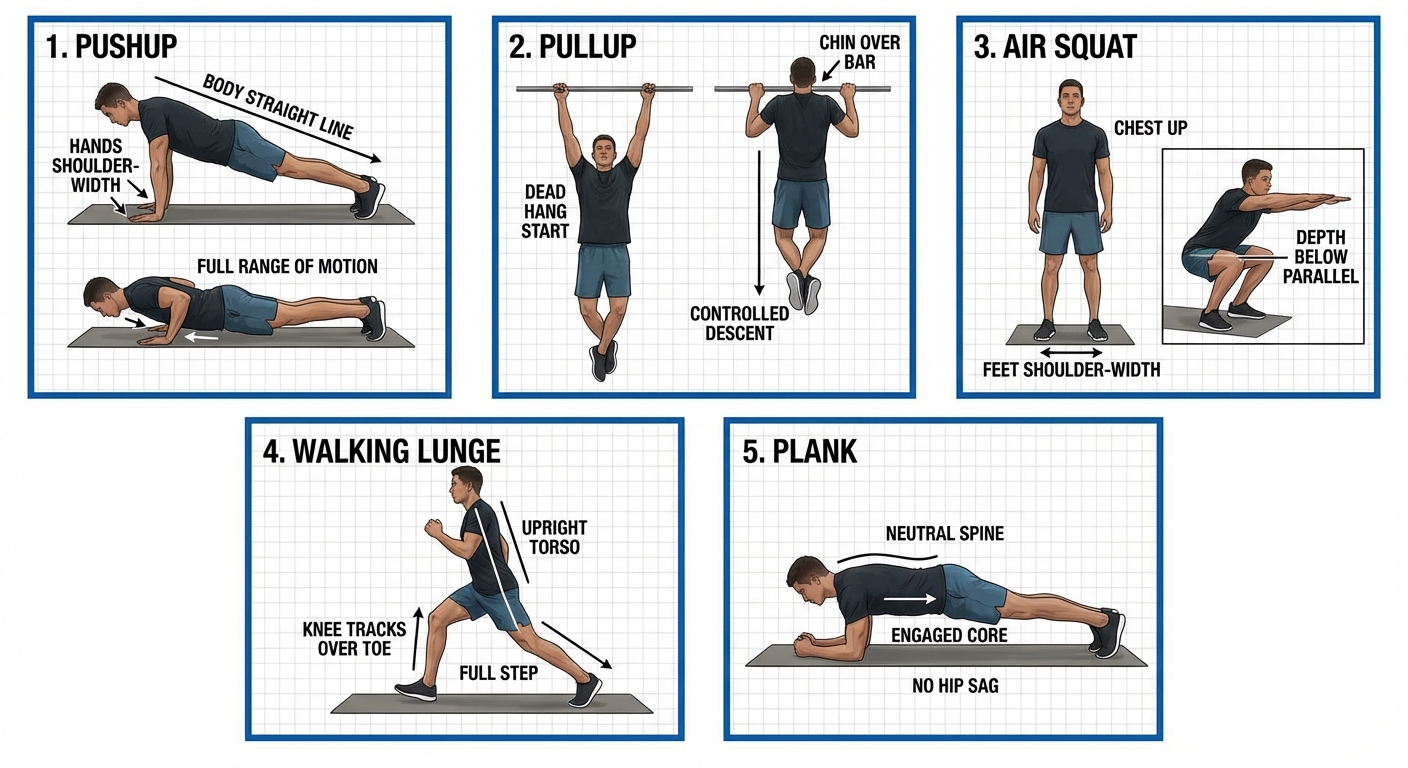
The military’s “daily dozen” consists of exercises that have remained essentially unchanged for decades: pushups, pullups, sit-ups, air squats, burpees, lunges, and variations thereof. These movements force you to stabilize your own body against resistance, engaging core muscles and stabilizers that machines deliberately eliminate. When you push a machine, the track guides the weight and removes the need for stabilization. When you do a pushup, you must control your entire body position while generating force. The strength developed transfers to real-world tasks because those tasks also require you to stabilize your own body while producing force.
The disconnect between gym strength and real-world capability is common enough to have a name. If you can bench press 225 pounds but can’t do 10 strict pullups, you have “mirror muscle” strength developed for appearance rather than function. The ability to push heavy weight on a track doesn’t mean you can pull yourself over a wall, carry a struggling child, or lift your own body weight in a fall recovery. Military fitness testing has always emphasized relative strength standards for this reason.
The US Army’s current fitness test (the Army Combat Fitness Test or ACFT) provides useful civilian benchmarks: 40 pushups in 2 minutes, 50 sit-ups in 2 minutes, and a 2-mile run in under 16 minutes represents the minimum passing standard. These aren’t elite numbers; they represent a basic foundation of physical capability that any reasonably healthy adult can achieve with consistent training. More ambitious standards from special operations selection courses include 80+ pushups, 80+ sit-ups, 10+ pullups, and a 2-mile run under 13 minutes.
Function Over Flash: Training Movements, Not Muscles
Tactical athletes train movements, not muscles. They don’t do bicep curls; they pull themselves over obstacles. They don’t do leg extensions; they squat with loaded packs. They don’t do tricep pushdowns; they push their bodies away from the ground. This movement-based approach builds coordination, balance, and strength that integrates across the entire kinetic chain rather than isolating individual muscles.
The distinction matters because real-world physical demands never isolate muscles. Lifting a heavy box requires integrated effort from your legs, core, back, and arms working in coordinated sequence. Pushing a stalled car engages your entire posterior chain along with chest, shoulders, and core. Catching yourself from a fall demands instantaneous coordinated response from dozens of muscles simultaneously. Training that isolates muscles may build impressive individual muscle size, but it doesn’t train the coordination patterns that real-world demands require.
Swapping isolation exercises for compound movements is straightforward: replace leg press with walking lunges or step-ups, replace chest fly machine with pushup variations (incline, decline, weighted), replace seated row with pullup variations or inverted rows, replace leg curl with Romanian deadlifts or Nordic curls. Each swap trades a machine that stabilizes for you with a movement that requires you to stabilize yourself, developing both strength and coordination simultaneously.
The military’s focus on compound movements also explains why tactical athletes often maintain capability well into middle age. Dr. Andy Galpin, a professor of kinesiology at Cal State Fullerton who works with special operations personnel, notes that movement-based training preserves neuromuscular function in ways that isolation training doesn’t. “The coordination demands of compound movements maintain the neural pathways that control integrated movement patterns,” he explains. “Isolation training builds muscle without training the software that controls it.”
Embracing the Suck: The Mental Dimension
The most valuable lesson from military fitness isn’t physical. It’s mental. The military concept of “embracing the suck” means accepting discomfort as a temporary and necessary state, not something to be avoided or eliminated. David Goggins, a former Navy SEAL who has become a prominent voice in endurance athletics, describes this as “callusing your mind.” Every time you complete something difficult that you didn’t want to do, you add a layer of mental resilience that compounds over time.
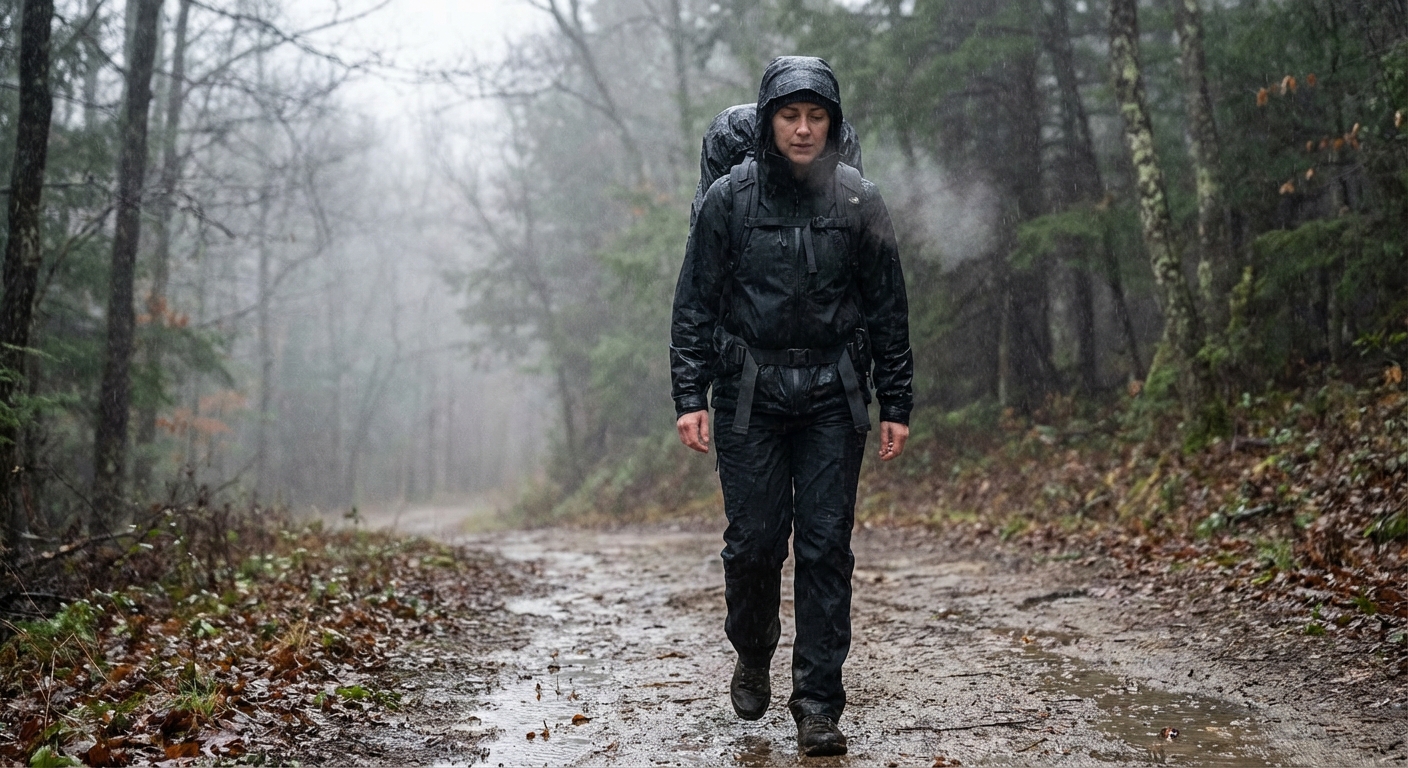
This psychological adaptation has tangible physiological benefits. Research on stress tolerance shows that voluntary exposure to controlled stressors improves the body’s stress response systems. People who regularly complete challenging physical tasks show lower cortisol responses to novel stressors and faster recovery from stress states. This same principle underlies the benefits of cold shower exposure, where brief discomfort builds lasting resilience. The experience of surviving difficulty creates a reservoir of confidence that extends beyond physical domains: if you can complete a grueling ruck march in the rain, a difficult conversation at work feels more manageable by comparison.
You can practice this without military training by deliberately incorporating “sub-optimal” conditions into your fitness routine. Run when it’s raining. Ruck when it’s hot and humid. Train early in the morning when you’d rather sleep. Turn off the music and train in silence with only your thoughts for company. Each of these choices decouples your performance from your comfort level, building the psychological flexibility to perform when conditions aren’t ideal.
The key is controlled exposure, not reckless suffering. Military training progressively increases demands within a structure designed to challenge but not destroy. Civilian application should follow the same principle: add one uncomfortable element at a time, master it, then add another. The goal is building capacity, not proving toughness through injury.
Building Your Tactical Fitness Program
A civilian tactical fitness program doesn’t require boot camp intensity or military time commitments. It requires consistent application of military principles within a sustainable structure.
Weekly structure for tactical fitness:
- 2-3 rucking sessions (30-60 minutes, 20-40 lbs, varied terrain)
- 2-3 calisthenics sessions (pushups, pullups, squats, lunges, core work)
- 1 “embrace the suck” session (training in challenging conditions)
- 1-2 rest or active recovery days
The calisthenics sessions should follow progressive overload principles. If you can do 20 pushups, aim for 25 next week. If you can do 5 pullups, aim for 6. Track your numbers and drive them up over time. The military uses test standards as benchmarks: working toward 40 pushups, 50 sit-ups, and 10 pullups in single sets provides concrete goals that indicate genuine capability improvement.
Integrate rather than isolate. Supersetting pushups with pullups (push-pull pairing) is more efficient and more functional than separating them. Combining rucking days with bodyweight finishers (a ruck followed by pushups and squats) mimics the real-world pattern of sustained effort followed by acute physical demands. Training should prepare you for unpredictable combinations of demands, not just isolated challenges.
For those seeking more structure, programs like GORUCK’s training plans, Mountain Tactical Institute’s protocols, or CrossFit Endurance provide frameworks specifically designed around tactical fitness principles. These programs have helped thousands of civilians develop the durability-focused fitness that military training builds.
The Bottom Line
You don’t need to enlist to train like someone who serves. The principles that make military fitness effective, the emphasis on durability over aesthetics, functional movement over isolation, mental resilience alongside physical capacity, are available to anyone willing to step away from the mirrors and machines of conventional gym culture.
Rucking provides cardiovascular conditioning with strength benefits that running can’t match. Calisthenics build relative strength that transfers directly to real-world demands. Training movements rather than muscles develops coordination that isolated exercises neglect. And deliberately embracing discomfort builds psychological resilience that extends far beyond the gym. For those looking to deepen their recovery practice, ice baths at optimal temperatures offer another avenue for building both physical and mental toughness.
The result isn’t a body that looks impressive in photographs. It’s a body that works when you need it to: carrying groceries up stairs, helping friends move, hiking difficult trails, playing with children or grandchildren, and maintaining physical independence throughout life. That’s the lesson military fitness offers civilians: capability matters more than appearance, and training for durability builds both.
Your Tactical Fitness Starter Protocol:
- Start rucking: 20-30 lbs, 30 minutes, twice weekly at 15-min/mile pace
- Establish calisthenics baselines: max pushups, max pullups, max squats in one set
- Train toward military minimums: 40 pushups, 10 pullups, 50 sit-ups
- Add one “sub-optimal” training session weekly (early morning, bad weather, no music)
- Progress rucking by time first, then weight (build to 60 min before adding load)
- Replace one machine exercise with its compound movement equivalent each week
Sources: US Army Combat Fitness Test standards, Special Forces Assessment and Selection program requirements, GORUCK training methodology, Dr. Andy Galpin exercise physiology research (Cal State Fullerton), military rucking caloric expenditure studies, David Goggins mental resilience frameworks.