Three months after her ACL reconstruction, Sarah could barely straighten her leg. Her surgeon cleared her for physical therapy but warned against any significant loading for another three months. Meanwhile, her quadriceps visibly shrinking each week. She was trapped in the frustrating gap between being medically restricted from heavy training and watching her hard-earned muscle waste away. Then her physical therapist introduced her to blood flow restriction training, and within six weeks, her quad circumference had not only stopped declining but actually increased, all while using weights her grandmother could lift.
This scenario plays out in rehabilitation clinics and home gyms around the world. Blood flow restriction (BFR) training, originally developed in Japan in the 1960s under the name “Kaatsu,” has evolved from a fringe technique into a research-validated method for building muscle and strength with remarkably light loads. The appeal is straightforward: get the muscle-building stimulus of heavy lifting while only using 20-30% of your maximum capacity. For anyone limited by joint pain, injury recovery, or simple logistics of not having heavy weights available, BFR offers a genuine alternative.
How Blood Flow Restriction Actually Works
Understanding why BFR produces results requires a brief dive into muscle physiology. Traditional strength training stimulates muscle growth primarily through mechanical tension, the direct force placed on muscle fibers that causes microdamage and triggers repair processes. This requires loads heavy enough to recruit high-threshold motor units, typically above 65% of your one-rep maximum. The heavier you lift (with good form), the more muscle fibers participate in the work.
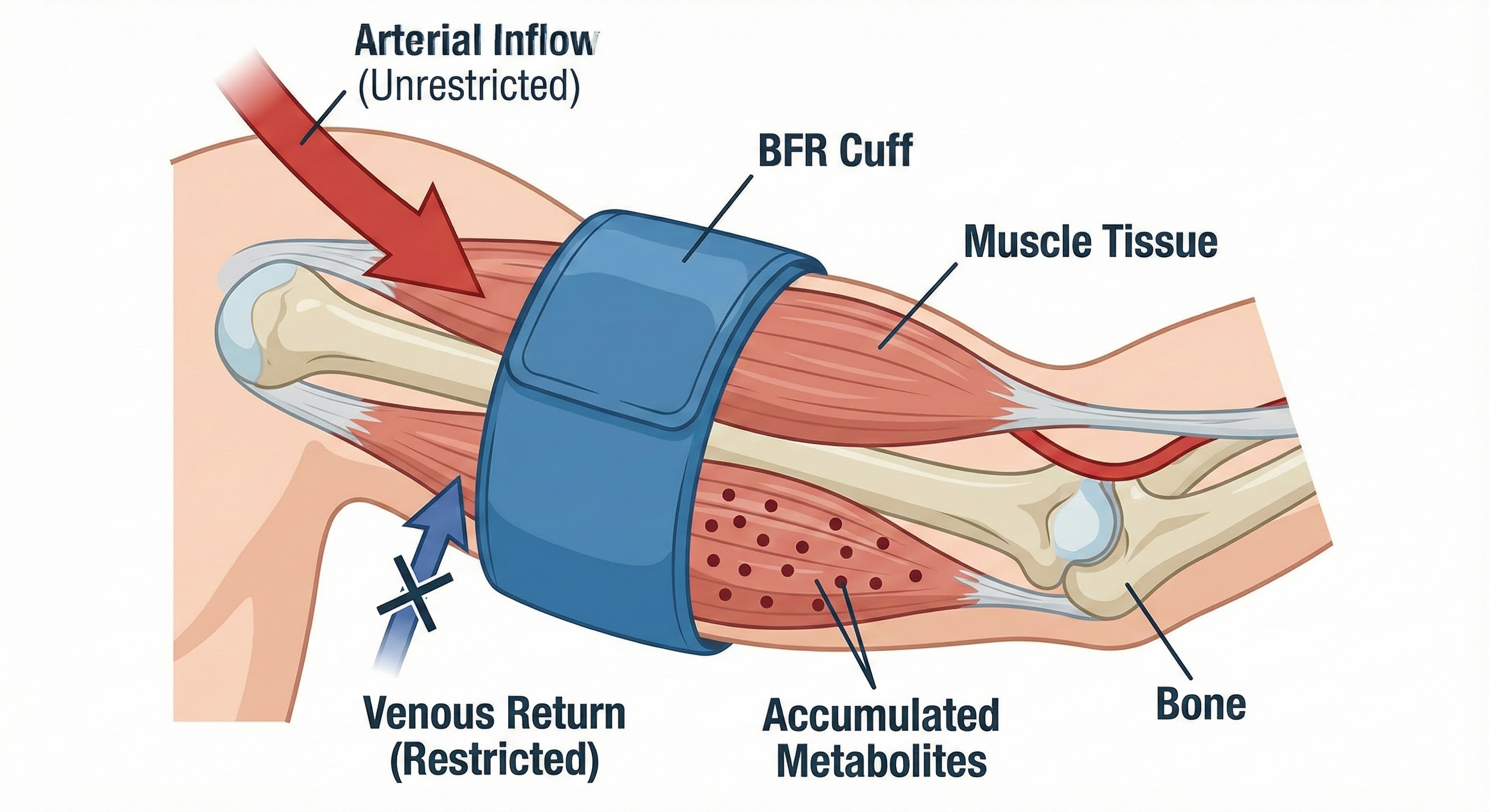
BFR bypasses this requirement through metabolic stress. By placing a specialized cuff around the proximal (upper) portion of a limb and partially occluding venous return while maintaining arterial inflow, you create a localized hypoxic environment within the working muscle. Blood enters the limb but cannot exit as efficiently, causing rapid accumulation of metabolic byproducts including lactate, hydrogen ions, and inorganic phosphate.
This metabolic buildup has several downstream effects that promote muscle growth. First, the low-oxygen environment fatigues your Type I (slow-twitch) muscle fibers almost immediately, forcing early recruitment of Type II (fast-twitch) fibers that are normally reserved for heavy lifting. You essentially convince your nervous system that you’re working much harder than the external load would suggest. Second, the metabolite accumulation stimulates a substantial growth hormone response, with studies showing increases of 100-300% above baseline following BFR sessions.
The molecular signaling pathways also align with traditional hypertrophy training. Research published in the Journal of Applied Physiology has demonstrated that BFR activates mTOR (mechanistic target of rapamycin), the master regulator of muscle protein synthesis, at levels comparable to heavy resistance training. The combination of metabolic stress, cell swelling from trapped blood, and recruitment of high-threshold motor units creates an anabolic environment despite the absence of heavy mechanical loading.
Who Benefits Most from BFR Training
While anyone can incorporate BFR into their training, certain populations stand to gain the most from this technique. The common thread is a mismatch between structural capacity and metabolic capability. Your muscles may be fully capable of growing, but your joints, tendons, or circumstances prevent you from loading them heavily enough to trigger adaptation.
Post-surgical rehabilitation represents the most dramatic use case. After procedures like ACL reconstruction, rotator cuff repair, or meniscectomy, patients typically face months of restricted loading. Traditional rehabilitation leads to significant muscle atrophy during this period. BFR allows muscle stimulation with loads as low as 20% of pre-injury capacity, meaning patients can begin meaningful muscle training weeks or months earlier than traditional protocols would allow.
Research from the American Journal of Sports Medicine found that ACL reconstruction patients using BFR during early rehabilitation maintained significantly more quadriceps muscle mass and strength compared to standard rehabilitation alone. The difference in outcomes wasn’t marginal, it was clinically meaningful in terms of functional recovery and return-to-sport timelines.
Older adults facing sarcopenia (age-related muscle loss) benefit substantially from BFR. Many seniors cannot safely perform heavy resistance training due to cardiovascular concerns, balance issues, or degenerative joint disease. Yet without adequate resistance stimulus, they continue losing muscle mass at rates of 1-2% per year after age 50. BFR provides a middle path: effective muscle stimulation without the cardiovascular strain or joint stress of heavy weights. A 2020 systematic review in Frontiers in Physiology concluded that BFR training improved muscle strength and hypertrophy in older adults to a greater degree than low-load training without BFR.
Athletes recovering from injury or managing chronic conditions like tendinopathy find BFR invaluable for maintaining training effect while respecting tissue limitations. The ability to stress the muscle without overstressing the tendon insertion allows continued adaptation during what would otherwise be forced detraining periods. This application connects to the broader principle of training adaptations as we age, where joint preservation becomes increasingly important.
Endurance athletes seeking to add muscle without the neural fatigue of heavy strength training use BFR as a supplementary tool. The metabolic stress of BFR doesn’t require the same recovery time as heavy mechanical loading, allowing more frequent training sessions without compromising primary sport performance.
Safety Protocols: Equipment and Pressure Guidelines
The most critical aspect of BFR training is safety, specifically ensuring you’re restricting venous return without fully occluding arterial flow. The difference matters enormously. Partial occlusion creates the desired metabolic stress and is safe for healthy individuals. Full occlusion cuts off blood supply to the limb and risks tissue damage, nerve compression, and in extreme cases, deep vein thrombosis.
Never use improvised equipment like knee wraps, elastic bands, or rubber tubing for BFR. These materials cannot provide consistent, measurable pressure, making it impossible to ensure safe application. The internet is full of DIY BFR tutorials using cheap alternatives, but the risk-benefit calculus doesn’t justify saving fifty dollars on equipment that interfaces directly with your circulatory system.
Proper BFR requires purpose-built equipment. Pneumatic cuffs with pressure gauges represent the gold standard, allowing precise pressure setting and adjustment. Quality pneumatic systems like those from Delphi, Smart Cuffs, or B Strong range from $150-400 but provide accurate, reproducible occlusion. Calibrated elastic bands with numbered tightness settings offer a more affordable option ($30-80) and are sufficient for most recreational users when used according to manufacturer guidelines.
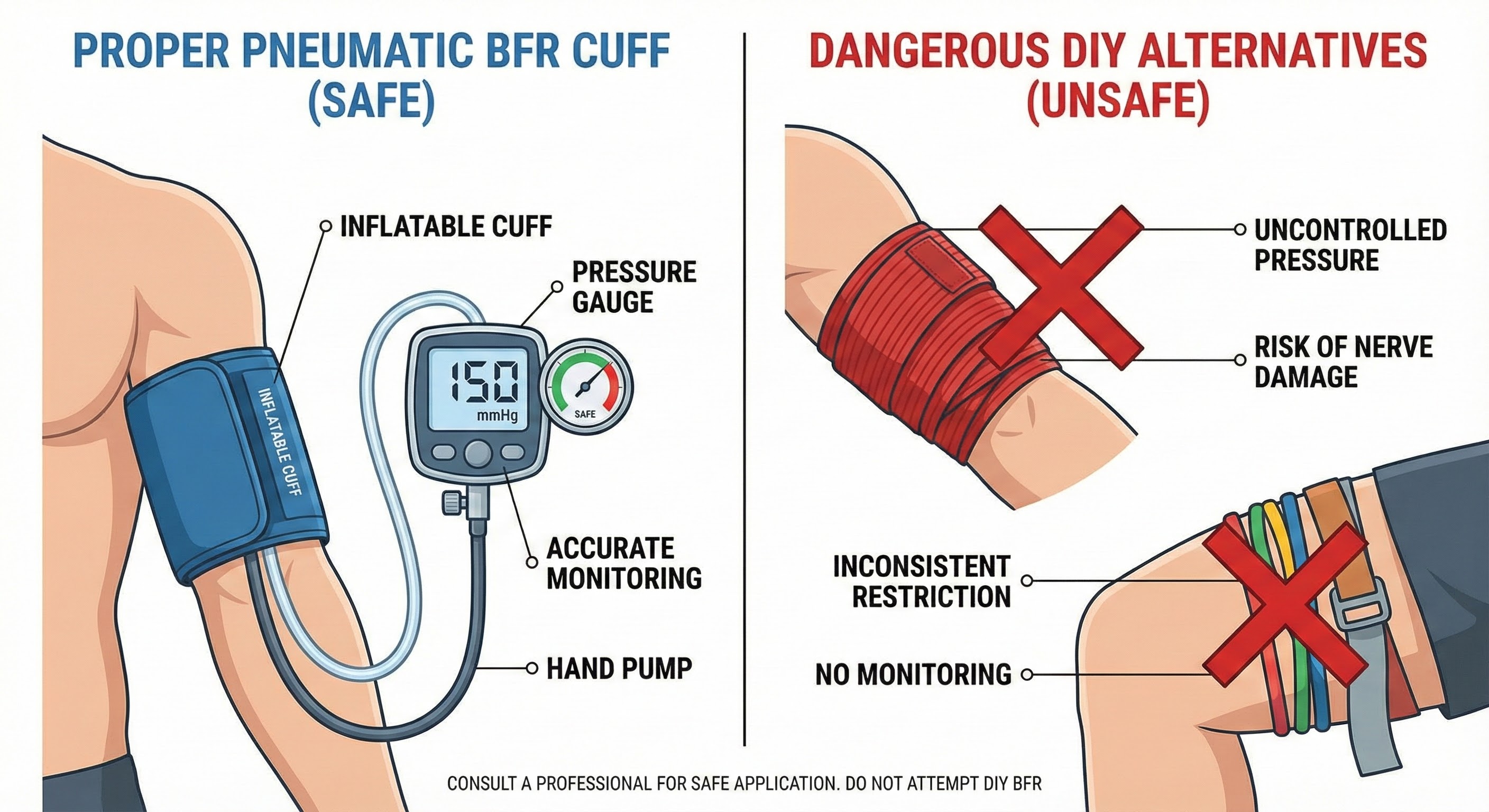
Pressure should be calibrated relative to your limb occlusion pressure (LOP), the pressure required to fully stop arterial blood flow. Optimal BFR uses 40-80% of LOP: enough to create metabolic stress but not enough to cut off arterial supply. For arms, this typically corresponds to pressures of 100-150 mmHg in most individuals. For legs, the range is higher at 150-250 mmHg due to greater tissue depth and larger vessels.
Without a Doppler device to measure your personal LOP, use the perceived pressure method. For arms, the cuff should feel like a 4-5 out of 10 tightness when inflated but before exercise begins. During exercise, you should feel significant pump and fatigue but never numbness, tingling, or throbbing pain. For legs, slightly higher perceived tightness of 6-7 out of 10 is appropriate given greater tissue mass.
The capillary refill test provides a quick safety check. Press your thumb firmly into your palm (for arm BFR) or thigh (for leg BFR) for two seconds until the skin blanches white. Release and observe how quickly pink color returns. Normal refill is under three seconds. If color returns slowly or incompletely, the cuff is too tight and must be loosened immediately. Perform this test before each set during your initial BFR sessions until you develop familiarity with appropriate pressure.
Absolute contraindications for BFR:
- History of deep vein thrombosis (DVT) or pulmonary embolism
- Active cardiovascular disease or uncontrolled hypertension
- Pregnancy
- Open wounds or skin infections on the limb
- Peripheral vascular disease
- Use of anticoagulant medications without physician clearance
The Standard BFR Protocol: 30-15-15-15
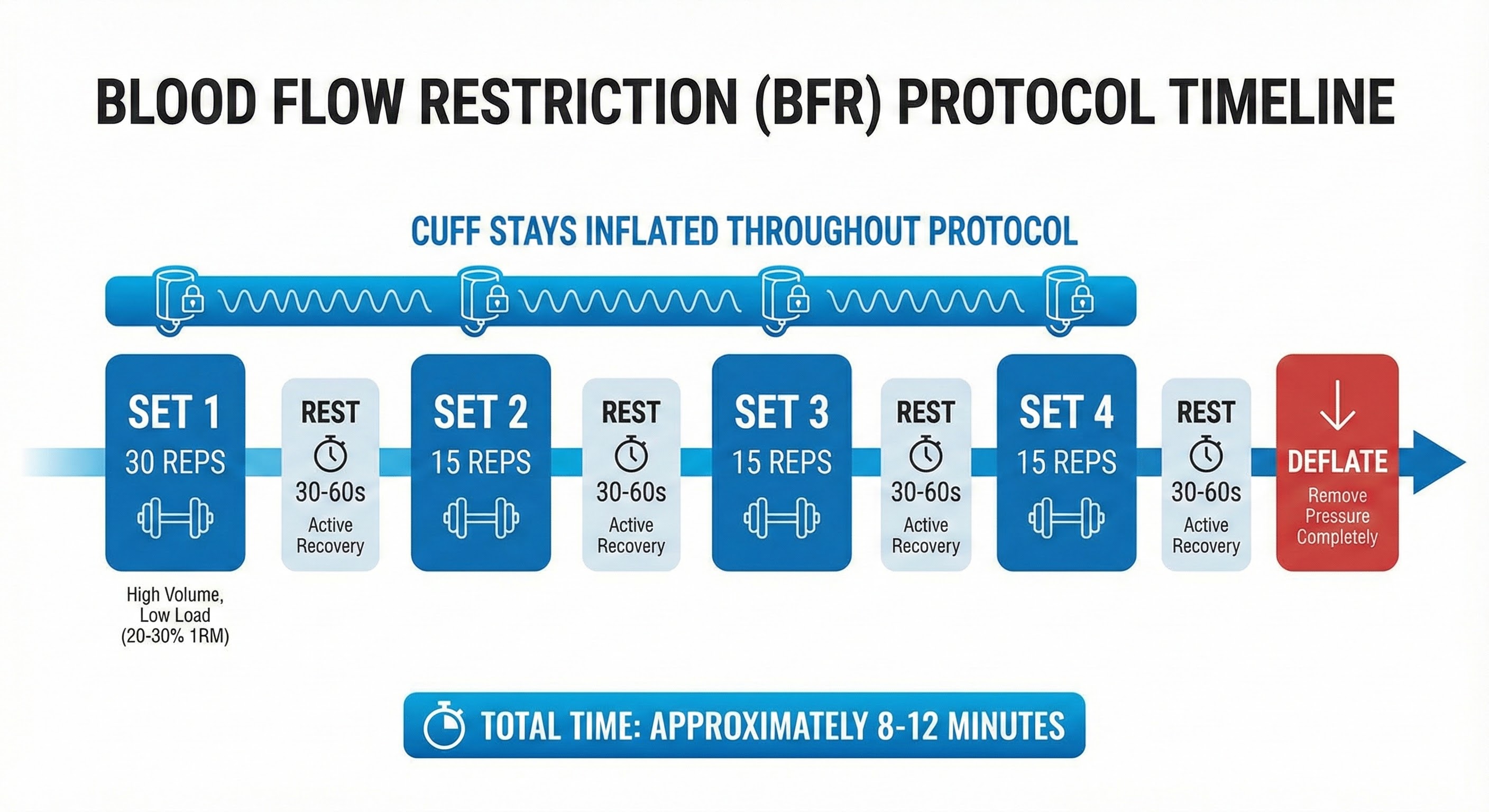
Research has converged on a specific protocol that optimizes the metabolic stress response while remaining practical for most exercises. This is the 30-15-15-15 structure, named for the rep scheme across four sets.
Use a weight that is 20-30% of your one-rep maximum for the exercise. This is lighter than it sounds. If you can bicep curl 40 pounds for one rep, your BFR weight would be 8-12 pounds. The light load is the point; you’re creating stimulus through metabolic stress, not mechanical tension.
Begin with one set of 30 repetitions, or continue to failure if you cannot reach 30. Rest for 30-60 seconds while keeping the cuff inflated. Then perform three additional sets of 15 repetitions each, with 30-60 second rest intervals between sets. The cuff remains inflated throughout all four sets and rest periods. Only deflate after completing the final set.
The metabolite accumulation is the mechanism, so removing the cuff between sets defeats the purpose. You should feel a progressively intense burning sensation and pump as lactate builds. By the third and fourth sets, reaching 15 reps should feel challenging even with such light weight. If you’re easily completing all sets, the weight is too light or the cuff pressure is insufficient.
If you cannot complete the prescribed reps, reduce the weight rather than pushing through with deteriorating form. BFR is not about grinding out ugly reps; the metabolic stress does the work regardless of whether you hit exactly 15 repetitions. A set of 12 quality reps with good time under tension provides more stimulus than 15 jerky, momentum-driven reps.
Best Exercises for BFR Training
Not all exercises are equally suited for BFR. The technique works best for single-joint isolation movements that allow sustained time under tension without position changes that could shift the cuff. Compound movements can be used but require more careful setup and monitoring.
Upper Body BFR Exercises (ranked by effectiveness):
-
Bicep Curls: The quintessential BFR exercise. The isolation nature, consistent cuff position, and ease of maintaining time under tension make curls ideal. Use dumbbells or cables.
-
Tricep Pushdowns/Extensions: Effective for triceps, though overhead extensions require attention to cuff position. Cable pushdowns maintain consistent resistance throughout the range.
-
Lateral Raises: Excellent for shoulder development without rotator cuff stress. Keep weight very light (5-10 pounds for most people) as the deltoids fatigue rapidly under BFR.
-
Hammer Curls: Targets brachialis and brachioradialis. The neutral grip position is comfortable for those with wrist issues.
Lower Body BFR Exercises (ranked by effectiveness):
-
Leg Extensions: Isolation of the quadriceps without hip or low back involvement. Ideal for post-knee-surgery rehabilitation.
-
Leg Curls: Hamstring isolation. Useful for those who cannot perform hip hinge movements due to back limitations.
-
Bodyweight Squats or Wall Sits: For those without access to machines. The cuff position at the upper thigh remains stable during these movements.
-
Calf Raises: Effective but requires higher rep ranges (40-20-20-20) due to the already endurance-oriented nature of calf musculature.
Compound movements like squats, bench press, and rows can incorporate BFR but present challenges. The cuff may shift during position changes, and the metabolic demand spreads across multiple muscle groups rather than concentrating on the target tissue. Most practitioners use BFR for isolation work and traditional loading for compounds.
Sample BFR Training Sessions
These templates demonstrate how to integrate BFR into various training contexts. The key principle is using BFR as a supplement or finisher rather than replacing your entire workout with restricted blood flow.
Upper Body BFR Finisher (10-15 minutes)
Complete your normal upper body workout, then add this finisher with arms restricted:
| Exercise | Sets x Reps | Rest | Notes |
|---|---|---|---|
| Bicep Curls | 30-15-15-15 | 30-60s | Cuff stays on |
| Tricep Pushdowns | 30-15-15-15 | 30-60s | Same cuff position |
| Lateral Raises | 30-15-15-15 | 30-60s | Very light weight |
Deflate cuffs after completing all exercises. Total arm BFR time should not exceed 15-20 minutes per session.
Lower Body BFR Rehabilitation Session (20-25 minutes)
For those unable to perform heavy leg training:
| Exercise | Sets x Reps | Rest | Notes |
|---|---|---|---|
| Leg Extensions | 30-15-15-15 | 30-60s | Cuff at upper thigh |
| Leg Curls | 30-15-15-15 | 30-60s | Same cuff position |
| Calf Raises | 40-20-20-20 | 30-60s | Higher reps for calves |
Deflate cuffs between leg extensions/curls and calf raises to reposition if needed.
Travel/Hotel Room BFR Session (15-20 minutes)
When equipment is limited, BFR makes bodyweight exercises effective:
| Exercise | Sets x Reps | Rest | Notes |
|---|---|---|---|
| Push-ups (arms restricted) | 30-15-15-15 | 30-60s | Knees down if needed |
| Bodyweight Squats (legs restricted) | 30-15-15-15 | 30-60s | Slow tempo |
| Wall Sits (legs restricted) | 4 x 30-45 seconds | 30-60s | Time instead of reps |
This approach transforms hotel-room workouts into legitimate muscle-maintaining sessions, connecting to the broader principle of efficient training when time and equipment are constrained.
Programming Considerations and Frequency
BFR can be performed more frequently than traditional heavy resistance training because the mechanical stress on connective tissue is minimal. While heavy squats might require 48-72 hours recovery between sessions, BFR leg training can often be performed daily or every other day without accumulating damage.
Most research protocols use BFR 2-4 times per week for a given muscle group. For general fitness purposes, 2-3 sessions weekly provides a good balance of stimulus and recovery. Those using BFR during rehabilitation may benefit from higher frequencies (4-6 times weekly) under practitioner guidance, as the low mechanical stress allows more frequent exposure.
Total occlusion time per limb should stay under 20-25 minutes per session. If you’re performing multiple BFR exercises for the same limb, accumulate this time across all exercises rather than per exercise. Exceeding 25-30 minutes of continuous occlusion increases risk without proportional benefit.
BFR produces significant metabolic fatigue but less neural fatigue than heavy training. This means you can often train a muscle group with BFR without impacting performance in your next traditional session. Many athletes use BFR on recovery days or as finishers after their main lifts, adding volume without additional joint stress or recovery debt.
The Bottom Line
Blood flow restriction training offers a research-validated method for building muscle with remarkably light loads. By creating metabolic stress through partial venous occlusion, BFR triggers hypertrophy signaling pathways normally reserved for heavy resistance training. This makes it valuable for rehabilitation, older adults, traveling athletes, and anyone seeking to add training volume without additional joint stress.
The technique requires respect for safety protocols. Use purpose-built equipment, follow pressure guidelines, and know the contraindications. BFR is not a replacement for heavy training in healthy individuals but rather a powerful supplementary tool. For those who cannot load heavily due to injury, age, or circumstance, it provides genuine muscle-building stimulus that would otherwise be unavailable.
Key takeaways:
- BFR creates muscle-building stimulus through metabolic stress rather than mechanical tension
- Use 20-30% of your one-rep max with the 30-15-15-15 protocol
- Never use improvised equipment; invest in proper BFR cuffs with pressure indicators
- Keep total occlusion time under 20-25 minutes per limb per session
- BFR supplements rather than replaces traditional training for most people
Next Steps:
- If interested, invest in quality BFR equipment (pneumatic cuffs or calibrated bands)
- Start with upper body isolation exercises to learn pressure calibration
- Use the capillary refill test to verify safe occlusion levels
- Add BFR as a finisher 2-3 times weekly to your existing program
Sources: Journal of Applied Physiology (mTOR activation studies), American Journal of Sports Medicine (ACL rehabilitation research), Frontiers in Physiology (older adult systematic review, 2020), Sports Medicine (BFR meta-analyses), American College of Sports Medicine BFR position statement.