Travel is the most commonly cited reason for broken fitness streaks, and the excuse is often legitimate. The hotel gym is a dungeon of rusted machines and a single elliptical with a broken display. Your schedule is packed with meetings, dinners, or family obligations. The buffet beckons with its endless continental offerings. Jet lag has destroyed your sleep architecture. The conditions that support your home training routine, your equipment, your schedule, your kitchen, are simply absent.
But the goal of travel training isn’t to achieve peak performance or hit personal records. It’s maintenance: sending a signal to your body that muscle is still necessary (so you don’t catabolize it for energy), maintaining the movement habit (so you don’t have to restart from zero), and generating the metabolic and psychological benefits of exercise even when circumstances are suboptimal. A 20-minute session in your underwear in a cramped hotel room is infinitely more valuable than the perfect workout you didn’t do.
This guide provides complete protocols for training anywhere, using only bodyweight, hotel furniture, and perhaps a filled suitcase for resistance. These aren’t watered-down alternatives to “real” training; they’re legitimate workout approaches used by military personnel, competitive athletes during travel, and fitness professionals who understand that something always beats nothing.
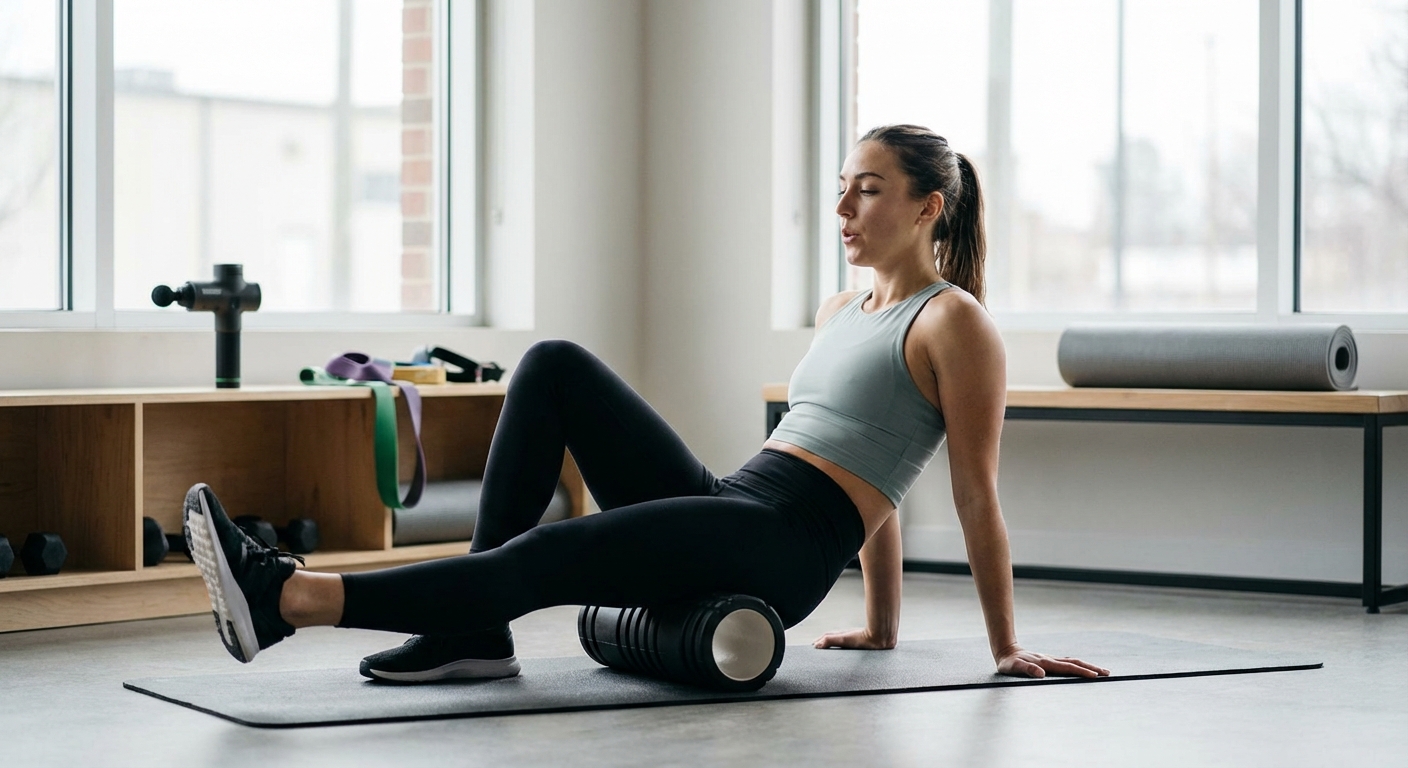
The Pre-Workout: Undoing Travel Damage
Before training, you need to address the physiological damage that travel inflicts. Air travel in particular creates specific stressors that go beyond simple sitting. Commercial aircraft cabins are pressurized to the equivalent of 6,000 to 8,000 feet altitude, reducing blood oxygen saturation by 2 to 4 percent and causing gas expansion in the gastrointestinal tract. Combined with the cramped seating position, this creates a perfect storm of hip flexor shortening, thoracic spine stiffness, and fluid pooling in the lower extremities.
Jumping straight into a high-intensity workout with this compromised posture is a recipe for injury, particularly to the lower back. The hip flexors, which have been held in a shortened position for hours, pull the pelvis into anterior tilt. The thoracic spine, compressed and rounded from airplane seats, limits overhead mobility. Attempting to squat, press overhead, or perform dynamic movements without first addressing these restrictions invites compensation patterns that stress the lumbar spine.
The solution is a 5 to 10 minute mobility sequence performed before any training. This isn’t just a warm-up; it’s a necessary reset that signals your nervous system that you’re no longer trapped in seat 14B and are ready to move dynamically.
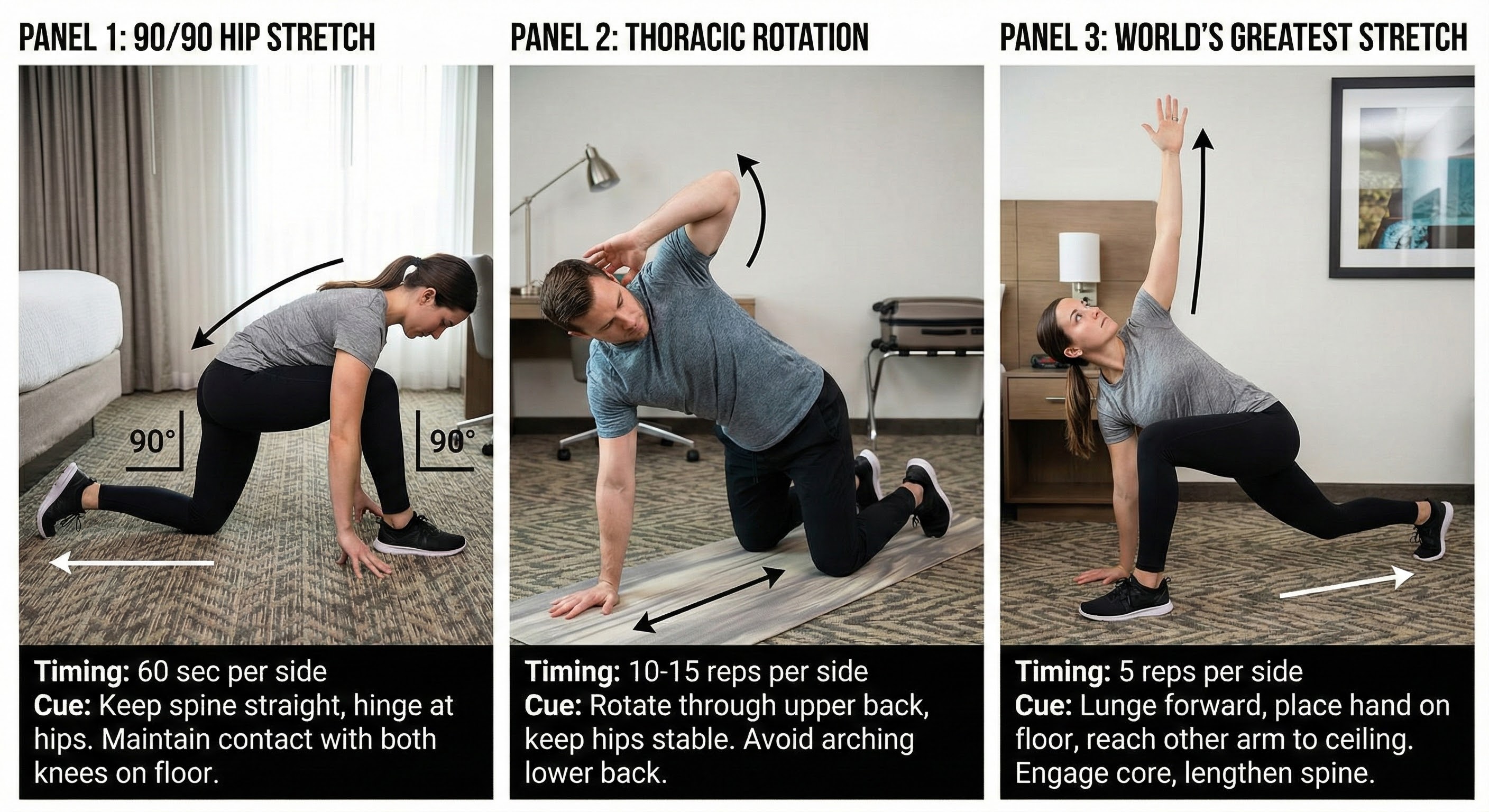
Begin with the 90/90 hip stretch: sit on the floor with both legs bent at 90 degrees, one in front and one behind. Lean forward over the front leg to stretch the external rotators, then rotate to lean back toward the rear leg to access the internal rotators. Spend 60 seconds per side, breathing deeply to facilitate tissue release.
Follow with thoracic rotations: from all fours, place one hand behind your head with the elbow pointing out. Rotate that elbow down toward the opposite hand, then rotate it up toward the ceiling, following with your gaze. Perform 10 to 15 rotations per side, feeling the mid-back gradually unlock.
Finish with the world’s greatest stretch: from a high plank, step your right foot outside your right hand. Rotate your right hand to the ceiling, following with your gaze. Return the hand to the floor and drop your hips toward the ground to stretch the hip flexor. Alternate sides for 5 reps each.
This sequence takes about eight minutes and transforms a stiff, compressed body into one capable of safe, effective training. Skip it at your own risk.
The Luggage and Gravity Circuit: Full-Body Training
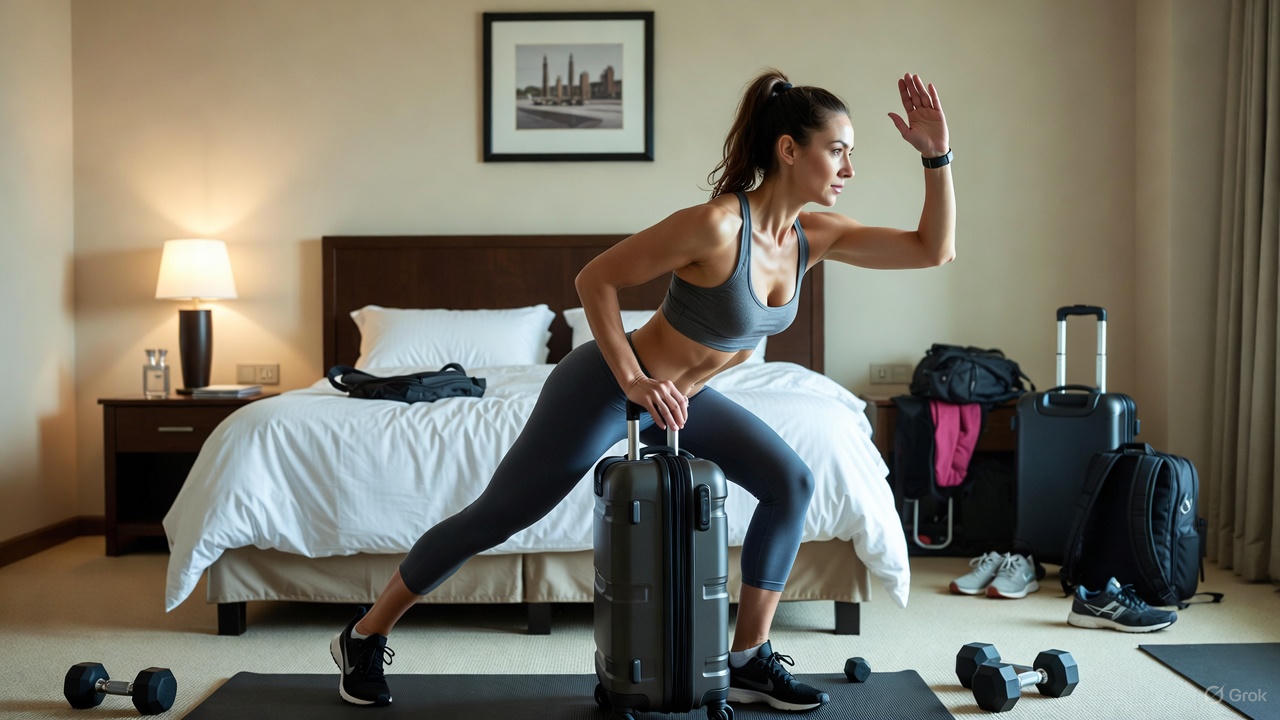
Your suitcase becomes your most versatile piece of exercise equipment. A typical checked bag weighing 30 to 50 pounds provides meaningful resistance for pulling and pressing movements, while its awkward shape creates stabilization demands that isolate resistance doesn’t. Combined with bodyweight exercises that leverage hotel furniture, you have everything needed for effective full-body training.
This 20-minute AMRAP (As Many Rounds As Possible) circuit trains all major movement patterns without requiring any equipment beyond what you packed. Perform each exercise back-to-back with minimal rest, then rest 60 to 90 seconds between rounds. Complete as many rounds as possible in 20 minutes, tracking your total for comparison on future trips.
Suitcase Thrusters (15 reps): Hold your suitcase at chest level by the handle or by gripping both ends. Squat down until your thighs are parallel to the floor, then stand explosively while pressing the bag overhead. Lower the bag to chest level as you descend into the next rep. This movement trains legs, shoulders, and core integration in a single compound exercise.
Feet-Elevated Pushups (10 reps): Place your feet on the hotel bed or a sturdy chair, hands on the floor. The decline angle shifts emphasis to the upper chest and anterior deltoids while increasing difficulty compared to standard pushups. Maintain a rigid plank from ankles to shoulders throughout. If this is too difficult, perform regular pushups with feet on the floor.
Suitcase Rows (15 reps per side): Place one hand on the bed for support, holding the suitcase in the opposite hand. Pull the bag up toward your hip, focusing on squeezing the shoulder blade back and down. Control the descent rather than letting gravity drop the weight. Complete all reps on one side before switching.
Bulgarian Split Squats (10 reps per leg): Stand about two feet in front of the bed, facing away from it. Place the top of one foot on the bed behind you. Lower your body until your front thigh is parallel to the floor, keeping your torso upright and your front knee tracking over your toes. This single-leg movement is brutally effective even without added weight; hold the suitcase for additional challenge.
The circuit structure means you’ll complete 100+ reps in 20 minutes, sufficient volume for maintenance training. The AMRAP format scales automatically to your fitness level: beginners might complete 3 rounds, advanced athletes 5 or 6. Track your performance and aim to beat it on your next trip.
The Deck of Cards Workout: Randomized Training
For longer hotel stays or when you need variety, the deck of cards format provides an engaging workout structure that eliminates decision fatigue while ensuring balanced training. This approach is popular among military personnel and combat athletes who need effective training without equipment or programming complexity.
The setup is simple: assign one exercise to each card suit. Draw a card, perform the indicated reps (face cards equal 10, aces equal 11, numbered cards equal their value), then draw the next card. Continue until you’ve worked through the entire deck.
A balanced assignment might include:
- Hearts: Pushups (upper body push)
- Diamonds: Bodyweight Squats (lower body push)
- Spades: Reverse Lunges (lower body, single-leg emphasis)
- Clubs: Burpees (full body, cardiovascular demand)
A standard 52-card deck produces approximately 380 total reps across the four movements. Depending on pace and fitness level, completing the deck takes 15 to 25 minutes. The randomized ordering prevents gaming, where you might otherwise save the hardest exercises for last and then quit early. When burpees might come at any point, you can’t negotiate your way out of them.
Advanced variations increase difficulty: substitute pike pushups for regular pushups, jump squats for bodyweight squats, or add jokers as “wild cards” that require 50 reps of a punishment exercise like mountain climbers. The format is infinitely customizable while maintaining the randomized structure that keeps workouts engaging.
The deck of cards approach also solves the motivation problem that often undermines travel training. When you’re tired and would rather collapse onto the hotel bed, “just one more card” feels more achievable than “20 more minutes of working out.” The gamified structure creates micro-goals that pull you through the session even when willpower is low.

The Time-Crunched Protocol: 10-Minute Hotel HIIT
When meetings, dinners, or travel logistics compress your available time to almost nothing, a 10-minute high-intensity session can still deliver meaningful benefits. The key is maximizing intensity during your limited window rather than accepting a watered-down version of a longer workout.
This protocol uses the EMOM (Every Minute On the Minute) format: perform the prescribed work at the start of each minute, then rest for whatever time remains before the next minute begins. This structure automatically scales intensity: the faster you complete the work, the more rest you get, but only fitter individuals can work fast enough to rest meaningfully.
10-Minute EMOM:
- Minute 1: 15 Air Squats
- Minute 2: 10 Pushups
- Minute 3: 20 Mountain Climbers (count each leg as 1)
- Minute 4: 10 Reverse Lunges (5 per leg)
- Minute 5: 5 Burpees
- Minute 6: 15 Air Squats
- Minute 7: 10 Pushups
- Minute 8: 20 Mountain Climbers
- Minute 9: 10 Reverse Lunges
- Minute 10: 5 Burpees
This workout produces approximately 150 reps in 10 minutes, maintaining significant intensity throughout. If you complete the prescribed reps in 30 seconds, you rest for 30 seconds before the next minute. If the reps take 45 seconds, you only get 15 seconds of rest. This automatic scaling makes the protocol appropriate for various fitness levels while ensuring that everyone is pushed to their current capacity.
For those with less than 10 minutes, even a 5-minute Tabata-style effort provides value. Perform 20 seconds of work followed by 10 seconds of rest for 8 rounds (4 minutes total), alternating between two movements like burpees and mountain climbers. This brief session may not be optimal, but it maintains the exercise habit, generates some metabolic benefit, and takes so little time that the “no time” excuse becomes genuinely invalid.
Walking: The Non-Negotiable Minimum
If every other training option fails, whether due to time, energy, or genuine logistical constraints, walking remains the non-negotiable minimum. The physiological and psychological benefits of walking are often underestimated precisely because the activity seems too easy to be meaningful. But walking is one of the most effective tools for maintaining metabolic health, particularly during travel when diet is often suboptimal.
Walking mobilizes fatty acids for oxidation without generating the stress hormones that accompany more intense exercise. It promotes digestive motility, helping process the irregular and often excessive meals that travel eating involves. It provides low-level muscular engagement that prevents the complete deconditioning that occurs with zero activity. And it offers cognitive benefits, including enhanced creativity and problem-solving, that make it particularly valuable during business travel.
Transform travel logistics into walking opportunities. Never take the terminal tram or train between gates if you can walk the distance. Always take stairs instead of elevators for any hotel floor below the 10th. Pace while on conference calls rather than sitting in your room. Walk to restaurants for dinner rather than taking cabs. These accumulated steps add up to meaningful daily totals without requiring dedicated workout time.
If you have one hour free and can’t decide between a mediocre hotel gym session and an outdoor walk, choose the walk. The fresh air, mental reset, and consistent movement often provide more practical benefit than struggling with unfamiliar equipment in a poorly ventilated basement gym.
For those looking for more structured approaches to micro-workouts, our guide on exercise snacking explores how brief movement sessions accumulate meaningful training benefits. The concept pairs well with our article on the underrated benefits of walking, which makes the case for walking as a foundational fitness practice during travel.
Jet Lag and Training: Timing Considerations
Exercise interacts with circadian rhythms in ways that affect both training quality and jet lag recovery. Understanding these interactions helps you optimize not just your workouts but also your adaptation to new time zones.
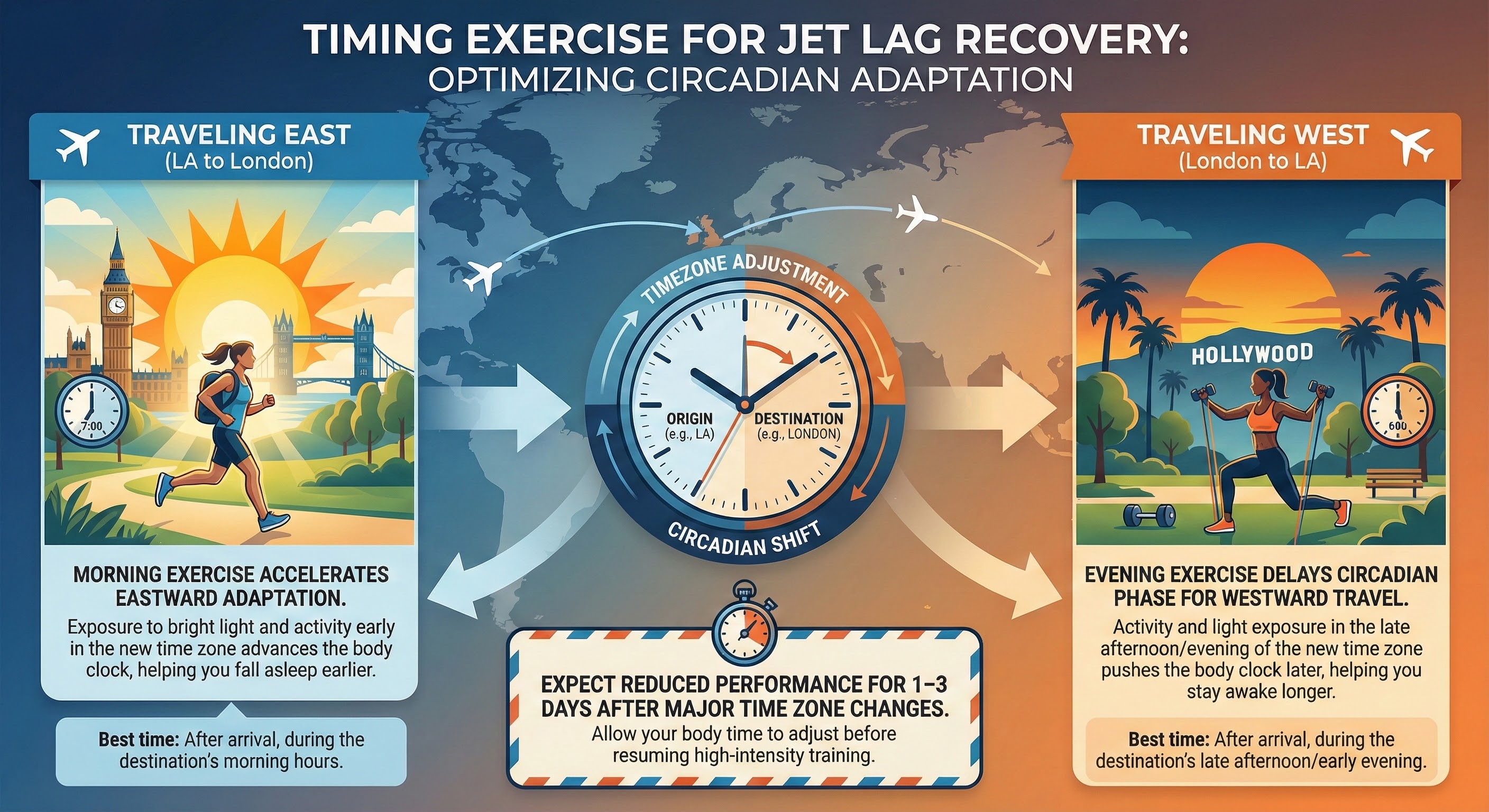
Exercise performed in the morning of your destination time zone appears to accelerate circadian adaptation when traveling east. Morning bright light exposure combined with physical activity sends a powerful “wake up” signal to the master circadian clock in the suprachiasmatic nucleus. If you’ve traveled from Los Angeles to London and are struggling to function at 7 AM local time (11 PM LA time), a morning workout helps convince your body that this is indeed morning.
When traveling west, evening exercise may accelerate adaptation by delaying the circadian phase. The exertion and associated cortisol elevation help extend wakefulness to the later local bedtime, rather than crashing at what your home time zone considers a reasonable hour.
Performance is typically reduced during the first few days of significant time zone changes. Reaction time, strength output, and exercise tolerance all decline when the body’s rhythms are misaligned with external time cues. Expecting peak performance immediately after crossing multiple time zones sets you up for frustration. Use the first few days for lighter maintenance training, reserving more demanding sessions for after adaptation is underway.
Sleep deprivation from red-eye flights or jet lag-disrupted nights affects training similarly to alcohol intoxication: impaired motor coordination, reduced power output, and compromised judgment about appropriate intensity. If you slept three hours on the flight and feel impaired, a gentle mobility session and walk serve you better than attempting the full AMRAP circuit. Training hard while severely sleep deprived elevates injury risk and produces minimal training adaptation.
Nutrition on the Road: Supporting Your Training
Travel workouts occur within a broader context of disrupted eating that affects both performance and body composition. Without your home kitchen and regular meal prep, food choices become either intentional or default to whatever’s most convenient, which is typically the least healthy option.
Protein becomes particularly important during travel because it’s the macronutrient most often underconsumed in travel eating. Continental breakfasts feature carbohydrates almost exclusively. Airport food courts emphasize fast, portable options that tend toward refined carbohydrates. Business dinners may provide adequate protein but often in portions smaller than what regular training demands.
Pack portable protein options in your carry-on: jerky, protein bars (choose those with at least 15 grams of protein and minimal sugar), nuts, or individual protein powder packets that can be mixed with water. Starting each day with protein from these sources, supplementing the carbohydrate-heavy hotel offerings, supports muscle maintenance and improves satiety throughout the day.
Hydration deserves particular attention. The pressurized, low-humidity cabin environment of aircraft is significantly dehydrating, and most travelers don’t compensate adequately. Start drinking water aggressively as soon as you board and continue throughout the flight. Upon arrival, continue prioritizing water intake, especially if your destination involves alcohol-heavy business entertainment. Dehydrated training is unpleasant and underperforming; arriving at your workout in a fluid-depleted state undermines the session before it begins.
Alcohol, prevalent in many travel contexts, impairs recovery from training by disrupting sleep architecture and reducing growth hormone secretion. This doesn’t require abstinence, but it does suggest moderation on nights before planned training sessions. If you’re drinking at the business dinner, your morning workout will be compromised regardless of how tough you feel going in.
Building the Travel Training Habit
The greatest benefit of travel training may be psychological rather than physiological. Maintaining the exercise habit during disrupted circumstances reinforces identity: you’re someone who trains, period, not someone who trains only when conditions are optimal. This identity maintenance makes resuming normal training upon return automatic rather than requiring a fresh motivation effort.
The minimum effective dose for habit maintenance is lower than most people assume. Even a single 10-minute session during a week-long trip preserves the habit loop in ways that zero sessions doesn’t. The person who did 10 minutes of hotel room squats returns home with an unbroken streak; the person who did nothing returns with a gap that creates psychological resistance to restarting.
Pack as if training is guaranteed to happen. Include athletic shoes, one workout outfit, and resistance bands if you use them. When training is convenient because equipment is available and clothes are ready, you’re more likely to actually do it. When training requires buying workout clothes at the airport or attempting squats in jeans, resistance increases and follow-through decreases.
Schedule training in your travel calendar as you would any other appointment. A blocked 30-minute slot at 6 AM labeled “workout” creates commitment in ways that vague intentions don’t. When the time arrives, the decision has already been made; you’re just executing rather than negotiating with yourself.
The Bottom Line
The “perfect” workout is the enemy of the “done” workout. A mediocre 20-minute session performed in your underwear in a cramped hotel room is infinitely better than the elaborate gym workout you couldn’t get to. The goal isn’t peak performance; it’s maintenance of muscle mass, habit, and metabolic health during circumstances that actively work against all three.
Your suitcase is a weight. The hotel bed is a bench. The floor is your gym. With these simple tools and the protocols outlined above, you have everything needed to keep the fitness chain unbroken no matter where travel takes you.
Your Travel Training Protocol:
- Perform the 8-minute mobility sequence before any training to undo travel damage
- Use the 20-minute AMRAP circuit for full-body maintenance training
- Employ the deck of cards format for variety on longer trips
- Fall back on the 10-minute EMOM when time is extremely limited
- Walk constantly: stairs, terminals, pacing on calls
- Pack protein sources and prioritize hydration, especially after flights
- Schedule workouts as calendar appointments and pack as if training is guaranteed
Sources: American College of Sports Medicine position stands on exercise during travel, Journal of Applied Physiology altitude and exercise research, Sleep Medicine Reviews jet lag and circadian adaptation studies, International Journal of Sports Physiology and Performance travel athlete research.