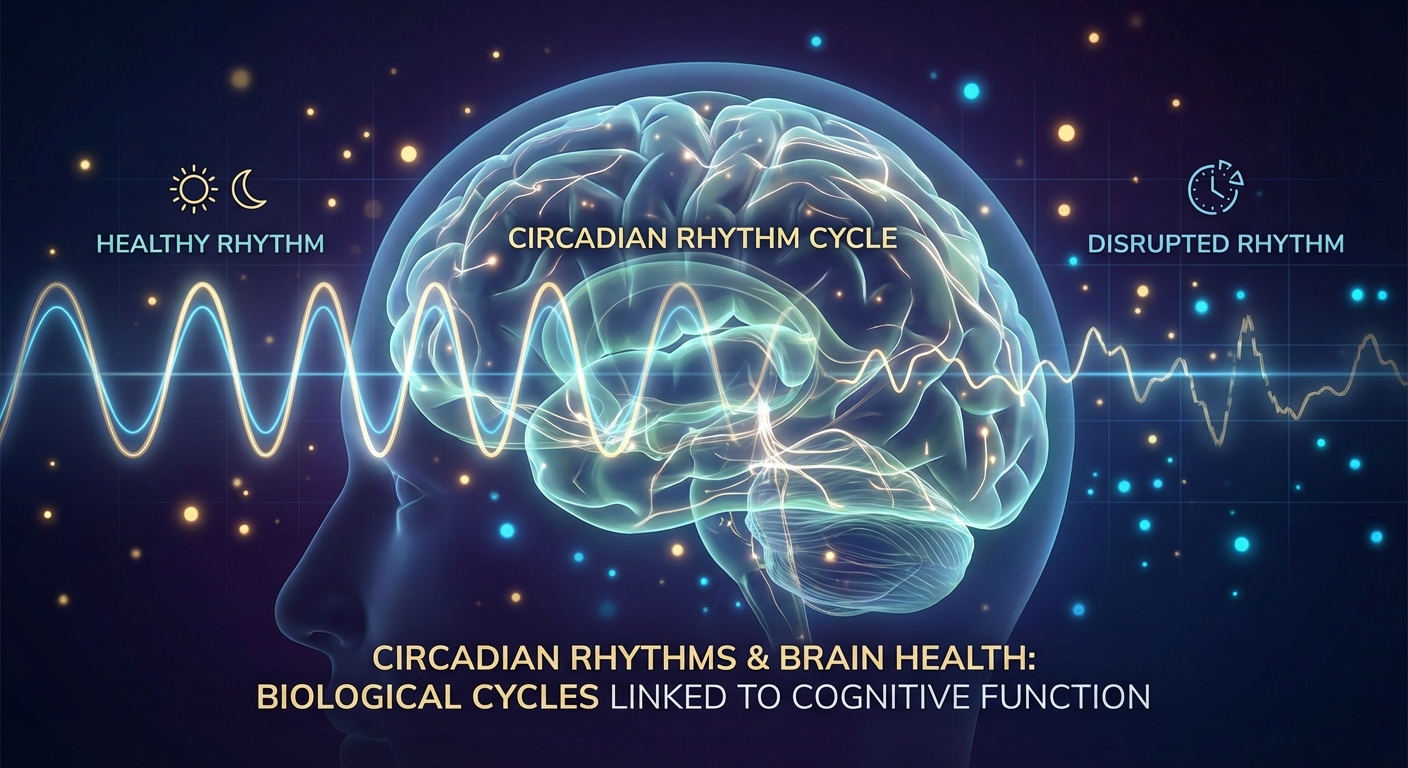
The relationship between alcohol and relaxation is deeply embedded in social culture. A drink after work signals the transition from productivity to rest. Wine with dinner represents sophistication and enjoyment. Holiday celebrations are nearly unimaginable without champagne toasts and cocktails. Yet when we examine what alcohol actually does to the physiological systems that govern recovery, the picture becomes considerably more complicated than the momentary warmth in the chest might suggest.
Modern wearable technology has given us unprecedented visibility into what happens after we close our eyes. Sleep trackers, continuous heart rate monitors, and devices measuring heart rate variability now quantify the recovery processes that previously remained invisible. The data these devices generate tells a consistent story: alcohol systematically disrupts the very systems we’re trying to relax, turning what feels like unwinding into a measurable setback for physical and cognitive performance.
This isn’t an argument for abstinence. For many people, moderate alcohol consumption is part of a life they enjoy. But understanding the actual physiological costs allows for informed decisions about when and how much to drink, particularly for those who prioritize athletic performance, cognitive function, or optimizing their health metrics. The research is clear enough that ignorance is no longer a valid excuse for surprise when the morning-after data reveals the damage.
Sleep Architecture: The Hidden Disruption
Sleep is not a monolithic state but a carefully orchestrated sequence of stages that serve distinct physiological functions. A healthy night cycles through light sleep, deep slow-wave sleep (SWS), and rapid eye movement (REM) sleep approximately four to six times. Each stage performs irreplaceable functions: deep sleep drives physical restoration and growth hormone release, while REM sleep consolidates memory and processes emotional experiences. The architecture of these cycles matters as much as total sleep duration.
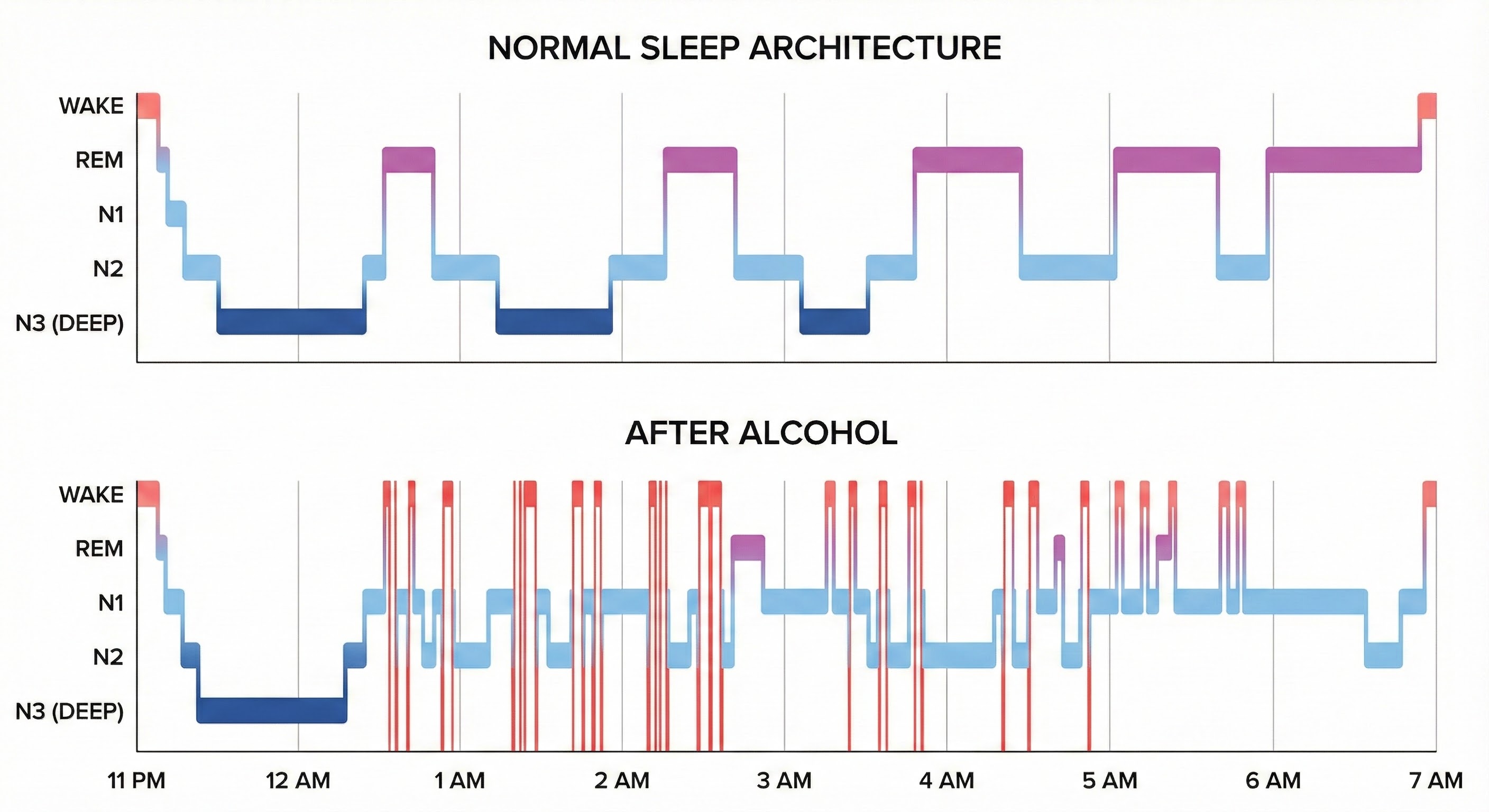
Alcohol disrupts this architecture in predictable and well-documented ways. As a central nervous system depressant, alcohol initially promotes sleep onset. You fall asleep faster after drinking, and the first half of the night often features increased deep sleep. This is the seductive part of the equation, the reason many people genuinely believe alcohol helps them sleep better. They’re unconscious within minutes of their head hitting the pillow.
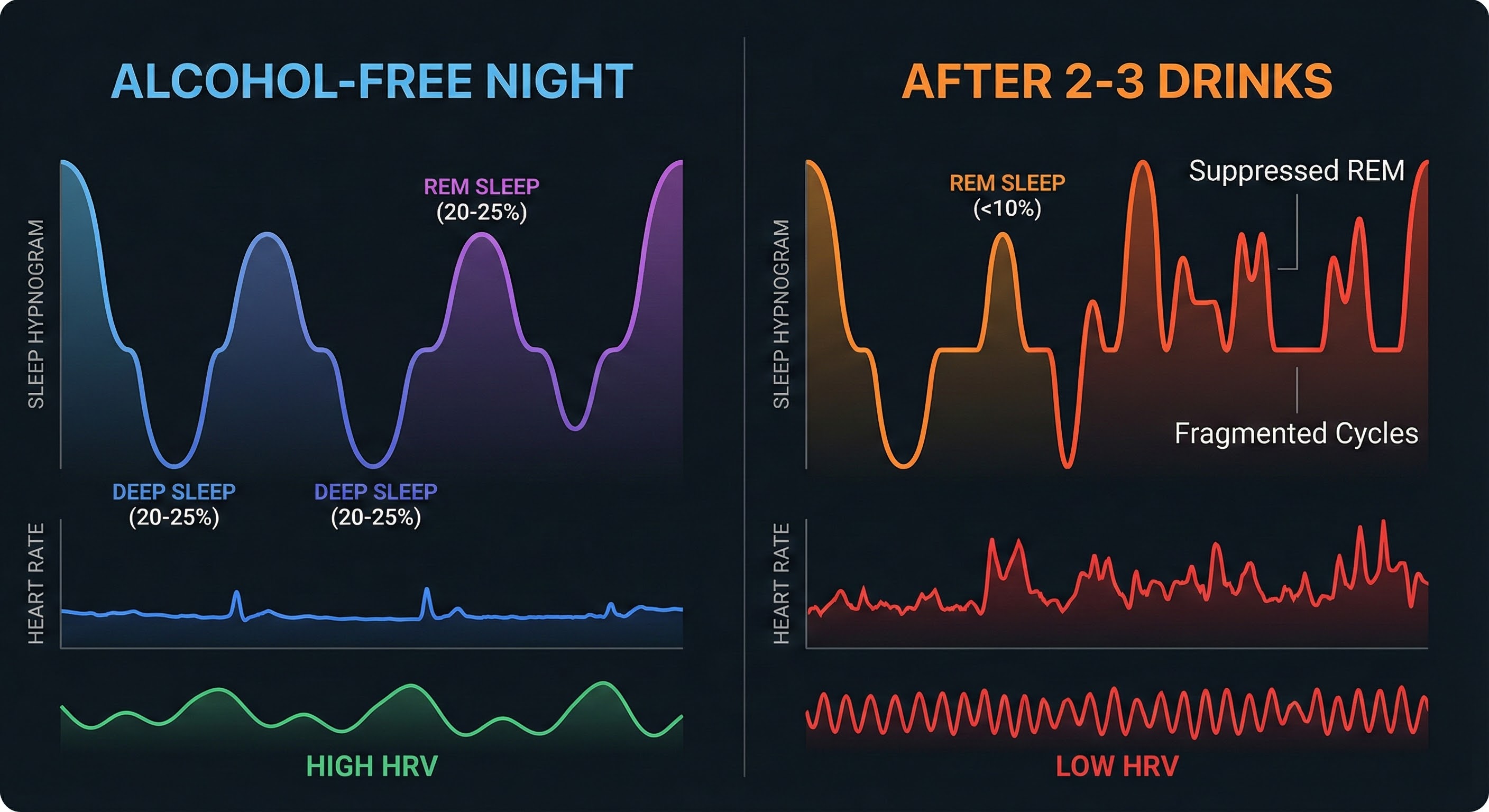
However, as blood alcohol levels fall during the night, the situation reverses dramatically. The second half of sleep becomes fragmented with frequent brief awakenings, many too short to remember but long enough to disrupt sleep architecture. REM sleep, which predominantly occurs in the later sleep cycles, is particularly vulnerable. Studies using polysomnography show that even moderate alcohol consumption, defined as two drinks for men or one drink for women, reduces REM sleep by 20 to 40 percent.
Research from the London Sleep Centre published in Alcoholism: Clinical and Experimental Research demonstrates that the sleep efficiency, defined as time asleep divided by time in bed, drops significantly after alcohol consumption. Participants spent more time in bed but less time in restorative sleep stages. The subjective experience of “sleeping well” after drinking reflects the rapid onset of unconsciousness, not the quality of sleep that follows.
The practical implication is that alcohol trades sleep quality for sleep onset speed. If your challenge is falling asleep, alcohol provides a temporary solution while creating a larger problem. If your goal is restorative sleep that supports recovery and performance, alcohol works directly against you regardless of how quickly you lose consciousness.
Heart Rate Variability: The Recovery Metric That Doesn’t Lie
Heart rate variability (HRV) has emerged as one of the most valuable biomarkers for assessing recovery status and readiness to train. Unlike resting heart rate, which measures beats per minute, HRV measures the variation in time between consecutive heartbeats. A healthy, well-recovered nervous system produces high variability, with intervals between beats ranging from perhaps 850 to 1050 milliseconds in a complex, somewhat chaotic pattern. A stressed or under-recovered system produces low variability, with beats arriving more metronomically.
This variability reflects the balance between the sympathetic nervous system (fight or flight) and the parasympathetic nervous system (rest and digest). High HRV indicates strong parasympathetic tone and robust vagal activity, suggesting the body is recovered and resilient. Low HRV indicates sympathetic dominance or parasympathetic suppression, suggesting the body is still processing stressors and has reduced capacity to take on new challenges.
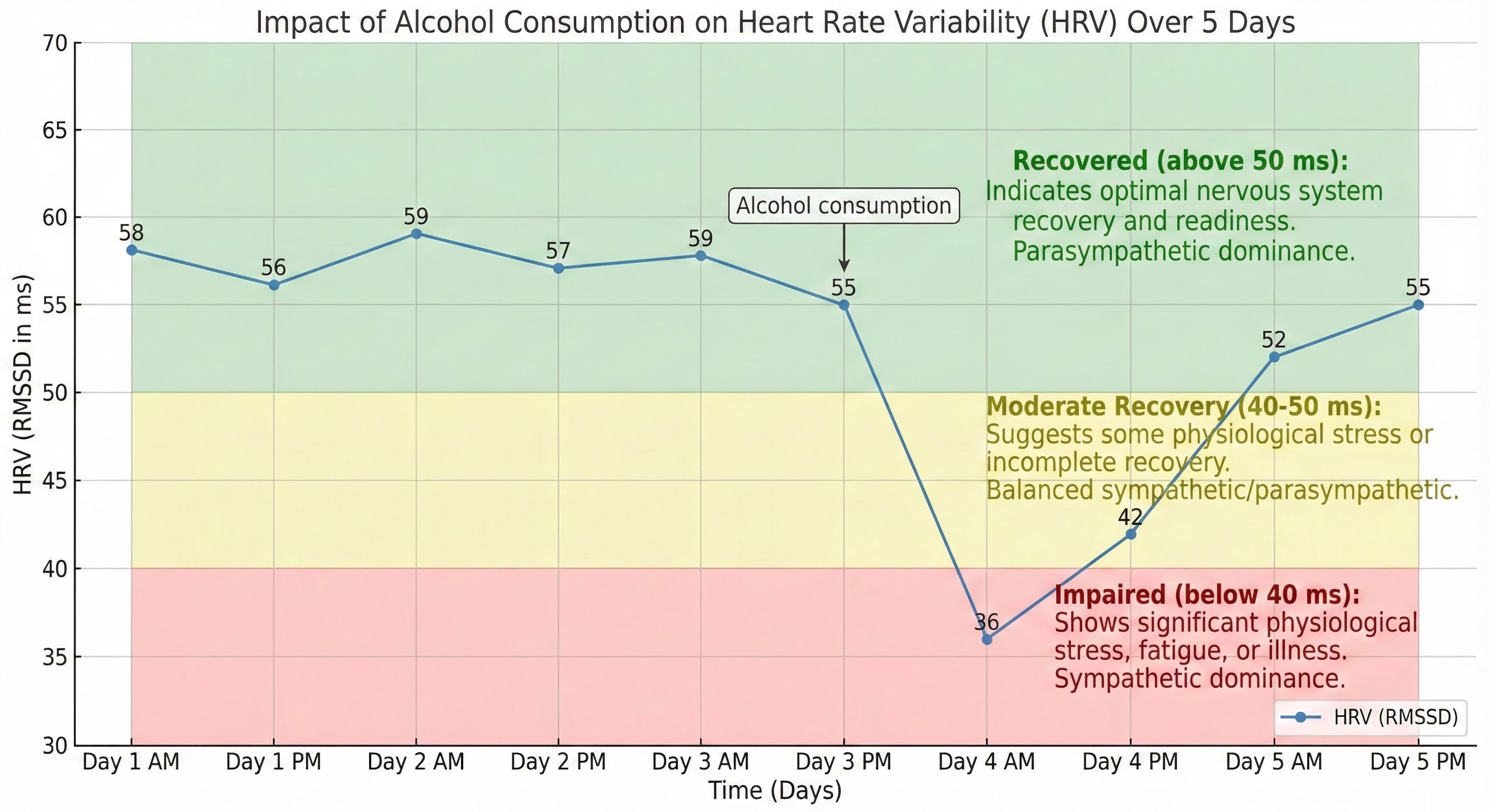
Alcohol profoundly suppresses HRV, often for 24 to 48 hours after consumption depending on the amount consumed. Research from the WHOOP performance optimization company, analyzing millions of nights of user data, found that even a single drink reduces overnight HRV by an average of 5 to 7 percent, with two to three drinks producing reductions of 15 to 20 percent. Heavy drinking can suppress HRV by 40 percent or more compared to alcohol-free baseline.
The mechanism involves both direct cardiovascular effects and indirect effects through sleep disruption. Alcohol initially causes vasodilation and reduced blood pressure, followed by a rebound as the alcohol metabolizes that elevates heart rate and blood pressure during the second half of the night. This rebound effect explains why you might wake at 3 or 4 AM with a racing heart after drinking, even if you don’t remember waking. The elevated resting heart rate during sleep is a clear marker of impaired recovery.
For athletes and fitness enthusiasts who track HRV to guide training decisions, the implications are straightforward: alcohol consumption should be factored into recovery calculations just as you would factor in a hard training session. The HRV suppression from a night of moderate drinking is physiologically similar to the suppression from an intense workout, except that the workout produces adaptation while the alcohol produces only cost.
Resting Heart Rate: The Overnight Stress Response
While HRV captures nervous system balance, resting heart rate provides a simpler metric that tells a similar story. A well-recovered body at rest during sleep should have a heart rate that gradually declines through the early part of the night, reaching its lowest point during deep sleep, then gradually rises as morning approaches and the body prepares for waking. This pattern reflects appropriate parasympathetic dominance during sleep.
Alcohol disrupts this pattern significantly. Research from Stanford University’s wearable device studies shows that alcohol consumption elevates overnight resting heart rate by 5 to 15 beats per minute depending on the amount consumed. More importantly, instead of the gradual decline and stable low point characteristic of restorative sleep, the heart rate often shows an initial depression (corresponding to alcohol’s depressant effects) followed by an extended elevation during the second half of the night as the body metabolizes the alcohol.
This elevated heart rate represents the cardiovascular system working harder than it should during what’s supposed to be a recovery period. The heart isn’t resting; it’s processing a toxin. This metabolic work consumes resources that would otherwise go toward tissue repair, immune function, and the other restorative processes sleep is meant to support.
For those who wear sleep trackers, the overnight heart rate graph after drinking provides immediate, visual feedback on alcohol’s effects. The contrast between an alcohol-free night, with its smooth decline and stable trough, and a drinking night, with its erratic pattern and elevated baseline, makes the impact unmistakable. This data often proves more persuasive than any lecture about alcohol’s effects because it’s personalized, objective, and undeniable.
Performance Implications: The Day After
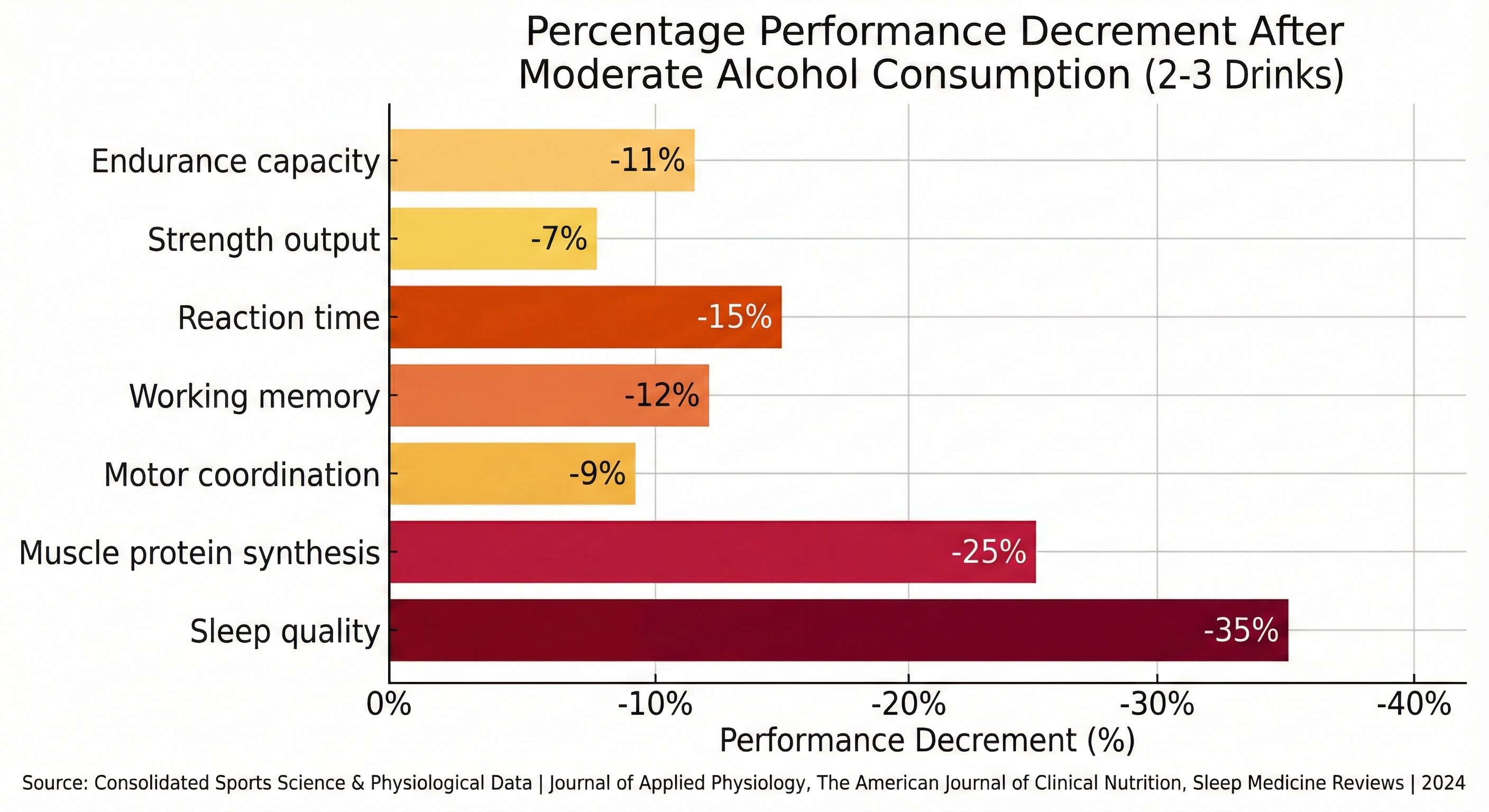
The sleep disruption and impaired recovery from alcohol consumption translate directly into measurable performance decrements the following day. These effects extend beyond the obvious symptoms of hangover into subtle impairments that persist even when you feel “fine.”
Cognitive performance suffers significantly. Research from the University of Bath found that alcohol consumption, even at levels below those producing subjective hangover, impaired next-day executive function, working memory, and reaction time. The impairments were proportional to the amount consumed and to the degree of sleep disruption measured by actigraphy. Participants who slept poorly after drinking performed worse on cognitive tests than those who slept poorly without drinking, suggesting alcohol adds cognitive impairment beyond what sleep loss alone produces.
Physical performance shows similar decrements. A meta-analysis published in Sports Medicine found that alcohol consumption in the 24 hours before exercise reduced endurance performance by an average of 11 percent, strength performance by 5 to 8 percent, and impaired motor control and coordination. The mechanisms include dehydration, glycogen depletion, impaired protein synthesis, and the lingering effects of disrupted sleep and suppressed HRV.
For athletes in competition or serious training, the performance cost of alcohol is substantial enough to warrant careful consideration. The night-before drink before a race or important training session represents a measurable handicap that no amount of talent or preparation can fully overcome. The competitive disadvantage is real and quantifiable.
Even for recreational exercisers, alcohol affects the return on training investment. Muscle protein synthesis, the process by which training stimulus is converted into new muscle tissue, is suppressed by approximately 25 percent when alcohol is consumed post-exercise, according to research from RMIT University. The workout happened, but the adaptation is blunted. You did the work without receiving the full benefit.
The Dose-Response Relationship
Not all alcohol consumption produces equal effects, and understanding the dose-response relationship allows for more nuanced decision-making. The research consistently shows that effects scale with consumption, meaning that less alcohol produces less disruption, and there may be thresholds below which effects become minimal.
One standard drink, defined as 14 grams of pure alcohol (approximately one 12-ounce beer, 5-ounce glass of wine, or 1.5-ounce shot of spirits), produces measurable but modest effects on sleep architecture and HRV in most individuals. The WHOOP data analysis found that a single drink reduced next-day recovery scores by approximately 5 percent on average, a noticeable but not dramatic impact.
Two to three drinks moves into clearly significant territory, with HRV suppression of 15 to 20 percent and substantially disrupted sleep architecture. This level of consumption, common at social events and holiday gatherings, produces effects that most wearable users can clearly identify in their morning data.
Four or more drinks produces severe disruption, with HRV suppression often exceeding 40 percent, dramatically fragmented sleep, and next-day performance impairments that may persist into the second day. At this level, the recovery cost begins to rival that of a significant training session or acute illness.
Individual variation matters significantly. Factors including body weight, sex, genetic variation in alcohol metabolism enzymes, habitual consumption patterns, and age all influence how a given dose affects a specific person. The only way to know your personal response is to track your own data over time, comparing nights with and without consumption.
Timing and Mitigation Strategies
While the cleanest solution is abstinence on nights when recovery matters most, practical strategies can reduce alcohol’s impact for those who choose to drink.
Timing matters considerably. Alcohol consumed earlier in the evening has more time to metabolize before the later sleep cycles when REM sleep predominates. The general guideline suggests allowing at least three to four hours between your last drink and bedtime, recognizing that the average body metabolizes approximately one standard drink per hour. This timing allows blood alcohol levels to decline substantially before the critical second half of sleep.
Hydration mitigates some effects. Alcohol is a diuretic that increases fluid loss, contributing to the dehydration that elevates heart rate and impairs recovery. Alternating alcoholic drinks with water and consuming substantial water before bed reduces, though doesn’t eliminate, these effects. Electrolyte supplementation may provide additional benefit.
Food consumption with alcohol slows absorption and reduces peak blood alcohol concentration. Drinking with a substantial meal produces lower peak levels and faster clearance than drinking on an empty stomach. The same total alcohol consumed over dinner produces less physiological disruption than the same amount consumed quickly at a bar.
Strategic scheduling acknowledges alcohol’s costs. Serious athletes often restrict alcohol to specific days that precede rest days rather than training days, minimizing the impact on important sessions. Some adopt complete abstinence during competition seasons or training blocks. Others simply track their data and make case-by-case decisions based on the importance of the next day’s activities.
For those tracking HRV and using it to guide training, our guide on heart rate variability and recovery monitoring provides protocols for interpreting your data and adjusting training based on recovery status, including how to factor in alcohol consumption.
The Honest Assessment
None of this research suggests that alcohol consumption is incompatible with fitness, performance, or health optimization. Many successful athletes and highly functional people drink moderately without obvious detriment. The question isn’t whether you can drink and still perform; it’s whether you’re making informed decisions with accurate information about the costs.
The cultural narrative that alcohol aids relaxation and sleep is physiologically false. Alcohol is a sedative that produces unconsciousness, not restorative sleep. The distinction matters because one helps you and one merely feels like it helps while actually impairing you. Recognizing this distinction allows you to drink for the reasons alcohol actually delivers, such as social lubrication, taste, or ritual, rather than for benefits it doesn’t actually provide.
For those serious about performance optimization, the data suggests treating alcohol as a calculated indulgence rather than a harmless daily habit. The occasional drink at a celebration is a reasonable trade-off. The nightly glass of wine justified as a sleep aid is a pattern worth reconsidering given what the research shows about actual effects on sleep quality.
The wearable revolution has made the effects of alcohol visible in ways they never were before. Your overnight HRV, your sleep stages, and your resting heart rate graphs now tell you exactly what alcohol is doing to your recovery. The data is personal, immediate, and undeniable. What you do with that information remains your choice.
The Bottom Line
Alcohol disrupts recovery through multiple interconnected mechanisms: fragmenting sleep architecture, suppressing REM sleep, elevating overnight heart rate, and dramatically reducing heart rate variability. These effects persist for 24 to 48 hours after moderate consumption and scale proportionally with the amount consumed. The subjective sense that alcohol aids relaxation and sleep is contradicted by objective physiological measurement.
Understanding these effects allows for informed decision-making. Some occasions warrant the trade-off; others don’t. The key is making that assessment with accurate information rather than the cultural mythology that alcohol helps you unwind. It doesn’t. It sedates you while impairing the recovery processes you need most. For optimizing the nights you do abstain, explore our guide on biohacking your sleep.
Key Takeaways:
- Alcohol increases sleep onset speed but fragments sleep architecture and suppresses REM by 20-40%
- HRV is suppressed by 15-20% after 2-3 drinks, taking 24-48 hours to recover
- Overnight heart rate elevates by 5-15 BPM as the body metabolizes alcohol
- Next-day performance decrements include 11% endurance reduction and 25% suppressed muscle protein synthesis
- Allow 3-4 hours between last drink and bedtime to minimize sleep disruption
- Track your own data to understand your personal response and make informed trade-offs
Sources: London Sleep Centre polysomnography studies (Alcoholism: Clinical and Experimental Research), WHOOP recovery data analysis (2024), Stanford University wearable device research, University of Bath cognitive performance studies, Sports Medicine alcohol and performance meta-analysis, RMIT University muscle protein synthesis research.