
You have 20 minutes between wrapping gifts and leaving for a holiday dinner. Your regular gym routine requires an hour you don’t have. The choice seems binary: skip the workout entirely or accept that fitness will suffer until January. But exercise physiology offers a third option. High-intensity interval training compresses meaningful cardiovascular and metabolic adaptations into time frames that fit even the most fragmented holiday schedule, and the science supporting its effectiveness has grown substantially over the past decade.
HIIT isn’t new, but understanding of its mechanisms and optimal application has evolved considerably. Early research focused primarily on cardiovascular adaptations, demonstrating that brief intense efforts could produce aerobic improvements comparable to much longer moderate sessions. More recent work has illuminated additional benefits: metabolic flexibility, insulin sensitivity, mitochondrial biogenesis, and even cognitive improvements that stem from the unique physiological demands of interval work. For holiday schedules where time is the limiting factor, HIIT represents the highest return on training investment available.
The protocols that follow are designed for real-world application during schedule-compressed periods. They require no equipment, minimal space, and can be completed in 15-25 minutes including warm-up. They’re not replacing your regular training program; they’re maintaining fitness capacity until that program can resume. The difference between training efficiently during the holidays and training nothing during the holidays compounds significantly by January.
The Physiology of Interval Training
Understanding why HIIT works explains how to apply it effectively. The adaptations from interval training differ mechanistically from steady-state cardio, and these differences have practical implications for protocol design.
During high-intensity effort, your working muscles rapidly deplete ATP (adenosine triphosphate), the immediate energy currency for muscle contraction. This depletion triggers a cascade of metabolic signals that don’t occur during moderate-intensity work where ATP turnover remains sustainable. The enzyme AMPK (AMP-activated protein kinase) activates in response to the energy deficit, initiating processes that improve the muscle’s future capacity to produce and utilize energy: increased mitochondrial density, enhanced glucose uptake, greater fat oxidation capacity, and improved metabolic flexibility.
The recovery intervals between high-intensity efforts serve a specific physiological purpose beyond simply allowing you to catch your breath. During recovery, your cardiovascular system works to clear metabolic byproducts (lactate, hydrogen ions) and replenish oxygen stores in muscle tissue. This repeated cycling between oxygen debt and repayment creates a training stimulus for the entire oxygen transport chain, from heart and lungs to blood vessels and muscle capillaries. The heart learns to increase stroke volume rapidly; blood vessels improve their ability to dilate and deliver blood; muscles become more efficient at extracting oxygen from blood.
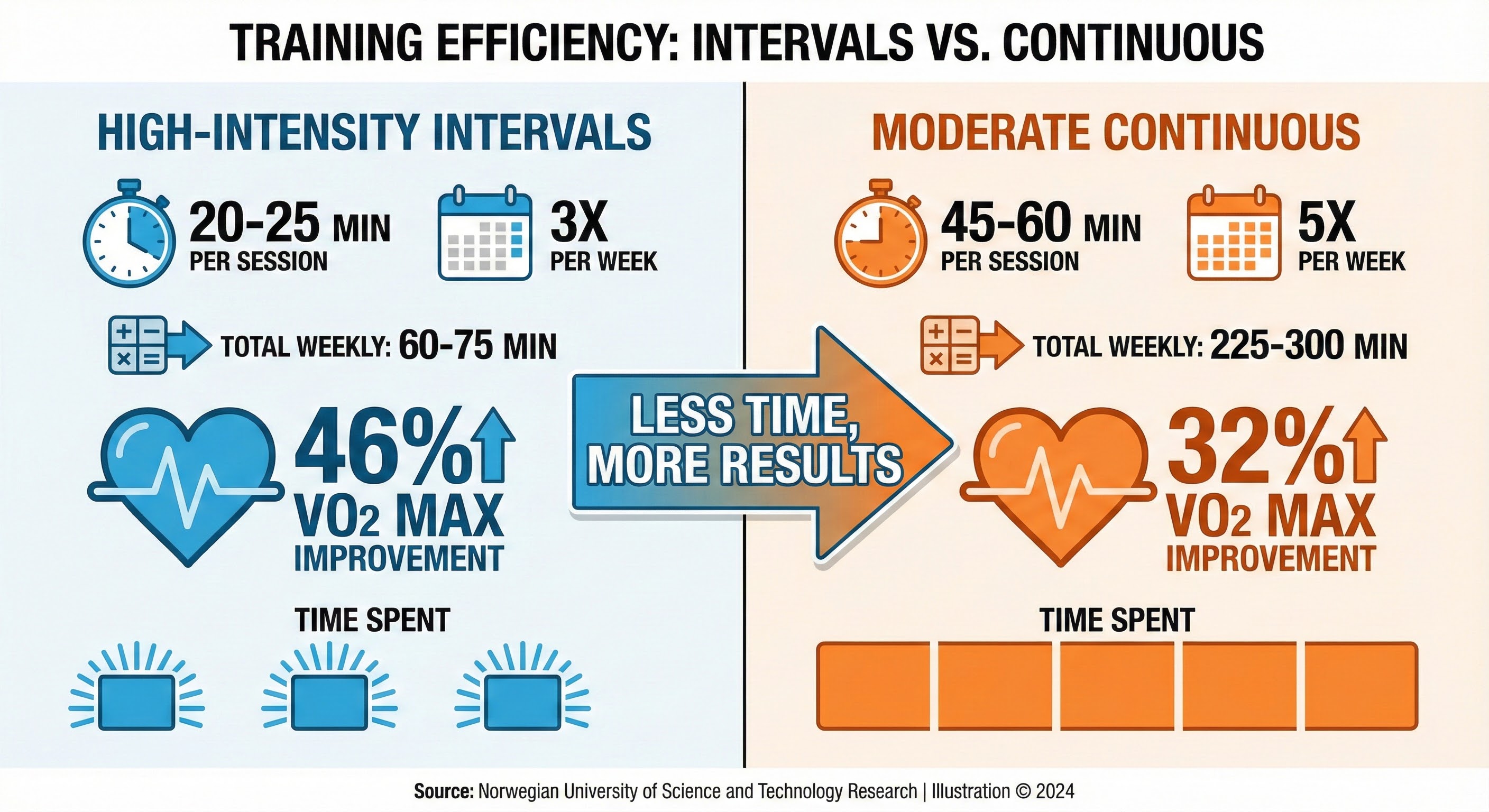
Research from the Norwegian University of Science and Technology, published in Circulation (2024), compared heart adaptations in participants performing either high-intensity intervals or moderate continuous training over 12 weeks. The interval group showed 46% greater improvement in VO2 max (the gold standard measure of cardiovascular fitness) and measurable increases in left ventricular mass and function, indicating structural heart adaptation. These changes occurred with less than half the total training time of the continuous group.
The metabolic afterburn effect (excess post-exercise oxygen consumption, or EPOC) provides additional value for time-constrained training. Following intense interval sessions, metabolic rate remains elevated for hours as the body restores homeostasis, repairs tissue, and processes metabolic byproducts. A 2023 study in the Journal of Sports Sciences measured EPOC following various protocols and found that 20 minutes of HIIT produced greater 24-hour energy expenditure than 45 minutes of moderate continuous exercise, even accounting for the longer duration of the moderate session.
Protocol Selection: Matching Method to Goal
Not all HIIT protocols are equivalent. Different work-to-rest ratios, effort durations, and intensity targets produce different adaptations. Selecting the right protocol depends on your primary training goal during the holiday period.
For cardiovascular maintenance and improvement, protocols with work intervals of 30 seconds to 4 minutes at 85-95% of maximum heart rate optimize aerobic adaptations. The classic Norwegian 4x4 protocol (4 minutes at 90-95% max HR, 3 minutes active recovery, repeated 4 times) remains one of the most research-validated approaches, though its 25-minute duration may exceed available time. A compressed version using 3x3 intervals provides approximately 80% of the cardiovascular benefit in 18 minutes.
For metabolic conditioning and fat oxidation, shorter work intervals (10-30 seconds) at maximum effort with incomplete recovery challenge the glycolytic energy system and create substantial EPOC. The Tabata protocol (20 seconds max effort, 10 seconds rest, 8 rounds, 4 minutes total) exemplifies this approach. Despite its brevity, research by Dr. Izumi Tabata demonstrated that this protocol improved both aerobic and anaerobic capacity simultaneously, a combination not achieved by traditional training.
For strength maintenance alongside conditioning, protocols incorporating resistance movements (burpees, jump squats, push-ups) with interval structure preserve neuromuscular adaptations while providing cardiovascular stress. This hybrid approach, sometimes called metabolic resistance training, addresses the concern that pure cardio HIIT might accelerate muscle loss during periods when strength training is reduced.
The 30-20-10 protocol, developed at the University of Copenhagen, offers versatility for multiple goals. Each 5-minute block consists of 30 seconds easy movement, 20 seconds moderate effort, and 10 seconds all-out sprint, repeated for 5 rounds. Three to four blocks with 2 minutes rest between blocks provides a complete 20-minute session addressing both aerobic and anaerobic systems. This protocol has shown particular effectiveness for improving running economy and speed even in trained athletes.
The Holiday HIIT Arsenal: Four Complete Protocols
The following protocols require no equipment and minimal space, designed specifically for hotel rooms, living rooms, or any carpeted area with enough room to perform a burpee. Each includes warm-up, work, and cool-down within the stated time.
Protocol 1: The 15-Minute Metabolic Blast (Tabata-Based)
Total time: 15 minutes Best for: Maximum metabolic impact in minimum time
Warm-up (3 minutes):
- Jumping jacks: 30 seconds
- Bodyweight squats: 30 seconds
- Arm circles: 30 seconds
- High knees: 30 seconds
- Walkouts: 30 seconds
- Mountain climbers (slow): 30 seconds
Work (8 minutes): Perform two Tabata blocks (8 rounds each of 20 seconds work, 10 seconds rest) with 1 minute rest between blocks.
Block 1: Lower Body Focus
- Alternate between jump squats and jumping lunges each round
- Modification: Fast air squats and reverse lunges if jumping is contraindicated
Block 2: Upper Body and Core Focus
- Alternate between burpees (no push-up) and mountain climbers each round
- Modification: Squat thrusts and plank shoulder taps
Cool-down (4 minutes):
- Walking in place: 1 minute
- Standing quad stretch: 30 seconds each leg
- Standing hamstring stretch: 30 seconds each leg
- Deep breathing: 1 minute
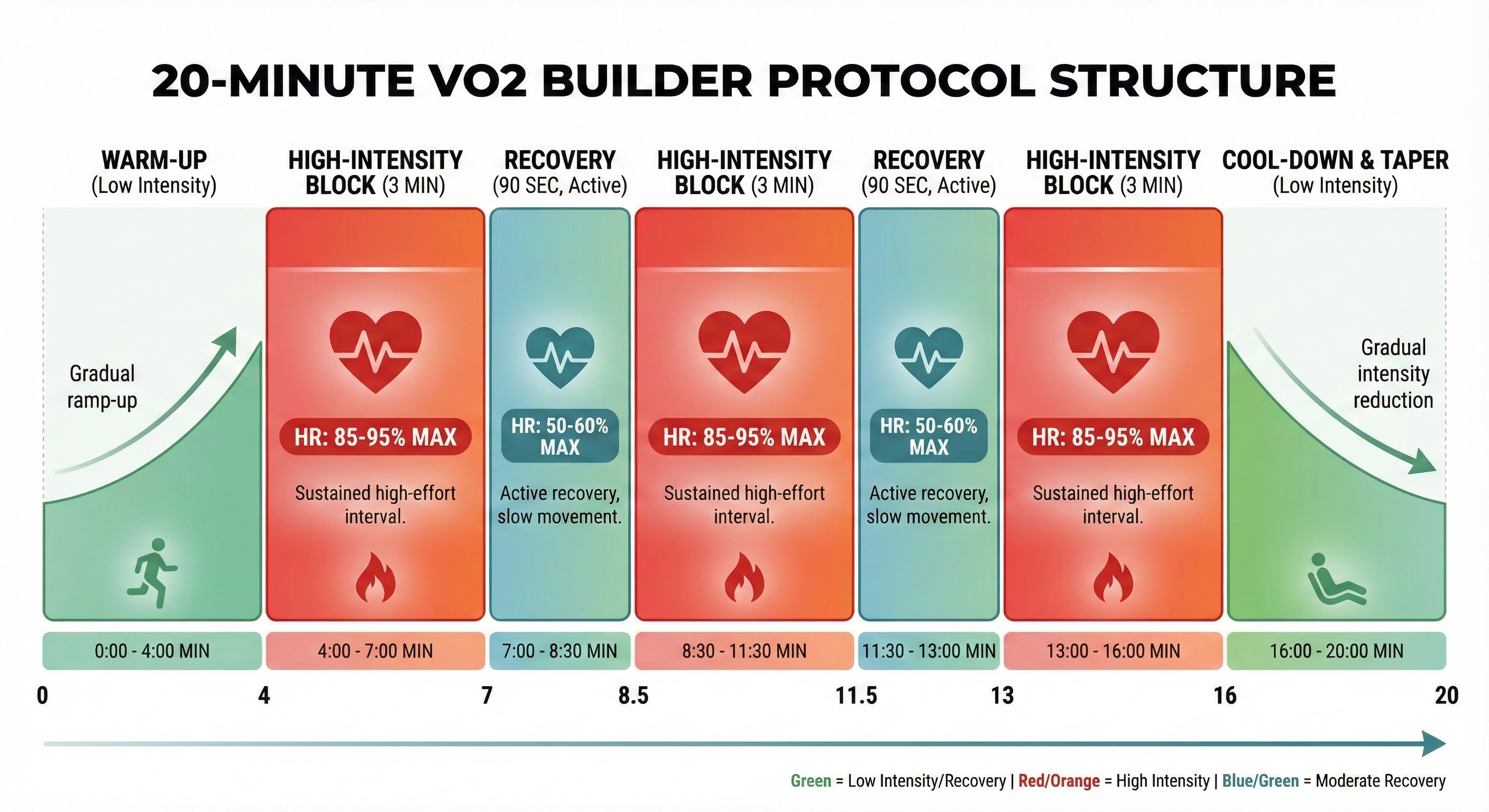
Protocol 2: The 20-Minute VO2 Builder (Norwegian-Inspired)
Total time: 20 minutes Best for: Cardiovascular fitness maintenance and improvement
Warm-up (4 minutes):
- March in place with arm swings: 1 minute
- Bodyweight squats: 1 minute
- Lateral shuffles: 1 minute
- Jumping jacks building to moderate intensity: 1 minute
Work (12 minutes): Three intervals of 3 minutes high-intensity effort with 90 seconds active recovery between each.
High-intensity intervals (pick one movement pattern per session):
- Option A: Burpees at sustainable pace (8-10 per minute)
- Option B: Running in place with high knees, focusing on maximum heart rate elevation
- Option C: Jump rope (or simulated jump rope without rope)
- Option D: Stair climbing if stairs are available
Recovery intervals:
- Walking in place or very slow marching
- Focus on breath recovery while maintaining movement
Cool-down (4 minutes):
- Gradual walking pace reduction: 2 minutes
- Standing stretches for hip flexors, quads, calves: 2 minutes
Protocol 3: The 18-Minute Strength-Cardio Hybrid (EMOM Format)
Total time: 18 minutes Best for: Maintaining both strength and cardiovascular conditioning
EMOM (Every Minute On the Minute) format provides structure that self-regulates intensity. At the start of each minute, perform the prescribed reps, then rest for the remainder of that minute.
Warm-up (3 minutes):
- Dynamic movement flow: inch worms, world’s greatest stretch alternating, arm circles
Work (12 minutes, EMOM): Cycle through these four movements, performing each at the start of its designated minute:
Minute 1: Push-ups x 10-15 (Scale to knee push-ups or incline push-ups if needed)
Minute 2: Jump squats x 15 (Scale to fast air squats if jumping is contraindicated)
Minute 3: Plank hold x 30-40 seconds (Rest remainder of minute)
Minute 4: Burpees x 8-10 (Scale to squat thrusts, eliminating the jump)
Repeat this 4-minute cycle 3 times for 12 minutes total.
Cool-down (3 minutes):
- Child’s pose: 45 seconds
- Lying spinal twist: 30 seconds each side
- Supine figure-four stretch: 30 seconds each side
Protocol 4: The 25-Minute Complete Session (30-20-10 Format)
Total time: 25 minutes Best for: Comprehensive session when slightly more time is available
Warm-up (5 minutes):
- Light jogging in place: 2 minutes
- Dynamic stretching: leg swings, arm circles, torso rotations: 2 minutes
- Gradually increasing intensity jumping jacks: 1 minute
Work (16 minutes): Four 5-minute blocks with 90 seconds rest between blocks.
Each 5-minute block consists of the 30-20-10 pattern repeated for 5 rounds:
- 30 seconds: Easy pace (walking or very light jogging in place)
- 20 seconds: Moderate effort (faster jogging, light jumping)
- 10 seconds: Maximum sprint effort (all-out, highest intensity possible)
Movement options by block:
- Block 1: All running/jogging in place
- Block 2: Incorporate lateral shuffles during moderate and sprint phases
- Block 3: Add high knees during sprint phase
- Block 4: Full-body option, burpees for sprint phase
Cool-down (4 minutes):
- Walking gradually slowing: 2 minutes
- Full-body stretching sequence: 2 minutes

Programming HIIT Through the Holiday Season
Random HIIT sessions provide random results. Strategic programming, even during disrupted holiday schedules, optimizes adaptation while preventing overtraining.
Frequency: Three to four HIIT sessions per week represents the maximum sustainable load for most people. True high-intensity training requires 48-72 hours of recovery for full nervous system restoration. Daily HIIT leads to accumulated fatigue, diminished workout quality, and potential overtraining symptoms. If you can perform HIIT daily without significant fatigue, you’re not reaching true high intensity.
Progression across the holiday period: The first week should emphasize protocol familiarization at slightly reduced intensity (80% of maximum rather than 95%). Week two can increase to full intensity with the selected protocol. Week three maintains intensity but may reduce frequency if holiday demands peak. Week four transitions back toward normal training as schedules normalize.
Complementary low-intensity work: HIIT works best when balanced with low-intensity movement on non-HIIT days. Walking, light yoga, or easy movement supports recovery while maintaining activity. The Zone 2 cardio approach provides an excellent complement to HIIT, training the aerobic system through different mechanisms. Combining two HIIT sessions with two Zone 2 sessions weekly creates a well-rounded minimal program.
Integration with strength training: If you’re maintaining some strength work during the holidays, schedule HIIT on separate days or at least 6 hours apart from resistance training. Performing HIIT immediately before strength training impairs force production. Performing it immediately after may blunt the strength adaptation response. On days when only one session is possible, the metabolic resistance protocol combining strength and conditioning offers an integrated approach.
Safety Considerations and Scaling
HIIT’s effectiveness depends on reaching genuine high intensity, but this intensity must be appropriate for your current fitness level and health status. Scaling protocols correctly preserves the training stimulus while managing injury risk.
Heart rate targets provide objective intensity guidance. True HIIT work intervals should reach 85-95% of maximum heart rate (estimated as 220 minus age for general populations, though individual variation exists). If you’re not reaching these heart rates, increase effort. If you’re exceeding them significantly, ensure adequate recovery before the next interval.
Rating of perceived exertion (RPE) offers a practical alternative when heart rate monitoring isn’t available. Work intervals should feel like 8-9 on a 10-point scale, where 10 is absolute maximum effort you couldn’t sustain for another second. Recovery intervals should drop to 3-4, feeling easy but not complete rest.
Movement scaling allows individuals of different fitness levels to perform the same protocol. For each high-impact movement, a lower-impact equivalent exists that preserves the training effect while reducing joint stress:
| Original Movement | Scaled Version |
|---|---|
| Jump squats | Fast air squats |
| Burpees | Squat thrusts (no jump) |
| Jumping lunges | Alternating reverse lunges |
| High knees (running) | Marching with knee drive |
| Jump rope | Step-touch with arm circles |
Contraindications for HIIT include uncontrolled cardiovascular conditions, recent surgery or injury, pregnancy (consult physician for modifications), and acute illness. If you experience chest pain, severe shortness of breath beyond normal exertion, dizziness, or nausea during HIIT, stop immediately and seek medical evaluation.
The Bottom Line
High-intensity interval training offers the highest fitness return on time investment, making it ideal for holiday schedules where training time compresses but fitness goals persist. The physiological adaptations from HIIT, including improved VO2 max, enhanced metabolic flexibility, increased mitochondrial density, and elevated post-exercise calorie burn, occur in a fraction of the time required for equivalent steady-state training.
The protocols provided range from 15 to 25 minutes and require no equipment or gym access. The Tabata-based metabolic blast maximizes impact in minimum time. The Norwegian-inspired VO2 builder optimizes cardiovascular adaptation. The EMOM strength-cardio hybrid maintains muscle while building conditioning. The 30-20-10 format offers comprehensive training when slightly more time is available.
Programming HIIT effectively requires respecting recovery needs. Three to four weekly sessions represent the sustainable maximum, with 48-72 hours between intense efforts. Complementary low-intensity movement on non-HIIT days supports recovery without requiring significant time investment.
The goal isn’t to replicate your normal training during the holidays. It’s to maintain fitness capacity efficiently so you return to normal training without the setback of complete detraining. Twenty minutes of strategic HIIT three times weekly accomplishes what hours of missed gym sessions cannot.
Your Holiday HIIT Action Plan:
- Select one protocol to master first (the 15-minute metabolic blast is most accessible)
- Schedule three specific time slots this week for HIIT sessions
- Perform the first session at 80% effort to learn the protocol and assess fitness level
- Scale movements as needed based on joint health and current conditioning
- Track heart rate or RPE to ensure you’re reaching true high intensity
- Allow at least one full rest day between HIIT sessions
Sources: Norwegian University of Science and Technology cardiovascular research (Circulation, 2024), Journal of Sports Sciences EPOC comparison study (2023), Dr. Izumi Tabata original protocol research, University of Copenhagen 30-20-10 studies, American College of Sports Medicine HIIT position stand, Journal of Physiology interval training adaptations research.