Your gym bag sits untouched by the door while holiday obligations fill every available hour. Between office parties, family gatherings, and travel schedules, the carefully structured workout routine you maintained for months seems impossible to preserve. Yet research from McMaster University demonstrates that properly designed 15-minute workouts can maintain and even improve cardiovascular fitness and muscular strength when longer sessions aren’t feasible.
Dr. Martin Gibala’s research team has spent over a decade studying time-efficient exercise protocols. Their findings, published in PLOS ONE and the Journal of Physiology, reveal that brief, intense workouts produce physiological adaptations comparable to traditional endurance training lasting three to five times longer. The key lies in exercise selection, intensity management, and strategic programming that targets multiple fitness qualities simultaneously.
In our clinical work with busy professionals, we’ve observed that patients who adopt short, consistent workout protocols during high-stress periods maintain 85-90% of their fitness markers, while those who attempt to maintain longer routines often abandon exercise entirely when schedules become unpredictable. The holiday season presents a perfect opportunity to test these findings: rather than abandoning exercise entirely or forcing hour-long sessions into packed schedules, shorter workouts can serve as fitness maintenance tools that keep you strong and conditioned until normal routines resume.
The Science of Short Workouts
Exercise physiology research has shifted dramatically over the past decade regarding minimum effective dose. Traditional recommendations suggested 30 to 60 minutes of moderate activity most days, but newer evidence supports much briefer protocols when intensity compensates for duration.
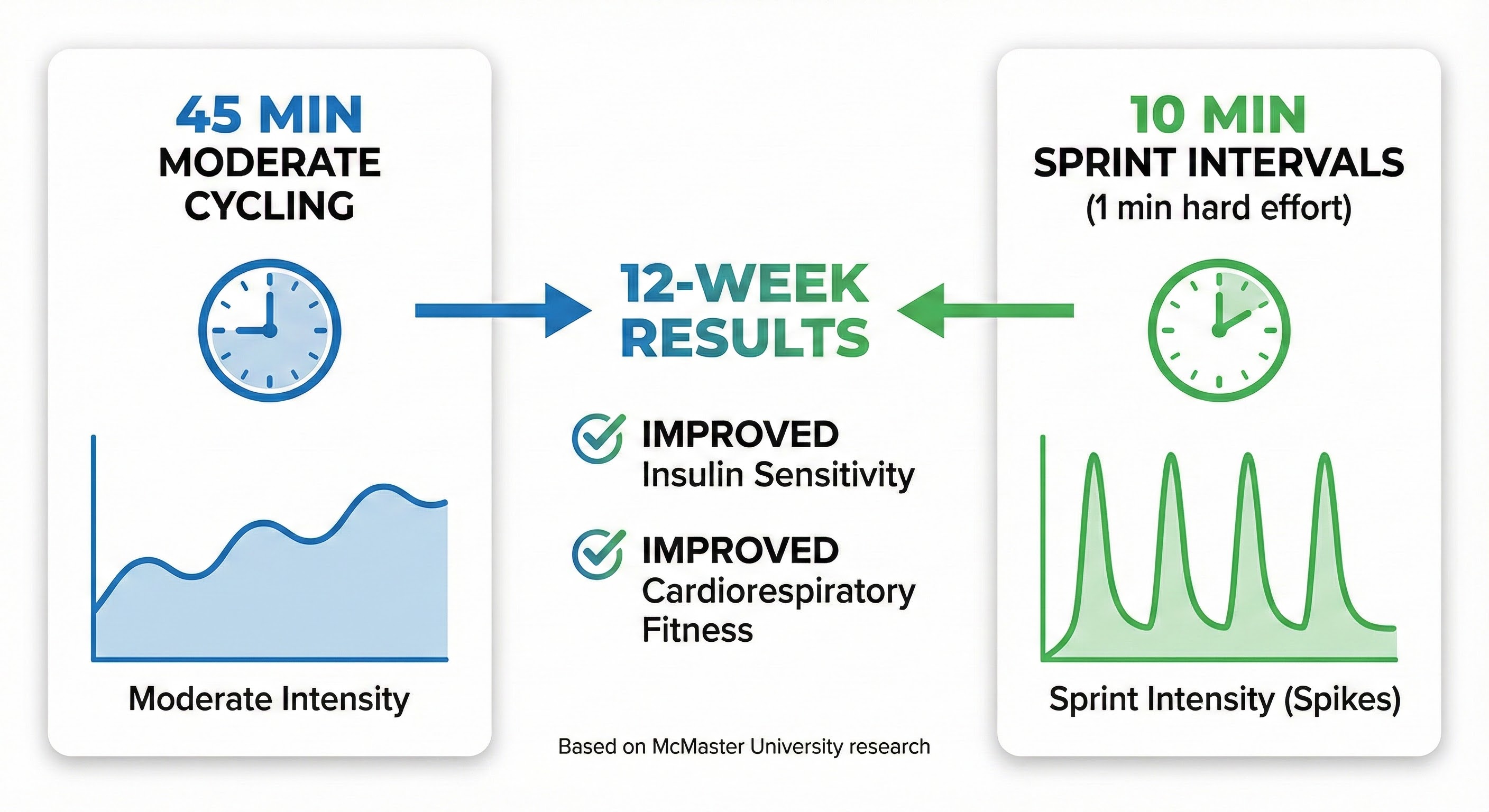
A landmark 2016 study in PLOS ONE compared three groups: one performing traditional 45-minute moderate cycling, another doing 10 minutes of sprint intervals (with only one minute of hard effort), and a sedentary control. After 12 weeks, both exercise groups showed similar improvements in insulin sensitivity and cardiorespiratory fitness. The sprint group achieved these benefits with a five-fold reduction in time commitment.
The mechanism involves metabolic stress and muscle fiber recruitment. High-intensity efforts recruit Type II muscle fibers that remain dormant during low-intensity activity. This recruitment triggers anabolic signaling cascades and mitochondrial adaptations that drive fitness improvements. Brief, intense exercise also creates an “afterburn” effect, elevated calorie expenditure lasting hours post-workout through excess post-exercise oxygen consumption (EPOC). For those interested in building aerobic capacity through different modalities, our guide on Zone 2 cardio training provides complementary strategies that pair well with high-intensity short workouts.
For holiday schedules, this research provides liberation. You don’t need an hour to maintain fitness. You need 15 minutes of strategically designed effort.
Workout Structure Principles
Effective short workouts follow specific design principles that maximize training stimulus within time constraints. The structure must address multiple fitness components, including cardiovascular conditioning, muscular endurance, and strength maintenance, without excessive rest periods that inflate total duration.
Compound movements form the foundation. Exercises like squats, push-ups, rows, and lunges engage multiple muscle groups simultaneously, providing more training stimulus per minute than isolation exercises. A single burpee, for example, involves hip extension, pushing, pulling your body from the floor, and cardiovascular demand, hitting quadriceps, glutes, chest, shoulders, and core in one movement.
Minimal transition time keeps intensity elevated. Rather than switching between equipment or moving to different stations, effective short workouts use bodyweight movements or single pieces of equipment. This reduces rest periods that accumulate when changing exercises.
Strategic exercise ordering prevents premature fatigue. Placing more technically demanding or neurologically challenging movements early ensures quality execution. Metabolic finishers or simpler movements conclude the session when fatigue is highest. This principle aligns with research on exercise snacking for metabolic health, where brief movement bursts throughout the day can complement dedicated workout sessions.
The 15-Minute Full-Body Protocol
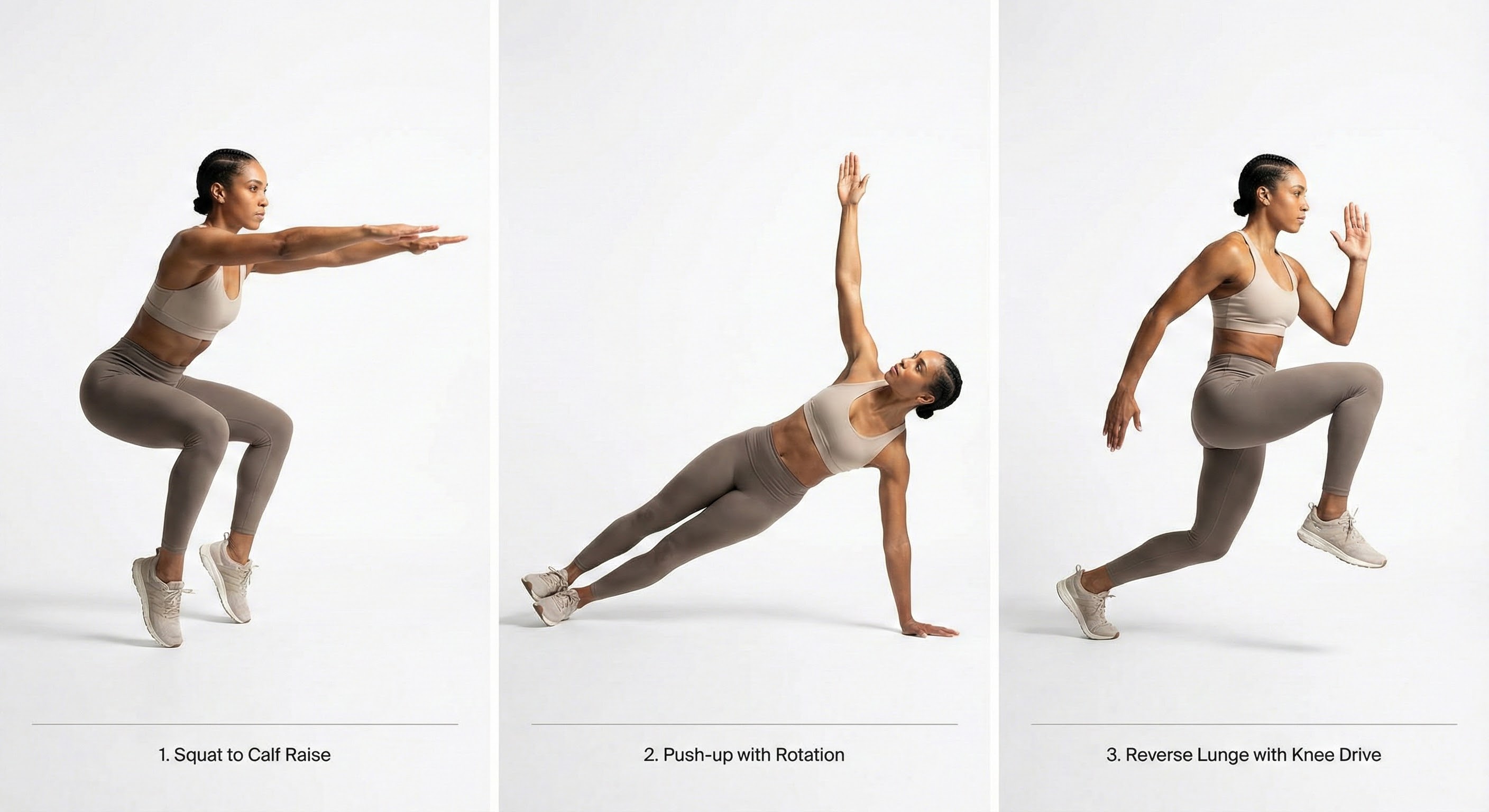
This protocol requires no equipment beyond your body and enough floor space for a push-up. Perform each exercise for 40 seconds, followed by 20 seconds of transition to the next movement. Complete three rounds with no additional rest between rounds.
Round Structure (5 minutes each):
Exercise 1: Squat to Calf Raise Stand with feet shoulder-width apart. Lower into a parallel squat, then explode upward onto your toes at the top. This combination targets quadriceps, glutes, and calves while elevating heart rate through the vertical displacement.
Exercise 2: Push-Up with Rotation Perform a standard push-up, then rotate into a side plank at the top, reaching one arm toward the ceiling. Alternate sides each rep. This adds anti-rotational core work and shoulder stability to traditional pressing.
Exercise 3: Reverse Lunge with Knee Drive Step backward into a lunge, then drive the rear knee forward and upward as you stand. This unilateral movement challenges balance and hip flexor activation while training single-leg strength.
Exercise 4: Mountain Climbers From a plank position, drive knees toward chest in alternating fashion. Maintain a neutral spine and avoid allowing hips to pike upward. This movement provides cardiovascular stress while challenging core stability.
Exercise 5: Bodyweight Row (using sturdy table or door) Position yourself under a sturdy table or hold a door frame, feet planted on the ground. Pull your chest toward your hands, squeezing shoulder blades together at the top. This horizontal pull balances the pushing movements and targets the upper back.
Three rounds of this sequence deliver 15 minutes of continuous work hitting every major muscle group and challenging the cardiovascular system.
Hotel Room Variation
Travel during holidays often means limited space and no equipment access. This variation requires only enough room to lie down and performs well in hotel rooms, guest bedrooms, or any carpeted floor space.
Exercise 1: Jump Squats (or Fast Air Squats) Explosive lower body movement that elevates heart rate immediately. If jumping isn’t appropriate for your setting, perform air squats as quickly as possible while maintaining depth.
Exercise 2: Diamond Push-Ups Hands positioned in a diamond shape beneath your chest increases triceps engagement and provides variation from standard push-ups.
Exercise 3: Skater Hops Lateral jumping from foot to foot, reaching the opposite hand toward the landing foot. This frontal plane movement challenges hip stability and provides cardiovascular stress.
Exercise 4: Plank Shoulder Taps From a push-up position, alternate tapping each shoulder with the opposite hand while maintaining a rigid torso. This anti-rotational challenge strengthens the core under dynamic conditions.
Exercise 5: Glute Bridges with March Lying face-up, bridge your hips toward the ceiling, then alternate lifting each foot while maintaining hip height. This targets posterior chain while providing active recovery.
The same 40-seconds-on, 20-seconds-transition format applies, completed for three rounds.
Strength Maintenance Protocol
When preserving strength is the priority rather than cardiovascular conditioning, adjust the protocol to emphasize load and tension over metabolic stress. This variation works well when you have access to minimal equipment like a resistance band or single pair of dumbbells.
Exercise 1: Goblet Squat or Band-Resisted Squat (45 seconds) Hold the weight at your chest or loop a band under your feet and over your shoulders. Perform controlled repetitions with a three-second lowering phase.
Exercise 2: Push-Up with Pause (45 seconds) Lower for three seconds, pause at the bottom for two seconds, then press up. This time under tension approach challenges strength without heavy loads.
Exercise 3: Single-Leg Romanian Deadlift (45 seconds each side) Balance on one leg while hinging at the hip, reaching opposite hand toward the floor. This unilateral hip hinge challenges hamstring and glute strength along with balance.
Exercise 4: Band Pull-Aparts or Prone Y Raises (45 seconds) Upper back and posterior shoulder work that counteracts holiday posture deterioration from sitting and driving.
Exercise 5: Dead Bug (45 seconds) Lying face-up with arms and legs raised, lower opposite arm and leg toward the floor while maintaining a flat lower back. This core exercise challenges anti-extension stability.
Rest 60 seconds between exercises. Complete two rounds. Total time: approximately 16 minutes including rest.

Programming Through the Holiday Season
Random workouts provide random results. Even brief sessions benefit from intentional programming that varies training stress across the holiday period.
Week 1 (High Frequency, Moderate Intensity): Perform the 15-minute full-body protocol four to five times. Focus on movement quality and establishing the routine habit despite schedule disruption.
Week 2 (Moderate Frequency, Higher Intensity): Reduce to three sessions but increase effort. Add a fourth round to each workout or reduce rest periods to 15 seconds.
Week 3 (Maintenance Mode): If travel or obligations intensify, drop to two sessions but make them count. Complete the full protocol with maximum effort.
Week 4 (Transition Back): As normal schedules resume, use the 15-minute workouts as warmups before returning to regular training or as standalone sessions on recovery days.
This periodized approach prevents both overtraining and detraining during the disrupted holiday schedule.
Recovery Considerations
Short workouts still create training stress requiring recovery. The temptation to perform 15-minute sessions daily because they seem “easy” can lead to accumulated fatigue that undermines both workout quality and holiday enjoyment.
Research from the American College of Sports Medicine indicates that even brief high-intensity sessions require 24 to 48 hours for full recovery of the neuromuscular system. Performing these workouts every day eliminates the adaptation window where fitness improvements actually occur.
Aim for four to five sessions maximum per week, with at least one full rest day. On non-training days, prioritize walking and light movement rather than additional structured exercise. Sleep quality, often compromised during holiday seasons, deserves particular attention as the primary recovery tool. For more on optimizing recovery, our guide on heart rate variability and recovery monitoring provides practical strategies for knowing when to push and when to rest.
The Bottom Line
Holiday schedules don’t require abandoning fitness goals. Research consistently demonstrates that 15-minute workouts, when properly designed, maintain cardiovascular conditioning and muscular strength during periods when longer training isn’t feasible. The protocols outlined here require no equipment, minimal space, and fit into the smallest schedule gaps while delivering genuine training stimulus.
The key is consistency over duration. Four 15-minute sessions across a holiday week provide far superior results to one heroic 60-minute effort followed by days of inactivity. Let go of the all-or-nothing mindset and embrace these brief, efficient workouts as tools for maintaining the fitness you’ve built.
Next Steps:
- Schedule three to four 15-minute workout slots in your calendar for the coming week
- Choose the protocol (full-body, hotel room, or strength maintenance) that matches your situation
- Set up a small workout space at home with enough room for push-ups
- Complete each session at high intensity, not as a casual warm-up
- Track completion to maintain accountability during schedule disruption
Sources: McMaster University research (Dr. Martin Gibala), PLOS ONE sprint interval studies (2016), Journal of Physiology metabolic adaptations research, American College of Sports Medicine recovery guidelines, exercise physiology research on Type II fiber recruitment and EPOC.