A 45-year-old male with a VO2 max of 35 mL/kg/min has the same mortality risk as someone 20 years older with a VO2 max of 45 mL/kg/min. That single data point, your maximal oxygen uptake capacity, is a more powerful predictor of how long you’ll live than smoking status, blood pressure, cholesterol, or blood sugar. Research from the Cleveland Clinic published in JAMA Network Open (2024) analyzing 30-year outcomes in over 120,000 individuals found that VO2 max was the strongest single predictor of all-cause mortality, outperforming every traditional cardiovascular risk factor.
The mortality curve is steep. Each 1-MET increase in VO2 max (roughly 3.5 mL/kg/min) reduces all-cause mortality risk by 13-15%. Moving from “below average” to “above average” for your age and sex can reduce mortality risk by 30-50%. The difference between being in the lowest fitness quartile versus the highest is a 4-5 fold difference in mortality risk over the next decade. December’s cold weather makes outdoor training challenging, but VO2 max improvement doesn’t require miles of running in freezing temperatures, it requires specific, structured interval training that you can do entirely indoors.
What VO2 Max Measures and Why It Matters
VO2 max is the maximum rate at which your body can transport and utilize oxygen during exercise, measured in milliliters of oxygen per kilogram of body weight per minute (mL/kg/min). It’s determined by three physiological systems working in coordination: your lungs’ ability to oxygenate blood (pulmonary capacity), your heart’s ability to pump that oxygenated blood (cardiac output), and your muscles’ ability to extract and use oxygen from blood (mitochondrial density and capillary networks).
When you perform intense exercise, your muscles demand oxygen to produce ATP (the energy currency cells use). Your breathing rate increases to pull more oxygen into your lungs. Your heart rate increases to pump more oxygenated blood to working muscles. At some point, even as you push harder, oxygen delivery and utilization can’t increase further, you’ve hit your VO2 max, the ceiling of your aerobic capacity.
A high VO2 max indicates that your cardiovascular and metabolic systems are highly efficient. Your heart is strong (pumps more blood per beat through higher stroke volume). Your lungs are efficient (extract more oxygen per breath). Your muscles are dense with mitochondria and have extensive capillary networks (extract and use oxygen effectively from bloodstream). Together, these adaptations allow you to perform work at higher intensities for longer durations before fatiguing.
The mortality connection isn’t mysterious. VO2 max reflects the functional capacity of your entire cardiovascular system, the system responsible for delivering oxygen and nutrients to every cell in your body and removing waste products. Higher VO2 max means your cardiovascular system has greater reserve capacity, allowing you to handle physical and physiological stressors without strain. It’s a biomarker of overall physiological robustness that researchers studying Blue Zones longevity have identified as critical for healthspan extension.
Research published in Circulation (2023) examining the relationship between VO2 max and healthspan (years lived without chronic disease, not just total years alive) found equally compelling results. Individuals maintaining VO2 max in the top quartile for their age remained functionally independent an average of 7-10 years longer than those in the lowest quartile. The benefit isn’t just living longer, it’s living healthier, maintaining independence, and avoiding the frailty and disability that often characterize the final years of life. When combined with strength training for muscle preservation and functional capacity, cardiovascular fitness creates a comprehensive longevity fitness foundation.
Testing and Baseline Assessment
True VO2 max testing requires laboratory equipment, you exercise on a treadmill or bike while wearing a mask that measures oxygen consumption and carbon dioxide production. As intensity increases, your oxygen uptake increases until it plateaus despite further increases in work rate, that plateau is your VO2 max. Few people have access to this testing, but several field tests and wearable device estimates provide reasonable proxies.
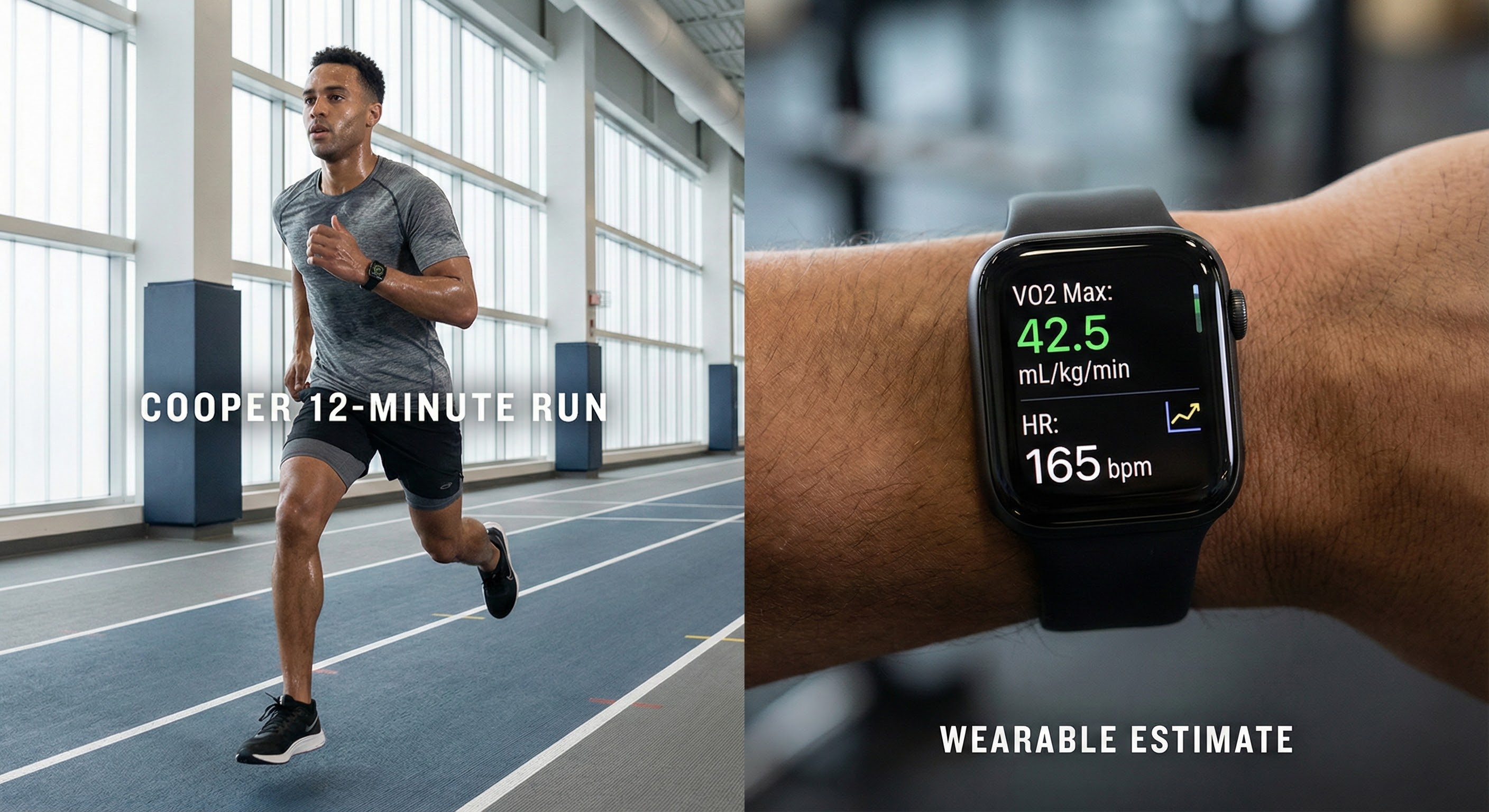
Cooper 12-Minute Run Test (outdoor or indoor track): Run as far as you can in 12 minutes at maximum sustainable effort. Your distance in meters plugs into a formula to estimate VO2 max:
- VO2 max (mL/kg/min) = (Distance in meters - 504.9) / 44.73
- Example: 2,400 meters in 12 minutes = (2400 - 504.9) / 44.73 = 42.4 mL/kg/min
1-Mile Walk Test (Rockport protocol - easier, suitable for beginners): Walk 1 mile as fast as possible, recording time and average heart rate during the final minute. Formula incorporates weight, age, time, and heart rate to estimate VO2 max. This test is less accurate than running tests but safer for individuals with lower fitness levels or joint issues.
Wearable Device Estimates: Many fitness watches (Garmin, Polar, Apple Watch, Whoop) estimate VO2 max using heart rate data during runs or bike rides. These estimates correlate reasonably well with lab-tested VO2 max (r = 0.7-0.85 depending on device and conditions) but tend to underestimate by 2-5 mL/kg/min. They’re useful for tracking relative changes over time even if the absolute number isn’t perfectly accurate.
VO2 Max Norms by Age and Sex (from American College of Sports Medicine data):
For men, the “excellent” threshold declines from 55+ mL/kg/min in the 20-29 age group to 41+ by age 60 and beyond, with “average” ranges dropping correspondingly from 38-44 in the youngest group to 25-30 for those over 60. For women, “excellent” ranges from 49+ in the 20-29 bracket to 35+ at 60 and above, with “average” values between 33-39 for the youngest and 21-25 for the oldest group. The “below average” threshold, which corresponds to elevated mortality risk, sits below 38 for men in their 20s and below 25 for men over 60; for women, the corresponding cutoffs are below 33 and below 21.
Knowing your baseline allows you to track progress and set realistic targets. In our coaching practice, we’ve seen average clients improve VO2 max by 15-25% (5-8 mL/kg/min) over 12-16 weeks of structured interval training. Elite athletes have less room for improvement (maybe 5-10%), while previously sedentary individuals can see gains of 30-40% or more.
The Physiology of VO2 Max Improvement
VO2 max improves through specific cardiovascular and muscular adaptations stimulated by training at high intensities, specifically, intensities at or near your current VO2 max. Training below this intensity (traditional “zone 2” steady-state cardio) improves aerobic endurance and metabolic efficiency but has minimal effect on VO2 max. Training at VO2 max intensity, roughly 90-95% of maximum heart rate or an exertion level where you can speak only 1-2 words at a time, triggers the adaptations that raise your ceiling.
The primary adaptation is increased stroke volume, the amount of blood your heart pumps per beat. High-intensity intervals place massive demand on your cardiovascular system, forcing your heart to pump at or near maximum capacity. Over weeks of this stimulus, your left ventricle undergoes eccentric hypertrophy, increasing chamber size and allowing more blood per contraction. A trained endurance athlete might have a stroke volume of 160-200 mL per beat compared to 70-90 mL in an untrained individual. This means the trained athlete’s heart delivers more than twice the oxygen per beat, requiring a lower heart rate for the same workload.
Peripheral adaptations are equally important. High-intensity training increases mitochondrial density in muscle cells, the organelles where oxygen is used to produce ATP. Research using muscle biopsies before and after 8 weeks of interval training shows 25-40% increases in mitochondrial enzymes and volume density. More mitochondria means your muscles can extract and use more oxygen from the blood passing through capillaries.
Capillary density also increases. Interval training stimulates angiogenesis, the formation of new capillaries surrounding muscle fibers. More capillaries mean greater surface area for oxygen exchange between blood and muscle tissue, improving oxygen extraction efficiency. Studies show 15-20% increases in muscle capillary density after 12 weeks of interval training.
The practical implication is that VO2 max improvement requires spending time at or near maximal effort. You can’t improve your ceiling by staying comfortably below it. Intervals at 90-95% max heart rate, sustained for 3-8 minutes with recovery periods, provide the intensity stimulus necessary to drive these adaptations.
The 4×4 Norwegian Protocol
The most researched and effective VO2 max training protocol is the “4×4” method developed by Norwegian exercise physiologists and popularized by Dr. Ulrik Wisløff’s research at the Norwegian University of Science and Technology. Published extensively in journals including Medicine & Science in Sports & Exercise (2024), the protocol is straightforward but demanding.
4×4 Protocol Structure:
- Warm-up: 10 minutes easy effort (60-70% max HR)
- Interval 1: 4 minutes at 90-95% max HR (very hard effort, RPE 8-9/10)
- Active recovery: 3 minutes easy (60-70% max HR)
- Interval 2: 4 minutes at 90-95% max HR
- Active recovery: 3 minutes easy
- Interval 3: 4 minutes at 90-95% max HR
- Active recovery: 3 minutes easy
- Interval 4: 4 minutes at 90-95% max HR
- Cool-down: 5 minutes easy
- Total session: ~40 minutes
The key is hitting the target intensity during work intervals. You should finish each 4-minute interval feeling like you pushed hard, breathing heavily, legs burning, unable to maintain a conversation beyond 1-2 word responses. If you finish feeling like you could have gone harder, you weren’t at 90-95% max HR and won’t get the adaptation stimulus.
Research on the 4×4 protocol shows impressive results. A 2024 meta-analysis in Sports Medicine reviewing 34 studies using the 4×4 method found an average VO2 max improvement of 7.2% (approximately 3-4 mL/kg/min) after 8 weeks of twice-weekly sessions. Some individual studies showed improvements up to 12-15% in previously untrained individuals. The protocol works equally well across modalities, running, cycling, rowing, ski erg, or swimming.
In our coaching practice training recreational athletes and general fitness clients, we’ve found that the 4×4 protocol produces consistent, measurable VO2 max improvements when performed 2× per week for 8-12 weeks. Clients who struggled to run a 10-minute mile can often run sub-8 minute miles after 12 weeks. Cyclists see wattage improvements of 15-25% at threshold intensities. The adaptations are real and substantial.

Indoor Equipment and Exercise Selection
December weather makes outdoor training challenging, but VO2 max training translates perfectly to indoor equipment. The key is choosing modalities that allow you to reach and sustain 90-95% max heart rate while maintaining proper form and minimizing injury risk.
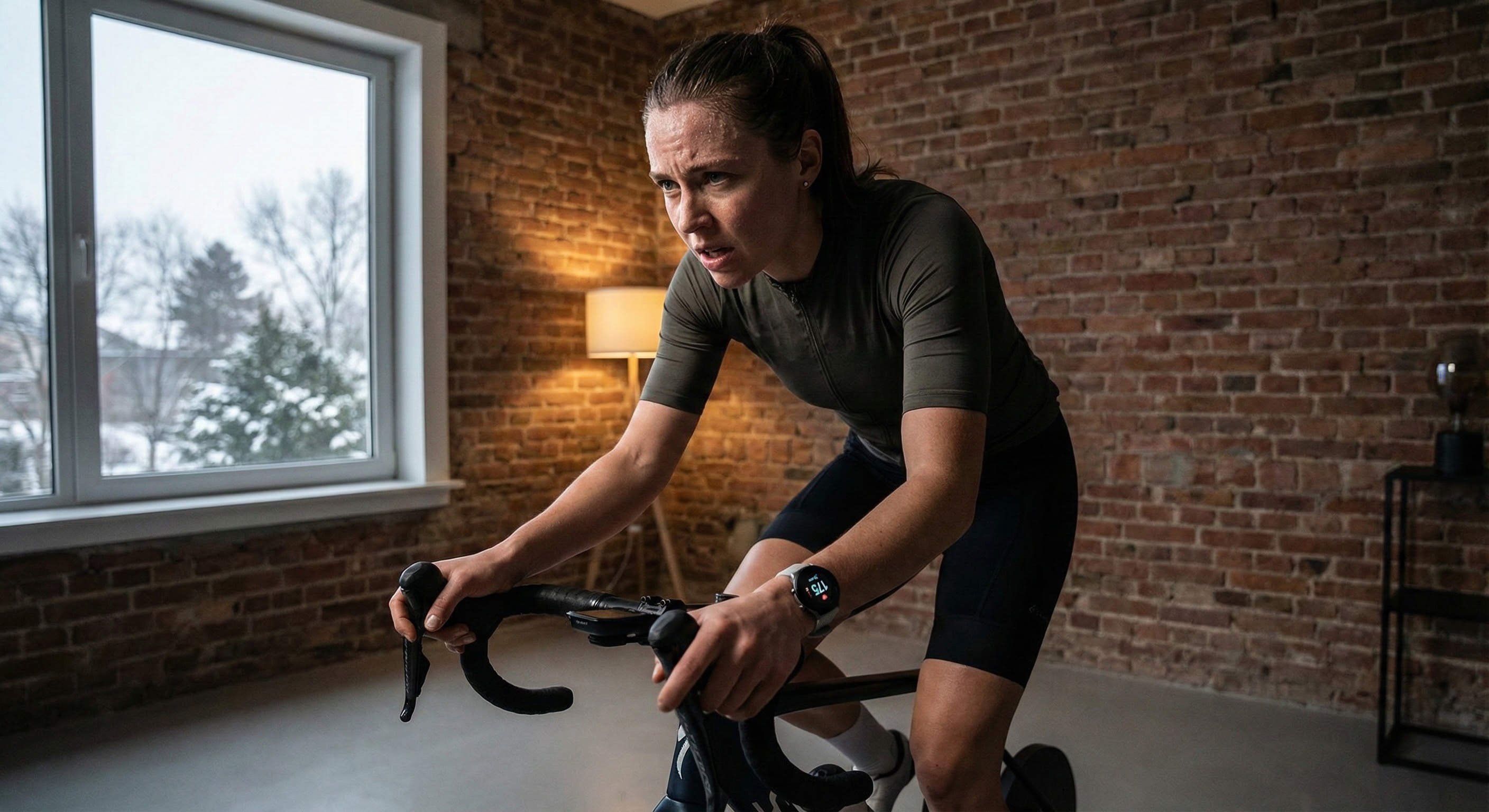
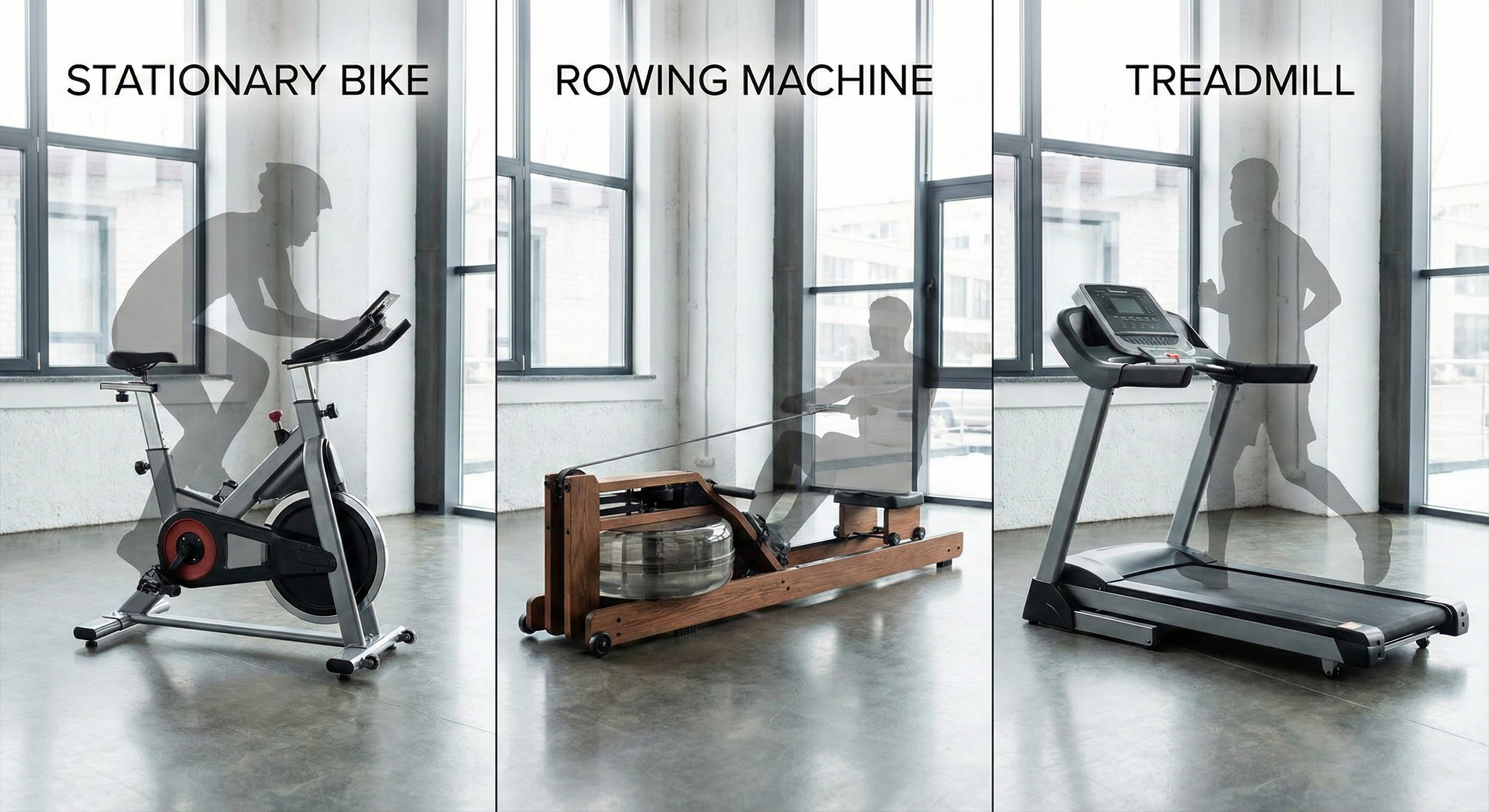
Stationary Bike or Indoor Trainer: Cycling is ideal for VO2 max intervals because it minimizes impact stress while allowing very high cardiovascular intensity. You can push to 95% max HR without the eccentric muscle damage and joint stress that running creates. Use a spin bike at a gym or a bike trainer at home (trainers that hold your outdoor bike indoors). Set resistance moderately high, you want to maintain 90-100+ RPM during intervals while feeling significant leg burn.
During the 4-minute work intervals, you should be pedaling hard enough that your breathing is labored, your legs are burning, and conversation is impossible. Heart rate should climb steadily over the 4 minutes, reaching 90-95% max in the final 2 minutes. If you have a power meter, target 90-100% of your FTP (functional threshold power) during intervals.
Treadmill: Running on a treadmill allows precise speed and incline control for intervals. Set the treadmill to a pace you can sustain for 4 minutes at maximum effort. For most people, this is slightly slower than mile race pace, hard, but sustainable for the 4-minute duration. A 1-2% incline better simulates outdoor running biomechanics.
Warning: Running intervals are higher injury risk than cycling, particularly for individuals with joint issues, previous injuries, or body weight above 200 lbs. The eccentric loading during running creates muscle damage that accumulates across sessions. If you experience joint pain, shin splints, or sharp pains during running intervals, switch to cycling or rowing.
Rowing Machine (Erg): Rowing provides full-body cardiovascular stimulus with minimal impact. The 4-minute intervals should be performed at a stroke rate of 26-32 strokes per minute with hard leg drive and powerful finishes. Target split times approximately 10-15 seconds faster than your comfortable steady-state pace. For example, if you can row comfortably at a 2:10/500m split, aim for 1:55-2:00 splits during the 4-minute intervals.
Rowing engages more muscle mass than cycling (legs, core, back, arms vs. primarily legs), which can make it harder to sustain intervals without upper body fatigue limiting you before cardiovascular fatigue. Practice proper rowing technique to avoid this, leg drive should provide 60% of power, core transfer 20%, arms finish 20%.
Ski Erg or Assault Bike (Advanced): These are brutal but effective for VO2 max work. The ski erg mimics Nordic skiing, using primarily upper body and core. The assault bike (fan bike) increases resistance as you pedal harder, making it self-regulating for intervals, you can’t “cheat” by reducing resistance. Both require significant fitness to perform 4-minute intervals effectively. We recommend these for athletes or individuals with cycling/running experience looking for variety.
Programming and Progression
VO2 max training is demanding on your cardiovascular and muscular systems. You cannot and should not do high-intensity intervals daily. Recovery between sessions is when adaptations occur, your body repairs microdamage, builds new capillaries, increases mitochondrial density. Training before recovery is complete prevents adaptations and increases injury risk.
Recommended Frequency:
- Beginners (VO2 max under 35 mL/kg/min or new to interval training): 1× per week for 4 weeks, then 2× per week
- Intermediate (VO2 max 35-50 mL/kg/min): 2× per week consistently
- Advanced (VO2 max 50+ mL/kg/min or competitive athletes): 2× per week + 1 additional mixed intensity session
Two 4×4 sessions per week provides optimal stimulus-to-recovery ratio for most people. More than this, and recovery becomes difficult; fatigue accumulates, increasing injury risk and reducing interval quality. Less than this, and adaptations are slower.
Weekly Schedule Example:
- Monday: 4×4 intervals (cycling)
- Tuesday: Easy zone 2 (30-45 minutes low intensity for active recovery)
- Wednesday: Strength training or rest
- Thursday: 4×4 intervals (running or rowing)
- Friday: Easy zone 2 or rest
- Saturday: Longer zone 2 (60-90 minutes moderate intensity)
- Sunday: Rest or light activity
The combination of high-intensity VO2 max work and lower-intensity zone 2 training for metabolic efficiency creates a comprehensive cardiovascular training stimulus that improves both your aerobic ceiling and your aerobic base.
Progression Protocol (12-Week Plan):
During weeks 1 through 4, the base building phase, perform one 4×4 session per week. Focus on completing all four intervals at target heart rate even if your pace or power output is modest. Expect significant muscle soreness and fatigue initially as your body adapts to the intensity demands.
In weeks 5 through 8, the adaptation phase, increase to two 4×4 sessions per week. You should notice that the same heart rate feels slightly easier to sustain, a sign that your VO2 max is improving. Track your pace, power, or split times to quantify the improvement objectively.
Weeks 9 through 12 represent the performance phase. Continue with two sessions per week but push your pace or power slightly harder to maintain the 90-95% max heart rate target. Retest your VO2 max at week 12 to measure your overall improvement.
Expected Improvements:
The magnitude of improvement depends on your starting fitness level and training adherence. Previously sedentary individuals can expect gains of 15-30% (roughly 6-12 mL/kg/min). Recreationally active individuals typically see improvements of 10-20% (4-8 mL/kg/min). Trained athletes, who already have high baselines, may improve 5-10% (2-4 mL/kg/min).
Improvements come faster initially, then plateau. After the initial 12-week block, maintain with 1-2 sessions weekly to preserve gains. You can cycle through 12-week focused blocks 2-3 times per year, with maintenance phases between.
Monitoring Intensity and Recovery
The effectiveness of VO2 max training depends entirely on reaching the correct intensity. Too easy, and you don’t stimulate adaptations. Too hard (above 95-98% max HR), and you accumulate excessive fatigue that impairs recovery.
Heart Rate Monitoring: Calculate your maximum heart rate using: 220 - age (rough estimate) or perform a max HR test (all-out 3-minute effort, take highest HR achieved). Target 90-95% of this number during the 4-minute intervals.
Example: Age 40, estimated max HR = 180 bpm
- Target interval HR: 162-171 bpm (90-95% of 180)
- Recovery HR should drop to 108-126 bpm (60-70% of 180) during 3-minute active recovery
Heart rate lags intensity, it takes 60-90 seconds for HR to climb to reflect the work you’re doing. This means you might start an interval at 70% max HR even though you’re pushing hard; by minute 3-4, your HR will have climbed to 90-95% if intensity is correct.
Rate of Perceived Exertion (RPE): On a 1-10 scale, work intervals should feel like 8-9/10, very hard, unsustainable beyond 5-6 minutes. If you finish a 4-minute interval at RPE 6-7/10, you went too easy. If you can barely complete 2 minutes, you went too hard. Dial in the intensity through trial and error over 2-3 sessions.
Recovery Indicators: High-quality intervals require full recovery between sessions. Monitor these signs:
- Resting heart rate: If morning resting HR is 5+ bpm higher than baseline, you’re under-recovered
- Heart rate variability (HRV): If HRV drops 20% or more below baseline, skip the interval session and do easy aerobic work instead
- Performance: If you can’t hit target intensity (HR, pace, power) despite hard effort, you’re fatigued, cut session short or make it an easy day
- Sleep quality: Poor sleep (under 6 hours or highly disrupted) impairs recovery and increases injury risk; don’t do hard intervals when under-slept
In our coaching practice, we’ve observed that the most common mistake is training through inadequate recovery. Athletes feel they should “push through,” but interval quality matters more than quantity. One high-quality 4×4 session per week beats three mediocre, fatigued sessions.
The Bottom Line
VO2 max is the strongest single predictor of all-cause mortality, outperforming traditional cardiovascular risk factors. Each 3.5 mL/kg/min improvement reduces mortality risk by 13-15%, with total reductions of 30-50% possible by moving from below-average to above-average fitness for your age and sex. December’s indoor training conditions don’t prevent VO2 max improvement, the adaptation requires high-intensity intervals, which work equally well on stationary bikes, treadmills, rowing machines, and other indoor equipment.
The research-validated 4×4 Norwegian protocol (4 intervals of 4 minutes at 90-95% max heart rate, with 3 minutes active recovery between) produces VO2 max improvements of 7-15% when performed 2× weekly for 8-12 weeks. Choose equipment that allows you to sustain target intensity with minimal injury risk, cycling is lowest impact, running is highest impact, rowing provides full-body stimulus.
Recovery between sessions is when adaptations occur. Train 2× weekly maximum for most individuals, with easy aerobic work and strength training filling the remaining days. Monitor heart rate, RPE, resting HR, and HRV to ensure adequate recovery. One high-quality interval session beats multiple fatigued sessions where you can’t reach target intensity.
Next Steps:
- Test baseline VO2 max (Cooper 12-minute run, wearable estimate, or lab test if available)
- Calculate max heart rate (220 - age or max HR test)
- Choose indoor equipment (bike, treadmill, rower)
- Perform one 4×4 session this week, targeting 90-95% max HR during 4-minute intervals
- Schedule second session 3-4 days later, with easy recovery between
- Retest VO2 max after 12 weeks to quantify improvement
Sources: JAMA Network Open VO2 max and mortality research (2024), Circulation VO2 max and healthspan study (2023), American College of Sports Medicine VO2 max norms, Medicine & Science in Sports & Exercise 4×4 protocol research (2024), Sports Medicine meta-analysis on interval training (2024), Dr. Ulrik Wisløff Norwegian University research, Journal of Applied Physiology mitochondrial adaptation studies, European Journal of Applied Physiology capillary density research.