
You can touch your toes when you reach down slowly, but your lower back screams when you pick up a bag of groceries from the floor. You can stretch your shoulder overhead when lying down, but raising your arm to grab something from a high shelf feels restricted and unstable. You pass every flexibility test at the physical therapist’s office, yet your body moves like it’s held together with rusty hinges. This disconnect between passive range of motion and functional movement is why flexibility training alone isn’t solving your movement problems. What you’re missing is mobility.
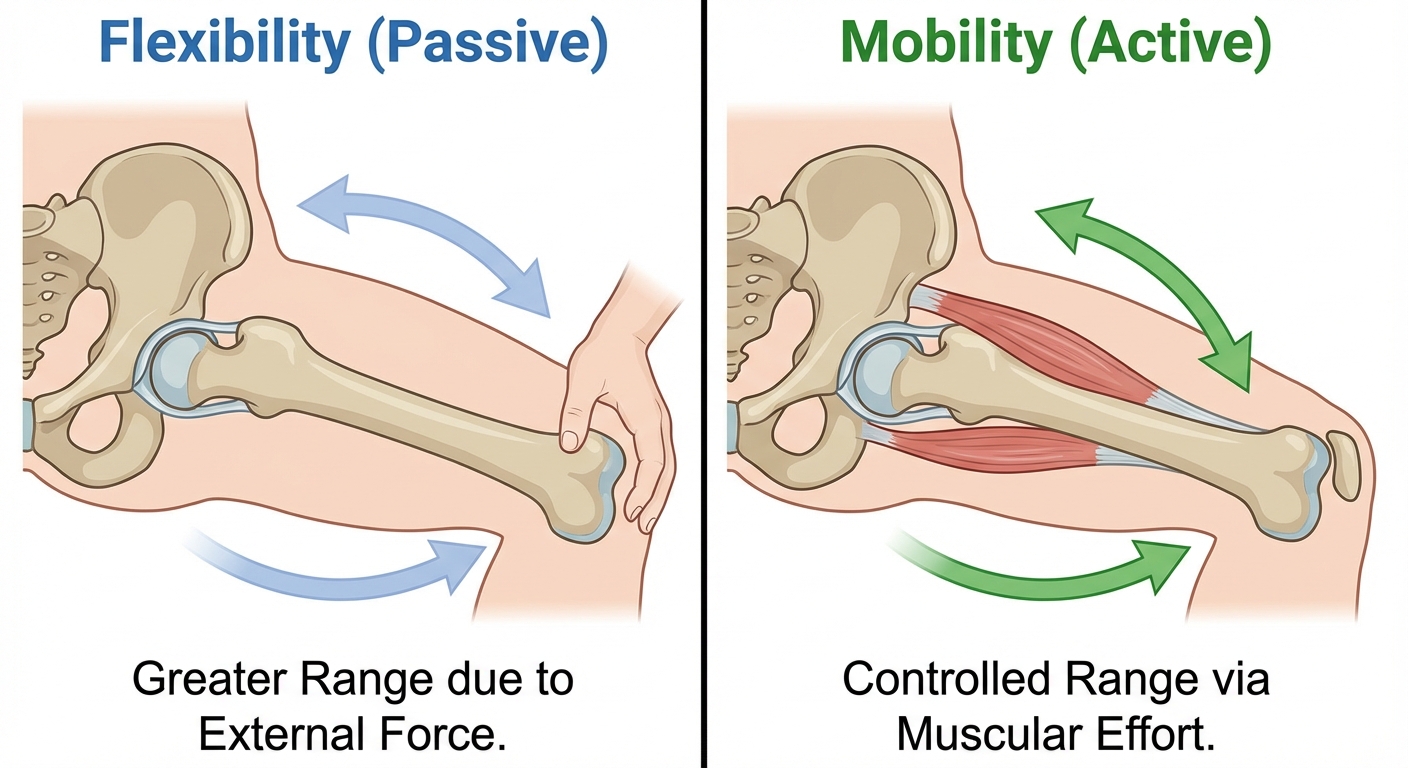
Flexibility and mobility are related but distinct qualities. Flexibility is passive: it measures how far a joint can be moved by external force, like a physical therapist pushing your leg toward your chest or gravity pulling you into a forward fold. Mobility is active: it measures how far you can move a joint using your own muscular control, under load, while maintaining stability. A ballet dancer might have extreme flexibility but poor mobility in certain ranges because they’ve never built strength at their end ranges. A powerlifter might have moderate flexibility but excellent mobility within the ranges they train because they’ve developed control under load.
The distinction matters because injuries typically occur when you enter a range of motion you can reach but can’t control. Your hamstring tears not because it was too tight, but because it was pulled into a range where it had no strength to protect itself. Your shoulder impinges not because it lacks flexibility, but because the stabilizing muscles can’t control the joint through its full arc of motion. Improving flexibility without simultaneously building strength and control at those new ranges creates a dangerous gap between where your body can go and where it’s safe to go.
Mobility training closes this gap by systematically developing both range of motion and the neuromuscular control to use that range safely under load. It’s the missing link between static stretching and functional strength, the quality that determines whether your body moves well through real-world demands or breaks down under them.
The Flexibility-Mobility Distinction: Why It Matters
Understanding the technical difference between flexibility and mobility helps explain why your stretching routine might not be translating to better movement. Flexibility is a tissue quality: it reflects the length and extensibility of muscles, tendons, and connective tissue around a joint. You can improve flexibility through sustained stretching that mechanically lengthens these tissues. Mobility is a neurological and muscular quality: it reflects your nervous system’s ability to generate force and maintain control throughout a joint’s range of motion.
Consider your hip as an example. You might have enough hamstring and hip flexor flexibility to achieve a deep squat position when someone assists you into it. But when you try to squat on your own, especially with weight, you can’t reach that same depth because your muscles lack the strength to pull you into that position and stabilize you there. The tissue length exists, but the motor control doesn’t. This is the flexibility-mobility gap, and it’s where injuries happen.
The nervous system plays a crucial gatekeeper role in determining usable range of motion. Your brain constantly monitors joint position, muscle tension, and stability. When it detects that you’re entering a range where you lack control, it triggers protective muscle tension that limits further movement. This is why you might feel “tight” in areas where stretching shows no improvement: the restriction isn’t in the tissue, it’s in the nervous system’s perception of safety. Building strength and control at end ranges teaches your nervous system that those positions are safe, and the protective tension releases.
This explains why some people stretch religiously for years without significant improvement. They’re addressing tissue length, but the actual limitation is neuromuscular control. Once they start training strength at end ranges, their usable range of motion often improves dramatically within weeks, not because the tissue lengthened, but because the nervous system stopped restricting access to ranges that were always anatomically available.
Controlled Articular Rotations: The Foundation of Mobility Training
The most effective approach to mobility training comes from the Functional Range Conditioning (FRC) system, developed by Dr. Andreo Spina. The foundational practice is Controlled Articular Rotations, or CARs: slow, controlled circular movements that take each joint through its complete range of motion while generating maximum muscular tension. CARs differ from casual joint circles or dynamic stretching in their intensity and intent. You’re not loosely swinging your arm in circles; you’re using maximum muscular effort to move the joint as far as possible in every direction while keeping the rest of your body completely still.
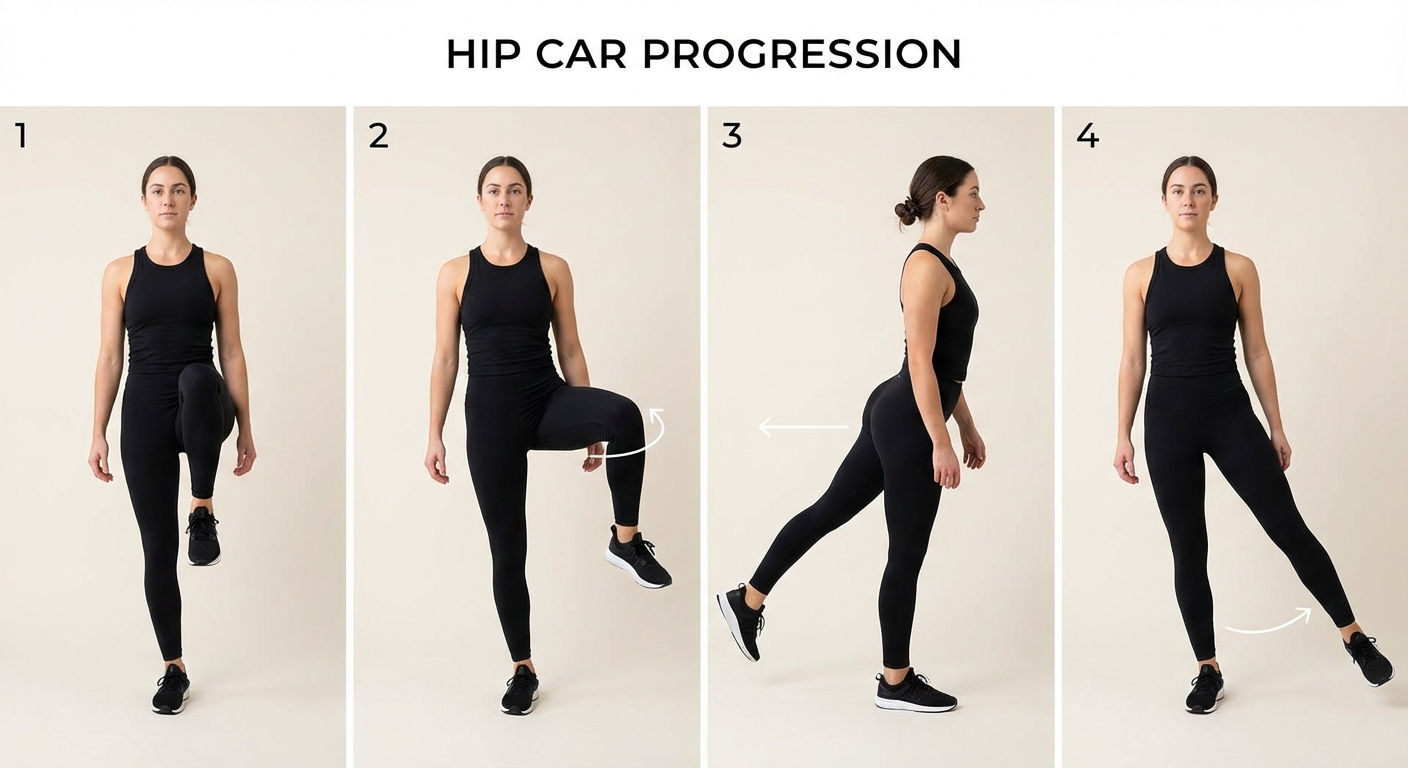
The protocol is simple but demanding. For hip CARs, you stand on one leg, lift the working knee toward your chest as high as possible while keeping your torso upright and pelvis stable, then rotate the knee outward and continue the circle by extending the leg behind you as far as possible before rotating back to the starting position. The entire revolution should take 20-30 seconds, with constant maximum effort to push into your end ranges at every point of the circle. You then reverse direction. The key is irradiation: you’re generating tension throughout your entire body to create stability while the working joint moves through its maximum range.
This approach builds mobility through several mechanisms. First, the slow controlled movement at end ranges creates isometric contractions in lengthened positions, which is the most effective stimulus for building strength where you need it most. Second, the maximum effort signals to your nervous system that you can control these positions, gradually expanding the ranges it perceives as safe. Third, the movement under tension produces the kind of mechanical loading that maintains cartilage health and joint fluid production. Unlike passive stretching, CARs are training, not just tissue manipulation.
CARs should be performed daily for every major joint: neck, shoulders, spine (thoracic), hips, and ankles. Each rotation takes about 30 seconds per direction, meaning a full-body CARs routine takes 10-15 minutes. This daily practice serves as both assessment and training. You’ll notice which joints feel restricted on particular days, where your control is weakest, and how your usable range of motion gradually expands over weeks of consistent practice.
Priority Joints for Most People
While every joint benefits from mobility work, modern life creates predictable restriction patterns that make certain joints higher priorities. The hips, thoracic spine, and shoulders bear the brunt of sedentary postures and deserve focused attention in any mobility program. Addressing these areas first produces the largest functional improvements for most people.
Hip mobility affects nearly every lower body movement and significantly influences lower back health. Sitting for hours daily keeps the hips flexed, and the muscles adapt by shortening in that position. But beyond the tissue changes, the nervous system loses its map of hip movement possibilities. Many people can’t generate internal rotation at the hip at all, they’ve simply never needed to access that range, and the neural pathways have atrophied. Hip CARs, combined with exercises like 90/90 transitions and controlled hip airplanes, systematically rebuild the neural connections and muscular strength throughout the hip’s full range. The payoff is better squat depth, reduced lower back compensation, and protection against hip impingement and labral issues.
The thoracic spine (mid-back) commonly stiffens from sustained seated postures, particularly the rotation and extension capacities that allow you to twist and arch. When thoracic mobility is limited, the lumbar spine (lower back) and shoulders compensate by moving more than they should, leading to the back pain and shoulder problems that seem to come from nowhere. Thoracic CARs, cat-cow variations emphasizing segmental movement, and seated rotations with hands behind head all address this area. Unlike passive flexibility work, which has its place for stretching tight musculature, thoracic mobility requires active movement that trains both range and control simultaneously.
Shoulder mobility is critical for overhead activities and upper body health. The shoulder is inherently unstable, a ball-and-socket joint where the ball is much larger than the socket, relying on muscular control rather than bony architecture for stability. When mobility deficits exist, the shoulder compensates with impingement patterns that grind down tissues over time. Shoulder CARs, combined with exercises like prone lift-offs and weighted shoulder flexion stretches, build the control that keeps the shoulder healthy through its enormous range of motion.
Programming Mobility Training
Mobility work can be integrated into your training in several ways, and the optimal approach depends on your goals, time availability, and current limitations. The most effective programs combine daily maintenance work with focused training sessions that target specific restrictions.
Daily CARs practice is the foundation and non-negotiable element. Ten to fifteen minutes each morning moving every major joint through controlled rotations maintains existing mobility, provides movement assessment data (you’ll notice restrictions as they develop), and primes the nervous system for the day’s activities. This routine works well immediately after waking, serving as a movement-based wake-up ritual that’s more functional than passive stretching. Many people find that morning CARs reduce the stiffness and “creakiness” that otherwise lasts until midday.
Pre-workout mobility preparation should focus on the specific joints you’ll be loading in that session. Before lower body training, spend 5 minutes on hip CARs, ankle mobility work, and dynamic movements that rehearse the patterns you’ll train under load. Before upper body work, shoulder CARs, thoracic rotations, and exercises like band pull-aparts prepare the relevant joints. This isn’t traditional static stretching, which can temporarily reduce power output; it’s active mobility work that enhances range of motion while activating the stabilizing muscles you’ll need during training.
Dedicated mobility sessions of 20-30 minutes, two to three times weekly, allow deeper work on specific limitations. These sessions might include progressive angular isometric loading (PAILs/RAILs), a technique where you hold an end-range stretch position and then contract maximally into and away from the stretch to build strength at that range. They might include longer holds in challenging positions with light load, like deep squat sits or hanging from a bar. The goal is expanding range of motion while simultaneously building the strength to control it.
Integration with strength training produces the best results. For athletes over 50, who often experience accelerated mobility loss, incorporating mobility work into warm-ups and between sets of strength exercises helps maintain function without requiring additional training time. Full-range strength exercises like deep squats, Romanian deadlifts, and overhead presses are themselves mobility training when performed with control through the complete range of motion. The loading under stretch builds strength at end ranges more effectively than unloaded mobility drills alone.
The 15-Minute Daily Mobility Routine
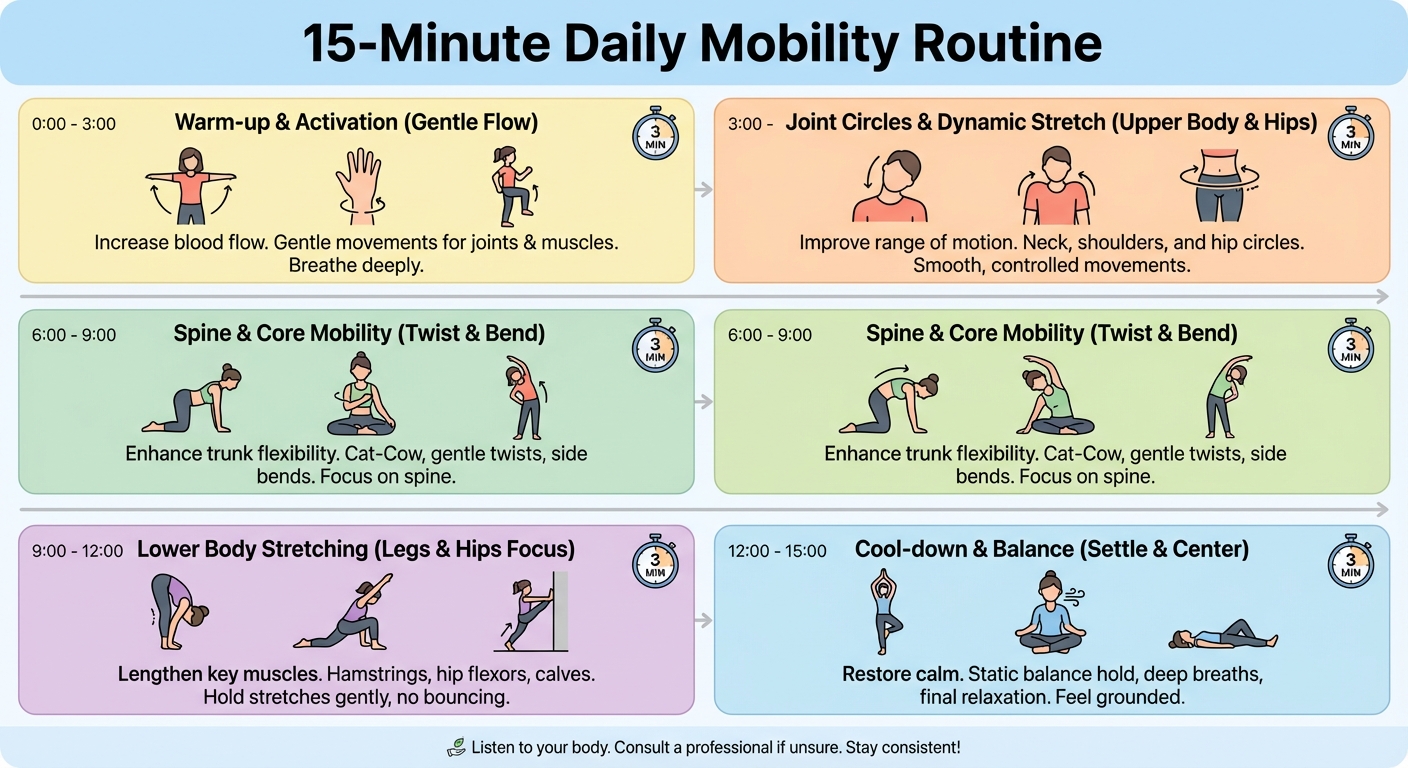
For those new to mobility training, here’s a structured daily routine that covers the major joints and can be performed in 15 minutes. This sequence works as a morning practice or pre-workout preparation.
Neck CARs (2 minutes): Stand tall, tuck chin slightly, and slowly rotate your head in the largest circle possible, leading with your nose. Move through every position you can access: looking up, to the side, down, and around. Take 20-30 seconds per rotation. Complete 2 rotations in each direction.
Shoulder CARs (3 minutes): Stand with arms at your sides. Raise one arm forward and up overhead, rotate to raise it out to the side, then continue behind you as far as possible before circling back to start. Generate maximum tension, trying to push farther at every point. Take 30 seconds per rotation, 2 in each direction, both arms. That’s about 1.5 minutes per shoulder.
Thoracic Spine Rotations (2 minutes): Sit cross-legged or in a chair. Place hands behind your head. Keeping your pelvis and lower back still, rotate your upper back and ribcage as far as possible to the right, then to the left. Move slowly and try to access more range at each end point. Complete 10 controlled rotations to each side.
Hip CARs (4 minutes): Stand on one leg (hold a wall for balance if needed). Lift your working knee toward your chest as high as possible while keeping your torso completely still, not leaning back or tilting your pelvis. Rotate the knee outward, then extend the leg behind you, then sweep it back to start. Take 30 seconds per rotation. Complete 2 rotations in each direction for each hip. That’s about 2 minutes per hip.
Ankle CARs (2 minutes): Seated or standing on one leg, point your toes and draw the largest circles possible with your foot, moving through maximum plantarflexion, inversion, dorsiflexion, and eversion. Take 15-20 seconds per circle, 2-3 circles in each direction for each ankle.
Deep Squat Hold (2 minutes): Sink into the deepest squat you can access with heels down (or on a small wedge if needed). Hold the position, breathing deeply and trying to relax into it. Shift your weight gently side to side to explore the position. This single exercise maintains hip, knee, and ankle mobility while providing the loaded stretch stimulus that drives adaptation.
Why Mobility Matters More as You Age
Joint health degrades predictably with age through mechanisms that mobility training directly addresses. Cartilage, the smooth tissue covering bone ends in joints, has no blood supply; it receives nutrients through compression and decompression during movement. When joints move through full ranges regularly, cartilage gets fed. When range of motion narrows (as happens with sedentary aging), portions of cartilage that never experience loading begin to break down. This is why the grandparent who stayed active into their 80s moves better than the sedentary 60-year-old: consistent full-range movement maintained cartilage health.
Synovial fluid, the lubricant inside joints, is produced in response to movement. The more you move a joint, the more fluid it produces. The less you move it, the thicker and scarcer the fluid becomes. This creates a vicious cycle where stiff joints become stiffer through disuse. Daily mobility work interrupts this cycle by ensuring adequate synovial fluid production regardless of other activity levels.
Neuromuscular control also declines with age, but it responds remarkably well to training. The nervous system loses connections to movement patterns that aren’t practiced, which is why elderly adults who stop reaching overhead eventually lose the ability to reach overhead. The range was always anatomically available; the neural pathways atrophied from disuse. Mobility training preserves and rebuilds these neural connections, maintaining the movement vocabulary that keeps you functional and independent.
The contrast with flexibility work is important here. Passive stretching can maintain tissue length, but it doesn’t provide the loaded stimulus that maintains cartilage or the neuromuscular training that maintains control. A comprehensive flexibility routine certainly has value, particularly for addressing tight muscles that restrict movement. But mobility training provides something additional: the active, loaded movement that keeps joints healthy and the nervous system connected to its full movement capacity. For aging well, both matter, but mobility may matter more.
The Bottom Line
Mobility is the quality that lets you use your range of motion under load, safely and repeatedly. It’s distinct from flexibility, which measures passive range without requiring control or strength. The gap between what you can reach passively and what you can control actively is where injuries occur. Mobility training closes this gap by systematically building strength and neuromuscular control throughout your joints’ full range of motion.
The foundation of mobility training is Controlled Articular Rotations (CARs), slow, maximally controlled circular movements through each joint’s complete range. Daily CARs practice maintains existing mobility, provides ongoing assessment of joint health, and gradually expands usable range by teaching your nervous system that end-range positions are safe. Priority areas for most people are hips, thoracic spine, and shoulders, the joints most affected by modern sedentary life.
Daily Protocol:
- Morning CARs for all major joints (10-15 minutes)
- Pre-workout mobility specific to the session’s demands (5 minutes)
- Full-range strength exercises as mobility training under load
- Optional: dedicated mobility sessions 2-3× weekly for specific limitations
Next Steps:
- Start with the 15-minute daily routine outlined above
- Perform morning CARs before any other activity for one week
- Notice which joints feel most restricted, these are your priorities
- Add specific mobility work for your most limited joints
- Integrate mobility into warm-ups rather than passive stretching
Sources: Functional Range Conditioning (Dr. Andreo Spina), joint health and cartilage nutrition research (British Journal of Sports Medicine), neuromuscular control and aging (Journal of Strength and Conditioning Research), mobility vs flexibility distinctions (Sports Medicine 2024).