If you could choose one number to predict how long you’ll live and how well you’ll age, what would it be? Not your cholesterol level. Not your blood pressure. Not your body weight or fasting glucose. The single strongest predictor of all-cause mortality is VO2 max, your body’s maximum capacity to transport and utilize oxygen during intense exercise.
The data supporting this claim is remarkable. A landmark study from the Cooper Clinic following over 66,000 individuals found that people in the highest quartile for VO2 max had 50% lower mortality risk than those in the lowest quartile, an effect size larger than almost any pharmaceutical intervention, dietary change, or other lifestyle modification. The Veterans Exercise Testing Study, analyzing 122,000 patients, found that each 1-MET increase in exercise capacity (roughly 3.5 ml/kg/min of VO2 max) was associated with 12% reduction in mortality. Mayo Clinic researchers found that VO2 max predicted death better than smoking status, diabetes, or hypertension. This isn’t one outlier study; it’s a consistent finding across decades of cardiovascular research.
The implication is profound: improving your cardiovascular fitness may be the single highest-return investment you can make in your longevity. And unlike genetic factors or irreversible health conditions, VO2 max is highly trainable at any age. People in their 60s, 70s, and 80s can significantly improve their VO2 max with appropriate training. This article covers what VO2 max actually measures, why it predicts mortality so powerfully, and the specific training protocols that improve it most effectively.
What VO2 Max Measures
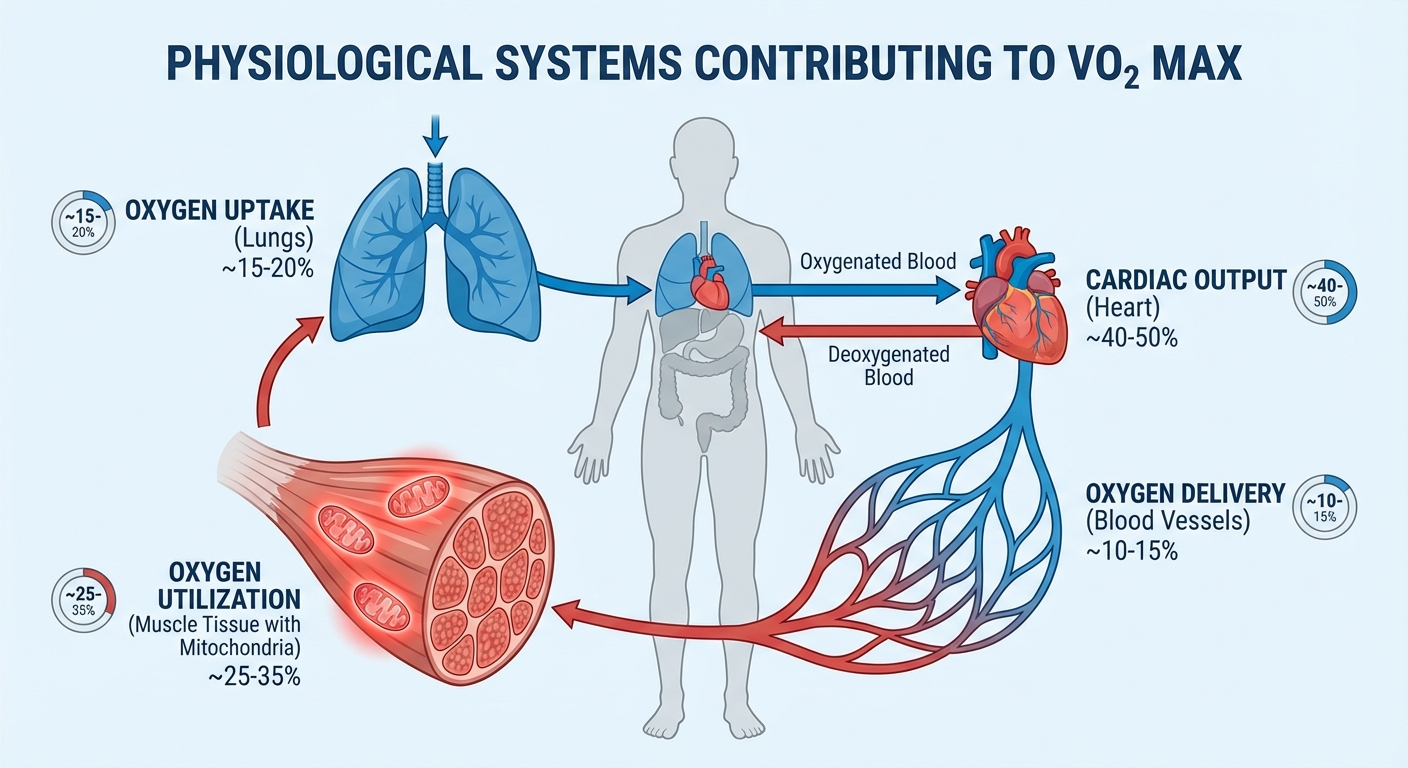
VO2 max represents the maximum volume of oxygen your body can utilize during intense exercise, expressed in milliliters of oxygen per kilogram of body weight per minute (ml/kg/min). The measurement captures how efficiently your entire oxygen delivery and utilization system functions when pushed to its limits.
Several interconnected physiological systems determine your VO2 max. Cardiac output, the volume of blood your heart pumps per minute, depends on both stroke volume (blood pumped per heartbeat) and heart rate. A stronger heart with larger ventricular capacity pumps more blood with each beat, delivering more oxygen to working muscles. Pulmonary function, your lungs’ ability to oxygenate blood and remove carbon dioxide, sets an upper limit on how much oxygen can enter your bloodstream. Vascular function, including capillary density in muscles and the health of arteries and veins, determines how effectively oxygenated blood reaches muscle tissue. Finally, mitochondrial density and function within muscle cells determines how efficiently oxygen is used to produce ATP, the energy currency your cells require for work.
When any of these systems improves, VO2 max rises. Training that challenges cardiovascular capacity triggers adaptations across all these systems: the heart grows stronger, capillary networks become denser, mitochondria multiply and become more efficient. The body responds to the repeated stress of high-intensity exercise by upgrading its oxygen delivery infrastructure.
For context on typical values, sedentary men average 35-40 ml/kg/min while sedentary women average 27-32 ml/kg/min. Active individuals with good fitness typically reach 45-52 ml/kg/min for men and 38-44 ml/kg/min for women. Elite endurance athletes can exceed 70-85 ml/kg/min, representing the upper limits of human cardiovascular capacity. Values naturally decline with age, approximately 10% per decade after 30 in sedentary individuals, but training can slow, halt, or even reverse this decline.
Why VO2 Max Predicts Longevity
The relationship between VO2 max and mortality isn’t merely correlation; the physiological mechanisms linking cardiovascular fitness to longevity are well understood. High VO2 max reflects the health of multiple organ systems that determine how well you age and resist disease.
Cardiovascular health improves dramatically with higher VO2 max. The training that builds VO2 max strengthens the heart muscle, improves its pumping efficiency, and enhances the health of blood vessels throughout the body. Blood pressure decreases as vessels become more compliant and responsive. Atherosclerosis progression slows as endothelial function improves. The combined effect is substantially reduced risk of heart attack, stroke, heart failure, and cardiovascular death, which collectively represent the leading cause of mortality in developed countries.
Metabolic function correlates strongly with cardiovascular fitness. People with higher VO2 max demonstrate better insulin sensitivity, more effective glucose regulation, and overall superior metabolic health. Muscles adapted to high oxygen utilization take up glucose more efficiently, cells respond more appropriately to insulin, and the body manages energy substrates more effectively. This translates to dramatically reduced risk of type 2 diabetes, metabolic syndrome, and the cascade of health problems these conditions trigger.
Mitochondrial function improves with the training that builds VO2 max. The cellular power plants responsible for energy production multiply and become more efficient when challenged by high-intensity exercise. Since mitochondrial dysfunction underlies many aging-related diseases, from neurodegeneration to heart failure to frailty, maintaining healthy mitochondria through exercise may be one mechanism through which cardiovascular fitness extends healthspan.
Functional capacity, the ability to perform activities of daily living without fatigue or limitation, depends heavily on cardiovascular fitness. High VO2 max means walking up stairs, carrying groceries, playing with grandchildren, and navigating daily life require a smaller fraction of your maximum capacity. You have substantial reserve for any physical demand. As people age, this reserve determines whether they maintain independence or require assistance. Higher VO2 max preserves functional independence for decades longer than low fitness, extending not just lifespan but the period of vigorous, active life.
The Norwegian 4x4 Protocol
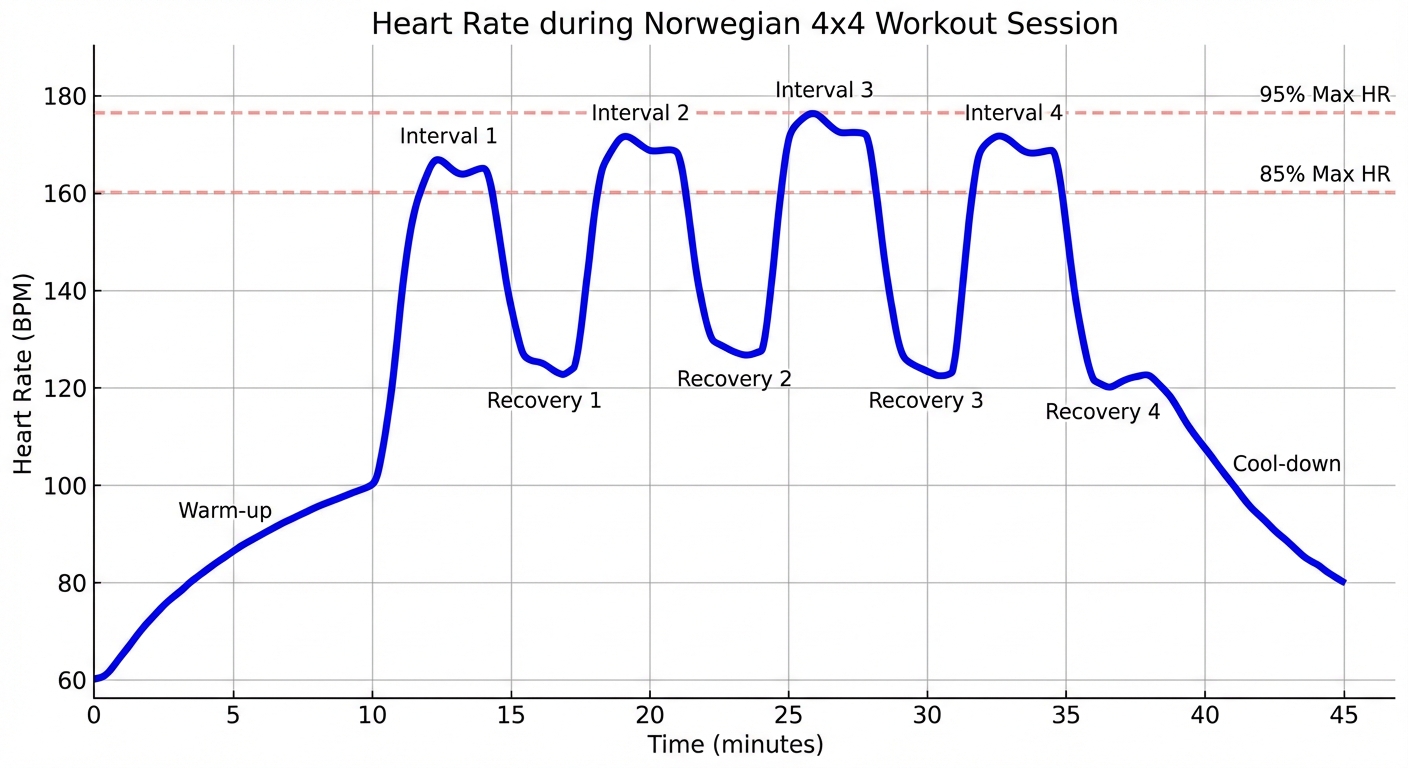
The most studied and consistently effective protocol for improving VO2 max comes from Norwegian exercise science research. The “4x4” protocol has been tested across populations ranging from sedentary heart failure patients to elite athletes, with measurable VO2 max improvements in virtually all groups.
The format involves four intervals of four minutes each at 85-95% of maximum heart rate, separated by three minutes of active recovery at low intensity. Including warm-up and cool-down, the total session takes 40-45 minutes. The intensity during work intervals is genuinely hard: you should be breathing heavily, only able to speak a few words at a time, and counting down the minutes until the interval ends. But it’s sustainable, not an all-out sprint you can only maintain for seconds. The three-minute recovery periods allow heart rate to drop while maintaining easy movement, preparing you for the next interval.
Research shows this protocol improves VO2 max by 10-15% in previously untrained individuals within 8-12 weeks. Even trained athletes with already good cardiovascular fitness see 5-8% improvements, meaningful gains at higher fitness levels where progress becomes harder. The frequency producing optimal results is two to three sessions per week; more than three rarely provides additional benefit and substantially increases overtraining and injury risk.
The mechanism behind the protocol’s effectiveness is straightforward: the four-minute intervals are long enough to push the cardiovascular system near its maximum capacity for a meaningful duration, but not so long that intensity must be reduced to complete them. The 85-95% heart rate target ensures sufficient physiological stress to trigger adaptation. Your body responds to this repeated near-maximum stimulus by strengthening the heart, increasing capillary density, improving mitochondrial function, and enhancing oxygen delivery throughout the system.
For those interested in building a complete cardiovascular training program, our guide on Zone 2 training covers the low-intensity component that complements high-intensity interval work.
Alternative Interval Protocols
While the Norwegian 4x4 has the strongest research support, several alternative protocols offer viable options for different preferences, time constraints, or fitness levels. The best protocol is ultimately the one you’ll perform consistently over months and years.
Tabata intervals use a 20-seconds-on, 10-seconds-off pattern repeated eight times for just four minutes of interval work. Originally developed by Japanese researcher Izumi Tabata for Olympic speed skaters, this protocol demands near-maximum effort during each 20-second burst. The advantage is extreme time efficiency; with warm-up and cool-down, the entire session takes 15-20 minutes. The disadvantage is psychological: the all-out intensity is difficult to maintain across all eight rounds, and many people find they can’t sustain appropriate effort by the later intervals. Tabata works well for people who prefer shorter, more intense workouts and can maintain the mental focus required for true all-out efforts.
The 30-20-10 protocol provides a gentler entry point for interval training novices. You alternate 30 seconds at an easy pace, 20 seconds at moderate intensity, and 10 seconds at maximum effort, repeating this pattern five times for five minutes of total interval work. The graduated intensity allows the body to adapt to high-intensity work without the sustained discomfort of four-minute intervals. It’s less effective than 4x4 for maximally improving VO2 max, but produces better adherence in people who would otherwise avoid interval training entirely.
A 1-minute-on, 1-minute-off protocol uses equal work and recovery periods, typically six to eight repetitions for 12-16 minutes of total interval work. The longer recovery periods make this protocol more psychologically sustainable both within a single session and across weeks of training. The trade-off is slightly less effectiveness compared to 4x4, but for people who struggle with consistency, better adherence often produces superior long-term results.
Whatever protocol you choose, the fundamental principle remains constant: push hard enough during work intervals to create genuine cardiovascular stress, recover enough between intervals to maintain quality, and repeat consistently over weeks and months. The specific interval structure matters less than sustained consistency at appropriate intensity.
Choosing Your Activity
High-intensity intervals can be performed using nearly any cardiovascular activity that allows you to modulate intensity. The specific activity matters far less than your ability to push hard, recover, and maintain consistency over time.
Running remains the most common choice because it’s straightforward, requires minimal equipment, and allows precise intensity regulation through pace adjustment. You can perform intervals on a track, treadmill, or any measured route. The primary limitation is impact stress; running places significant force on joints and connective tissue, making it less suitable for people with knee, hip, or ankle issues or those carrying substantial excess weight. If you can run comfortably, it’s an excellent interval modality.
Cycling offers a lower-impact alternative that works exceptionally well for VO2 max training. Whether on a stationary bike, road bike, or spin bike, cycling allows you to push cardiovascular intensity high without the joint stress of running. This makes it ideal for people with joint issues, those recovering from injuries, heavier individuals, or anyone who simply prefers cycling. The main requirement is access to appropriate equipment with resistance adjustment for intensity modulation.
Rowing provides a full-body option engaging upper body, core, and lower body simultaneously while remaining low-impact. The whole-body engagement creates substantial cardiovascular demand, and many people find rowing more engaging than single-modality activities. Proper rowing technique has a learning curve, but most gyms now have rowing machines and basic instruction available.
Swimming offers excellent cardiovascular training for people with joint limitations or those who enjoy water exercise. The main challenge is heart rate monitoring: wrist-based monitors don’t work underwater, requiring either chest straps or reliance on perceived exertion. For those comfortable swimming, it provides low-impact, full-body cardiovascular work.
Elliptical machines and stair climbers work well for intervals while providing less impact than running. They’re widely available in gyms, allow easy intensity modulation, and accommodate various fitness levels. The movement patterns don’t replicate real-world activities as directly as running or cycling, but for pure VO2 max training, they’re entirely effective. Our guide to indoor VO2 max training covers equipment selection and indoor-specific protocols in detail.
Monitoring Intensity
The effectiveness of interval training depends entirely on hitting appropriate intensity during work periods. Too easy, and you don’t create sufficient stress for adaptation. Too hard, and you can’t complete prescribed intervals or recover adequately between sessions.
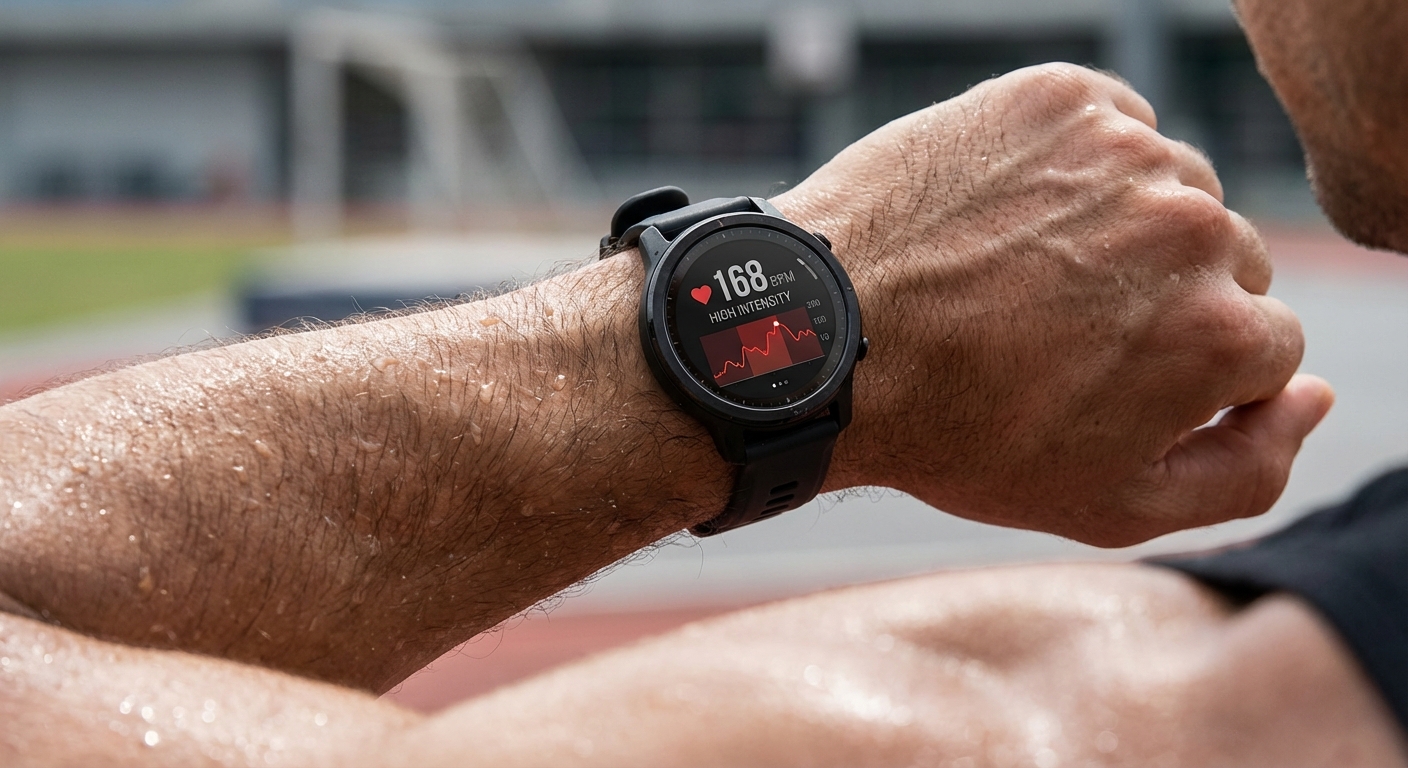
Heart rate monitoring provides the most objective intensity measure. For VO2 max intervals, target 85-95% of maximum heart rate during work periods. Estimate maximum heart rate by subtracting your age from 220; for a 45-year-old, that’s 175 bpm maximum, making the target interval range 149-166 bpm. This formula isn’t perfectly accurate for everyone, but it’s close enough for practical training purposes. Modern wearables from Apple, Garmin, and Polar make continuous heart rate monitoring accessible. Chest strap monitors provide greater accuracy than wrist-based optical sensors, particularly during high-intensity exercise.
Rate of perceived exertion (RPE) offers a subjective but valid alternative. On a 1-10 scale where 1 is minimal effort and 10 is maximum possible effort, interval work should feel like 8-9. This is very hard, sustainable for the interval duration, but not an all-out sprint. You should think “this is difficult and I’m counting down the minutes” rather than “I’m about to collapse.”
The talk test provides the simplest gauge. During interval work, you should only be able to speak a few words at a time. Full sentences are impossible; conversation is out of the question. During recovery periods, you should be able to speak in sentences, though you’re still breathing harder than at rest. If you can chat comfortably during intervals, you’re not working hard enough.
Progression for Beginners
Starting high-intensity interval training requires careful progression, especially if you’re new to this type of work or returning after time off. Jumping immediately into full 4x4 protocol at maximum intensity invites injury, excessive fatigue, and psychological burnout that derails consistency before adaptations occur.
Begin conservatively in weeks one and two with just two intervals of three minutes each at slightly lower intensity, around 80% of maximum heart rate rather than 85-95%. Use three minutes of recovery between intervals. The goals in these initial weeks are learning what appropriate effort feels like, developing familiarity with the interval format, and allowing your cardiovascular system to begin adapting without overwhelming it.
Progress to weeks three and four by adding a third interval and extending duration to 3.5 minutes each while increasing intensity toward the target 85-95% range. Your body is adapting at this point. You’ll likely notice that the intensity feeling overwhelming in week one now feels manageable.
By weeks five and six, you’re ready for the full 4x4 protocol: four intervals of four minutes each at 85-95% maximum heart rate with three-minute recoveries. This represents the full training stimulus that produces maximum VO2 max improvement. Most people can reach this point within six weeks if consistent and attentive to their bodies.
Once you’ve reached the full protocol, maintain two to three sessions weekly indefinitely. The critical principle throughout is patience. VO2 max improvements take 6-12 weeks to manifest measurably. Consistency matters far more than intensity initially. It’s better to complete every session at slightly lower intensity than to miss sessions because you pushed too hard and need extra recovery.
Balancing With Other Training
VO2 max intervals are one component of comprehensive fitness, not the entirety. A well-rounded program includes several complementary elements that together produce optimal health and performance outcomes.
Zone 2 cardio, low-intensity exercise where you can maintain conversation comfortably, should comprise the majority of your cardiovascular training volume. This intensity builds aerobic base, enhances fat oxidation, and supports recovery without creating the fatigue that high-intensity work produces. Aim for 2-3 hours weekly of Zone 2 work through walking, easy cycling, swimming, or any activity keeping heart rate at 60-70% of maximum.
Strength training maintains muscle mass, bone density, and functional capacity that pure cardiovascular training doesn’t optimize. Two to three sessions weekly focusing on compound movements provides the resistance training stimulus that supports metabolic health, injury prevention, and daily function. Our guide on strength training after 50 covers age-appropriate programming.
Flexibility and mobility work supports movement quality and injury prevention. This needn’t be extensive; 10-15 minutes of stretching or yoga several times weekly maintains the range of motion that supports both interval training and daily life.
The combination of Zone 2 work building aerobic base and mitochondrial density with VO2 max intervals pushing cardiovascular ceiling creates comprehensive cardiorespiratory fitness. Neither alone produces optimal results; the synergy between consistent low-intensity volume and periodic high-intensity peaks drives the full spectrum of cardiovascular adaptation.
Realistic Expectations
Setting appropriate expectations for VO2 max improvement helps maintain motivation and prevents discouragement. The magnitude and speed of gains depend heavily on starting fitness level.
Previously untrained individuals can expect the most dramatic improvements: 15-30% increase in VO2 max over 12-24 weeks of consistent training. Someone starting with a VO2 max of 35 ml/kg/min might reach 42-45 ml/kg/min within six months. Those starting from very low fitness due to prolonged inactivity or medical conditions sometimes see even larger percentage gains.
Moderately trained people who already exercise regularly can expect 8-15% improvement with systematic interval work. The gains come more slowly because easy adaptations have already occurred, but improvements are still meaningful. Moving from 45 to 50 ml/kg/min might take 4-6 months rather than 8-12 weeks.
Already fit individuals with VO2 max already in “good” or “excellent” range see the smallest percentage improvements: 5-10% increases requiring months of consistent, well-structured training. At high fitness levels, the body has made most easy adaptations, and further improvement requires precise training manipulation.
The critical insight is that even small improvements are valuable. A 5% VO2 max increase translates to measurably lower mortality risk, better functional capacity, improved exercise tolerance, and enhanced quality of life. Don’t get discouraged by slower progress if already fit or by comparing yourself to less fit people making faster percentage gains.
Safety Considerations
High-intensity training is demanding and requires appropriate precautions. If you have cardiovascular conditions, get medical clearance before beginning interval training.
Concerning symptoms requiring physician consultation before starting include chest pain or pressure during activity, dizziness or fainting episodes, known heart disease or previous heart attack, uncontrolled high blood pressure, and irregular heart rhythm. For most healthy people, VO2 max training is safe when properly progressed, but the intensity demands respect for individual limitations.
Start conservatively regardless of previous fitness history. The progression outlined above protects against overtraining and injury. Listen to your body: persistent fatigue, declining performance, sleep disruption, or elevated resting heart rate signal overtraining requiring reduced volume or additional recovery days.
The Bottom Line
VO2 max is the strongest single predictor of all-cause mortality, and it’s highly trainable at any age through high-intensity interval work. The Norwegian 4x4 protocol, performing four four-minute intervals at 85-95% maximum heart rate twice weekly, represents the most evidence-supported approach for improving cardiovascular fitness.
You don’t need to become an elite athlete. Moving from “low” to “moderate” or “moderate” to “good” VO2 max dramatically improves longevity outlook and functional capacity. This is achievable for most people with consistent training over several months.
Your cardiovascular fitness today predicts your health and longevity decades from now. The investment of 40-45 minutes twice weekly produces returns in quality and quantity of life that few other interventions can match.
Your VO2 Max Training Protocol:
- Estimate your maximum heart rate (220 minus age) and calculate 85-95% target zone
- Choose your preferred activity (running, cycling, rowing, swimming)
- Start with 2-3 shorter intervals (3 minutes) at moderate intensity (80% max HR) for the first two weeks
- Progress over 6 weeks to the full 4x4 protocol (4 intervals of 4 minutes at 85-95%)
- Maintain 2-3 sessions weekly; combine with Zone 2 cardio and strength training
- Test VO2 max every 2-3 months (wearable estimate, field test, or lab test) to track progress
Sources: Cooper Clinic longitudinal mortality study (66,000+ participants), Veterans Exercise Testing Study (122,000+ patients), Mayo Clinic cardiovascular research, Norwegian 4x4 protocol studies, JAMA mortality prediction analysis, American College of Sports Medicine position stands on exercise and cardiovascular health.