
At 52, Margaret noticed the skin on her hands and face losing the firmness it once had. Her dermatologist had recommended retinoids and sunscreen, which helped somewhat, but she wondered if the collagen supplements she kept seeing advertised could provide additional benefit. Her yoga practice had also left her with nagging knee discomfort that ibuprofen barely touched. When she saw collagen powder marketed for both skin elasticity and joint health, the appeal was obvious: one supplement potentially addressing both concerns.
The global collagen supplement market hit $8 billion in 2024 and continues growing at roughly 10% annually. The promises are compelling: younger-looking skin, reduced wrinkles, stronger joints, better hair and nails, improved gut health, even weight loss support. These claims appear on everything from powders and pills to gummies, drinks, and coffee creamers with added collagen.
But here’s the skeptic’s reasonable objection: collagen is just protein. When you consume it, your digestive system should break it down into amino acids like any other protein. The idea that eating collagen directly builds collagen in your skin or joints sounds questionable from basic biochemistry. Does the collagen you swallow actually end up where you want it, or is this expensive placebo?
The answer based on clinical research is more nuanced than either enthusiasts or skeptics typically acknowledge. Collagen supplementation appears to work modestly for some applications, particularly skin elasticity and possibly joint pain. The effect sizes are real but modest. Whether these benefits justify the cost compared to simply eating adequate protein from any source is the genuinely debatable part.
Understanding Collagen’s Role in Your Body
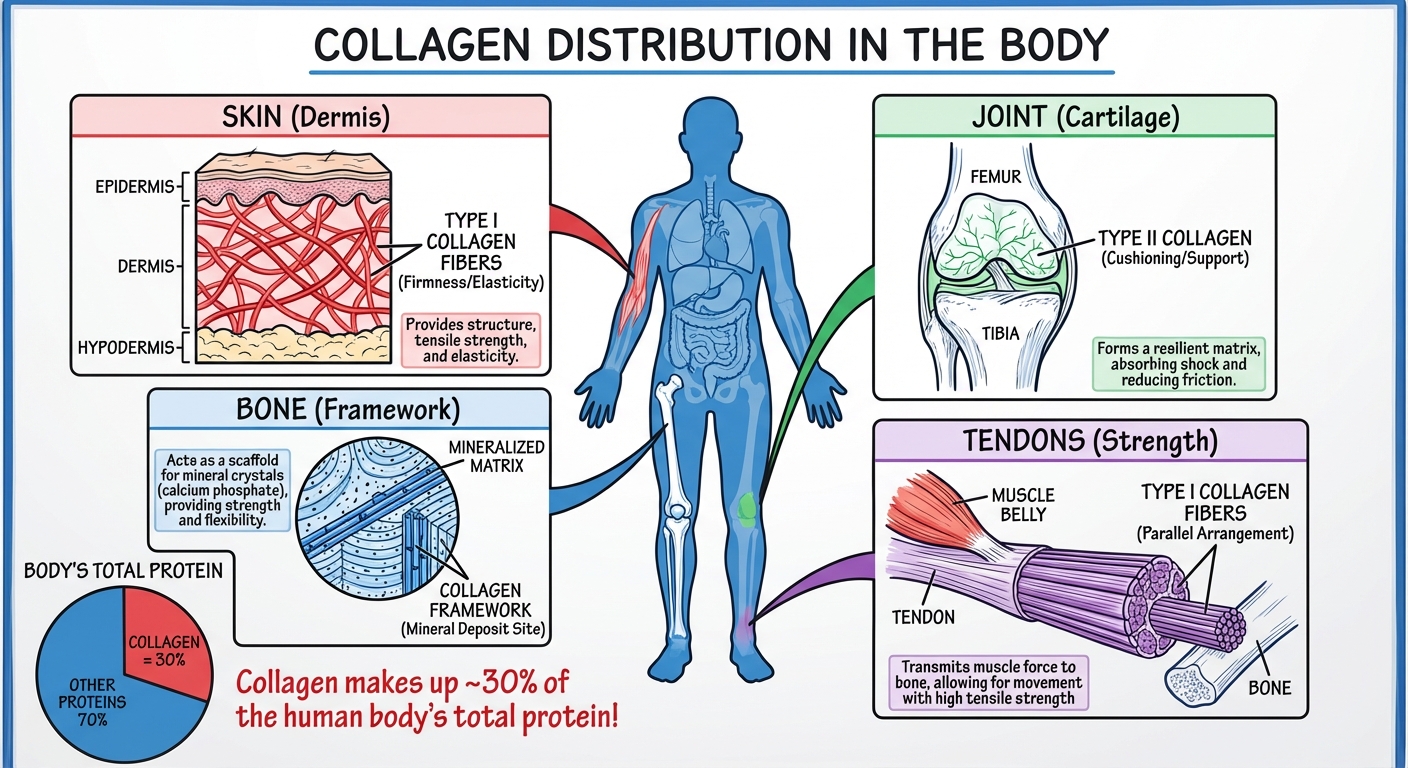
Collagen is the most abundant protein in your body, comprising about 30% of total protein content. It’s the structural scaffolding that gives strength and integrity to tissues throughout your body, from the dermis layer of your skin to the cartilage cushioning your joints.
Your skin relies on collagen for firmness and elasticity; roughly 75-80% of your skin’s protein content is collagen. This is why collagen loss with age creates visible changes: wrinkles form as the structural support diminishes, and skin begins to sag as the underlying scaffolding weakens. The dermis, the middle layer of skin where collagen resides, thins by about 1% per year after age 20, accelerating after menopause due to hormonal changes affecting collagen synthesis.
Joints depend on collagen because cartilage, the cushioning tissue that protects bone surfaces, is primarily composed of type II collagen. When cartilage degrades in conditions like osteoarthritis, the underlying collagen structure breaks down, leading to joint pain, stiffness, and reduced mobility. Tendons and ligaments are also almost entirely collagen, providing the tensile strength needed to connect muscles to bones and bones to bones.
Scientists have identified 28 distinct types of collagen with different functions, though types I, II, and III are most relevant for supplementation. Type I is the most abundant, comprising about 90% of your body’s collagen and found primarily in skin, bones, and tendons. Type II is specific to cartilage and is often marketed for joint health. Type III commonly occurs alongside Type I in skin, blood vessels, and organs.
Your body manufactures collagen naturally from amino acids, particularly glycine, proline, and hydroxyproline, along with vitamin C as an essential cofactor. You don’t technically need to eat collagen to make collagen; your body can synthesize it from any protein source plus adequate vitamin C. This is the basis for skepticism about collagen supplements: why should consuming collagen be better than consuming any other protein?
The Skin Health Evidence
The strongest research support for collagen supplementation comes from skin health studies, where multiple randomized controlled trials have documented measurable, if modest, improvements in skin parameters.
Studies using 2.5-10 grams of collagen peptides daily show improvements in skin hydration and elasticity after 4-12 weeks of consistent supplementation. The effect sizes are real but not dramatic: improvements in elasticity typically range from 7-12% and hydration improvements from 12-16% across various studies. You won’t look 20 years younger, but dermatological instruments measuring skin properties detect consistent improvements compared to placebo groups.
Wrinkle depth reduction appears in several studies, though the effects primarily apply to fine lines rather than deep creases. Improvements in the 10-20% range have been documented using precise measurement techniques, meaning wrinkles become slightly less pronounced without disappearing entirely. The benefits are most apparent for sun-exposed areas like the face and for aging-related fine lines rather than expression wrinkles or deep creases formed by repeated muscle movements.
The mechanism that makes this work isn’t what you might intuitively expect. Ingested collagen doesn’t travel intact to your skin and deposit there like spackling on a wall. Instead, collagen peptides, the broken-down fragments created when collagen protein is hydrolyzed, appear to function as signaling molecules. Research shows that some of these peptides survive digestion partially intact and appear in the bloodstream. When they reach skin tissue, they seem to stimulate fibroblast cells to increase their own collagen production. You’re not providing raw materials so much as sending a signal to your skin to manufacture more collagen itself.
A 2019 meta-analysis published in the Journal of Drugs in Dermatology analyzed 11 randomized controlled trials with a total of 805 participants. The researchers found that collagen supplementation significantly improved skin hydration, elasticity, and wrinkle depth compared to placebo, with effects emerging after 8 weeks of consistent use. Importantly, benefits appeared to disappear when supplementation stopped, suggesting ongoing use is required for maintenance rather than this being a one-time intervention that creates permanent change.
Joint Pain and Osteoarthritis
The evidence for collagen supplementation improving joint health is more variable than skin evidence but suggests possible benefits for specific populations, particularly those with existing joint conditions.
Several studies in people with knee osteoarthritis show that collagen supplementation, typically using type II collagen at doses of 8-12 grams daily, reduces joint pain and improves function. A 24-week study at Penn State found significant reduction in joint pain among athletes taking 10 grams of collagen hydrolysate compared to placebo. Pain reductions in osteoarthritis studies typically fall in the 10-20% range, statistically significant but not dramatic enough to replace other interventions. Some participants report meaningful improvements in mobility and quality of life, while others notice minimal difference, suggesting significant individual variation in response.
The mechanism for joint benefits remains unclear and may differ from skin effects. Collagen peptides might reduce inflammation in joints through immune-modulating effects. They might provide amino acid building blocks that support cartilage repair, though theoretically any protein source should provide these. There could be signaling effects similar to skin benefits, where peptides stimulate chondrocytes (cartilage cells) to increase their own collagen production. Or some portion of the effect might be placebo, which is known to produce genuine pain reduction in osteoarthritis through psychological mechanisms affecting pain perception.
For joint health specifically, it’s worth noting that glucosamine and chondroitin supplements have substantially more research support than collagen, with larger, longer trials demonstrating benefits. However, collagen shows enough promise that people with osteoarthritis who haven’t found adequate relief from other interventions might reasonably add it as part of a comprehensive approach including physical therapy, appropriate exercise, and weight management.
Claims With Weaker Evidence
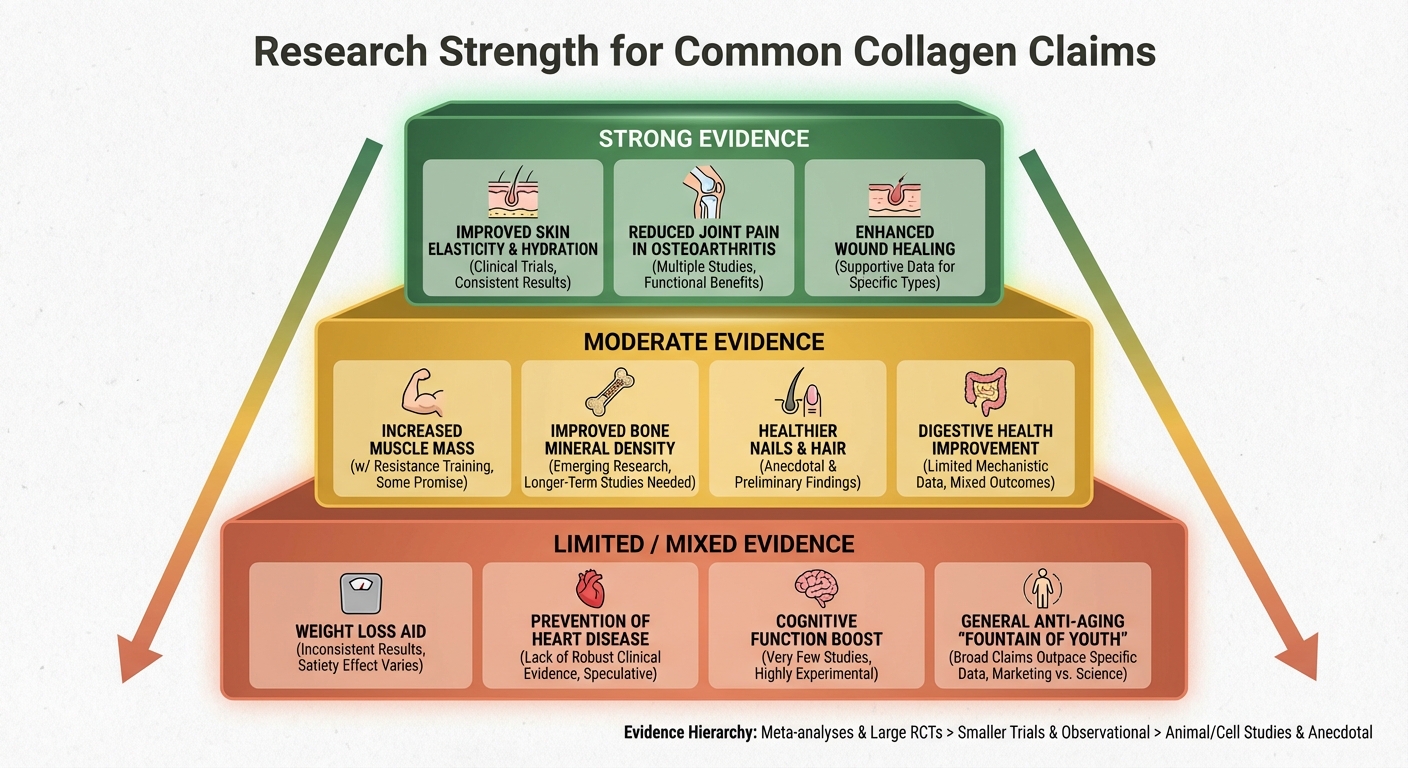
Marketing materials for collagen supplements often extend far beyond what research supports, making claims about hair, nails, gut health, and bone density that rest on thin scientific foundations.
The evidence for collagen improving hair and nail growth consists primarily of anecdotal reports and poorly designed studies rather than rigorous clinical trials. The theoretical basis is that hair and nails are protein structures that might benefit from collagen’s amino acid profile, particularly glycine and proline. However, hair and nails are made of keratin, not collagen, and there’s no clear physiological reason why collagen would be superior to other high-quality proteins for supporting keratin production. If your diet already includes adequate protein from varied sources, collagen is unlikely to improve hair or nails beyond what you’re already getting.
Gut health claims for collagen are similarly unsupported by rigorous human evidence. The marketing pitch centers on glycine, an amino acid abundant in collagen that might support gut barrier function and reduce inflammation in conditions like leaky gut syndrome. The theoretical mechanism has some biological plausibility, but almost no controlled human studies support these claims. If you have significant digestive issues, collagen probably isn’t the solution. Proven interventions like adequate fiber intake, fermented foods, identifying food triggers, and managing stress have far stronger evidence for gut health.
Bone health represents another area where collagen is marketed aggressively but evidence remains preliminary. Collagen does form a significant component of bone structure, providing flexibility that prevents brittleness. A few small studies suggest possible benefits when collagen is combined with calcium and vitamin D supplementation in post-menopausal women. However, the effect sizes, if real, are small compared to established interventions. Calcium, vitamin D, and resistance training have dramatically stronger evidence for bone health than collagen supplements.
Dosing, Types, and Practical Considerations
If you decide to try collagen supplementation, understanding the practical details helps you choose appropriately and set realistic expectations.
Clinical trials showing benefits typically use 2.5-10 grams daily for skin health, with 5 grams being the most common dose, and 8-12 grams daily for joint applications. Lower doses of 1-2 grams haven’t been studied as extensively and may have minimal effects. Going above 15-20 grams daily probably doesn’t provide additional benefits and simply increases cost without proportional return.
Most supplements use hydrolyzed collagen, also called collagen peptides, which has been broken down into smaller fragments for better absorption and easier mixing into liquids. The collagen source varies across products: bovine (cow) collagen from hides or bones provides types I and III; marine collagen from fish skin and scales provides type I and works for pescatarians; chicken collagen from cartilage provides type II, often marketed specifically for joints. Eggshell membrane collagen provides mixed types but is less common.
Whether source or type matters significantly remains questionable. Your digestive system breaks down all of these into amino acids and peptides regardless of origin. The theoretical rationale for matching collagen type to application (type II for joints, type I for skin) makes sense, but research hasn’t definitively proven that this matching produces better results than using whatever source you prefer based on dietary or ethical considerations.
Timing appears less important than consistency. Some practitioners recommend taking collagen on an empty stomach for better absorption, while others suggest taking it with vitamin C to support the body’s own collagen synthesis. Neither approach has clear research advantage; consistent daily intake matters more than specific timing protocols.
Practical Protocol for Trying Collagen:
- Choose hydrolyzed collagen peptides from a reputable brand with third-party testing
- Start with 5-10 grams daily (follow product serving size)
- Take consistently for at least 8-12 weeks before evaluating effects
- Unflavored powder mixes easily into coffee, smoothies, or water
- Ensure adequate vitamin C intake to support collagen synthesis
Cost-Benefit Analysis
Collagen supplements typically cost $20-60 monthly depending on brand, quality, and dose, representing a significant ongoing expense. Understanding what you’re getting for that investment helps determine whether it makes sense for your situation.
For skin health, assuming research findings translate to your personal response, you’re potentially getting modest improvements in elasticity and hydration that may slow visible aging. The effects are measurable with dermatological instruments but won’t produce dramatic visible transformation. Retinoids (prescription or over-the-counter retinol) have stronger evidence for anti-aging benefits, with larger effect sizes. Sun protection prevents collagen breakdown more effectively than supplementation can rebuild it. Collagen might add marginal benefit when layered on top of these fundamentals, but it’s not a substitute for proven skincare interventions.
For joint health, collagen provides possible modest pain reduction in osteoarthritis, though effects are inconsistent and not everyone responds. Physical therapy, appropriate exercise, and weight management (if relevant) have stronger evidence and address root causes rather than just symptoms. Collagen might provide supplementary benefit in a comprehensive joint health strategy.
For hair, nails, gut health, and bone density, the evidence is too weak to justify the expense for most people. If you’re primarily interested in these applications, you’re better off investing in interventions with stronger research support.
The opportunity cost also matters. The $30-60 monthly spent on collagen could instead purchase high-quality protein foods, produce for nutrient diversity, or other supplements with stronger evidence bases. For budget-conscious consumers, whole food protein sources provide amino acids more cost-effectively than specialized supplements.

The Bottom Line
Collagen supplements occupy a middle ground between the miracle claims of marketing and the complete skepticism of critics. Clinical research supports modest benefits for skin elasticity and hydration, with possible benefits for joint pain in osteoarthritis. The supplements aren’t snake oil, but they’re not transformative either.
The mechanism appears to involve collagen peptides functioning as signaling molecules that stimulate your body’s own collagen production, rather than providing raw materials that directly incorporate into tissues. This explains why effects emerge gradually over 8-12 weeks and require ongoing supplementation to maintain.
If you decide to try collagen:
- Use 5-10 grams daily of hydrolyzed collagen peptides
- Commit to at least 8-12 weeks before evaluating results
- Set realistic expectations for modest improvement, not transformation
- Choose quality brands with third-party testing (Vital Proteins, Sports Research, Further Food)
- Continue proven fundamentals: adequate protein, vitamin C, sun protection, resistance training
If you skip collagen: You’re not missing a miracle. Focus on fundamentals that support your body’s natural collagen production: varied protein sources providing all amino acids, sufficient vitamin C from fruits and vegetables, consistent sun protection, and resistance training for structural tissue health. These interventions have stronger evidence and better cost-effectiveness than supplementation for most people.
Collagen might provide marginal gains when layered on top of optimized fundamentals. But it’s a supplement to proven practices, not a substitute for the basics that actually determine tissue health over time. For a more comprehensive review of the evidence, see our detailed collagen evidence analysis.
Sources: Journal of Drugs in Dermatology 2019 meta-analysis, Penn State collagen and joint health study, skin aging and collagen research, systematic reviews on collagen supplementation efficacy, dermatology literature on collagen mechanisms.