
You drag yourself to the gym at 6 AM because that’s what productive people do. The weights feel heavier than usual, your coordination is off, and by the time you finish, you’re questioning whether this torture is worth it. Meanwhile, your colleague swears by evening workouts and seems to make gains effortlessly. The difference might not be dedication or genetics. It might be timing.
Bio-sync training, the practice of aligning your workouts with your body’s natural circadian rhythms, is emerging as one of the most significant fitness trends of 2026. According to David Lloyd Clubs’ annual fitness report, this approach is reshaping how trainers and athletes think about exercise programming. The science behind it suggests that when you exercise may matter almost as much as what you do.
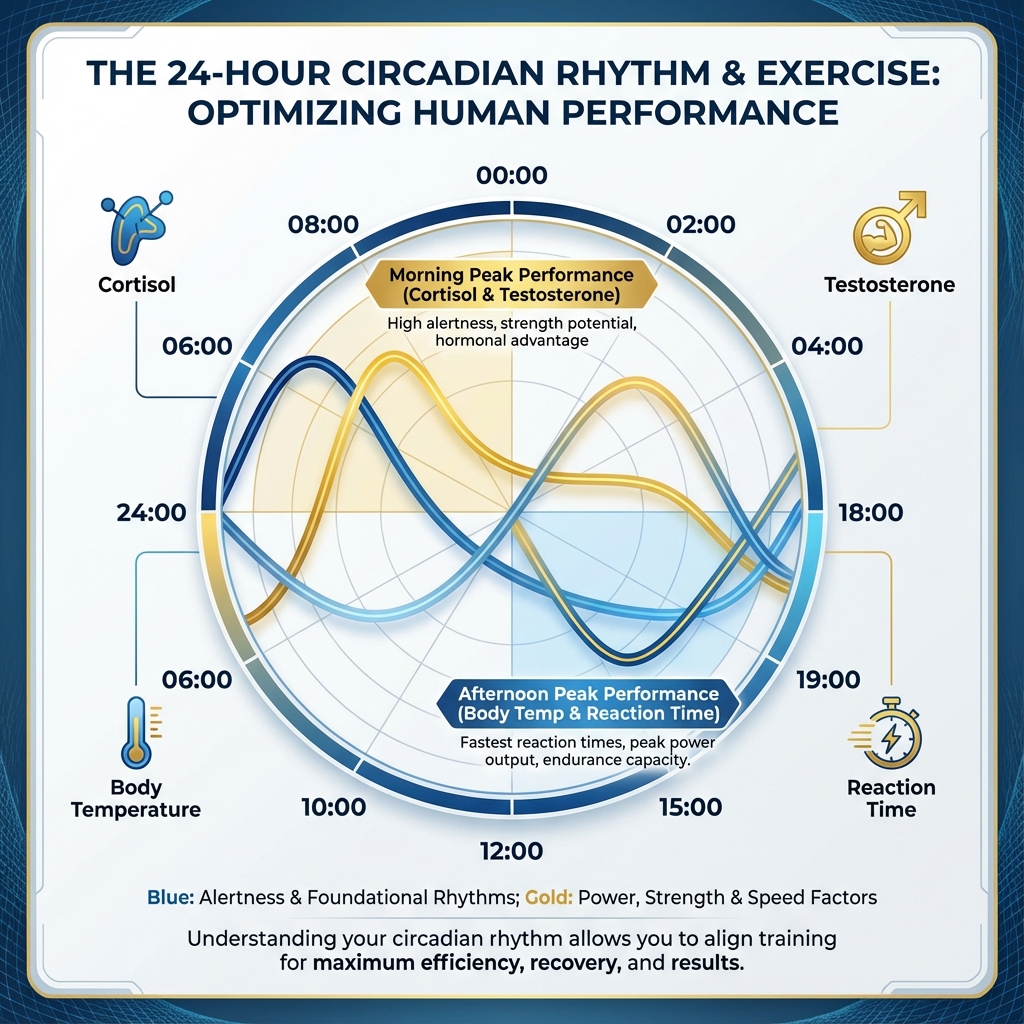
Your body doesn’t operate at the same capacity throughout the day. Core temperature, hormone levels, reaction time, and muscle function all fluctuate in predictable patterns governed by your internal clock. Training in sync with these rhythms, rather than against them, can unlock performance improvements that no supplement or training technique can match.
The Science of Circadian Exercise Performance
Your circadian rhythm is a roughly 24-hour internal cycle that regulates nearly every physiological process in your body. This biological clock, centered in the suprachiasmatic nucleus of your hypothalamus, coordinates the timing of hormone release, body temperature, blood pressure, and cellular function. Exercise performance is no exception to this orchestration.
Research published in Cell Metabolism has demonstrated that muscle cells contain their own circadian clocks that influence everything from glucose uptake to protein synthesis. These peripheral clocks operate in coordination with your master clock, creating windows of optimal and suboptimal performance throughout the day. Understanding these windows is the foundation of bio-sync training.
Core body temperature follows a predictable daily pattern, reaching its lowest point around 4-5 AM and peaking in the late afternoon, typically between 4-6 PM. This temperature variation directly affects muscle function. Warmer muscles contract more forcefully, respond faster, and are less susceptible to injury. The difference between your temperature nadir and peak can be nearly 1°C, which translates to measurable performance differences.
Hormonal fluctuations add another layer to the timing equation. Testosterone peaks in the morning for most people, while cortisol follows a similar pattern, starting high and declining throughout the day. Growth hormone, critical for recovery and adaptation, surges during deep sleep. These hormonal rhythms influence not just how you feel but how effectively your body responds to training stress.
Finding Your Chronotype: Morning Larks vs. Night Owls
Not everyone’s circadian rhythm operates on the same schedule. Chronotype, your genetic predisposition toward being a morning person or an evening person, significantly influences when your body performs best. Research suggests that chronotype is approximately 50% heritable, meaning your preference for early or late activity has biological roots.
Morning chronotypes, often called larks, experience their peak alertness and performance earlier in the day. Their cortisol awakening response is robust, their body temperature rises quickly after waking, and they tend to feel most energetic in the first half of the day. For these individuals, morning workouts often feel natural and productive, aligning with their biological prime time.
Evening chronotypes, or owls, operate on a delayed schedule. Their body temperature peaks later, their reaction time improves as the day progresses, and they often feel sluggish in the morning regardless of sleep quality. Forcing early morning workouts on a strong evening chronotype creates a mismatch between training demands and physiological readiness that can compromise both performance and recovery.
The mismatch between chronotype and training time has measurable consequences. A study in the Scandinavian Journal of Medicine and Science in Sports found that athletes training at times misaligned with their chronotype showed reduced power output, slower reaction times, and higher perceived exertion compared to training at chronotype-appropriate times. The performance deficit ranged from 10-26% depending on the metric measured.
Determining your chronotype doesn’t require expensive testing. The Morningness-Eveningness Questionnaire, developed by researchers Horne and Östberg, provides a validated assessment based on your natural preferences. Questions about ideal wake times, peak mental performance, and energy patterns throughout the day reveal where you fall on the spectrum from extreme morning type to extreme evening type.
Optimal Training Windows by Exercise Type
Different types of exercise have different physiological demands, and these demands interact with circadian variations in specific ways. Strength training, cardiovascular work, and skill-based activities each have their own optimal timing considerations based on the underlying physiology.
Strength and power training benefits most from the late afternoon window, typically between 4-7 PM for most chronotypes. At this time, body temperature is near its daily peak, which improves muscle contractility and nerve conduction velocity. Reaction time is fastest, joint flexibility is greatest, and the natural decline in cortisol reduces the catabolic environment that can interfere with muscle building. Studies have shown strength performance improvements of 3-20% in afternoon versus morning sessions.

Cardiovascular training shows more flexibility in timing, though some nuances exist. Long, steady-state cardio can work well in the morning, when cortisol levels naturally support fat oxidation and the calming effect of aerobic exercise can set a positive tone for the day. High-intensity interval training, however, tends to perform better later in the day when reaction time, anaerobic capacity, and pain tolerance are elevated.
Skill acquisition and motor learning present an interesting case. While afternoon timing generally supports better physical performance, some research suggests that morning training may offer advantages for learning new movement patterns. The theory is that the morning brain, refreshed from sleep, has greater capacity for encoding new motor memories. This suggests that learning a new lift technique might be better scheduled in the morning, while executing that technique at maximum intensity should wait until afternoon.
Flexibility and mobility work may be the one category where morning training offers clear advantages for most people. Joints tend to be stiffer in the morning due to fluid accumulation during sleep, making this an ideal time to address mobility restrictions. Additionally, the parasympathetic-promoting nature of stretching and mobility work complements the natural transition from sleep to wakefulness.
The Morning Workout Paradox
Despite the physiological evidence favoring afternoon training for many goals, morning workouts remain popular and, for many people, practically necessary. Work schedules, family obligations, and gym crowding often make early morning the only viable training time. The question becomes: can you optimize morning training to minimize the circadian disadvantage?
The answer is yes, though it requires strategic adjustments. Extended warm-ups become critical for morning exercisers. Since body temperature hasn’t yet reached its peak, you need to artificially elevate it through longer, more progressive warm-up protocols. Research suggests that 15-20 minutes of graduated warm-up activity can partially compensate for the lower baseline temperature of morning training.
Light exposure immediately upon waking can accelerate the phase-advance of your circadian system, making your body more “awake” earlier. Exposure to bright light, particularly in the blue wavelength range, suppresses melatonin and triggers cortisol release, essentially telling your body that morning has arrived. A light therapy lamp or simply spending 10-15 minutes outdoors after waking can shift your performance curve earlier.
Caffeine, used strategically, can mask some of the performance deficits of morning training. By blocking adenosine receptors, caffeine increases alertness and can improve strength and endurance performance. However, timing matters. Consuming caffeine immediately upon waking may be less effective because cortisol is already naturally elevated. Waiting 90-120 minutes after waking, or timing caffeine intake to coincide with the natural mid-morning cortisol dip, may provide greater benefit.
For those committed to morning training, consistency itself becomes an adaptation. Research on shift workers and athletes suggests that regular training at a specific time can shift the circadian clock of muscle tissue to anticipate exercise at that time. This adaptation takes weeks to develop but can partially align your physiology with your schedule rather than the other way around.

Recovery and the Circadian Dimension
Training is only half the equation. Adaptation and improvement happen during recovery, and recovery itself follows circadian patterns. Growth hormone, essential for tissue repair and adaptation, is released primarily during the early stages of deep sleep. Protein synthesis rates vary throughout the day. Even inflammation and immune function follow daily rhythms that affect how quickly and completely you recover from training.
Sleep timing and quality become critical components of bio-sync training. Research shows that sleep deprivation impairs exercise performance, but the timing of sleep relative to training also matters. Training late in the evening, particularly high-intensity work, can elevate core temperature and delay the natural decline in cortisol that facilitates sleep onset. This creates a potential conflict between optimal training timing and optimal recovery.
The solution for most people is to finish intense training at least 3-4 hours before intended bedtime. This allows body temperature to begin its natural decline and gives the sympathetic nervous system activation from exercise time to subside. If you prefer evening training, lower-intensity work like Zone 2 cardio or mobility practice may be better choices close to bedtime than heavy strength work or HIIT.
Nutrition timing interacts with both exercise timing and circadian rhythms. Post-workout protein intake is important regardless of when you train, but the overall pattern of nutrient intake throughout the day also matters. Research suggests that aligning your largest meals with the earlier part of the day, when insulin sensitivity is highest, may support both performance and body composition goals. For a deeper dive into this topic, see our coverage of circadian fasting and eating windows.
Building Your Bio-Sync Training Schedule
Implementing bio-sync training requires an honest assessment of your constraints, chronotype, and goals. The theoretically optimal schedule means nothing if it’s impossible to follow consistently. A good enough schedule you can maintain beats a perfect schedule you abandon after two weeks.
Start by identifying your chronotype using the Morningness-Eveningness Questionnaire or simply reflecting on your natural tendencies on days without obligations. Are you naturally awake and alert early, or do you come alive as the day progresses? Your answer provides the foundation for your training schedule.
Next, map your available training windows against your chronotype and the demands of your training goals. If you’re a moderate evening type focused on strength training, the 5-7 PM window is ideal. If you’re a morning type doing primarily cardio and mobility work, early morning training aligns well with both your biology and your goals. Mixed goals or mismatched constraints require prioritization and compromise.
Consider periodizing your training timing as you would periodize intensity or volume. During phases focused on strength and power, prioritize afternoon training even if it requires schedule adjustments. During phases focused on aerobic base building or technique work, morning sessions may be more practical and equally effective. This flexible approach allows you to optimize when it matters most while maintaining consistency overall.
The interaction between exercise timing and sleep quality deserves careful attention. If evening training consistently interferes with your sleep, the recovery cost may outweigh the performance benefit of better training timing. Monitor your sleep quality and make adjustments accordingly. A heart rate variability monitor can provide objective feedback on how different training times affect your recovery.
The Bottom Line
Bio-sync training isn’t about finding a magic hour that transforms mediocre workouts into exceptional ones. It’s about understanding that your body operates on a rhythm and working with that rhythm rather than against it. The performance benefits are real, ranging from 10-20% improvements in various metrics, but perhaps more importantly, training in alignment with your biology tends to feel better and be more sustainable.
For most people focused on strength and power, afternoon training between 4-7 PM offers physiological advantages worth pursuing when schedules allow. Morning exercisers can compensate through extended warm-ups, strategic light exposure, and caffeine timing. Whatever time you train, consistency matters more than optimization, and recovery remains the foundation upon which all adaptations are built.
Your Bio-Sync Action Steps:
- Assess your chronotype using the Morningness-Eveningness Questionnaire
- Match high-intensity training to your peak performance window when possible
- Extend warm-ups to 15-20 minutes for morning training sessions
- Use bright light exposure immediately upon waking to advance your circadian phase
- Finish intense training 3-4 hours before bed to protect sleep quality
- Track and adjust based on performance and recovery feedback
Sources: Cell Metabolism circadian muscle research, Scandinavian Journal of Medicine and Science in Sports chronotype study, David Lloyd Clubs 2026 Fitness Report, Horne-Östberg Morningness-Eveningness Questionnaire validation studies.