For decades, we’ve been told saturated fat is the enemy. Then came the nuanced understanding that not all saturated fats behave the same way in the body. Now, emerging research suggests one particular saturated fatty acid might belong in the same conversation as metformin and rapamycin, two of the most studied longevity-enhancing compounds in existence.
Pentadecanoic acid, known as C15:0, is an odd-chain saturated fatty acid found primarily in full-fat dairy products from grass-fed ruminants. Until recently, it received little attention from researchers. That’s changing rapidly. Studies published in 2024 and 2025 demonstrate that C15:0 activates the same longevity pathways as some of the most promising anti-aging interventions, while human population data shows striking correlations between C15:0 levels and healthy aging.
The research is still early, and C15:0 isn’t a magic bullet. But the evidence is compelling enough that 2026 may be the year this obscure fatty acid moves from scientific curiosity to mainstream longevity discussion.
What Makes C15:0 Different
Most saturated fatty acids have even numbers of carbon atoms in their molecular chains: 14, 16, 18. C15:0 is unusual because it has 15 carbons, making it an odd-chain saturated fatty acid. This structural difference appears to give C15:0 unique biological properties that distinguish it from its even-chain relatives.
While even-chain saturated fats like palmitic acid (C16:0) have been associated with increased cardiovascular risk in some studies, odd-chain saturated fats like C15:0 show the opposite pattern. Population studies consistently find that higher circulating C15:0 levels correlate with lower risk of type 2 diabetes, cardiovascular disease, and metabolic syndrome. This isn’t a minor statistical quirk. The associations are strong enough that some researchers have proposed C15:0 as a biomarker for metabolic health.
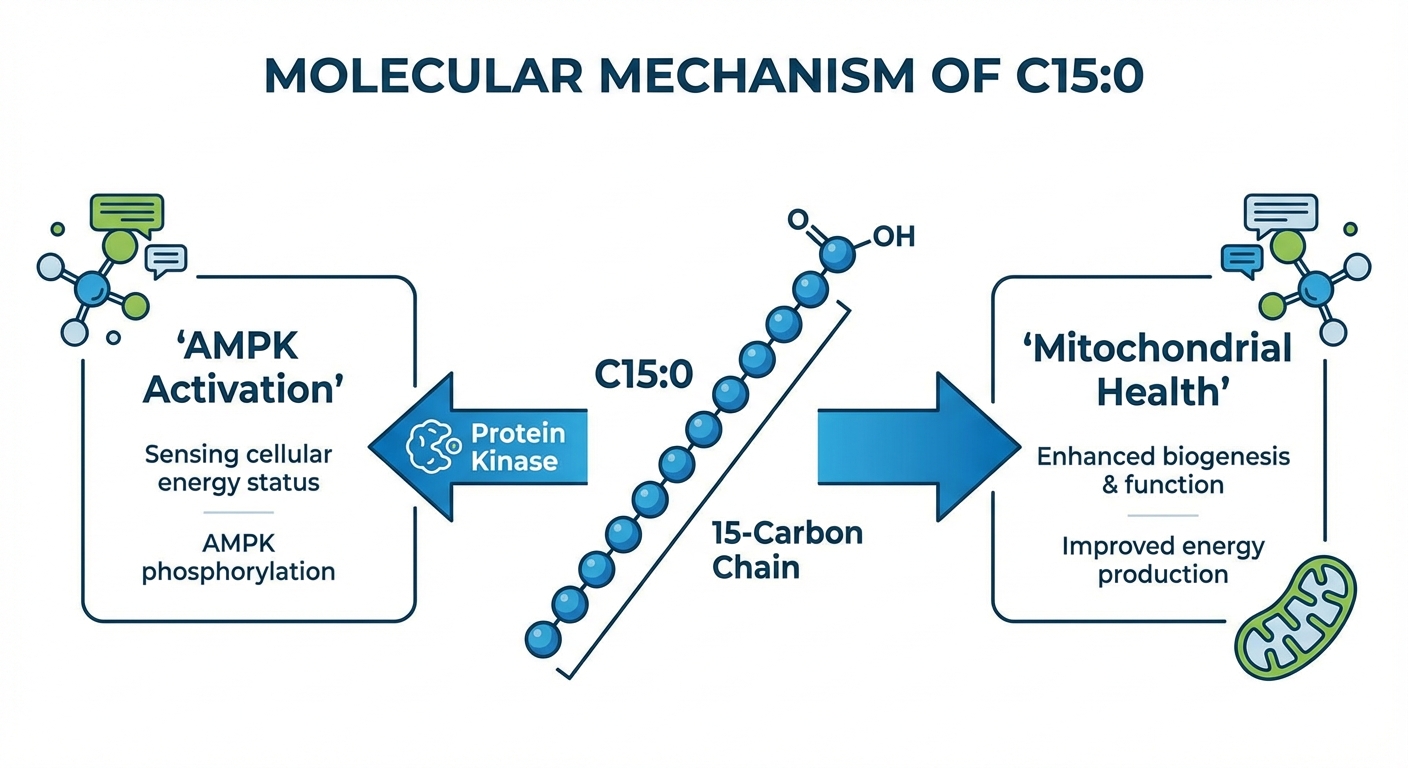
The mechanisms explain why. C15:0 appears to work through several pathways relevant to aging and chronic disease. It activates AMPK (adenosine monophosphate-activated protein kinase), a cellular energy sensor that triggers beneficial metabolic adaptations when activated. It inhibits mTOR (mechanistic target of rapamycin), a pathway that promotes cell growth but accelerates aging when chronically elevated. These are the same pathways targeted by metformin, rapamycin, and caloric restriction, three of the most studied longevity interventions in existence.
The Longevity Research
A 2023 study published in Nutrients directly compared C15:0’s cell-based activities with three leading longevity-enhancing compounds: acarbose, metformin, and rapamycin. The results surprised even the researchers.
Using human cell-based molecular phenotyping assays, the team found that C15:0 demonstrated 36 clinically relevant, dose-dependent activities across 10 of 12 cell systems tested. Only rapamycin came close, with 32 activities across all 12 systems. At their optimal doses, C15:0 and rapamycin shared 24 activities across 10 cell systems, including anti-inflammatory, antifibrotic, and anticancer effects.
This doesn’t mean C15:0 is equivalent to rapamycin, which remains one of the most potent longevity interventions identified. But it suggests C15:0 may offer some similar cellular benefits through dietary means rather than pharmaceutical intervention. For people interested in mitochondrial health and cellular energy, C15:0 represents a potential nutritional approach to supporting the same pathways.
The cell membrane stability hypothesis adds another layer. A 2024 paper in Metabolites proposed that C15:0’s primary role may be stabilizing cell membranes and repairing mitochondrial function. When C15:0 levels drop below 0.2% of total circulating fatty acids, the risk of ferroptosis increases. Ferroptosis is a type of iron-dependent cell death linked to type 2 diabetes, cardiovascular disease, nonalcoholic fatty liver disease, and neurodegenerative conditions. Maintaining adequate C15:0 may help protect cells from this destructive process.
The Blue Zone Connection
Here’s where the research gets particularly interesting. A study of people living in Sardinia, one of the world’s validated blue zones, found that C15:0 levels varied dramatically with age and geography.
Sardinians aged 60 to 70 had the highest C15:0 levels, averaging 0.64% of total circulating fatty acids. People over 80 in Sardinia had lower levels at 0.42%, suggesting C15:0 naturally declines with age. But the most striking comparison was with people outside blue zones. Individuals over 80 in low-longevity areas had C15:0 levels averaging just 0.29%, less than half the levels seen in younger Sardinians.

The connection makes biological sense. Traditional Sardinian diets include substantial amounts of dairy from local grass-fed sheep and goats, exactly the foods highest in C15:0. The same dietary pattern appears in other blue zones with strong dairy traditions. When researchers examine what’s actually in these longevity-promoting diets, C15:0 emerges as a potential unifying factor.
This doesn’t prove causation. People with higher C15:0 levels might be healthier for other reasons correlated with traditional dairy consumption, such as overall diet quality, physical activity, or lifestyle factors. But the consistency of the association across multiple populations and the mechanistic research supporting C15:0’s cellular effects suggest this isn’t merely coincidental.
Emerging Research on Brain Health
The most recent C15:0 research focuses on cognitive protection. A study published in April 2025 examined the relationship between C15:0 and age-related cognitive decline, using bottlenose dolphins as a model. Dolphins develop histologic changes remarkably similar to Alzheimer’s disease in humans, including amyloid-beta plaques that increase with age, particularly in the hippocampus.
The research found that C15:0 inhibits two enzymes relevant to brain health: fatty acid amide hydrolase (FAAH) and monoamine oxidase B (MAO-B). Both enzymes are targets for Alzheimer’s disease research, and their inhibition may help protect against cognitive decline. Like humans, dolphins with higher C15:0 levels showed better markers of brain health.
For humans concerned about brain health and cognitive function, the C15:0 research adds another potential dietary intervention to consider. While it’s too early to make specific claims about Alzheimer’s prevention, the mechanistic evidence is building.
Practical Considerations
If you’re interested in increasing your C15:0 intake, the primary dietary source is full-fat dairy from grass-fed ruminants. This includes whole milk, butter, cheese, and yogurt from cows, sheep, and goats that graze on pasture rather than consuming grain-based feed. The grass-fed distinction matters because the fatty acid profile of dairy products changes significantly based on what the animals eat.

Dietary sources of C15:0 (approximate, varies by production method):
- Full-fat butter from grass-fed cows: 1.0-1.5% of fatty acids
- Aged cheese from grass-fed sheep: 0.8-1.2% of fatty acids
- Whole milk from grass-fed cows: 0.8-1.0% of fatty acids
- Conventional dairy: 0.3-0.6% of fatty acids
Epidemiological studies and laboratory research suggest that 100 to 300 mg of C15:0 daily may be needed to achieve and maintain active circulating concentrations of 10 to 30 micromolar. This translates to roughly 2 to 3 servings of full-fat grass-fed dairy daily, or smaller amounts of concentrated dairy fat like butter and aged cheese.
For those who avoid dairy or want more precise supplementation, C15:0 supplements have recently become available. These typically provide 100 mg of pure pentadecanoic acid per capsule. However, the research on supplemental C15:0 is newer than the research on dietary intake, and it’s unclear whether isolated C15:0 provides the same benefits as C15:0 consumed as part of whole dairy foods with their accompanying nutrients.
What We Don’t Know Yet
The C15:0 research is promising but not conclusive. Most studies are observational (showing correlation, not causation) or conducted in cell and animal models. We don’t yet have large randomized controlled trials demonstrating that increasing C15:0 intake improves human health outcomes.
The relationship between C15:0 and cardiovascular health deserves particular scrutiny. While population studies consistently show lower cardiovascular risk with higher C15:0 levels, this is an association, not proof that increasing C15:0 intake will reduce your personal cardiovascular risk. People with higher C15:0 levels tend to eat more traditional diets overall, which includes many factors beyond C15:0 that might protect cardiovascular health.
There’s also the question of whether C15:0’s benefits can be separated from the broader context of full-fat dairy consumption. Dairy contains hundreds of bioactive compounds beyond fatty acids, including proteins, calcium, probiotics in fermented products, and various micronutrients. The benefits attributed to C15:0 might actually require the whole food matrix to manifest.
The Bottom Line
Pentadecanoic acid (C15:0) is emerging as a potentially significant longevity nutrient. Cell-based studies show it shares activity profiles with rapamycin and metformin, two of the most studied anti-aging compounds. Population studies consistently link higher C15:0 levels to lower chronic disease risk. And people in blue zones, those regions with exceptionally high rates of healthy longevity, tend to have significantly elevated C15:0 levels, likely due to their traditional reliance on grass-fed dairy.
The research isn’t mature enough to make definitive recommendations, but it’s compelling enough to watch closely. For those interested in nutritional approaches to longevity, C15:0 deserves attention as the science continues to develop.
Next Steps:
- If you consume dairy, prioritize grass-fed, full-fat options over low-fat conventional alternatives
- Include aged cheeses and butter from grass-fed sources as part of a balanced diet
- Consider testing your circulating fatty acid profile if your healthcare provider offers it
- Follow emerging research on C15:0 and longevity through 2026 and beyond
The longevity research community spent years studying caloric restriction, then metformin, then rapamycin. C15:0 may join that list as a dietary compound that activates similar protective pathways, one that happens to be abundant in the traditional diets of the world’s longest-lived populations.
Sources: 2023 Nutrients study comparing C15:0 with longevity compounds, 2024 Metabolites cellular stability hypothesis, Sardinian blue zone C15:0 population data, 2025 bottlenose dolphin cognitive research, pentadecanoic acid pharmacokinetic studies.