You’ve been told for decades that losing weight is the path to better health. Every January brings the same cycle: new diet, initial progress, gradual regain, renewed guilt. The $78 billion weight loss industry thrives on this pattern, promising that the number on the scale determines your health destiny. But a growing body of research, culminating in the largest study of its kind published in the British Journal of Sports Medicine in 2025, is forcing a fundamental reconsideration of this assumption. The data now clearly shows that cardiorespiratory fitness, not body weight, is the more powerful predictor of how long you’ll live.
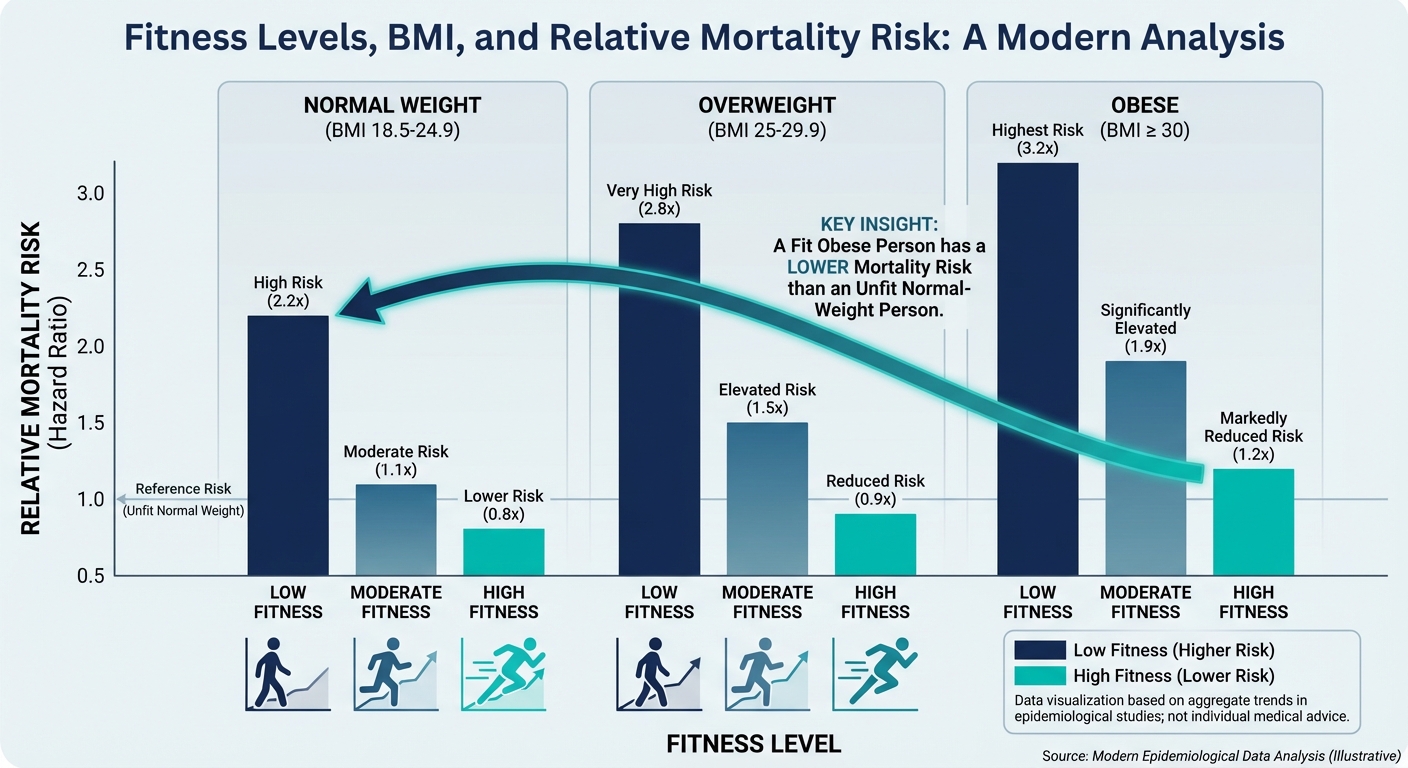
The study analyzed data from over 20,000 adults tracked for up to 30 years, measuring both their aerobic fitness levels and body mass index at baseline, then following health outcomes over decades. The findings challenge everything mainstream health messaging has emphasized: people who were aerobically fit had their risk of premature death cut by half, regardless of whether they were classified as normal weight, overweight, or obese. An obese individual with high cardiorespiratory fitness had better longevity outcomes than a normal-weight individual who was sedentary. The implications are profound, both for individuals struggling with weight and for healthcare systems that have prioritized weight loss above all else.
The Fitness-Longevity Connection: What the Research Actually Shows
The relationship between cardiorespiratory fitness and mortality risk isn’t a subtle statistical correlation requiring careful interpretation. It’s one of the strongest associations in all of preventive medicine, consistently replicated across populations, age groups, and decades of follow-up. When researchers at the Cleveland Clinic analyzed outcomes in over 120,000 individuals followed for 30 years, published in JAMA Network Open in 2024, they found that cardiorespiratory fitness was the single strongest predictor of all-cause mortality, outperforming smoking status, blood pressure, cholesterol levels, and blood sugar. Each 1-MET increase in fitness (roughly equivalent to improving your VO2 max by 3.5 mL/kg/min) reduces all-cause mortality risk by 13-15%.
The dose-response relationship is dramatic. Moving from the lowest fitness quartile to merely average fitness reduces mortality risk by 30-40%. Moving from average to above-average adds another significant reduction. The difference between being in the lowest fitness category versus the highest represents a 4-5 fold difference in mortality risk over the following decade. To put this in perspective, the mortality benefit of high fitness exceeds the combined benefit of controlling blood pressure, cholesterol, and blood sugar simultaneously.
What makes this finding particularly significant is its independence from body weight. Traditional medical thinking assumed that the health benefits of exercise came primarily through weight loss, that exercise was a means to the end of being thinner. The new research inverts this logic. Exercise provides direct physiological benefits that operate independently of any changes on the scale. Your heart becomes stronger, capable of pumping more blood per beat. Your vascular system becomes more efficient, with improved endothelial function and blood flow. Your mitochondria, the energy-producing organelles in every cell, multiply and become more efficient. Your metabolic flexibility improves, allowing your body to switch between burning carbohydrates and fats more easily. These adaptations occur whether or not you lose a single pound.
Why Weight Loss Rarely Produces Lasting Health Improvements
The uncomfortable truth about weight loss is that it almost never lasts. Meta-analyses examining long-term outcomes of dietary interventions consistently find that most people regain the majority of lost weight within 2-5 years. A comprehensive review published in The American Journal of Clinical Nutrition found that the average participant in weight loss studies regains about two-thirds of lost weight within one year and nearly all of it within five years. This isn’t a failure of willpower or discipline. It reflects fundamental biological adaptations that evolved to protect against starvation.
When you lose weight through caloric restriction, your body responds with a coordinated defense against what it perceives as famine. Your metabolic rate decreases, meaning you burn fewer calories at rest and during activity than would be predicted for someone of your new weight. Your hunger hormones increase, specifically ghrelin (the hunger hormone) rises while leptin (the satiety hormone) falls. Your brain’s reward circuitry becomes hypersensitive to food cues, making high-calorie foods more appealing. These adaptations can persist for years after weight loss, creating a biological environment that powerfully promotes weight regain.
The psychological toll compounds the physiological challenges. The diet-regain cycle creates a sense of personal failure that can undermine motivation for healthy behaviors altogether. Someone who has “failed” at multiple diets may conclude that their health is beyond their control, leading them to abandon not just dietary efforts but exercise habits as well. The focus on weight as the primary health metric has paradoxically made many people less healthy by discouraging them from the behaviors, particularly physical activity, that would actually improve their outcomes.
Perhaps most troubling is evidence that weight cycling itself may be harmful. The repeated loss and regain of significant weight appears to stress the cardiovascular system more than stable obesity. Some studies suggest that weight cycling is associated with increased inflammation, worse metabolic markers, and potentially higher cardiovascular risk compared to maintaining a stable higher weight. The prescription to “just lose weight” may be actively harmful when it leads to repeated cycles of loss and regain.
The Metabolic Benefits of Fitness Independent of Weight Loss
Cardiorespiratory fitness improves metabolic health through mechanisms that don’t require weight loss as an intermediary. Regular aerobic exercise increases insulin sensitivity directly by enhancing glucose transporter (GLUT4) expression in muscle tissue, allowing your muscles to absorb glucose more efficiently without requiring higher insulin levels. This effect occurs within days of beginning an exercise program and persists as long as training continues, independent of any change in body weight or composition.
The cardiovascular adaptations are equally direct. Aerobic training increases left ventricular volume and stroke volume, meaning your heart pumps more blood with each beat. This reduces resting heart rate, a marker of cardiovascular efficiency associated with longevity across species. Blood vessel function improves through increased nitric oxide production, enhancing the vessels’ ability to dilate and contract in response to changing demands. Blood pressure typically decreases, both systolic and diastolic, through a combination of reduced vascular resistance and improved autonomic nervous system regulation.
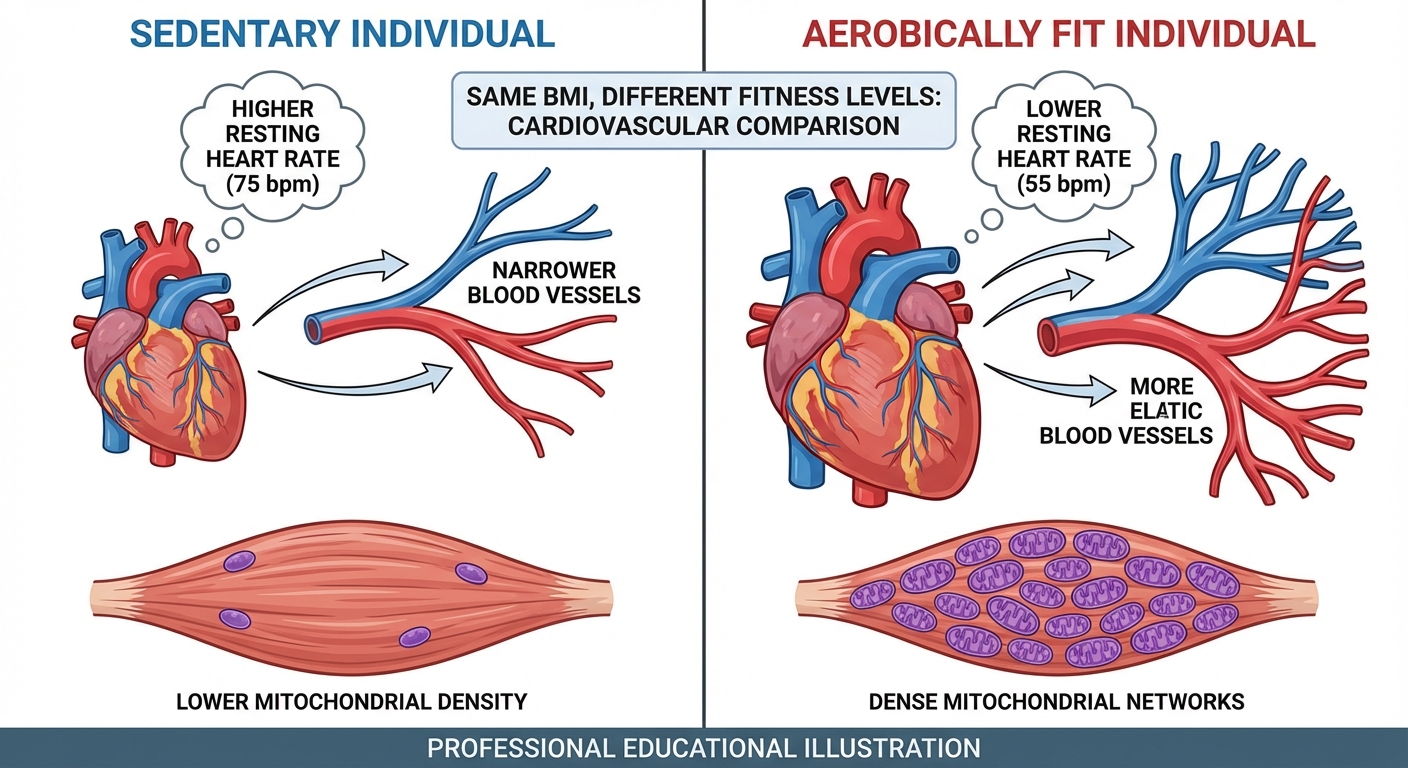
Mitochondrial adaptations represent another weight-independent pathway. Endurance exercise stimulates mitochondrial biogenesis, the creation of new mitochondria within muscle cells. It also improves the efficiency of existing mitochondria, enhancing their ability to produce ATP (cellular energy) while generating fewer reactive oxygen species (damaging byproducts). These mitochondrial improvements are increasingly recognized as central to healthy aging. Research on longevity biomarkers consistently identifies mitochondrial function as a key determinant of biological aging rate.
The anti-inflammatory effects of regular exercise are particularly relevant given that chronic low-grade inflammation underlies most age-related diseases. Exercise triggers an acute inflammatory response during activity that’s followed by a prolonged anti-inflammatory state. Regular training results in lower baseline levels of inflammatory markers like C-reactive protein, interleukin-6, and tumor necrosis factor-alpha. These reductions occur with exercise training even when body weight remains unchanged, demonstrating that the anti-inflammatory benefits aren’t simply a consequence of having less fat tissue.
How to Measure and Improve Your Cardiorespiratory Fitness
The gold standard measurement for cardiorespiratory fitness is VO2 max, the maximum rate at which your body can transport and utilize oxygen during exercise. Laboratory testing provides the most accurate measurement, but estimates from fitness trackers and standardized field tests can give useful approximations. What matters more than precise measurement is understanding where you fall relative to age and sex norms, and whether your fitness is improving over time.
For a general benchmark, average VO2 max values decline with age: a 40-year-old male averages approximately 35-38 mL/kg/min, while a 40-year-old female averages 30-33 mL/kg/min. Values significantly below these averages place you in higher-risk categories, while values 20% or more above average are associated with substantially reduced mortality risk. The good news is that cardiorespiratory fitness is highly trainable at any age. Even individuals in their 70s and 80s can achieve meaningful improvements with appropriate training.
The most effective approach for improving cardiorespiratory fitness combines moderate-intensity steady-state exercise with high-intensity interval training. Steady-state exercise at 60-75% of maximum heart rate builds aerobic base and mitochondrial density. This could be brisk walking, cycling, swimming, or any activity that elevates your heart rate to a sustainable level for 30-60 minutes. For those interested in the research behind optimal intensity, our article on Zone 2 cardio training provides detailed guidance on finding your personal sweet spot.

High-intensity interval training (HIIT) provides a more time-efficient stimulus for VO2 max improvement. Protocols typically involve short bursts (30 seconds to 4 minutes) of near-maximal effort alternating with recovery periods. Research consistently shows that HIIT produces similar or greater improvements in VO2 max compared to longer steady-state sessions, despite requiring less total time. However, HIIT places greater stress on the body and requires adequate recovery. Most people benefit from 1-2 HIIT sessions per week combined with 2-3 moderate steady-state sessions. Our indoor VO2 max training protocol offers specific workouts designed for winter months when outdoor training is challenging.
Rethinking Health Metrics: What to Measure Instead of Weight
If weight isn’t the primary health metric, what should you track instead? Cardiorespiratory fitness itself is the most important metric, whether measured directly through VO2 max testing or estimated through performance improvements in your chosen activities. Can you walk farther or faster than you could six months ago? Has your heart rate recovery after exercise improved? These functional markers tell you more about your health trajectory than the scale ever could.
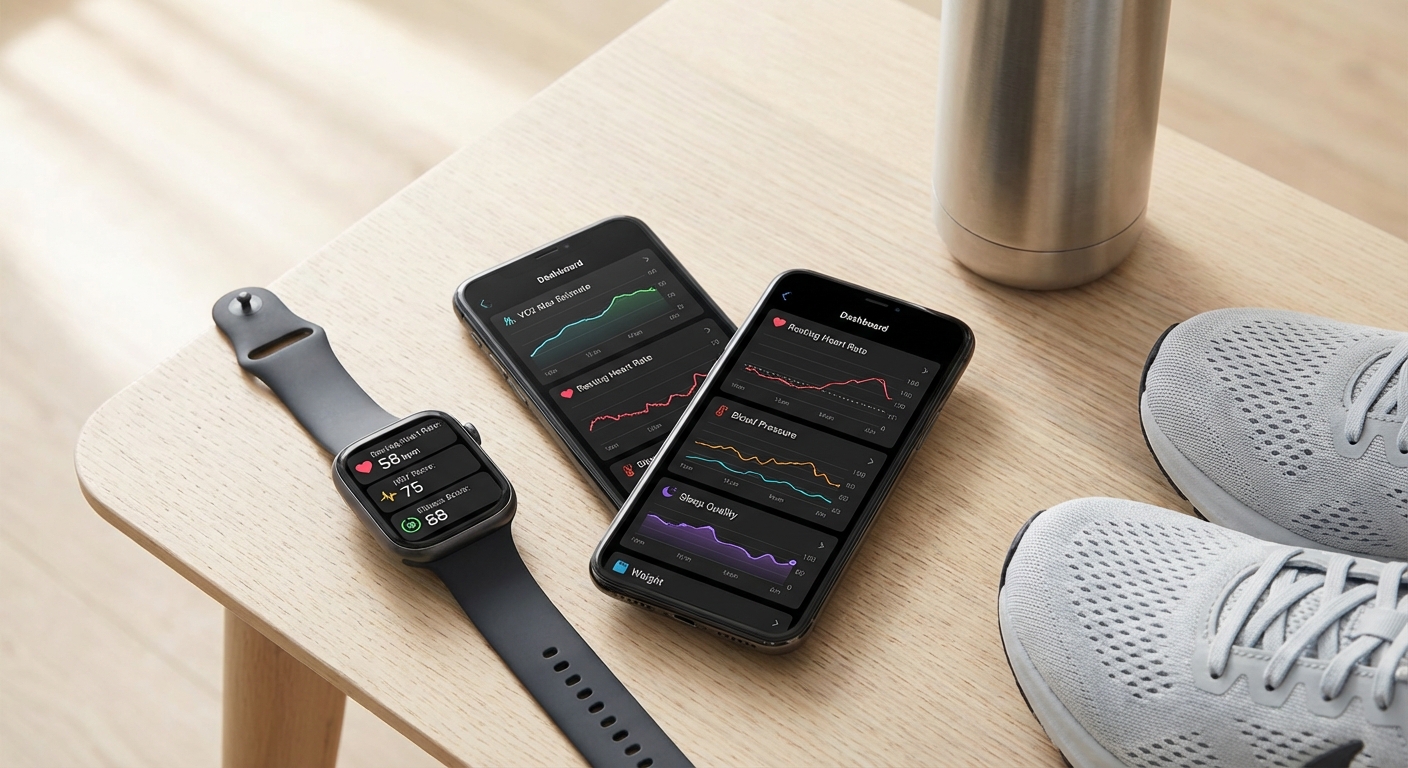
Resting heart rate provides a simple daily metric. A lower resting heart rate generally indicates better cardiovascular efficiency. Most fitness trackers can measure this automatically during sleep or first thing in the morning. Heart rate variability, the variation in time between heartbeats, offers an even more sophisticated marker of cardiovascular and autonomic nervous system health. Higher HRV generally indicates better fitness and recovery capacity. Our guide to heart rate variability and recovery explains how to interpret and use this metric.
Blood markers can provide additional insight. Triglycerides, HDL cholesterol, fasting glucose, and hemoglobin A1c all respond to improvements in fitness, often improving significantly even without weight loss. These markers reflect the metabolic improvements that exercise produces directly, and tracking them over time can demonstrate health benefits that the scale would miss entirely. Someone whose weight has remained stable but whose triglycerides have dropped 40% and HDL has increased 20% has achieved substantial health improvement invisible to weight-focused monitoring.
The Bottom Line
The evidence is now overwhelming: cardiorespiratory fitness matters more than body weight for longevity. An aerobically fit individual with obesity has better health outcomes than a sedentary person of normal weight. This doesn’t mean weight is irrelevant, but it does mean that the obsessive focus on the scale has been misguided. If you have limited time and energy for health improvement, investing in consistent aerobic exercise will yield greater returns than investing in another diet.
Next Steps:
- Assess your current fitness baseline (estimate VO2 max through a fitness tracker or field test)
- Establish a consistent aerobic exercise habit (aim for 150+ minutes of moderate intensity or 75+ minutes of vigorous intensity weekly)
- Add 1-2 high-intensity interval sessions per week for accelerated VO2 max improvement
- Track fitness metrics (resting heart rate, HRV, exercise performance) rather than weight
- Consider blood work every 6-12 months to track metabolic improvements
The shift from weight-focused to fitness-focused health represents a fundamental reorientation in how we think about our bodies. Your body’s ability to transport and utilize oxygen, to adapt to physical demands, to recover from stress, these capacities matter far more than its size. The path to longevity isn’t through deprivation and restriction, it’s through building the cardiovascular and metabolic capacity that allows you to live fully at any age.
Sources: British Journal of Sports Medicine 2025 (fitness-mortality study), JAMA Network Open 2024 (Cleveland Clinic VO2 max analysis), The American Journal of Clinical Nutrition (weight loss maintenance meta-analyses), Cell Metabolism (metabolic adaptations to exercise), American Heart Association position statements on cardiorespiratory fitness.